

What Is Quantum Machine Learning? Concepts, Models, and Use Cases
 Suyash Raizada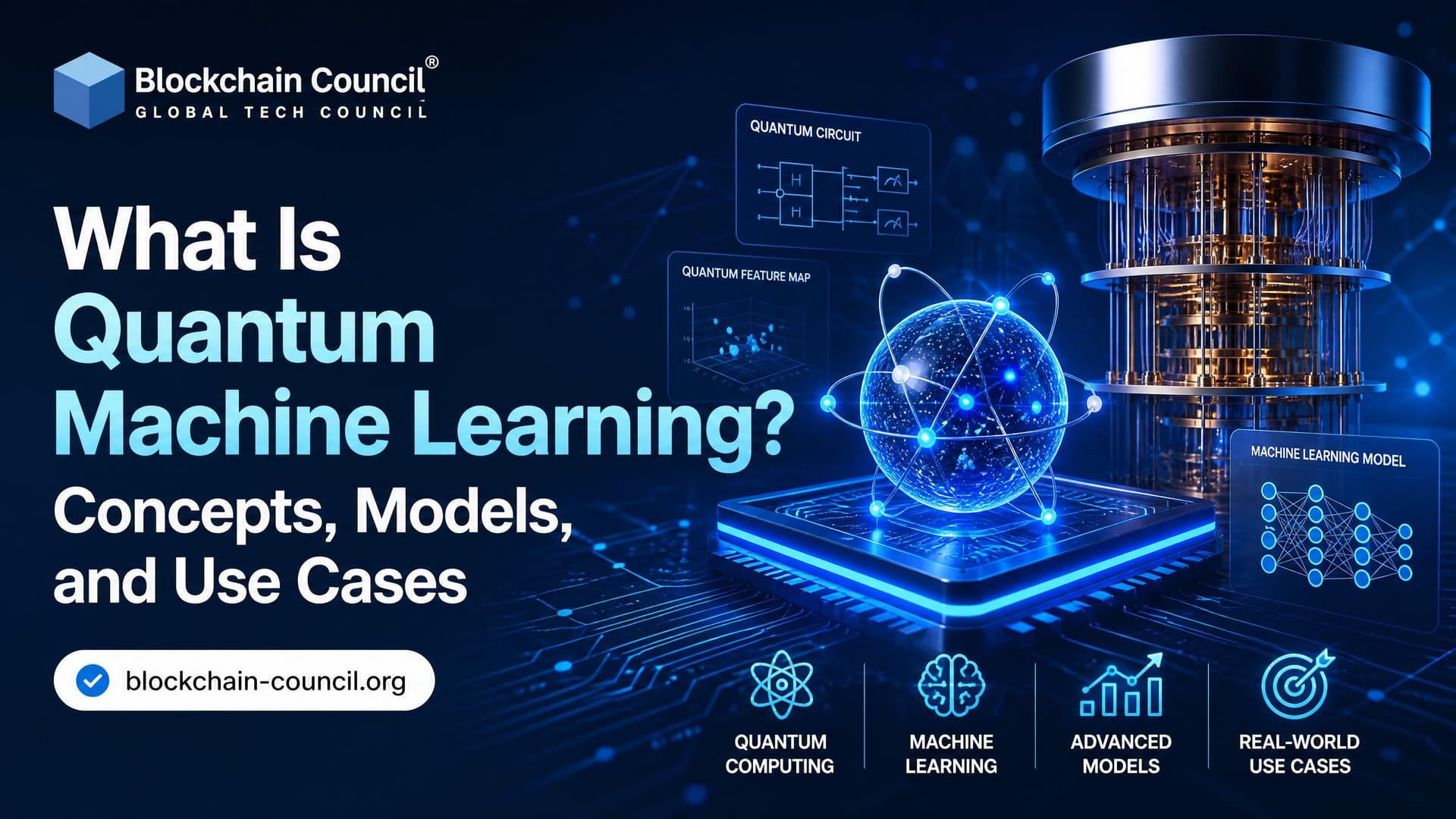
Quantum machine learning is the use of quantum computing techniques inside machine learning workflows. In practice, that usually means a classical system prepares the data, a quantum circuit performs a narrow task such as kernel evaluation or sampling, and a classical optimizer updates the model. It is not a drop-in replacement for TensorFlow, PyTorch, or scikit-learn. Not yet.
Think of QML as a specialist tool. It fits workloads where high-dimensional structure, combinatorial search, or quantum-native data makes classical computation expensive. Reviews from IBM Quantum, Nature, and recent academic surveys point to the same reality: QML is promising, but most real work today is experimental, hybrid, and small scale.

What Is Quantum Machine Learning?
Quantum machine learning combines quantum information processing with classical statistical learning. It can support tasks such as classification, regression, clustering, optimization, anomaly detection, and generative modeling.
Classical machine learning uses bits and numerical operations on CPUs, GPUs, or TPUs. QML uses qubits, which can exist in superposition and become entangled with other qubits. Quantum circuits then manipulate those qubits through gates, measurements, and repeated sampling.
There are two broad forms:
- Quantum-enhanced machine learning: Classical data and classical infrastructure stay central, but selected subroutines run on quantum processors.
- Native quantum machine learning: The data itself is quantum, such as molecular states, quantum sensor outputs, or quantum simulations.
For most professionals, the first category is the one to learn now. You will see it in quantum kernels, variational classifiers, QAOA-style optimization, and quantum neural network experiments.
Core Concepts Behind QML
Qubits, Superposition, Entanglement, and Interference
QML rests on the same foundations as quantum computing:
- Superposition lets a quantum state represent combinations of values before measurement.
- Entanglement creates correlations between qubits that cannot be described as independent classical variables.
- Interference amplifies desirable outcomes and cuts the probability of poor ones when a circuit is designed correctly.
These properties give quantum systems access to very large state spaces. A register of 20 qubits represents a state vector with over one million complex amplitudes. That sounds powerful. Here is the catch: you cannot simply read all those values out. Measurement gives samples, not a full database dump.
How a Hybrid QML Workflow Works
A typical QML pipeline for classical data follows four steps:
- Encode features into quantum states. Feature values may control RX, RY, or RZ rotation angles in a parameterized circuit.
- Run a quantum circuit. The circuit may act as a feature map, classifier, sampler, or optimizer.
- Measure many times. Repeated circuit executions, often called shots, estimate probabilities or expectation values.
- Update parameters classically. A classical optimizer adjusts model parameters based on a loss function.
This loop is why most QML is called hybrid quantum-classical. Your laptop or cloud server still handles data loading, preprocessing, batching, metrics, and deployment. The quantum processor handles one very specific inner-loop computation.
A practical warning. If you experiment with Qiskit, older examples often use from qiskit import Aer. In newer Qiskit setups, that can fail with ImportError: cannot import name 'Aer' from 'qiskit'. Install qiskit-aer and import AerSimulator from qiskit_aer instead. Small version changes like this waste more beginner time than the math does.
Key Quantum Machine Learning Models
Quantum Kernel Methods and QSVM
Quantum kernel methods map classical data into quantum feature spaces. A quantum circuit estimates similarities between data points, then a classical support vector machine uses those kernel values for classification.
A quantum support vector machine, or QSVM, is one of the most discussed QML models because it fits naturally into classical ML thinking. You still train an SVM. The quantum part is the kernel computation.
These methods are being tested for image classification, radio signal detection, fraud detection, credit scoring, and anomaly detection. They are most interesting when the quantum feature map is hard to simulate classically. If your dataset is small and a radial basis function kernel already works well, a QSVM may add complexity without better results.
Variational Quantum Circuits
Variational quantum circuits, often called VQCs, are parameterized circuits trained by classical optimizers. They are central to near-term QML because current quantum devices are noisy and have limited circuit depth.
VQCs appear in:
- Variational quantum classifiers for supervised learning
- Quantum neural networks with trainable gate layers
- QAOA-style circuits for combinatorial optimization
- Hybrid reinforcement learning policies for routing or scheduling
The hard part is not drawing the circuit. It is training it. Barren plateaus, shot noise, hardware noise, and optimizer sensitivity can make gradients unreliable. Start with small circuits and clear baselines. If logistic regression beats your QML model, report that honestly and move on.
Quantum Neural Networks
Quantum neural networks use layers of parameterized quantum gates in a way that loosely resembles trainable layers in classical networks. Some designs use discrete qubits. Others use continuous-variable systems, such as optical modes.
Current QNN research covers medical imaging, signal processing, financial modeling, and security analytics. Most examples use small datasets or heavily reduced feature spaces. That does not make them useless. It means you should treat them as prototypes, not production AI systems.
Quantum PCA, Clustering, and Regression
Other QML algorithm families target familiar machine learning tasks:
- Quantum PCA aims to speed up eigenvalue estimation for dimensionality reduction.
- Quantum K-means variants explore distance estimation and cluster assignment in high-dimensional spaces.
- Quantum linear regression ties into quantum linear systems algorithms, with possible gains for structured large-scale problems.
These approaches look attractive on paper, but data loading can erase the advantage. Encoding a massive classical dataset into amplitudes is not free. This is one of the biggest practical bottlenecks in QML.
Real-World Use Cases of Quantum Machine Learning
Drug Discovery and Materials Science
Chemistry is one of the strongest long-term cases for QML because molecules are quantum systems. Researchers are exploring quantum generative models, variational quantum eigensolvers, and QNN-based surrogate models for molecular property prediction, protein binding, battery chemistry, and catalyst design.
Companies in pharmaceuticals and materials, including Roche, Moderna, BASF, and ExxonMobil, have been linked with quantum and QML exploration. The work is still limited by hardware, but the problem fit is real.
Finance and Risk Analytics
Finance teams are testing QML for portfolio optimization, derivatives pricing, fraud detection, credit scoring, and risk modeling. QAOA-style methods can propose candidate portfolio allocations under constraints. Quantum-enhanced Monte Carlo and amplitude estimation are being studied for selected pricing workloads.
None of this replaces bank risk engines next quarter. The better use case is targeted experimentation on narrow optimization or anomaly detection tasks where classical benchmarks are well defined.
Logistics, Manufacturing, and Supply Chains
Routing, scheduling, inventory planning, and production assignment are natural candidates for quantum optimization. D-Wave's annealing systems have been used in traffic and logistics experiments, while hybrid solvers are being tested for warehouse and supply chain decisions.
The key lesson: formulation matters. A poorly encoded routing problem will perform poorly on any machine, quantum or classical.
Cybersecurity and Anomaly Detection
QML is being studied for network intrusion detection, fraud monitoring, and high-dimensional security telemetry. Quantum kernels and quantum generative models may help surface subtle correlations in complex data.
For cybersecurity teams, the realistic near-term pattern is a hybrid scoring module inside a classical detection pipeline. You still need SIEM integration, feature engineering, alert triage, and incident response skills.
Healthcare and Medical Imaging
Research groups have tested quantum classifiers for Alzheimer's diagnosis, quantum convolutional models for medical image classification, and quantum kernels for biosignal analysis. These are research-scale demonstrations, but they hint at where QML may help with noisy, high-dimensional clinical data.
Current State of QML in 2024-2026
QML is active, but early. IBM Quantum, D-Wave, Amazon Braket, Microsoft Azure Quantum, PennyLane, Qiskit Machine Learning, and TensorFlow Quantum have made experimentation easier. None of that removes the underlying hardware limits.
The major barriers are clear:
- Limited qubit counts and short coherence times
- Noise and gate errors
- High data encoding cost
- Lack of fault-tolerant quantum computers for deep circuits
- Unclear quantum advantage for many practical ML tasks
Market studies for quantum AI generally estimate a small 2025 market, roughly in the hundreds of millions of US dollars, with projected annual growth rates around 30 to 35 percent into the 2030s. Treat those forecasts carefully. They signal interest and investment, not guaranteed production value.
How to Start Learning Quantum Machine Learning
If you already know machine learning, learn the quantum basics first: qubits, gates, measurement, Bloch sphere intuition, and simple circuits. Then build a tiny variational classifier in PennyLane or Qiskit. Use a classical baseline. Always.
If you come from quantum computing, strengthen your ML foundations: loss functions, regularization, kernels, cross-validation, and model evaluation. Many QML papers fail in practice because the ML comparison is weak.
For structured learning, look at Blockchain Council's certification paths, especially the Certified Quantum Computing Expert™ for quantum foundations and the Certified Artificial Intelligence (AI) Expert™ for applied AI concepts. If your interest is security analytics, pair QML study with cybersecurity training as well.
Final Takeaway
Quantum machine learning is best understood as a set of hybrid techniques, not a magic replacement for classical AI. It is worth learning if you work in optimization, chemistry, finance, cybersecurity, advanced manufacturing, or AI research. Start small. Implement a quantum kernel classifier, compare it with scikit-learn, document the result, then move to variational circuits once you understand where the costs appear.
Related Articles
View All
Quantum Computing
Quantum Computing in Climate and Energy: Use Cases for a Sustainable Future
Quantum computing in climate and energy is moving from theory to pilots in grids, climate risk, data centers, and materials, with hybrid methods leading today.

Quantum Computing
Quantum Computing in Healthcare: Use Cases, Benefits, and Challenges
Quantum computing in healthcare could support drug discovery, imaging, genomics, and security, but clinical proof remains limited and early stage.
Quantum Computing
Top Quantum AI Use Cases Across Industries
Explore the top Quantum AI use cases in pharma, finance, logistics, energy, cybersecurity, manufacturing, and AI workflows with practical industry examples.
Trending Articles
AWS Career Roadmap
A step-by-step guide to building a successful career in Amazon Web Services cloud computing.

Top 5 DeFi Platforms
Explore the leading decentralized finance platforms and what makes each one unique in the evolving DeFi landscape.
How Blockchain Secures AI Data
Understand how blockchain technology is being applied to protect the integrity and security of AI training data.