

Top Applications of Quantum Computing in the Real World

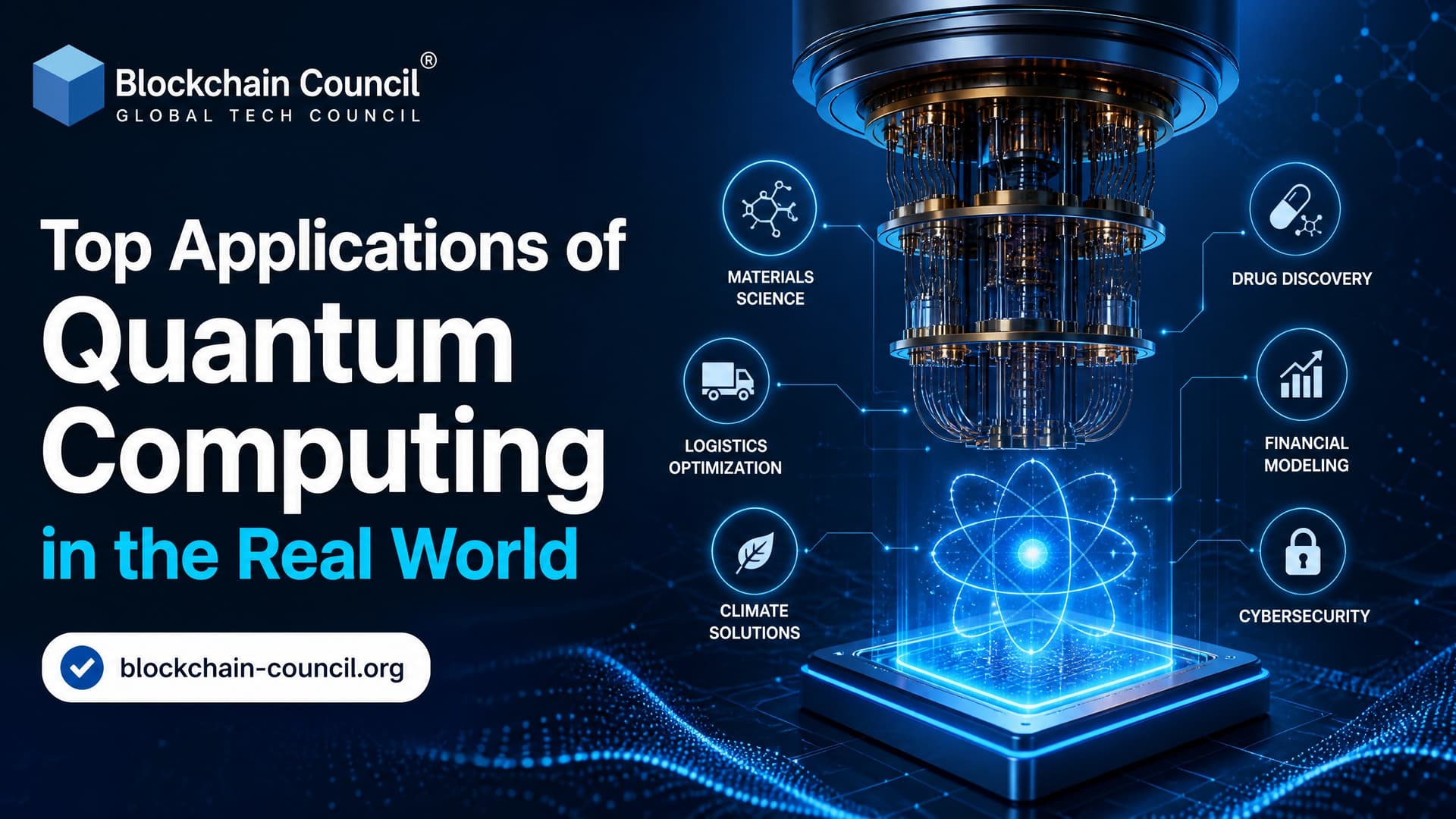
Applications of quantum computing are moving from lab demonstrations into practical pilots, especially in molecular simulation, materials research, optimization, finance, cybersecurity, and energy systems. The honest picture is this: quantum computers are useful for exploration today, but they have not yet delivered clear quantum advantage on a live production workload.
That distinction matters. Hundreds of companies, including Airbus, JPMorgan Chase, and Boehringer Ingelheim, are working with quantum vendors on real business problems. Still, most projects remain proofs of concept or hybrid workflows where quantum processors, simulators, and classical high-performance computing systems work together.

Where Quantum Computing Stands Today
Current quantum computing is still in the noisy intermediate-scale quantum, or NISQ, phase. NISQ machines can run meaningful experiments, but they are error-prone, limited in qubit count, and sensitive to noise from gates, measurement, and the surrounding environment.
In practice, companies do not replace their trading systems, drug discovery platforms, or logistics engines with quantum computers. They test small, hard subproblems. Then they compare results against classical solvers. Sometimes the quantum-inspired method is the useful part, not the quantum hardware itself.
A small practitioner note: if you try old Qiskit tutorials, you may hit ImportError: cannot import name 'execute' from 'qiskit'. Qiskit 1.x removed the old top-level execute helper, so you now use primitives such as Sampler or Estimator, or call backend.run after transpilation. This is the sort of small tooling change that trips beginners before the actual quantum theory does.
1. Drug Discovery and Quantum Chemistry
Molecular simulation is widely viewed as the strongest near-term use case for quantum computing. Why? Molecules are quantum systems. Modeling electron interactions, reaction paths, and molecular energy states can become painfully expensive on classical machines as systems grow.
Pharmaceutical and chemical companies use quantum chemistry methods to study small molecules, drug-metabolizing enzymes, catalyst behavior, and polymer structures. Roche, Boehringer Ingelheim, and BASF have all been connected with quantum chemistry pilots in industry reporting.
How it helps in drug research
- Lead optimization: Better estimates of molecular properties can help teams prioritize compounds earlier.
- Protein-ligand interaction studies: Quantum methods may improve modeling of binding behavior in difficult cases.
- Catalyst and enzyme simulation: Some reactions are hard to approximate with classical methods alone.
- Screening support: Quantum and quantum-inspired models can narrow the search space before costly lab work.
Do not overstate it. These systems are not designing blockbuster drugs end to end. Today they mostly support early-stage research and benchmarking on smaller molecular systems.
2. Materials Science, Batteries, and Industrial Chemistry
Materials research faces the same core challenge as drug discovery: matter behaves according to quantum mechanics. Electron correlation effects in batteries, catalysts, and polymers can make classical approximation difficult.
Automotive, chemical, and energy companies are testing quantum simulations for next-generation batteries, electrolytes, hydrogen catalysts, and advanced materials. Mitsubishi Chemical, Toyota, Mercedes-Benz, BASF, and ExxonMobil are among the organizations reported in industry case studies around quantum-influenced materials work.
Real-world targets
- Battery electrode and electrolyte design
- Polymer durability and performance modeling
- Hydrogen production catalyst research
- Lightweight aerospace materials
- Corrosion and degradation studies
The business value is simple: reduce the number of failed physical prototypes. If a model helps a team discard weak candidates earlier, that can save months of lab time.
3. Financial Services and Quantitative Finance
Finance is one of the most active fields for applications of quantum computing because many financial problems involve large search spaces, uncertainty, and constraints. Banks are not waiting for perfect quantum machines. They are testing where quantum algorithms might improve pricing, risk, or optimization.
JPMorgan Chase, Goldman Sachs, and other financial institutions have explored quantum methods for derivatives, portfolio construction, and Monte Carlo-style risk analysis.
Common finance use cases
- Portfolio optimization: Finding asset allocations under constraints such as risk, liquidity, sector exposure, and transaction costs.
- Derivative pricing: Testing quantum approaches for option pricing in complex models.
- Risk modeling: Quantum amplitude estimation may offer theoretical speedups for some Monte Carlo tasks.
- Fraud detection: Quantum-enhanced anomaly detection is being tested on transaction patterns.
The caveat is important. Most finance pilots use simplified versions of production problems. A classical optimizer tuned by an experienced quant team is hard to beat.
4. Supply Chain, Logistics, and Transportation
Routing, scheduling, and resource allocation are natural testbeds for quantum optimization. These problems often explode combinatorially. Add delivery windows, fuel limits, driver availability, regulations, traffic, and customer priority, and the search space gets ugly fast.
Volkswagen has run quantum traffic optimization experiments in Lisbon. DHL has tested quantum-enhanced last-mile delivery routing. Airbus and partners have explored cargo loading, flight planning, and crew scheduling. Other carriers and manufacturers have appeared in supply chain and scheduling pilots as well.
Where quantum methods fit
- Route selection in dense delivery networks
- Flight scheduling and crew assignment
- Warehouse picking and packing optimization
- Factory production scheduling
- Traffic flow modeling in smart cities
These are rarely stand-alone quantum systems. A realistic architecture sends a narrow optimization kernel to a quantum annealer, gate-based quantum processor, or quantum-inspired solver, then passes the result back into an existing planning platform.
5. Cybersecurity and Post-Quantum Cryptography
Cybersecurity is one of the most urgent application areas, but not because companies are using quantum computers to attack systems today. The real issue is future risk.
A large fault-tolerant quantum computer could break widely used public-key cryptosystems such as RSA and many elliptic-curve schemes using Shor's algorithm. That is why governments and enterprises are preparing now. Data stolen today may still be sensitive when stronger quantum computers arrive later. Security teams call this the "harvest now, decrypt later" problem.
NIST has standardized post-quantum cryptographic algorithms, including ML-KEM (FIPS 203) for key encapsulation and ML-DSA (FIPS 204) for digital signatures. Enterprises in finance, telecoms, healthcare, and government should start with cryptographic asset discovery before migration. You cannot replace what you have not inventoried.
Quantum security applications
- Post-quantum encryption migration
- Quantum-safe identity and authentication
- Quantum key distribution pilots for sensitive networks
- Quantum random number generation
- Crypto-agility planning for regulated sectors
If your role touches security architecture, this is the one quantum topic you cannot ignore. Blockchain Council readers may pair this path with the Certified Cybersecurity Expert™ program and related security training.
6. Artificial Intelligence and Quantum Machine Learning
Quantum machine learning gets attention, but it is less mature than chemistry or optimization. Be blunt: most QML is still research.
That said, the work is real. Researchers test quantum kernels, variational quantum circuits, quantum sampling, and hybrid quantum-classical neural networks. The lambeq library from Quantinuum, for example, has been used for quantum natural language processing experiments where sentence structures are encoded into quantum circuits.
Promising QML directions
- Quantum feature maps for classification
- Variational circuits paired with classical neural networks
- Quantum sampling for complex distributions
- Quantum-inspired image processing
- Small-scale natural language experiments
The right attitude is curiosity with discipline. Always compare QML results against strong classical baselines. A small support vector machine or gradient boosting model may outperform a flashy circuit on real data.
7. Energy Systems and Grid Optimization
Energy grids are becoming harder to manage as renewable generation, battery storage, electric vehicles, and distributed resources grow. Quantum optimization may help with grid balancing, storage dispatch, demand forecasting, and industrial process tuning.
Utilities and energy firms are testing quantum and quantum-inspired models for dispatch problems, refinery operations, hydrogen production, and battery degradation. Many of these systems run inside high-performance computing environments, with quantum processors acting as accelerators for specific tasks.
That is the future many practitioners expect: not a quantum laptop on every desk, but quantum resources available through cloud and HPC workflows.
8. High-Performance Computing and Scientific Workflows
Quantum computing is increasingly treated as part of the scientific computing stack. A research team might use classical simulation, GPUs, HPC clusters, and cloud quantum backends in one workflow.
Resource allocation is a practical example. Quantum algorithms and quantum-inspired optimization can help schedule tasks, allocate compute capacity, or search complex configuration spaces. In genomics, quantum-inspired methods have been explored for pangenome-guided assembly and resolving difficult genomic regions.
The pattern is consistent: quantum helps most where the bottleneck is combinatorial growth or quantum-scale simulation.
What Is Actually Practical in 2026?
The most credible real-world applications of quantum computing are not evenly distributed. Some areas are stronger than others.
- Most credible near term: Molecular simulation, materials science, and constrained optimization.
- Strategically urgent: Post-quantum cryptography and crypto-agility planning.
- Useful but narrow: Logistics, finance pilots, grid optimization, and HPC resource allocation.
- Still experimental: Broad quantum machine learning and general AI acceleration.
No major industrial user has publicly shown unambiguous quantum advantage on a live production workload as of 2026. That should not discourage you. It should shape expectations. The smart teams are building skills, testing algorithms, and benchmarking carefully now.
Skills Professionals Need for Quantum Applications
If you want to work with quantum computing, do not start by memorizing buzzwords. Build a foundation.
- Linear algebra, probability, and complex numbers
- Quantum gates, circuits, measurement, and entanglement
- Optimization concepts such as QAOA and annealing
- Quantum chemistry basics if you target pharma or materials
- Post-quantum cryptography if you work in security
- Hands-on tools such as Qiskit, Cirq, PennyLane, and D-Wave Ocean
For structured learning, consider Blockchain Council's Certified Quantum Computing Expert™. If your focus is AI or security, pair it with Certified AI Expert™ or Certified Cybersecurity Expert™.
Final Takeaway
The top applications of quantum computing are practical but narrow: chemistry, materials, optimization, finance research, cybersecurity planning, and energy systems. The wrong move is to assume quantum will replace classical computing soon. The right move is to learn where it fits, test it against classical methods, and build small projects that map to real bottlenecks.
Start with one domain. Simulate a small molecule, run a QAOA scheduling experiment, or inventory cryptographic systems for post-quantum migration. Then deepen your skills through the Certified Quantum Computing Expert™ and related Blockchain Council programs.
Related Articles
View All
Quantum Computing
Top Quantum Computing Tools and Frameworks to Learn in 2026
Explore the top quantum computing tools and frameworks to learn in 2026, including Qiskit, Cirq, PennyLane, Braket, Q#, CUDA-Q, TKET, TFQ, and Ocean.

Quantum Computing
Quantum Computing Certification: Benefits, Career Value, and How to Choose One
Learn how quantum computing certification supports career growth, what employers value, and how to choose a credential with real technical depth.

Quantum Computing
Best Quantum Computing Courses in India for Students and Professionals
Explore the best quantum computing courses in India, including IIT, NPTEL, AICTE aligned, C-DAC, and regional programmes for students and professionals.
Trending Articles
The Role of Blockchain in Ethical AI Development
How blockchain technology is being used to promote transparency and accountability in artificial intelligence systems.
What is AWS? A Beginner's Guide to Cloud Computing
Everything you need to know about Amazon Web Services, cloud computing fundamentals, and career opportunities.
Blockchain in Supply Chain Provenance Tracking
Supply chains are under pressure to prove not just efficiency, but also authenticity, sustainability, and fairness. Customers want to know if their coffee really is fair trade, if the diamonds are con