

What Are Quantum Algorithms? Types, Examples, and Applications

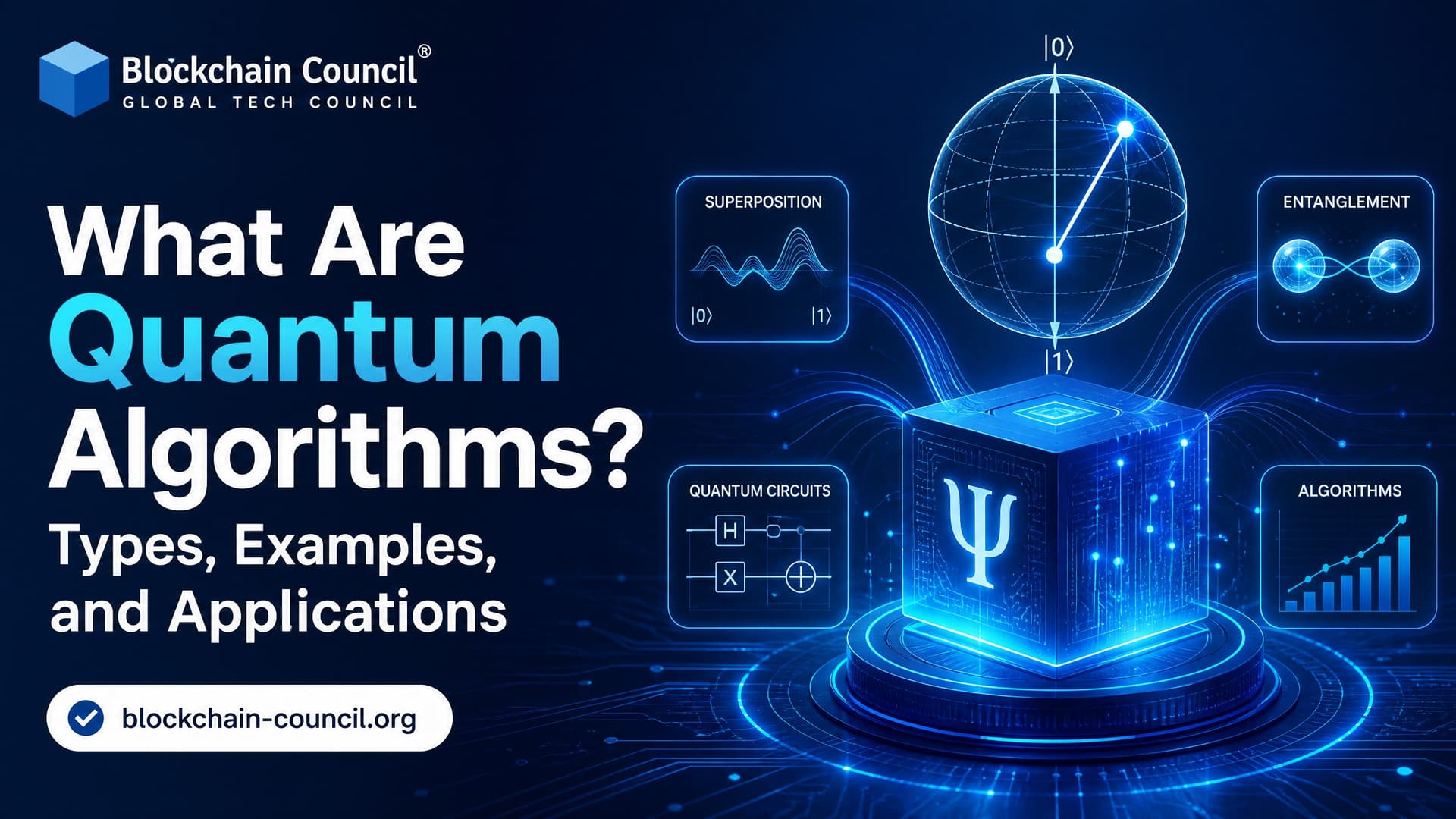
Quantum algorithms are step-by-step procedures designed to run on quantum computers, using superposition, entanglement, and interference to solve selected problems faster than the best known classical methods. That last part matters. A quantum algorithm is not automatically better because it runs on qubits. It needs a problem structure where quantum behavior actually helps.
If you work in cryptography, blockchain, AI, finance, logistics, or advanced computing, quantum algorithms are no longer a distant academic topic. Shor's algorithm already shapes post-quantum cryptography standards. Variational algorithms are being tested in chemistry and optimization. Still, most production use remains experimental, and good classical baselines often beat weak quantum pilots.

What Is a Quantum Algorithm?
A quantum algorithm is a computational procedure where at least one meaningful step uses quantum operations. Classical algorithms process bits, which are either 0 or 1. Quantum algorithms process qubits, which can exist in superpositions and become entangled with other qubits.
The practical trick is not "trying all answers at once," which is the usual bad explanation. The real value comes from interference. A well-designed quantum circuit increases the probability of measuring useful answers and reduces the probability of measuring wrong ones.
Most quantum algorithms are described as quantum circuits: gates act on n-qubit registers, measurements produce classical bits, and a classical computer handles post-processing. If you have used Qiskit, Cirq, or PennyLane, you have seen this split directly. One detail that bites beginners: Qiskit count strings are often read with little-endian ordering in mind, so a result like 01 may not mean what you first think it means. I have seen perfectly correct toy circuits "fail" in class because the bit order was interpreted backward.
Main Types of Quantum Algorithms
1. Shor's Algorithm for Factoring and Cryptography
Shor's algorithm, introduced by Peter Shor in 1994, is the best-known quantum algorithm for breaking public-key cryptography based on integer factorization and discrete logarithms. It reduces factoring to order finding and uses the quantum Fourier transform to detect periodicity.
Why does this matter? RSA, Diffie-Hellman, and elliptic-curve cryptography depend on problems that are hard for classical computers at large sizes. A sufficiently large fault-tolerant quantum computer running Shor's algorithm could break those schemes.
This is why the U.S. National Institute of Standards and Technology has standardized post-quantum cryptography. In August 2024, NIST published FIPS 203, FIPS 204, and FIPS 205, covering standards derived from CRYSTALS-Kyber, CRYSTALS-Dilithium, and SPHINCS+. NIST has also selected HQC as an additional code-based key encapsulation mechanism.
For blockchain professionals, this is not theoretical housekeeping. Wallet signatures, validator identities, bridges, custody systems, and secure messaging layers all need crypto-agility. If you are building in Web3, pair quantum awareness with practical study in Blockchain Council's Certified Blockchain Expert™ or Certified Cybersecurity Expert™ programs.
2. Grover's Algorithm and Amplitude Amplification
Grover's algorithm gives a quadratic speedup for unstructured search. A classical brute-force search over N items needs O(N) queries. Grover reduces that to O(√N).
That is powerful, but not magic. It does not turn every hard problem into an easy one. For symmetric cryptography, the usual response is larger keys. Grover-like search weakens the effective security margin of a symmetric key, so conservative systems can compensate by increasing key length.
Grover's broader idea, called amplitude amplification, appears as a subroutine in many quantum algorithms. It repeatedly applies an oracle and a diffusion operation to increase the probability of measuring a desired answer.
3. Quantum Simulation Algorithms
Quantum simulation may be the most natural application of quantum computing. Classical machines struggle to simulate large quantum systems because the state space grows exponentially. Quantum computers are quantum systems themselves, so they can represent certain molecular and physical systems more directly.
Common techniques include:
- Trotterization: approximates time evolution by breaking it into small gate sequences.
- Hamiltonian simulation: models the energy and dynamics of quantum systems.
- Quantum phase estimation: estimates eigenvalues, often used for energy calculations.
Applications include molecular ground-state estimation, reaction pathway modeling, catalyst design, battery materials, and semiconductor research. In the near term, these methods are often combined with classical electronic structure tools rather than used alone.
4. Quantum Linear Algebra and HHL
The Harrow-Hassidim-Lloyd algorithm, usually called HHL, solves certain sparse and well-conditioned systems of linear equations with impressive theoretical speedups. It has influenced quantum machine learning, recommendation systems, and numerical analysis research.
Here is the trade-off: HHL has strict assumptions. Data loading, condition number, sparsity, and readout cost can erase the apparent advantage. If someone claims HHL will speed up every AI workload, be skeptical. For many real datasets, moving classical data into quantum states is the bottleneck.
5. Variational Quantum Algorithms: VQE and QAOA
Variational quantum algorithms, or VQAs, are hybrid quantum-classical methods. A quantum processor runs a parameterized circuit. A classical optimizer updates the parameters based on measured results.
The two names you will hear most are:
- Variational Quantum Eigensolver: used for estimating molecular ground-state energies.
- Quantum Approximate Optimization Algorithm: used for combinatorial optimization problems such as MaxCut, scheduling, and portfolio construction.
These algorithms are popular because they can run on noisy intermediate-scale quantum devices. They use shallower circuits than full fault-tolerant algorithms. But they are heuristics. They can get stuck in barren plateaus, suffer from measurement noise, or lose to a tuned classical optimizer. To be blunt, QAOA is useful to study, but it is not a guaranteed shortcut for every NP-hard problem.
6. Quantum Annealing and Adiabatic Optimization
Quantum annealing encodes an optimization problem into an energy landscape and seeks a low-energy state. Many business problems are first converted into QUBO or Ising formulations before being sent to an annealer.
Industries have tested annealing for routing, workforce scheduling, production planning, portfolio optimization, and smart charging of electric vehicles. These projects usually include classical pre-processing and post-processing. That is normal. The quantum processor handles a subproblem, not the entire enterprise workflow.
Quantum Algorithms in Real-World Applications
Cryptography and Blockchain Security
Shor's algorithm is the reason security teams are planning post-quantum migration now. The "harvest now, decrypt later" threat means attackers can store encrypted data today and wait for stronger quantum computers.
For blockchain networks, the main concerns are digital signatures, exposed public keys, bridge security, long-lived identities, and protocol upgrade paths. Teams should track NIST PQC standards and design systems that can swap cryptographic primitives without rewriting everything.
Finance and Risk Modeling
Quantum algorithms are being tested for portfolio optimization, risk analysis, hedging, and scenario simulation. QAOA and annealing are common candidates for constraint-heavy allocation problems. Quantum amplitude estimation could, in theory, speed up some Monte Carlo-style calculations, although large-scale advantage is not yet established.
Chemistry, Materials, and Drug Discovery
VQE and quantum simulation are actively studied for drug discovery, fuel cell chemistry, battery materials, and industrial catalysts. This is one of the better-aligned use cases because molecules are quantum systems. The hard part is scale: useful chemistry requires accuracy, error correction, and careful mapping of molecular Hamiltonians.
Logistics, Manufacturing, and Energy
Routing, supply chains, warehouse planning, machine scheduling, and smart-grid optimization are natural targets because they involve huge search spaces. Quantum algorithms may help when the problem maps cleanly to QUBO, Ising, or circuit-based optimization formats. If the mapping is forced and bloated, the quantum run will not save you.
Current State of Quantum Algorithms
Most available machines are NISQ devices with noisy qubits, limited coherence times, and imperfect gates. That shapes what you can run. Shor's algorithm at cryptographic scale, deep phase estimation, and many HHL-style workloads require fault-tolerant quantum computers. VQE, QAOA, small simulations, and annealing are more realistic today.
Quantum advantage remains problem-specific. Google's random circuit sampling work pushed the field forward, but classical simulation methods later narrowed parts of the claimed gap. D-Wave reported quantum advantage for a simulation problem in 2024. The lesson is simple: always compare against the best current classical method, not last year's benchmark.
Market Outlook and Skills Demand
Market estimates vary because analysts define the sector differently. MarketsandMarkets has projected the quantum computing market to grow from 3.52 billion USD in 2025 to 20.20 billion USD by 2030. BCC Research estimates 1.6 billion USD in 2025 and 7.3 billion USD by 2030. Grand View Research reported about 1.416 billion USD in 2024, with a projection of 4.243 billion USD by 2030.
The exact number matters less than the direction. Organizations are investing in quantum software, cloud access, security migration, and talent. If you want a structured path, look at Blockchain Council's Certified Quantum Computing Expert™ for fundamentals, then connect it with Certified Blockchain Developer™ or Certified Cybersecurity Expert™ if your work touches Web3 infrastructure or cryptographic systems.
How to Start Learning Quantum Algorithms
- Learn linear algebra first: vectors, matrices, eigenvalues, tensor products, and complex numbers.
- Build small circuits: use Qiskit or Cirq to create Bell states, phase kickback examples, and simple oracles.
- Study the classics: Grover, Shor, quantum Fourier transform, phase estimation, VQE, and QAOA.
- Benchmark honestly: compare with classical solvers such as Gurobi, OR-Tools, NumPy, SciPy, and domain-specific simulators.
- Track PQC standards: especially if you work in blockchain, identity, payments, or cybersecurity.
Final Thoughts
Quantum algorithms are not a replacement for classical computing. They are specialized tools for problems where quantum mechanics gives a measurable edge: factoring, structured simulation, selected search tasks, optimization heuristics, and certain linear algebra workloads.
Your next step should be practical. Pick one algorithm family, implement a small example, and test it against a classical baseline. If your goal is professional depth, start with Blockchain Council's Certified Quantum Computing Expert™, then add blockchain or cybersecurity certification depending on the systems you build or secure.
Related Articles
View All
Quantum Computing
What Is Quantum Entanglement? Meaning, Examples, and Applications
Quantum entanglement links particles through shared quantum states. Learn its meaning, examples, applications, and why it matters for quantum security.
Quantum Computing
Top Applications of Quantum Computing in the Real World
Explore the top real-world applications of quantum computing, from drug discovery and finance to cybersecurity, logistics, AI, and energy systems.

Quantum Computing
What Is the Quantum Fourier Transform? Concepts and Applications
Understand the quantum Fourier transform, how QFT circuits work, and why it matters for Shor's algorithm, phase estimation, simulation, and quantum security.
Trending Articles
The Role of Blockchain in Ethical AI Development
How blockchain technology is being used to promote transparency and accountability in artificial intelligence systems.
AWS Career Roadmap
A step-by-step guide to building a successful career in Amazon Web Services cloud computing.

Can DeFi 2.0 Bridge the Gap Between Traditional and Decentralized Finance?
The next generation of DeFi protocols aims to connect traditional banking with decentralized finance ecosystems.