

What Is Quantum Interference? Role in Quantum Speedups Explained

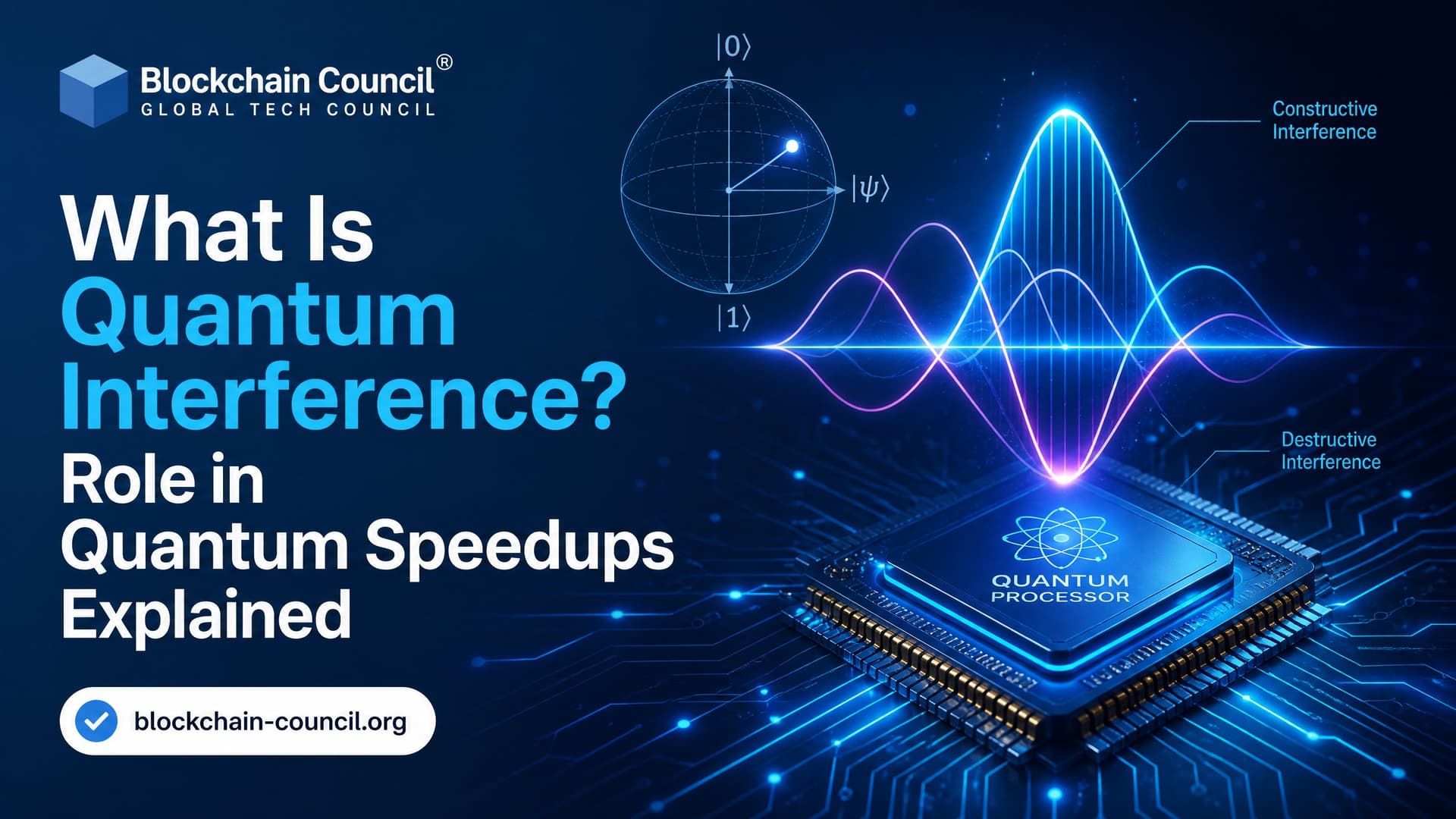
Quantum interference is the reason a quantum computer can do more than sample random bitstrings. It lets probability amplitudes add or cancel, so a circuit can make useful answers more likely and wrong answers less likely before measurement. Superposition gives a quantum algorithm many possible paths. Interference decides which paths survive.
That distinction matters. Without carefully controlled interference, a quantum processor would behave much like a noisy probabilistic classical machine. You would get outcomes, but not the directed probability shaping behind algorithms such as Shor's factoring algorithm, Grover's search, quantum phase estimation, and quantum simulation.

What Is Quantum Interference?
In quantum mechanics, a system is described by a wavefunction. More practically for computing, a qubit state is described by complex probability amplitudes. When you measure, the squared magnitude of an amplitude gives the probability of an outcome.
Interference happens when multiple computational paths contribute amplitudes to the same outcome. Those amplitudes are not ordinary probabilities. They have magnitude and phase. If their phases line up, they add through constructive interference. If their phases oppose each other, they cancel through destructive interference.
A simple one-qubit example is enough to see the point:
- Apply a Hadamard gate to |0>, and you get an equal superposition of |0> and |1>.
- Apply a Z gate, and the probability of measuring 0 or 1 does not change. The phase changed, not the visible probability.
- Apply another Hadamard, and that hidden phase becomes measurable. The result flips from what you would have seen without the Z gate.
This is the detail that catches many beginners in labs: phase is invisible until a later operation converts it into a probability difference. In Qiskit or another simulator, you can stare at the counts after a Z gate and think nothing happened. Add the next Hadamard, and suddenly the interference shows up.
Why Interference Is the Engine of Quantum Speedups
Most quantum algorithms follow a recognizable pattern. The circuit prepares a starting state, creates superposition, changes phases according to the problem, then uses interference to concentrate probability on useful answers.
- Start with qubits initialized to |0>.
- Use gates such as Hadamard gates to create many computational paths.
- Apply problem-specific operations, often called oracles or controlled unitaries.
- Engineer phase relationships so wrong answers cancel and correct answers add.
- Measure and read out an answer with high probability.
This is why the phrase quantum parallelism can be misleading. A quantum computer does not simply try every answer and print the right one. Measurement gives only one result. The algorithm must use interference to make that one result useful.
To be blunt, superposition without interference is not a speedup strategy. It is just a broad distribution. The hard part is designing a circuit where the amplitudes are shaped in the right direction.
Constructive and Destructive Interference in Circuits
Constructive interference increases the probability of target outcomes. Destructive interference reduces the probability of unwanted outcomes. These two effects work together.
Think of an optical interferometer. Light can take different paths, and depending on phase differences, one detector becomes bright while another goes dark. A quantum circuit does something similar, but with computational basis states instead of light paths. Gates act like carefully placed mirrors and phase shifters.
The analogy is useful, but do not push it too far. In a many-qubit circuit, the number of basis states grows as 2^n. Ten qubits have 1,024 basis states. Fifty qubits have more than one quadrillion. The interference pattern is not something you can inspect by hand once the circuit becomes large.
How Grover's Algorithm Uses Interference
Grover's search algorithm is the cleanest example for learners because the speedup is easy to state. If you have N possible items and one marked solution, a classical unstructured search needs O(N) queries in the worst case. Grover's algorithm needs O(√N) oracle queries.
The algorithm starts with a uniform superposition over all N items. Then it repeats two operations:
- Oracle step: mark the solution by flipping its phase.
- Diffusion step: reflect amplitudes around their average.
Together, these steps rotate amplitude toward the solution state. The marked item gains probability through constructive interference. The non-solution states lose probability through destructive interference.
There is a catch. More iterations are not always better. If you keep applying Grover iterations after the optimal point, the amplitude rotates past the target and the success probability falls again. This is one of those exam questions that trips people up: Grover's algorithm is not a monotonic amplification process forever. You stop near (π/4) × √N iterations for a single solution.
How Shor's Algorithm Uses Interference
Shor's algorithm is more subtle, but the same principle is at work. It factors large integers by reducing the problem to period finding. The quantum part evaluates modular exponentiation in superposition and then applies the quantum Fourier transform.
The quantum Fourier transform creates an interference pattern where amplitudes associated with the hidden period add up. Outcomes inconsistent with that period tend to cancel. After measurement, classical post-processing uses continued fractions to recover the period and then the factors.
This is why Shor's algorithm matters for cybersecurity. RSA security depends on the practical difficulty of factoring large integers on classical computers. A large, fault-tolerant quantum computer running Shor's algorithm would threaten RSA and related public-key systems. The same broad concern applies to discrete logarithm schemes used in elliptic curve cryptography.
That threat is not because quantum computers are magically faster at everything. It is because Shor's circuit has a structure where interference aligns extremely well with the mathematics of periodicity.
Is Quantum Interference Necessary for Speedup?
The short answer is yes, for the known model of circuit-based quantum computation. Researchers often compare interference with entanglement as a quantum computational resource. Entanglement describes correlations in the state. Interference describes how amplitudes propagate and combine as gates act.
Theoretical work points to a useful trade-off: too little interference cannot produce meaningful quantum advantage, but large interference by itself is not enough. The pattern must match the problem. Randomly scrambling phases can make a circuit hard to simulate, but it does not automatically solve a business or scientific problem.
This is a sober point for enterprises. Quantum speedup is not a feature you buy by adding more qubits. You need the right algorithm, enough circuit depth, low enough noise, and phase relationships that survive until measurement.
Interference, Noise, and Real Hardware
On real quantum hardware, interference is fragile. Decoherence, gate errors, crosstalk, calibration drift, and readout error can all damage phase relationships. If those phases wash out, the carefully designed cancellation pattern disappears.
This is why noisy intermediate-scale quantum devices, often called NISQ devices, are useful for experiments but limited for large cryptographic attacks. Small demonstrations of Grover-style amplification have run on platforms such as trapped ions and superconducting qubits. Random circuit sampling experiments, including Google's 2019 Nature experiment, also rely on complex interference patterns that are difficult to reproduce classically.
Still, practical fault-tolerant execution of Shor's algorithm against real-world RSA key sizes requires error correction at a scale beyond today's machines. The engineering challenge is not just more qubits. It is preserving phase information across very long circuits.
Why This Matters for Blockchain and Cybersecurity
For blockchain professionals, quantum interference is not just physics vocabulary. It explains why quantum computers could eventually affect cryptographic assumptions.
- Digital signatures: Many blockchain systems use elliptic curve signatures. Shor's algorithm is relevant because it can solve discrete logarithms on a sufficiently powerful quantum computer.
- Public-key infrastructure: RSA and elliptic curve cryptography would need migration planning in a post-quantum setting.
- Hash functions: Grover's algorithm gives a quadratic speedup for brute-force search, which affects security margin analysis, but it does not break hash functions in the same dramatic way Shor's algorithm affects RSA.
- Post-quantum cryptography: NIST finalized standards in 2024 including ML-KEM, ML-DSA, and SLH-DSA, giving enterprises concrete migration targets.
If you work on blockchain architecture, do not treat quantum risk as science fiction. Also do not overstate it. The right position is practical: track standards, design upgrade paths, and understand which cryptographic primitives face the most direct pressure.
Common Misconceptions About Quantum Interference
Misconception 1: Quantum computers test all answers at once
They can represent many amplitudes at once, but measurement returns a limited result. Interference is what turns the hidden amplitude structure into a useful output distribution.
Misconception 2: More interference always means better performance
No. Badly arranged interference can suppress the answer you want. Algorithm design is about controlled interference, not maximum chaos.
Misconception 3: Entanglement and interference are the same thing
They are related, but not identical. Entanglement concerns correlations between subsystems. Interference concerns amplitude addition and cancellation across computational paths.
Misconception 4: Quantum speedups apply to every problem
They do not. Grover's algorithm gives a quadratic gain for unstructured search. Shor's gives an exponential improvement for factoring and discrete logarithms. Many ordinary workloads have no known practical quantum advantage.
How to Build Intuition as a Practitioner
If you want to understand quantum interference beyond diagrams, build tiny circuits. Use a simulator first. Test how H, Z, S, T, controlled gates, and measurement change outcomes. Then run the same circuits on real hardware and compare ideal counts with noisy counts.
Pay attention to phase kickback. It is the practical mechanism behind many oracle-based algorithms, and it feels strange until you implement it. Also watch bit ordering in frameworks such as Qiskit, where displayed bitstrings can surprise beginners if they forget the convention used by the circuit and measurement registers.
For a structured learning path, consider Blockchain Council's Certified Quantum Computing Expert™. If your focus is security planning, pair it with Certified Cybersecurity Expert™. For blockchain teams assessing long-term cryptographic risk, Certified Blockchain Expert™ and Certified Blockchain Developer™ are natural next steps.
What to Learn Next
Quantum interference is the operational heart of quantum speedups. Superposition creates possible paths, entanglement links qubits in non-classical ways, and interference shapes amplitudes so measurement is likely to return something useful.
Your next step is concrete: simulate a one-qubit H-Z-H circuit, then implement a two-qubit phase oracle, then study Grover's algorithm with four items. Once you can explain why the marked state grows, Shor's algorithm and quantum phase estimation become far less mysterious.
Related Articles
View All
Quantum Computing
Advantages and Disadvantages of Quantum Computing Explained
Understand the advantages and disadvantages of quantum computing, including speed, optimization, simulation, cryptography risks, hardware limits, and enterprise use cases.

Quantum Computing
What Is Quantum Cryptography? Secure Communication Explained
Quantum cryptography uses quantum physics, mainly QKD, to detect eavesdropping and distribute secure encryption keys for high-value communication links.

Quantum Computing
Qiskit Explained: A Beginner's Guide to IBM's Quantum Computing Framework
A beginner-friendly explanation of Qiskit, IBM's open source quantum framework, covering circuits, transpilation, recent updates, use cases, and learning steps.
Trending Articles
The Role of Blockchain in Ethical AI Development
How blockchain technology is being used to promote transparency and accountability in artificial intelligence systems.
AWS Career Roadmap
A step-by-step guide to building a successful career in Amazon Web Services cloud computing.

Top 5 DeFi Platforms
Explore the leading decentralized finance platforms and what makes each one unique in the evolving DeFi landscape.