

Grover's Algorithm Explained: Quantum Search Made Simple

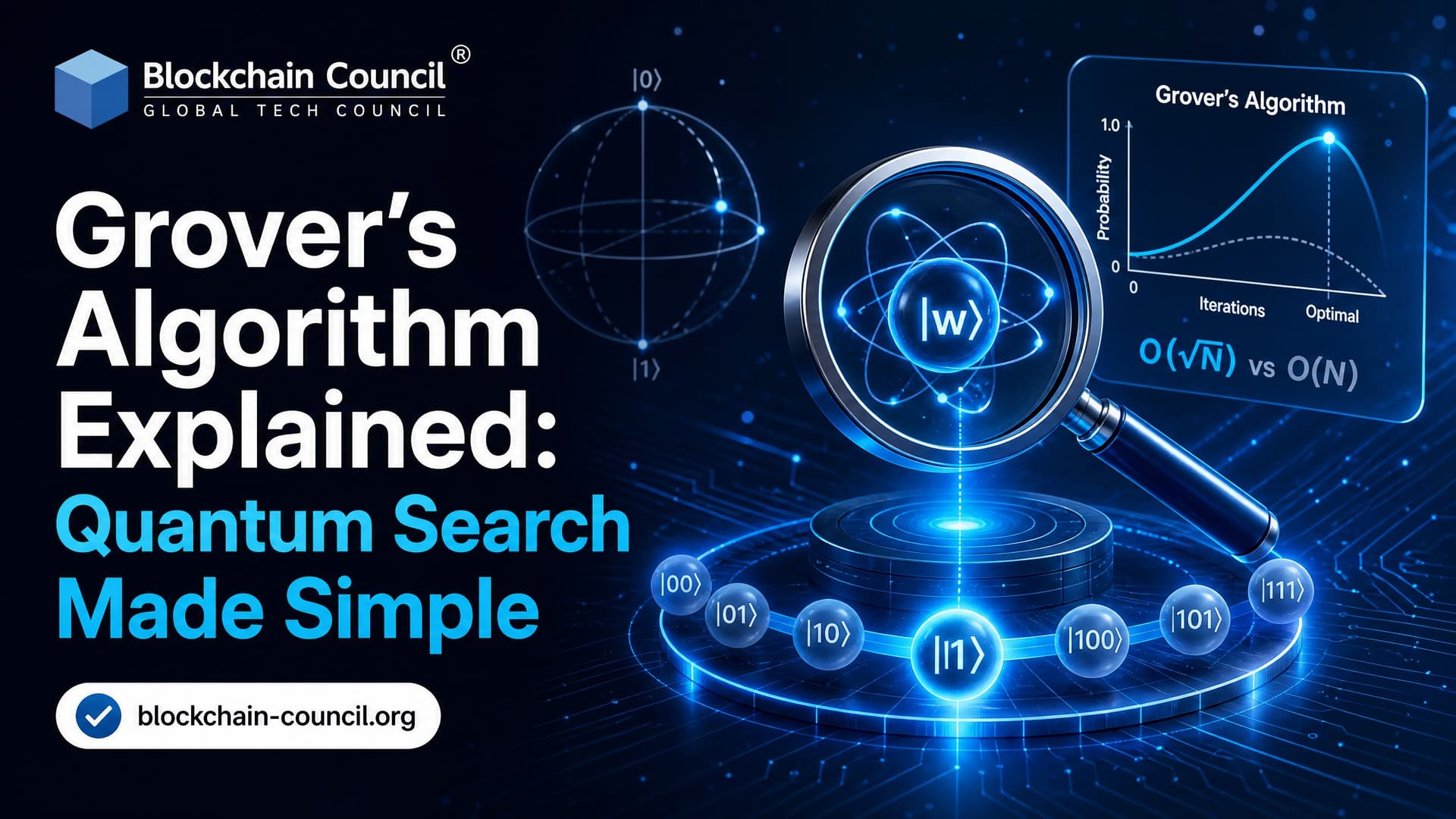
Grover's Algorithm is the quantum search method you need to understand if you work in quantum computing, cybersecurity, blockchain, or post quantum risk planning. It searches an unstructured space of N possible answers in about √N oracle calls, while a classical brute force search needs about N calls in the worst case. That is a quadratic speedup. Not magic. Still powerful.
The practical takeaway is simple. Grover's Algorithm does not make every hard search problem easy, but it changes the cost curve. For symmetric cryptography, password search, hash preimage attacks, optimization, and constraint solving, that cost curve matters.

What Problem Does Grover's Algorithm Solve?
Grover's Algorithm solves the unstructured search problem. You have N possible inputs. Somewhere in that space, one or more inputs satisfy a condition. You also have a yes or no test, called an oracle, that can tell whether a candidate is a valid answer.
Classically, if the data has no useful structure, you check candidates one by one. On average, you find a single target after N/2 checks. In the worst case, you use N checks.
Grover's Algorithm uses quantum superposition and amplitude amplification to find a marked item in O(√N) oracle queries. If N is 1,000,000, a classical search may need up to 1,000,000 checks. Grover needs about 1,000 checks, ignoring oracle construction and hardware overhead.
That last clause matters. In real systems, building the oracle is often the hard part.
Grover's Algorithm Made Simple
Think of the algorithm as a controlled way to increase the probability of measuring the right answer. It does not inspect every item at once in the casual pop science sense. Instead, it shapes amplitudes so the marked answer becomes more likely when you measure.
1. Create a Uniform Superposition
Start with n qubits in the |0⟩ state. Apply Hadamard gates to all of them. This creates an equal superposition over all N = 2^n possible inputs:
(1 / √N) Σ |x⟩ for x from 0 to N - 1
At this point, every candidate has the same amplitude.
2. Use an Oracle to Mark the Answer
The oracle is a quantum operation that flips the phase of solution states. If x is a solution, the oracle maps |x⟩ to -|x⟩. Non solution states are left unchanged.
This phase flip is not directly visible as a measured bit. The next step turns that phase difference into a higher probability.
3. Apply the Diffusion Operator
The diffusion operator is often described as inversion about the mean. It reflects amplitudes around their average value. After the oracle marks the solution by phase, the diffusion step increases the marked state's amplitude and reduces the others.
A common textbook form is:
H⊗n (2|0⟩⟨0| - I) H⊗n
In circuit form, this often means Hadamards, X gates, a multi-controlled Z or X operation, and then the inverse sequence.
4. Repeat, Then Measure
One Grover iteration is: oracle, then diffusion. Repeat this sequence the right number of times. Then measure the qubits. The result is a classical index, and with high probability it is a marked solution.
There is a catch candidates often miss in certification exams. Too many Grover iterations reduce the success probability. The amplitude does not keep climbing forever. It oscillates. You need the right number of rotations.
The Grover Speedup: How Much Faster Is It?
For one marked item among N candidates, Grover's Algorithm needs approximately:
(π / 4)√N iterations
If there are M marked items, the typical optimal iteration count is:
floor((π / 4)√(N / M) - 1/2)
This is why Grover's speedup is called quadratic. It does not reduce O(N) to O(log N). It reduces O(N) to O(√N).
For cryptography, that means the exponent is effectively cut in half. A 256 bit symmetric key search has 2^256 possibilities classically. A Grover style quantum search reduces the query count to roughly 2^128. That is still enormous, but it is a major security consideration. This is one reason post quantum planning often treats 256 bit symmetric keys as the safer long term choice where 128 bit security was previously acceptable.
Why Grover's Algorithm Matters for Blockchain and Cybersecurity
Blockchain systems rely on cryptographic primitives: hash functions, digital signatures, key derivation, symmetric encryption in wallets and infrastructure, and password based access controls. Grover's Algorithm is most relevant to brute force style search against symmetric keys and hash preimages.
For example:
- AES key search: Grover can model a quantum brute force attack against symmetric ciphers.
- Password hash search: An oracle can test whether a guessed password produces a target hash.
- Hash preimage search: Given a target digest, Grover can search candidate inputs in square root time.
- Constraint solving: SAT and similar problems can be searched by marking valid assignments.
- Graph and database search: If you can define an oracle for the property you want, Grover can search unstructured records.
To be blunt, Grover is not the main quantum threat to today's public key blockchain signatures. Shor's algorithm is the bigger concern for elliptic curve signatures such as ECDSA. But Grover still matters for hash based assumptions, symmetric security margins, password policies, and long term protocol design.
Grover as Amplitude Amplification
Modern quantum computing texts often present Grover's Algorithm as a special case of amplitude amplification. That broader technique increases the success probability of a quantum procedure when you can recognize good outputs.
This framing is useful. It explains why Grover-like methods appear in quantum optimization, quantum machine learning, simulation, and constraint satisfaction. You are not just learning a single search algorithm. You are learning a reusable quantum design pattern.
IBM Quantum and Microsoft Azure Quantum both teach Grover as a core example because the circuit is small enough to simulate, but deep enough to show real quantum behavior. Commercial tools such as Classiq also use Grover examples to show how an oracle description can be converted into a working circuit.
What a Small Grover Circuit Looks Like in Practice
On today's hardware, Grover demonstrations usually search tiny spaces: 4, 8, or 16 items. That sounds unimpressive until you try to run the circuit on a noisy backend and watch the histogram. The marked state appears, but noise, transpilation choices, and multi-controlled gates can blur the result fast.
A practical detail: many older Qiskit Grover tutorials break on newer installations with an error like ImportError: cannot import name 'Aer' from 'qiskit'. In Qiskit 1.x, Aer is installed through the qiskit-aer package and imported from qiskit_aer. It is a small version change, but it trips up beginners all the time. Another hidden issue is circuit depth. A clean looking multi-controlled X gate can decompose into a long chain of basis gates after transpilation, which is exactly where noisy devices punish you.
This is why educational examples are useful, but claims about near-term industrial Grover speedups should be treated carefully.
Limitations of Grover's Algorithm
1. The Speedup Is Quadratic, Not Exponential
Grover halves the exponent in brute force search. That is a big deal for very large spaces, but it does not turn an arbitrary exponential search into an easy polynomial time task.
2. Oracle Design Can Dominate the Cost
The algorithm assumes you have a unit cost oracle. Real applications do not hand you one for free. Encoding AES, a hash function, or a complex business rule as a reversible quantum circuit may require many gates and ancilla qubits.
3. Noise Breaks Deep Circuits
Grover needs repeated oracle and diffusion steps. Each repetition adds gates. On near-term devices, errors accumulate before you reach useful search sizes. Fault-tolerant quantum computers are needed for serious cryptographic scale searches.
4. Grover Is Provably Near Optimal
In the black box query model, no quantum algorithm can solve generic unstructured search asymptotically faster than O(√N), up to constant factors. If you want a bigger gain, you must exploit structure in the problem. Grover alone will not provide it.
How Professionals Should Study Grover's Algorithm
If you are a developer, do not stop at the diagram. Build a 2 qubit Grover circuit by hand. Then build a 3 qubit version. Change the marked state. Watch how the optimal iteration count changes. Finally, inspect the transpiled circuit depth.
If you work in cybersecurity or blockchain architecture, connect Grover to risk modeling:
- Map which systems depend on symmetric keys, hashes, or password derived secrets.
- Check whether key lengths and hash outputs have enough margin under square root search.
- Separate Grover risks from Shor risks. They affect different primitives.
- Track post quantum migration guidance from standards bodies such as NIST.
For structured learning, Blockchain Council programs such as the Certified Blockchain Expert™, Certified Blockchain Developer™, Certified AI Expert™, and Certified Cybersecurity Expert™ cover where this topic intersects with blockchain security, deeptech systems, and quantum aware risk planning.
Future Outlook
Grover's Algorithm will matter more as fault-tolerant quantum hardware improves. Current devices can show the principle, not threaten large key spaces. The long term picture is different. Once error corrected machines can run deep circuits reliably, Grover becomes a practical input to key management, password policy, blockchain protocol design, and security audits.
The better near-term use is education and modeling. Learn how the oracle works. Learn why the iteration count matters. Learn where the quadratic speedup helps and where it does not. Then build a small circuit and test it yourself on a simulator before you trust any high level claim about quantum search.
Your next step: implement Grover for four marked states in a 3 qubit search space, then calculate the optimal iteration count for M = 4 and N = 8. That one exercise teaches more than another abstract definition.
Related Articles
View All
Quantum Computing
Shor's Algorithm Explained: How Quantum Computing Could Break RSA Encryption
Shor's algorithm could break RSA and ECC on a future fault tolerant quantum computer. Learn how it works, why it matters, and how PQC helps.

Quantum Computing
Advantages and Disadvantages of Quantum Computing Explained
Understand the advantages and disadvantages of quantum computing, including speed, optimization, simulation, cryptography risks, hardware limits, and enterprise use cases.

Quantum Computing
What Is Quantum Cryptography? Secure Communication Explained
Quantum cryptography uses quantum physics, mainly QKD, to detect eavesdropping and distribute secure encryption keys for high-value communication links.
Trending Articles
How Blockchain Secures AI Data
Understand how blockchain technology is being applied to protect the integrity and security of AI training data.
Claude AI Tools for Productivity
Discover Claude AI tools for productivity to streamline tasks, manage workflows, and improve efficiency.
How to Install Claude Code
Learn how to install Claude Code on macOS, Linux, and Windows using the native installer, plus verification, authentication, and troubleshooting tips.