

Quantum Computing With Python: A Beginner's Guide to Building Quantum Programs

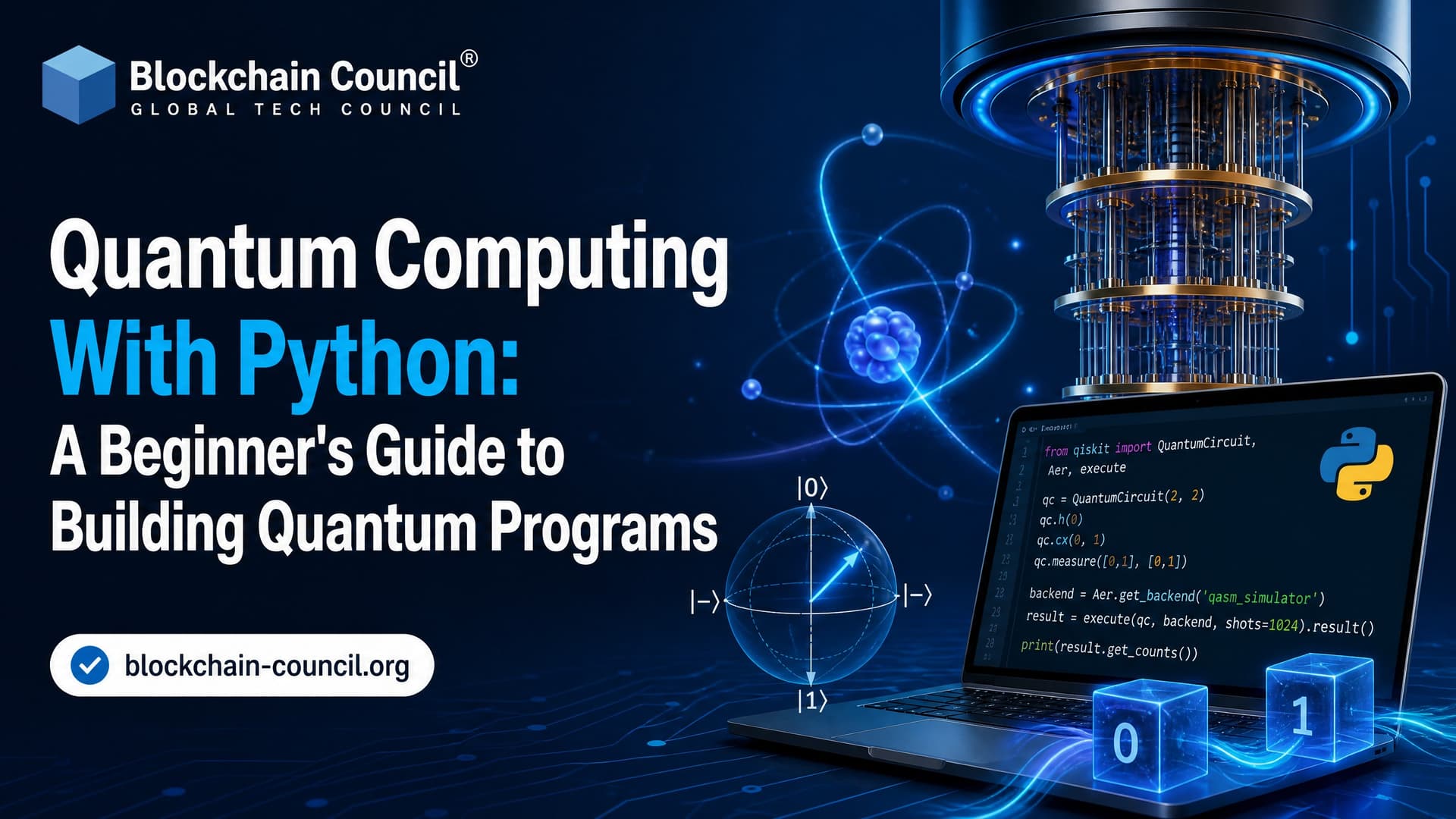
Quantum computing with Python is the most practical starting point if you want to build quantum programs without first learning a hardware-specific instruction language. You can create circuits, simulate results, visualize qubit behavior, and submit jobs to cloud quantum processors from a normal Python workflow. That matters. Beginners learn faster when theory and code sit next to each other.
Python will not make quantum mechanics easy. Nothing does. But it gives you a readable way to test ideas, make mistakes, and see measurement results quickly. If you already use Python for data science, backend development, or automation, you have enough programming background to start.

Why Python Is the Main Entry Point for Quantum Programming
Quantum circuits are mathematical objects. A qubit state is represented with complex amplitudes, and gates are represented as matrices. Python fits this style well because it already has a strong scientific stack, including NumPy, SciPy, Matplotlib, Jupyter Notebook, and GPU-aware tooling.
Most beginner courses and textbooks now teach quantum programming through Python. IBM Quantum's Qiskit documentation, Google's Cirq resources, PennyLane tutorials, and QuTiP research examples all follow this path. You write Python objects that describe circuits, then run them on a simulator or send them to a real backend.
That abstraction is useful, but do not mistake it for magic. Real quantum hardware is noisy. Queue times exist. Measurement results change from run to run. A two-qubit Bell state may look perfect in a simulator and slightly messy on hardware. That gap is where the real learning begins.
Prerequisites Before You Write Quantum Programs
You do not need a PhD to start, but you do need a few basics.
- Python fundamentals: functions, lists, dictionaries, virtual environments, and package installation.
- Linear algebra: vectors, matrices, tensor products, eigenvalues, and complex numbers.
- Core quantum ideas: qubits, superposition, entanglement, interference, gates, and measurement.
- Comfort with notebooks: Jupyter helps because you can run small cells and inspect output step by step.
If your linear algebra is rusty, fix that first. Quantum code that looks simple can hide a lot of matrix behavior. Take the Hadamard gate. It is often introduced as a way to create superposition, but its real power shows up in the interference it creates when you place it before and after other operations.
Set Up a Python Quantum Development Environment
Use a clean environment. This avoids dependency conflicts, especially because quantum packages move quickly.
python -m venv quantum_env
source quantum_env/bin/activate
pip install qiskit qiskit-aer matplotlib jupyter
On Windows, activate the environment with:
quantum_env\Scripts\activateA common beginner error is copying older Qiskit examples that use this import:
from qiskit.providers.aer import AerSimulatorIn many current installs, that fails with ModuleNotFoundError: No module named 'qiskit.providers.aer'. Use the separate package import instead:
from qiskit_aer import AerSimulatorSmall detail. Big time saver.
Your First Quantum Program in Python
The Bell state is the cleanest first program because it shows superposition and entanglement in only two qubits.
from qiskit import QuantumCircuit, transpile
from qiskit_aer import AerSimulator

qc = QuantumCircuit(2, 2)
qc.h(0)
qc.cx(0, 1)
qc.measure([0, 1], [0, 1])

simulator = AerSimulator()
compiled = transpile(qc, simulator)
result = simulator.run(compiled, shots=1024).result()
counts = result.get_counts()

print(counts)
You will usually see counts close to:
{'00': 510, '11': 514}The exact numbers change because measurement is probabilistic. The key point is that you should see mostly 00 and 11, not all four bitstrings equally. That correlation is the signature of entanglement in this simple example.
What the Code Actually Does
- QuantumCircuit(2, 2): creates two qubits and two classical bits.
- h(0): applies a Hadamard gate to put qubit 0 into superposition.
- cx(0, 1): applies a controlled-NOT gate, entangling qubit 0 with qubit 1.
- measure: maps quantum states to classical bits.
- shots=1024: repeats the experiment 1,024 times to estimate the distribution.
Do not skip the measurement step. In Qiskit, statevector simulations can inspect amplitudes directly, but real devices return measured classical outcomes. Beginners often mix those two mental models.
Important Python Quantum Frameworks
Qiskit is not the only option. The right framework depends on what you want to build.
Qiskit
Qiskit, maintained in the IBM Quantum ecosystem, is the best first choice for most beginners. It has strong learning material, local simulators through Qiskit Aer, visualization tools, and a route to IBM Quantum hardware through the IBM Runtime service.
Pick Qiskit if your goal is to understand circuits, gates, measurement, transpilation, and basic algorithms such as Grover's search or quantum phase estimation.
Cirq
Cirq is a Python framework associated with Google's quantum computing work. It gives lower-level control over circuits and device constraints. That is useful for research, but it can feel less friendly if you are still learning what a CNOT gate does.
Choose Cirq when you care about hardware-specific circuit design or want to study Google's approach to quantum processors.
PennyLane
PennyLane is built for differentiable quantum programming, quantum machine learning, and hybrid quantum-classical models. It integrates with machine learning tools and lets you train parameterized quantum circuits.
Use PennyLane if you are coming from ML and want to experiment with variational circuits. Avoid starting here if you have not yet learned basic gates and measurements. The abstraction can hide too much too early.
PyQuil
PyQuil is Rigetti's Python library for writing quantum programs using Quil concepts. It is relevant if you are working with Rigetti's stack or comparing hardware providers.
QuTiP
QuTiP, the Quantum Toolbox in Python, is widely used in quantum optics, open quantum systems, and quantum control. QuTiP 5 added improved solver infrastructure and tools for time-dependent evolution. This is research-grade simulation territory, not the shortest route for a beginner's first circuit.
cuQuantum Python APIs
NVIDIA cuQuantum provides GPU-accelerated simulation libraries with Python access. It is useful when classical simulation becomes the bottleneck. For a two-qubit tutorial, it is overkill. For large circuit benchmarks, it can save serious runtime.
Running on Real Quantum Hardware
After you can run circuits locally, try cloud hardware. IBM Quantum provides access to real devices and simulators through its platform. Your Python code needs account setup, backend selection, transpilation, and job submission.
Expect noise. Expect queues. Also expect to learn more from a noisy run than from a perfect simulator. On real hardware, gate errors, readout errors, qubit connectivity, and circuit depth all affect results. The transpiler may rewrite your circuit to fit a device's coupling map, which is why two circuits that look equivalent on paper can behave differently in practice.
For beginners, run the same Bell circuit on a simulator and then on hardware. Compare the histograms. That single exercise teaches probability, noise, and experimental thinking.
Where Python Quantum Programs Are Used
Most quantum applications are still early-stage, but Python is already used in serious experiments.
- Education: universities and training providers use Qiskit notebooks to teach Bell states, teleportation, Grover's algorithm, and measurement statistics.
- Quantum machine learning: PennyLane supports hybrid models where classical optimizers tune quantum circuit parameters.
- Quantum chemistry: Python workflows support simulations of molecular systems, variational eigensolvers, and specialized packages for chemistry research.
- Quantum control: QuTiP is used to model open quantum systems, time-dependent Hamiltonians, and decoherence.
- High-performance simulation: cuQuantum connects Python code with GPU kernels for larger circuit simulations.
Be blunt about expectations. Quantum computing is not a drop-in replacement for classical computing. For most business problems today, classical algorithms win on cost, reliability, and speed. Quantum becomes interesting when the problem maps naturally to quantum states, optimization landscapes, chemistry, cryptography research, or simulation tasks that strain classical methods.
A Practical Learning Path for Beginners
- Learn the math: review vectors, matrices, complex numbers, and probability.
- Build simple circuits: start with X, H, Z, CNOT, and measurement.
- Simulate first: use Qiskit Aer before cloud hardware.
- Study transpilation: learn why circuits are rewritten before execution.
- Run on hardware: compare simulator results with noisy device results.
- Explore a specialty: choose PennyLane for quantum ML, QuTiP for dynamics, or Cirq for lower-level circuit work.
If you are building a professional skill path, pair hands-on Python labs with structured study. Blockchain Council's Certified Quantum Computing Expert™ can support your work on quantum foundations, while developers working across AI and emerging technology may also connect this topic with Blockchain Council's AI certification tracks.
Next Step: Build, Break, and Measure
Start with Qiskit and build five circuits: a single-qubit superposition, a Bell state, a three-qubit GHZ state, a simple interference circuit, and a tiny Grover search. Run each one with 128, 1,024, and 8,192 shots. Watch how the distributions change.
Then submit one circuit to real hardware and compare the output. That is the moment quantum computing with Python stops being an abstract topic and becomes an engineering workflow you can practice, debug, and improve.
Related Articles
View All
Quantum Computing
Qiskit Explained: A Beginner's Guide to IBM's Quantum Computing Framework
A beginner-friendly explanation of Qiskit, IBM's open source quantum framework, covering circuits, transpilation, recent updates, use cases, and learning steps.

Quantum Computing
How Do Quantum Algorithms Work? A Beginner's Guide
Learn how quantum algorithms use qubits, gates, entanglement, interference, and measurement to solve selected problems faster than classical methods.

Quantum Computing
What Is a Qubit? The Building Block of Quantum Computing Explained
A clear explanation of what a qubit is, how it differs from a classical bit, and why superposition, entanglement, and error rates matter.
Trending Articles
The Role of Blockchain in Ethical AI Development
How blockchain technology is being used to promote transparency and accountability in artificial intelligence systems.
How Blockchain Secures AI Data
Understand how blockchain technology is being applied to protect the integrity and security of AI training data.
What is AWS? A Beginner's Guide to Cloud Computing
Everything you need to know about Amazon Web Services, cloud computing fundamentals, and career opportunities.