

Quantum Machine Learning vs Classical Machine Learning: Key Differences

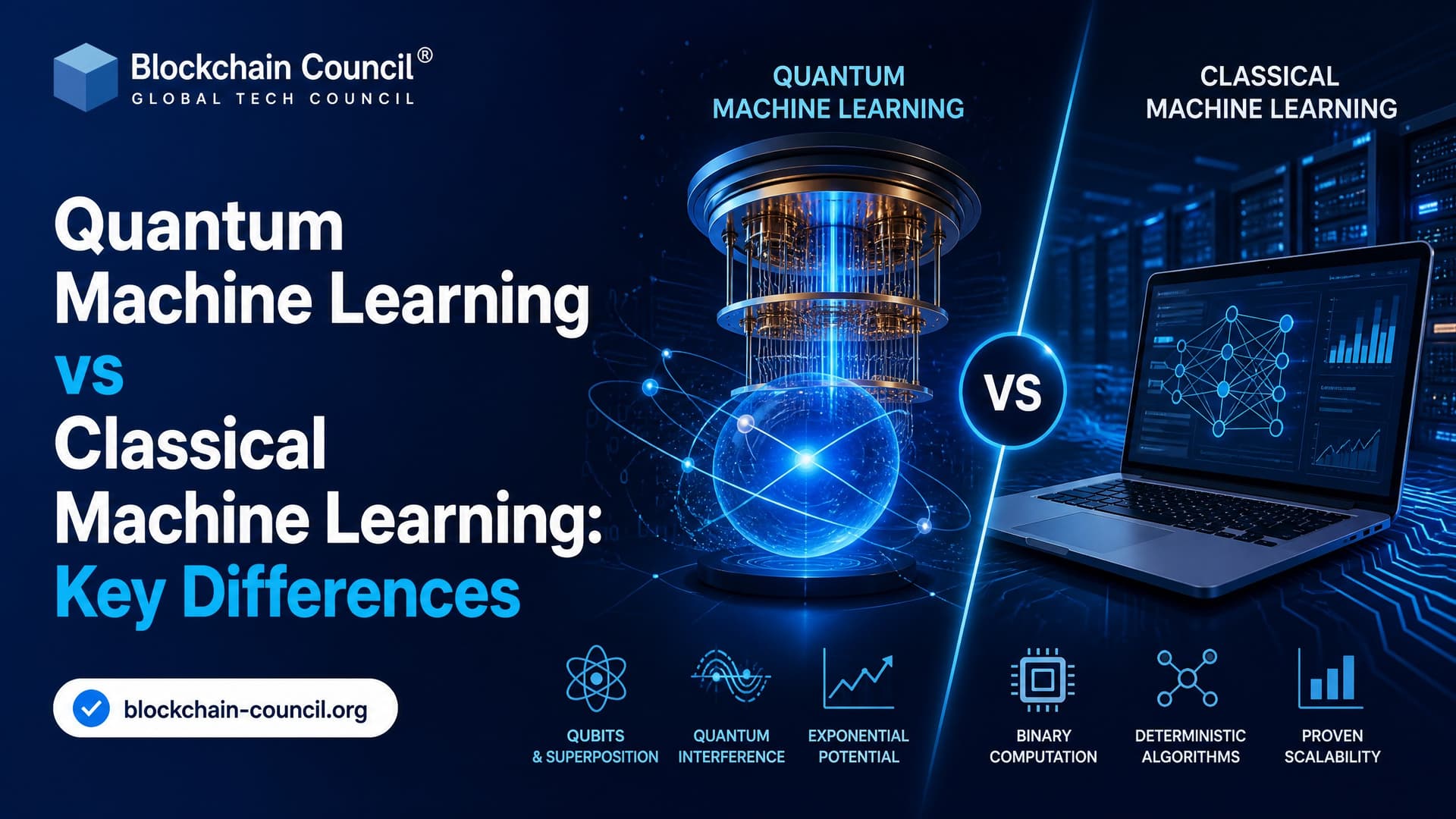
Quantum Machine Learning vs Classical Machine Learning comes down to more than faster hardware. Classical machine learning works with bits, tensors, floating point arithmetic, and mature optimization stacks. Quantum machine learning, or QML, works with qubits, quantum states, unitary circuits, and measurements. That changes how data is represented, how models are trained, and where any advantage can realistically show up.
The short answer: classical ML still wins for most business, engineering, and software tasks today. QML is most convincing when the data or the system being learned is quantum in nature, such as quantum chemistry, many-body physics, or carefully designed learning problems where quantum access cuts the number of experiments you need.

What Is Classical Machine Learning?
Classical machine learning, or CML, uses algorithms running on classical computers to learn patterns from data. You train linear models, decision trees, support vector machines, gradient boosted models, neural networks, or transformers using numerical operations on CPUs, GPUs, or specialized accelerators.
The tooling is deep. PyTorch, TensorFlow, scikit-learn, XGBoost, JAX, CUDA, and cloud ML platforms have years of production testing behind them. A classical model can scale from a small fraud classifier to a billion-parameter neural network if you have enough data, compute, and engineering discipline.
This is why classical ML remains the default choice. Not because it is simple, but because it works under normal production constraints.
What Is Quantum Machine Learning?
Quantum machine learning applies quantum computation to learning tasks. Instead of processing only bits, a QML model manipulates qubits through quantum gates, creates superposition and entanglement, and pulls out information through measurement.
Most QML used today is hybrid quantum-classical learning. A parameterized quantum circuit runs on a quantum processor or simulator, measurements produce outputs, and a classical optimizer updates circuit parameters. This pattern shows up in quantum neural networks, variational quantum classifiers, and quantum kernel methods.
Do not picture a quantum version of ChatGPT running on current hardware. That is not where the field is. Current quantum devices are noisy, circuit depth is limited, and many experiments use tens of qubits rather than millions.
Quantum Machine Learning vs Classical Machine Learning: Core Differences
1. Computation model
Classical ML stores and processes data as bits and floating point numbers. Matrix multiplication, gradient descent, backpropagation, and statistical estimation do the heavy lifting.
QML uses quantum states. A system of n qubits lives in a Hilbert space with 2^n amplitudes, which sounds powerful. But you cannot simply read all those amplitudes out. Measurement collapses the state, and you need repeated shots to estimate probabilities or expectation values.
This is the first practical trade-off: quantum state space is huge, but extracting useful information is expensive and task-dependent.
2. Data representation
Classical ML loads data directly into memory. If you have a table with 100 columns, you pass those features into a model. Feature scaling and embedding matter, but data access is direct.
QML must encode data into quantum states. Common methods include:
- Angle encoding: maps features into rotation angles, often using gates such as RX, RY, or RZ.
- Amplitude encoding: stores a normalized vector in quantum amplitudes, requiring 2^n entries for n qubits.
- Quantum feature maps: map classical inputs into states where a kernel can compare them.
Here is the part beginners underestimate. Amplitude encoding may look exponentially compact on a slide, but preparing the state can cost enough operations to wipe out the speedup. In practice, when you use a library such as PennyLane or Qiskit, you also have to normalize vectors and match dimensions exactly. A four-qubit amplitude embedding expects 16 amplitudes. Pass 15 values and the circuit is not just inaccurate, it is invalid.
3. Training behavior
Classical neural networks can be hard to train, but the failure modes are familiar: overfitting, exploding gradients, poor learning rates, bad initialization, data leakage, and distribution shift.
QML adds quantum-specific issues:
- Decoherence: quantum information is lost as the device interacts with its environment.
- Gate noise: operations are imperfect.
- Readout error: measurement can report the wrong bit value.
- Barren plateaus: gradients can vanish as circuits grow, making optimization painfully slow.
A concrete example: with the parameter-shift rule, a gradient estimate often needs two circuit evaluations per trainable parameter. If your circuit has 80 trainable parameters and you use 1,000 shots per expectation estimate, one optimizer step can get costly very quickly. On a simulator this is annoying. On cloud quantum hardware, it can be the difference between a quick test and a queue-bound experiment.
4. Scalability
Classical ML scales today. Enterprises routinely train models on millions of samples and deploy them through APIs, mobile apps, edge devices, and data platforms.
QML is still boxed in by noisy intermediate-scale quantum devices. Many real experiments use circuits with tens of qubits and shallow depth. Reviews in journals such as Reports on Progress in Physics keep pointing to the same bottlenecks: limited qubit counts, noise, data loading overhead, and the lack of fault-tolerant machines.
Where Classical ML Wins Today
For ordinary tabular data, image classification, text analytics, recommender systems, forecasting, fraud detection, and reinforcement learning, use classical ML. It is the practical answer.
Recent benchmark studies comparing QML and CML models have found that classical approaches generally outperform quantum models in accuracy, training time, and stability. A 2025 time series study reported that variational quantum models often struggled to match simple classical baselines. Conference benchmarking has shown quantum neural networks reaching more than 80 percent accuracy on some real classification tasks, but the classical models still performed better overall.
That matters. A model that is interesting in a lab is not automatically useful in production. If a random forest, XGBoost model, or small neural network gives better accuracy, trains faster, and is easier to monitor, do not replace it with QML for novelty.
Where Quantum Machine Learning Shows Real Promise
QML gets far more credible when the learning task itself is quantum. The Science paper Quantum advantage in learning from experiments, from Google and collaborators, showed that a quantum agent can learn certain properties of quantum systems with exponentially fewer experiments than any classical strategy, even one with unlimited computation.
The demonstrations used up to 40 superconducting qubits and about 1,300 quantum gates on Google's Sycamore processor. That is not a broad claim that QML beats all classical ML. It is narrower and stronger: for particular quantum learning tasks, quantum access can slash sample complexity.
A 2025 Nature Quantum Information study also reported entanglement-induced advantages using trapped-ion experiments on IonQ Aria, a 25-qubit device available through cloud access. The work showed gains in expressivity, inference speed, and training efficiency for constructed learning tasks.
These are the kinds of results practitioners should watch. They are not marketing claims. They mark out where quantum learning may have a defensible edge.
Algorithm Families in QML
Quantum kernel methods
Quantum kernels map data into a quantum feature space and estimate similarities through circuits. They are attractive because they fit into familiar workflows such as support vector machines. The hard part is proving that the quantum feature map captures useful structure a strong classical kernel cannot.
Variational quantum models
These use parameterized circuits trained by classical optimizers. They are the main NISQ-era approach because they can run on current devices with shallow circuits. They are also sensitive to noise and barren plateaus, so circuit design matters.
Native quantum learning algorithms
Algorithms such as quantum principal component analysis, quantum support vector machines, and quantum generative models are designed for more capable quantum computers. Many depend on assumptions such as efficient state preparation or fault-tolerant hardware, which limits near-term use.
Decision Guide: Which Should You Use?
- Use classical ML if your task involves customer data, logs, images, documents, transactions, forecasts, recommendations, or standard enterprise analytics.
- Explore QML if you work in quantum chemistry, condensed matter physics, quantum sensing, or quantum system control.
- Test quantum kernels only when you have structured data and a clear benchmark against strong classical baselines.
- Avoid QML for production if your only reason is that quantum sounds faster. That is a weak technical case.
My rule of thumb: if you cannot beat a tuned classical baseline, you do not have a QML result yet. You have a circuit experiment.
Skills Professionals Need Next
If you are building toward this field, learn both sides. Start with classical ML fundamentals, then study quantum computing basics: qubits, gates, measurement, entanglement, noise, variational circuits, and quantum kernels.
For Blockchain Council readers, this is a natural learning path: build AI foundations through the Certified Artificial Intelligence (AI) Expert™, then broaden into distributed and emerging technology thinking with the Certified Blockchain Expert™. If your goal is quantum-first research or architecture, pair those skills with a dedicated quantum computing course and hands-on practice in Qiskit, PennyLane, or Cirq.
Future Outlook
Near-term QML will stay hybrid. Expect better error mitigation, smarter ansatz design, improved benchmarking, and more work on tasks where sample efficiency matters more than raw throughput.
Fault-tolerant quantum ML is a longer story. Large-scale quantum classifiers, quantum generative models, and quantum linear algebra routines may need thousands to millions of physical qubits once error correction is included. That is beyond current machines.
The useful framing is not quantum versus classical as a winner-takes-all fight. Classical ML is the production standard. Quantum ML is an emerging tool for special problems, especially where quantum data is involved. If you want to prepare seriously, train a classical baseline, implement a small quantum kernel or variational classifier, and compare them honestly on the same dataset. That exercise teaches more than any headline about quantum advantage.
Related Articles
View All
Quantum Computing
Quantum Computing vs Classical Computing: Key Differences, Benefits, and Limitations
A practical comparison of quantum computing vs classical computing, covering qubits, algorithms, benefits, limits, market growth, and security risks.

Quantum Computing
How Quantum Computing Can Accelerate Machine Learning Workflows
Quantum computing can speed selected ML workflows through quantum kernels, variational circuits, optimization, and sampling, but gains remain task specific.

Quantum Computing
What Is Quantum Machine Learning? Concepts, Models, and Use Cases
Quantum machine learning combines quantum circuits with classical ML workflows for specialized tasks such as optimization, kernels, anomaly detection, and simulation.
Trending Articles

Can DeFi 2.0 Bridge the Gap Between Traditional and Decentralized Finance?
The next generation of DeFi protocols aims to connect traditional banking with decentralized finance ecosystems.
Blockchain in Supply Chain Provenance Tracking
Supply chains are under pressure to prove not just efficiency, but also authenticity, sustainability, and fairness. Customers want to know if their coffee really is fair trade, if the diamonds are con
How to Create Claude Skills?
Claude Skills are one of the most important features Anthropic has introduced for users who want automation that is structured, consistent and reusable. Instead of giving Claude long instructions ever