

Quantum Computing vs AI: Differences, Similarities, and Future Impact

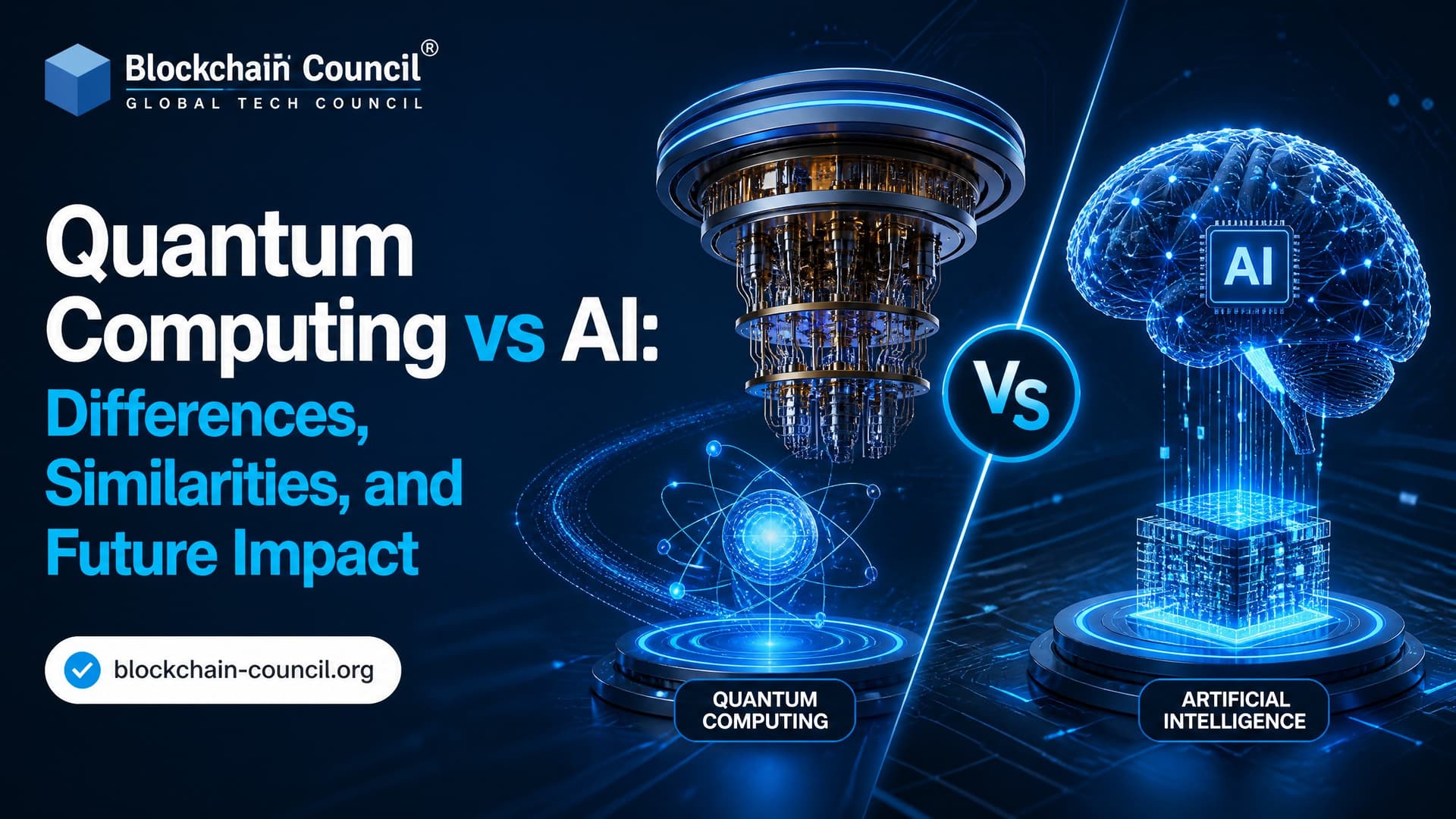
Quantum Computing vs AI is not a contest between two versions of the same technology. AI is a mature software discipline that runs on classical computers and is already deployed across banks, hospitals, factories, security teams, and consumer apps. Quantum computing is a hardware-heavy field built on physics, qubits, and error correction. It sits earlier in its commercial life, but it could change specific high-value areas such as cryptography, chemistry, materials science, and optimization.
The practical takeaway is simple. Use AI now, prepare for quantum next. If you work in blockchain, cybersecurity, finance, healthcare, logistics, or R&D, you should understand both.

What Is Quantum Computing?
Quantum computing uses qubits instead of classical bits. A classical bit is either 0 or 1. A qubit can represent a quantum state that involves superposition, and multiple qubits can become entangled. These effects let quantum algorithms process certain mathematical structures in ways classical computers cannot efficiently copy.
That does not mean a quantum computer is faster at everything. It is not a better laptop. It is closer to a specialized scientific instrument.
Current quantum hardware includes:
- Superconducting circuits, used by companies such as Google and IBM.
- Trapped ions, used by companies such as IonQ and Quantinuum.
- Neutral atoms, an architecture that has shown large qubit arrays.
- Photonics, which uses particles of light.
- Topological qubits, a harder and still debated route associated with Microsoft research.
In practice, developers often reach these systems through cloud services and SDKs. A small but useful detail: in Qiskit, measurement strings trip up beginners because the rightmost character usually corresponds to classical bit 0. If you measure q into c, do not read the output left to right like a normal binary label without checking the register order first.
What Is Artificial Intelligence?
Artificial intelligence is a broad field focused on building systems that learn patterns, generate outputs, classify information, recommend actions, and automate decisions. Modern AI includes machine learning, deep learning, reinforcement learning, large language models, computer vision, and symbolic methods.
AI runs on classical hardware: CPUs, GPUs, TPUs, and other accelerators. Unlike quantum computing, it does not require cryogenic cooling or fragile quantum states. You can train or call an AI model through a cloud API, run smaller models on edge devices, or wire AI into enterprise software.
AI is already used for:
- Fraud detection and credit risk scoring.
- Medical imaging support and diagnostics workflows.
- Predictive maintenance in manufacturing.
- Language interfaces, code assistants, and document analysis.
- Threat detection, anomaly analysis, and incident response in cybersecurity.
For working teams, AI feels immediate because the tooling is mature. Python, PyTorch, TensorFlow, scikit-learn, vector databases, and managed AI platforms give developers a production path. Model settings still matter. A language model at temperature 0.1 behaves very differently from the same model at 0.9, especially for security reports or compliance summaries where consistency beats creative wording.
Quantum Computing vs AI: Key Differences
1. Physical substrate
AI uses classical digital infrastructure. Quantum computing depends on quantum states that are sensitive to noise, temperature, vibration, and electromagnetic interference. Superconducting quantum processors usually need dilution refrigerators operating near absolute zero. Trapped-ion systems use lasers and ultra-high vacuum chambers.
This is the first major difference. AI is mostly software and data. Quantum computing is physics, hardware, control engineering, and mathematics.
2. Maturity
AI is production-ready today. Enterprises already use it in customer service, analytics, cybersecurity, software engineering, operations, and research.
Quantum computing is still in the noisy intermediate-scale quantum era, often called the NISQ era. Devices are improving fast, but they remain error-prone and limited compared with the fault-tolerant machines needed for broad commercial impact.
Progress is real, though. Google has reported major results using its Willow superconducting quantum chip, including work on error reduction and physics benchmarks. IBM has published a roadmap that targets verified quantum advantage around 2026 and a fault-tolerant Starling system later in the decade. Quantinuum has reported record quantum volumes for its H-series systems. Research groups have reported superconducting qubit coherence times in the sub-millisecond range, which matters because longer coherence allows more useful operations before information is lost.
3. Best-fit problems
AI is best when you have data and need prediction, classification, generation, or decision support. It can read contracts, spot fraud patterns, recommend maintenance schedules, or summarize security logs.
Quantum computing is expected to matter most for problems with mathematical structure that maps well to quantum mechanics. Those include:
- Quantum chemistry and molecular simulation.
- Materials discovery, including batteries and catalysts.
- Optimization in logistics, scheduling, and finance.
- Cryptanalysis and post-quantum security planning.
- Certain sampling and kernel methods in machine learning.
To be blunt, using quantum computing for a normal business dashboard is the wrong choice. Use classical analytics or AI. Reach for quantum when the underlying problem is hard for classical computers and the payoff justifies experimental work.
How Are Quantum Computing and AI Similar?
They are different, but they do overlap. Both fields try to pull useful structure out of complex systems. Both rely on advanced mathematics, high-performance computing, specialized hardware, and scarce talent.
They also share a similar adoption pattern inside enterprises: start with a narrow use case, test measurable benefit, build internal skills, then scale only when results justify the cost.
For professionals, that means you should not study them as isolated topics. AI, quantum computing, blockchain, and cybersecurity are becoming part of the same deeptech stack.
Where Quantum Computing and AI Work Together
AI for quantum systems
AI can help tune and control quantum devices. As qubit counts grow, manual calibration gets harder. Machine learning can assist with pulse optimization, noise modeling, error mitigation, and experiment design.
This is one of the most practical AI-plus-quantum use cases today. You use AI to improve quantum hardware and workflows, not to replace them.
Quantum for AI
Quantum machine learning is still experimental, but active. Researchers are studying quantum kernels, quantum-enhanced feature spaces, sampling methods, and optimization subroutines. The promise is not that every neural network will run on a quantum processor. The more realistic view is that quantum systems may accelerate specific steps inside larger AI pipelines.
Cybersecurity convergence
Cybersecurity is where the overlap gets urgent. AI is already used in security operations for anomaly detection, alert triage, malware analysis, and automated response. Quantum computing introduces a longer-term risk: sufficiently powerful fault-tolerant quantum computers could threaten public-key cryptography used in blockchains, digital signatures, VPNs, and identity systems.
Most expert assessments do not expect a cryptographically dangerous quantum computer within the next five years. Waiting is still a bad plan. Post-quantum cryptography migration takes years, because organizations must inventory systems, update protocols, test compatibility, and manage long-lived data that could be harvested now and decrypted later.
Real-World Examples
Quantum computing examples
- Engineering simulation: IonQ and Ansys reported a medical device simulation on a 36-qubit trapped-ion system with a 12 percent performance advantage over classical high-performance computing.
- Optimization: D-Wave has reported quantum advantage claims using annealing-based technology for certain real-world optimization problems.
- Materials and chemistry: Quantum algorithms are being tested for molecular behavior, battery materials, catalysts, and drug discovery.
- Healthcare research: University research teams are exploring quantum methods for biomarker discovery and precision medicine.
- Defense and national labs: Governments are funding quantum laboratories because the technology affects sensing, secure communication, cryptography, and strategic computing.
AI examples
- Insurance firms use AI to detect unusual claims and estimate risk.
- Hospitals use AI-assisted imaging systems to support clinical review.
- Manufacturers use AI vision systems for quality control.
- Security teams use AI to prioritize alerts and detect abnormal network behavior.
- Developers use AI coding assistants for tests, refactoring, and documentation.
Future Impact: Which Will Matter More?
Over the next decade, AI will have the larger day-to-day impact. It is already changing workflows, software development, customer operations, data analysis, cybersecurity, and education. The main AI challenges are governance, bias, privacy, model reliability, cost control, and workforce redesign.
Quantum computing will likely have a narrower but deeper impact. It may not touch every employee's workflow, but it could reshape industries where simulation, optimization, and cryptography sit at the center. McKinsey has described quantum as moving from concept toward reality, and Bain has argued that recent progress makes timing the main question rather than feasibility. Public investment supports that view, with major national funding programs announced in Japan, Spain, the United States, Europe, and other regions.
For blockchain, the most important issue is cryptographic resilience. Bitcoin and Ethereum are not broken by today's quantum computers. The concern is future machines powerful enough to attack elliptic curve signatures or other public-key systems. Developers and enterprises should track NIST post-quantum cryptography standards and plan migration paths for wallets, identity systems, bridges, custody platforms, and long-term archives.
What Should Professionals Learn First?
If you need results this quarter, start with AI. Learn model evaluation, prompt testing, data governance, and secure deployment. Blockchain Council's Certified Artificial Intelligence (AI) Expert™ gives readers a structured path into that knowledge.
If you work in security, blockchain infrastructure, digital identity, or regulated finance, add quantum literacy now. You do not need to become a quantum physicist, but you should understand qubits, Shor's algorithm, Grover's algorithm, post-quantum cryptography, and the limits of current NISQ devices. Blockchain Council's Certified Quantum Computing Expert™, Certified Cybersecurity Expert™, and Certified Blockchain Expert™ connect these areas.
If you are a developer, build one small project in each area:
- Use an AI model to classify or summarize security logs, then measure false positives.
- Run a basic quantum circuit in Qiskit or Cirq and inspect measurement results carefully.
- Map the cryptographic dependencies in a blockchain or identity application and mark which ones need post-quantum review.
Final Takeaway
Quantum Computing vs AI is best understood as near-term scale versus long-term specialization. AI is already changing how organizations operate. Quantum computing is still maturing, but it is moving toward practical advantage in problems where classical systems struggle.
Your next step: adopt AI with proper governance, start a post-quantum risk assessment, and build enough quantum literacy to know when the technology is useful and when it is just noise.
Related Articles
View All
Quantum Computing
The Future of Quantum Computing: Predictions and Emerging Trends
Explore the future of quantum computing, from error corrected qubits and cloud access to post-quantum cryptography, AI, and blockchain impact.

Quantum Computing
Quantum Computing in Climate and Energy: Use Cases for a Sustainable Future
Quantum computing in climate and energy is moving from theory to pilots in grids, climate risk, data centers, and materials, with hybrid methods leading today.

Quantum Computing
Quantum Computing in Cryptography: Impact on Encryption and Data Security
Quantum computing could break RSA, ECC, and current PKI. Learn how PQC, AES-256, crypto agility, and NIST standards protect long term data security.
Trending Articles
The Role of Blockchain in Ethical AI Development
How blockchain technology is being used to promote transparency and accountability in artificial intelligence systems.
How Blockchain Secures AI Data
Understand how blockchain technology is being applied to protect the integrity and security of AI training data.
What is AWS? A Beginner's Guide to Cloud Computing
Everything you need to know about Amazon Web Services, cloud computing fundamentals, and career opportunities.