

How to Start Learning Quantum Computing: Beginner Roadmap

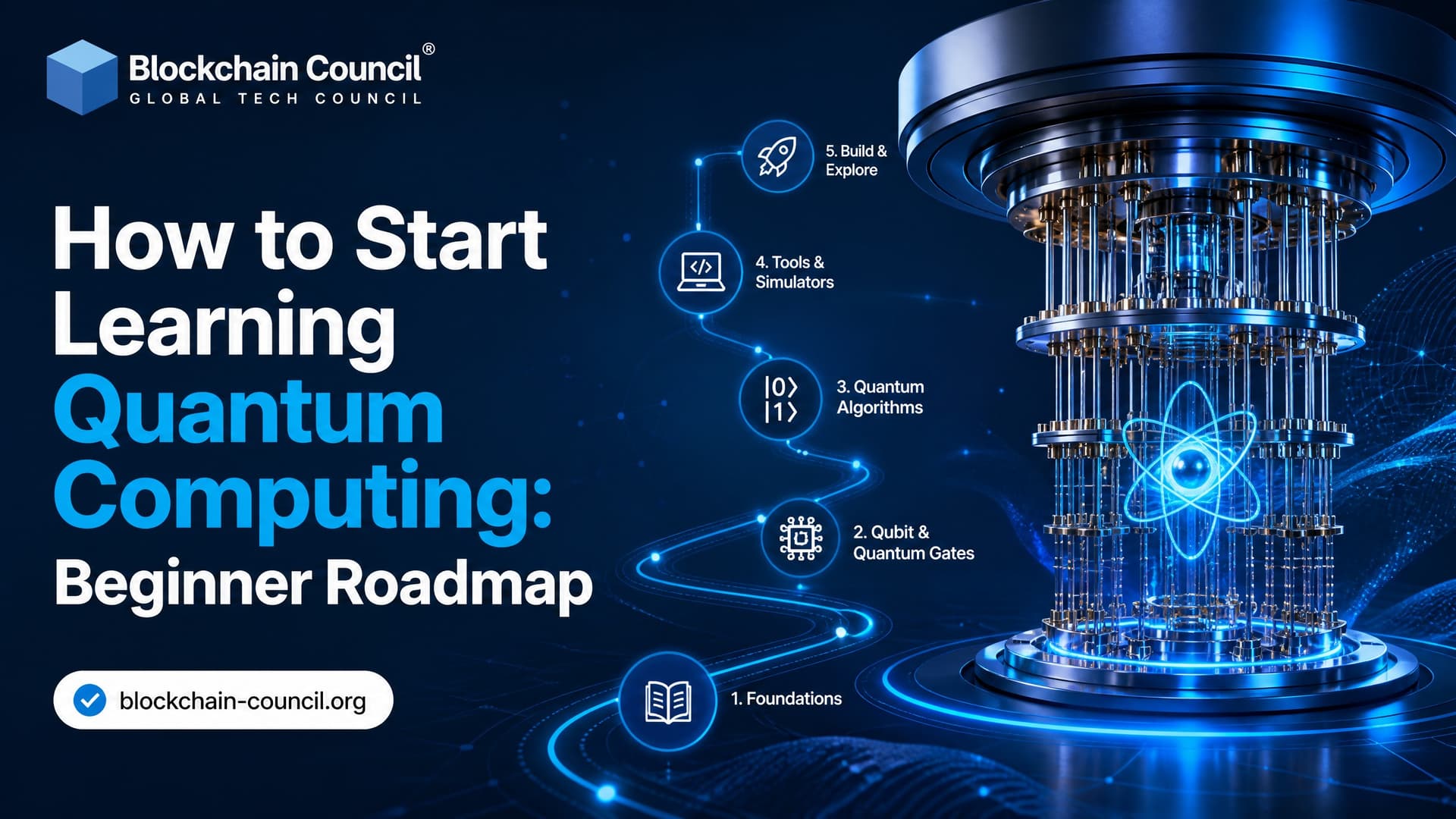
How to start learning quantum computing is no longer a question reserved for physics PhD students. If you can write basic Python, handle some linear algebra, and put in five to ten hours a week, you can build practical quantum computing skills in 12 to 24 months. The field is still early. The learning path, though, is now clear: learn the math, understand qubits, write circuits, run simulations, then build projects tied to real domains such as optimization, finance, chemistry, AI, or cybersecurity.
Why bother now? Quantum computing is moving from research labs into early commercial use. McKinsey reported that quantum computing companies generated more than 1 billion USD in worldwide revenue in 2025, with possible growth to 4.4 billion USD by 2028. Broader estimates put the wider quantum technologies market at roughly 1.9 billion USD in 2025, with strong annual growth and rising demand for trained people.

What Is Quantum Computing, in Plain Terms?
Classical computers process bits, usually represented as 0 or 1. Quantum computers use qubits, which are described by probability amplitudes. A qubit can sit in a state that behaves like a mix of 0 and 1 until you measure it. That is the short version. The useful version is this: quantum computing lets you design computations around interference, entanglement, and measurement.
You do not need to master all of quantum mechanics on day one. Good beginners focus on the circuit model first. Think of a quantum circuit as a sequence of gates applied to qubits, followed by measurement. That is the abstraction you will use in Qiskit, Cirq, and most cloud quantum platforms.
Why Learn Quantum Computing Now?
Be realistic. Quantum computers are not replacing classical servers next year. Most current devices are noisy, small, and expensive to access at scale. Still, the skill signal is becoming valuable.
Recent industry analysis points to nearly 70,000 active quantum patents worldwide and a sharp rise in filings over the last decade. Public funding commitments and private venture investment have climbed too. The Quantum Economic Development Consortium has reported growth in the pure-play quantum workforce, and several market studies show double-digit growth in quantum-related hiring.
The practical takeaway is simple: start before the field gets crowded. If you already work in software, data science, cybersecurity, blockchain, or AI, quantum computing can become a strong secondary specialization.
Prerequisites Before You Start
You do not need a physics degree. You do need patience with math. Here is the minimum stack.
1. Python Programming
Most beginner quantum software work happens in Python. You should be comfortable with:
- Functions, loops, and imports
- Jupyter notebooks
- NumPy arrays
- Basic plotting with Matplotlib
- Reading documentation without panic
A small detail from the trenches: many old Qiskit tutorials break on newer installs. If you see ImportError: cannot import name 'execute' from 'qiskit', the tutorial was probably written for an older Qiskit pattern. In Qiskit 1.x you will often use primitives such as Sampler, or transpile circuits and run them through a backend. This is normal. Do not assume you are the problem.
2. Linear Algebra
This is the real gatekeeper. Learn these topics well enough to calculate small examples by hand:
- Complex numbers
- Vectors and matrices
- Matrix multiplication
- Inner products
- Eigenvectors at a basic level
- Tensor products
Tensor products trip up beginners because they make the state space grow fast. One qubit needs 2 amplitudes. Two qubits need 4. Three qubits need 8. Ten qubits need 1,024. That exponential growth is both the promise and the headache.
3. Probability
Quantum measurement produces probability distributions. You must know how to read counts from repeated circuit shots. For example, if a simulator runs 1,024 shots and returns roughly 512 counts for 0 and 512 for 1, that is not a bug. It may be exactly what a Hadamard gate should produce.
4. Basic Classical Computing Concepts
Understand bits, logic gates, algorithms, and complexity at a high level. You should know why a faster algorithm matters, and why not every problem gets a quantum advantage.
A Practical Roadmap
Use this roadmap if you are a beginner with limited weekly study time. It is built for part-time learners, not full-time graduate students.
Weeks 1 to 2: Build Intuition and Vocabulary
Start with the words you will see everywhere:
- Qubit
- Superposition
- Entanglement
- Measurement
- Quantum gate
- Quantum circuit
- Simulator
- Noise
Sketch circuits by hand. Predict simple outcomes. A one-qubit circuit with a Hadamard gate followed by measurement is a perfect first exercise. Keep it small. Two qubits are enough at this stage.
Weeks 3 to 6: Learn the Math That Actually Gets Used
Do not try to read a full quantum mechanics textbook yet. You will lose momentum. Focus on the math used in circuits:
- Represent |0> as a vector.
- Represent |1> as a vector.
- Apply X, H, and Z gates as matrices.
- Compute simple measurement probabilities.
- Use tensor products for two-qubit states.
A good milestone: you should be able to explain why applying H to |0> creates equal measurement probabilities for 0 and 1.
Weeks 5 to 8: Pick One SDK and Write Circuits
Choose one framework first. For most beginners I recommend Qiskit, because the learning material, simulator support, and community examples are extensive. Cirq is also solid, especially if you are interested in Google's quantum ecosystem. Do not learn both at once.
Build these circuits:
- One-qubit Hadamard circuit
- Bell state circuit using H and CX
- Simple measurement circuit with 1,024 shots
- Three-qubit GHZ state
Run them on a local simulator first. Real quantum devices are interesting, but noisy hardware can hide whether your circuit is correct. Simulate, then try cloud hardware once you know what output to expect.
Weeks 9 to 12: Implement Foundational Algorithms
Once basic circuits feel normal, study algorithms. Start with:
- Deutsch-Jozsa algorithm for learning oracle-based thinking
- Grover's search for amplitude amplification
- Shor's algorithm conceptually, especially its impact on RSA and elliptic curve cryptography
- VQE for hybrid quantum-classical chemistry problems
- QAOA for optimization examples
To be blunt, Shor's algorithm is usually too much for a first implementation unless it is heavily guided. Grover's search is a better first serious project. You can explain it, test it, and watch the probability distribution shift toward the marked item.
Months 4 to 12: Build Portfolio Projects
This is where learning turns useful. Build two to four small projects with clear notebooks, explanations, and results. Good beginner projects include:
- Grover search on a toy database
- QAOA for a small Max-Cut problem
- VQE estimate for a simple molecule such as H2
- Quantum kernel classification on a tiny dataset
- A comparison of simulator output and noisy hardware output
Keep the claims modest. A quantum model beating a weak classical baseline on a tiny dataset does not prove quantum advantage. It proves you can design, run, and evaluate a workflow. That is already worth showing.
Months 12 to 24: Choose a Specialization
Pick a track based on your current career.
- Software developers: quantum SDKs, circuit optimization, cloud workflows, and testing
- Data scientists: quantum machine learning, kernels, variational circuits, and benchmarking
- Finance professionals: portfolio optimization, risk modeling, Monte Carlo methods, and QAOA
- Chemistry or biology learners: VQE, molecular simulation, and quantum chemistry packages
- Cybersecurity and blockchain professionals: post-quantum cryptography, key management, and protocol risk analysis
If you work with blockchain systems, pay close attention to quantum-safe cryptography. Large fault-tolerant quantum computers are not here yet, but planning for migration takes years. Professionals studying Blockchain Council programs such as Certified Blockchain Expert™, Certified Blockchain Developer™, or Certified Cybersecurity Expert™ can use quantum fundamentals to better understand long-term cryptographic risk.
Best Tools for Beginners
Start with a small toolchain. Too many tools will slow you down.
- Python: core programming language
- NumPy: vectors and matrices
- Jupyter: experiments and notebooks
- Qiskit: circuit building, simulation, and IBM Quantum workflows
- Cirq: alternative SDK with strong circuit design features
- OpenQASM: useful for understanding circuit representation
My bias: learn Qiskit first unless a course or employer specifically uses Cirq. Qiskit has changed over time, so use current documentation rather than copying three-year-old snippets from random blogs.
Common Beginner Mistakes
- Skipping linear algebra: You can copy code without it, but you cannot debug results.
- Chasing quantum advantage too early: Learn correctness before performance claims.
- Using real hardware too soon: Noise will confuse you if you have not mastered simulators.
- Learning five frameworks at once: Pick one SDK for the first two months.
- Ignoring classical baselines: Every quantum project should be compared against a simple classical method.
Where Quantum Computing Fits With AI, Blockchain, and Cybersecurity
Quantum computing does not sit apart from other deeptech fields. It touches AI through quantum machine learning, cybersecurity through post-quantum cryptography, and blockchain through long-term signature security. If you already study AI, the Certified AI Expert™ path can pair well with quantum machine learning fundamentals. If your focus is blockchain infrastructure, connect quantum learning with cryptographic agility, wallet security, and protocol design.
The strongest professionals will not be pure quantum generalists. They will combine quantum skills with a domain. That could be finance, pharma, logistics, cybersecurity, or AI engineering.
Your Next Step
Set a 12-week target: learn the vocabulary, review linear algebra, install Qiskit, build Bell state circuits, and implement Grover's search on a simulator. After that, choose one domain project and document it properly. If your background is blockchain or cybersecurity, pair this roadmap with Blockchain Council certifications such as Certified Blockchain Expert™ or Certified Cybersecurity Expert™ so your quantum learning connects to real security and protocol decisions.
Related Articles
View All
Quantum Computing
How Quantum Computing Can Accelerate Machine Learning Workflows
Quantum computing can speed selected ML workflows through quantum kernels, variational circuits, optimization, and sampling, but gains remain task specific.

Quantum Computing
Careers in Quantum Computing: Skills, Certifications, Projects, and Learning Roadmaps
Explore careers in quantum computing with role paths, skills, certifications, portfolio projects, and a practical 6 to 12 month learning roadmap.

Quantum Computing
Quantum Computing Certification: Benefits, Career Value, and How to Choose One
Learn how quantum computing certification supports career growth, what employers value, and how to choose a credential with real technical depth.
Trending Articles
The Role of Blockchain in Ethical AI Development
How blockchain technology is being used to promote transparency and accountability in artificial intelligence systems.
How to Install Claude Code
Learn how to install Claude Code on macOS, Linux, and Windows using the native installer, plus verification, authentication, and troubleshooting tips.
How to Create Claude Skills?
Claude Skills are one of the most important features Anthropic has introduced for users who want automation that is structured, consistent and reusable. Instead of giving Claude long instructions ever