

Edge AI for Industrial Automation: Real-Time Intelligence on the Factory Floor
 Suyash Raizada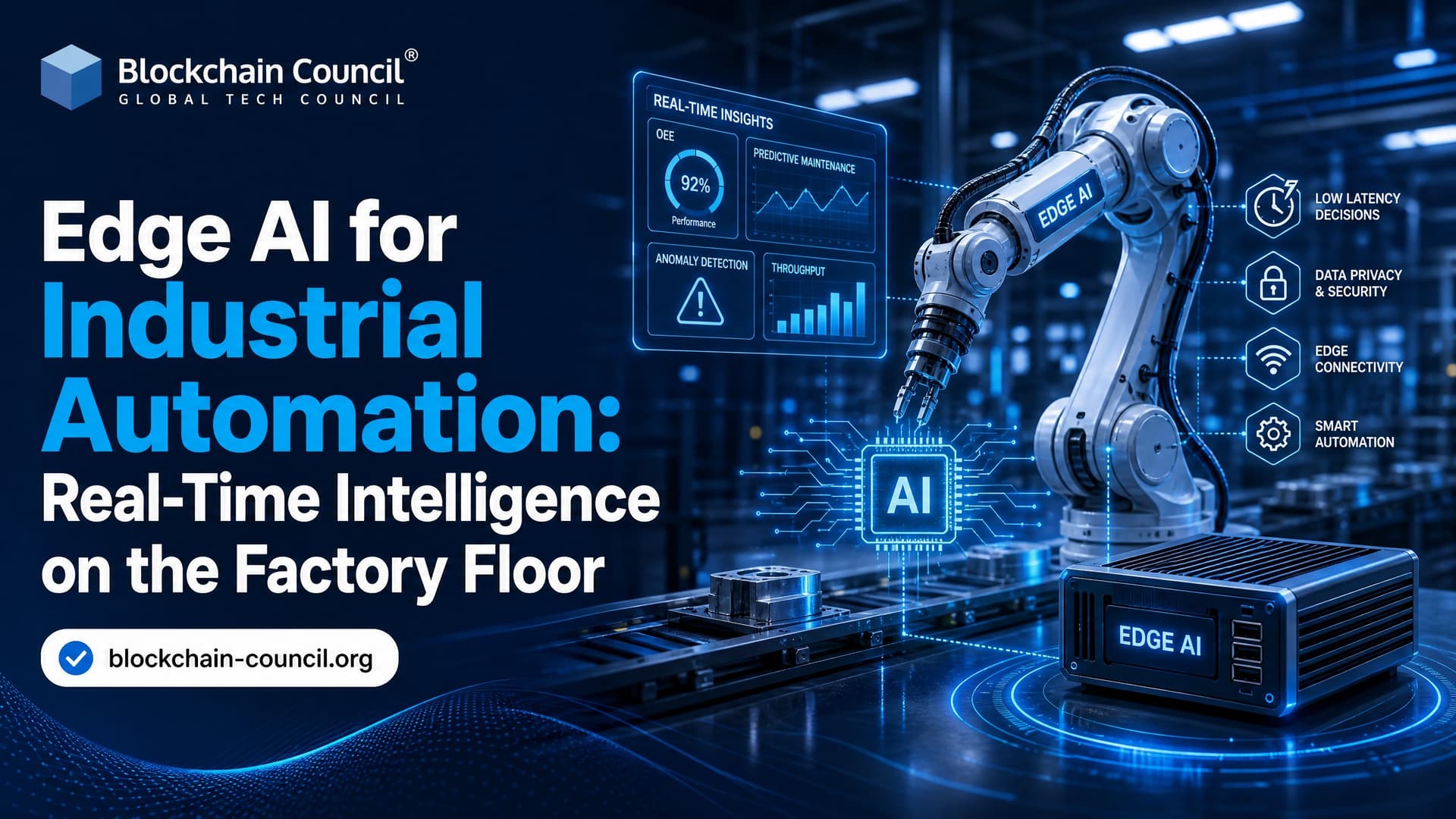
Edge AI for industrial automation puts machine learning models close to the machines: sensors, cameras, controllers, and production lines, instead of sending every signal to the cloud. That change sounds simple. It is not. It changes how factories inspect products, predict failures, tune processes, manage energy, and protect workers in real time.
The reason comes down to latency. A cloud dashboard is fine for monthly yield analysis, but it is the wrong place to decide whether a fast-moving component should be rejected in 40 milliseconds. Edge AI handles those decisions locally, then sends selected events, summaries, and trends upstream for wider analysis.

As manufacturers accelerate their adoption of intelligent automation, professionals with a Certified Edge AI Expert background are increasingly helping organizations design edge AI architectures that combine low-latency decision-making with reliable, production-ready deployments across industrial environments.
What Edge AI Means in Industrial Automation
In an industrial setting, edge AI means running AI inference on devices near the operation itself. That could be an industrial PC beside a packaging line, an AI-enabled camera over a conveyor, a gateway wired to vibration sensors, or an embedded module inside an OEM machine.
The model might classify defects, detect abnormal vibration, estimate remaining useful life, spot unsafe behavior, or recommend new process setpoints. The common thread is location. The intelligence sits close enough to act before the opportunity passes.
Key characteristics
Local inference: Models run on edge devices such as industrial PCs, gateways, embedded systems, smart cameras, and IIoT sensors.
Real-time response: Decisions can happen in milliseconds, which matters for safety, quality, motion, and closed-loop control.
Lower cloud dependence: Plants keep operating when connectivity is limited, expensive, or unstable.
Better data control: Sensitive production data can stay on site, while only alarms, metadata, or compressed features move to central systems.
Arm has highlighted the shift toward AI-ready, low-power edge compute platforms for industrial OEMs. That matters because factories do not buy data center hardware for every machine. They need rugged, fanless, power-aware systems that survive dust, heat, vibration, and long maintenance cycles.
Why Edge AI Is Growing So Quickly
Market research forecasts the global edge AI in industrial automation market to reach roughly 268 billion USD by 2031, with an estimated compound annual growth rate above 25 percent. The demand comes from manufacturing, energy, automotive, logistics, and process industries that need faster decisions and less downtime.
Rockwell Automation has reported that industrial organizations are directing a growing share of IT budgets toward industrial data analytics and AI. That does not mean every plant is mature. Most are not. Many facilities are still moving from pilot projects to targeted production deployments.
The pattern I see most often is practical. One line gets edge vision for quality inspection. One critical pump train gets local anomaly detection. One energy system gets AI-assisted optimization. If those projects survive the first maintenance window and the first network outage, the plant expands from there.
Scaling these pilot projects into enterprise-wide deployments also requires disciplined model lifecycle management, automated updates, monitoring, and version control. Many engineers strengthen these operational capabilities through a Certified MLOps Expert program before managing AI systems across multiple production sites.
Edge AI Architecture: Edge First, Cloud Still Matters
The best industrial AI systems are not edge-only or cloud-only. They are hybrid.
Use the edge for fast inference, filtering, local alarms, and decisions that cannot wait. Use the cloud or a central data platform for model training, fleet benchmarking, long-term optimization, and reporting across plants.
A typical industrial edge AI stack
Data sources: PLCs, SCADA systems, historians, cameras, vibration sensors, temperature sensors, pressure transmitters, RFID, and ultra-wideband tags.
Connectivity: OPC UA, MQTT, Modbus TCP, EtherNet/IP, PROFINET, and sometimes 5G for mobile assets or large facilities.
Edge compute: Industrial PCs, rugged gateways, AI cameras, NVIDIA Jetson devices, Arm-based modules, or controller-integrated compute.
AI runtime: ONNX Runtime, TensorRT, OpenVINO, containerized Python services, or vendor-specific inference engines.
Operations layer: Alerts, dashboards, MES integration, maintenance work orders, and cloud synchronization.
One detail that catches beginners: model conversion is rarely painless. Exporting a PyTorch model to ONNX and then running it on an edge device can fail with an error such as INVALID_ARGUMENT : Got invalid dimensions for input if the model was exported with a fixed 640 x 640 image size and the camera pipeline sends a different tensor shape. In a lab, you resize the frame and move on. On a production line, that mismatch can stop inspection until the deployment package is corrected.
Core Use Cases for Edge AI in Factories
Predictive Maintenance
Predictive maintenance is one of the strongest use cases for edge AI in industrial automation. Sensors track vibration, temperature, current, pressure, and acoustic patterns. Local models identify early warning signs such as bearing wear, misalignment, cavitation, or motor imbalance.
A pump sensor, for example, can detect abnormal vibration frequencies and compare them against known failure patterns. Instead of streaming raw vibration data all day, the edge device sends a maintenance alert with the relevant frequency bands, a confidence score, and a timestamp. The team can schedule work before the pump fails.
This is especially useful on remote oil rigs, in underground mines, at wind farms, and in large process plants where connectivity is inconsistent and downtime is expensive.
Quality Control and Visual Inspection
Edge AI cameras are changing inspection on high-speed lines. In electronics manufacturing, computer vision models can detect solder defects, missing components, bent pins, scratches, poor labeling, or surface contamination in milliseconds.
The advantage is not only speed. It is consistency. Human inspectors get tired. Lighting changes. Shift handovers introduce variation. Edge vision systems apply the same criteria across shifts and lines, as long as the model is trained well and monitored for drift.
To be blunt, edge AI vision is the wrong choice if your process has poor lighting, inconsistent fixturing, and no clean defect labels. Fix the basics first. A model cannot compensate forever for a camera mounted on a vibrating bracket.
Real-Time Process Control
In process industries, edge AI can analyze flow, pressure, temperature, viscosity, moisture, and other variables to recommend better setpoints. In some cases, AI-enhanced controllers can make approved local adjustments to reduce variation, improve yield, or lower scrap.
This is where engineering discipline matters. You should not drop an unvalidated model into a safety-critical control loop. Start with advisory mode. Compare recommendations against operator actions and process outcomes. Only then consider closed-loop control, with clear fallback logic.
Energy Management and Sustainability
Compressors, steam systems, chillers, HVAC systems, ovens, and pumps consume large amounts of energy. Edge AI can monitor local operating conditions and adjust loads or setpoints to cut electricity use without hurting production.
An edge model can detect when several compressors are running inefficiently at partial load and recommend a different load-sharing pattern. The result can be lower energy cost, reduced emissions, and less wear on equipment.
Safety Monitoring
Edge AI can process video and sensor feeds locally to flag hazards. Common examples include detecting missing helmets, missing safety jackets, entry into restricted zones, gas concentration changes, or unsafe proximity between people and mobile equipment.
Local processing matters here because safety alerts cannot wait for a remote server. It also reduces the need to transmit continuous video outside the plant, which helps with privacy and compliance.
Asset Tracking and Logistics
Factories lose time when tools, pallets, fixtures, and mobile equipment sit in the wrong place. Edge AI can analyze RFID, ultra-wideband, barcode, and camera data locally to spot idle assets, misplaced inventory, and flow bottlenecks.
Warehouses and logistics hubs use similar methods for automated sorting, congestion detection, and real-time material tracking.
Benefits of Edge AI for Industrial Automation
Lower latency: Decisions happen near the machine, not after a round trip to the cloud.
Higher resilience: Operations continue during network outages or cloud service interruptions.
Reduced downtime: Local anomaly detection helps teams act before failure.
Improved quality: Defects are caught earlier, before more material and labor are wasted.
Lower bandwidth use: Edge systems send events and summaries instead of raw streams.
Better safety: Video and sensor analytics can trigger fast local alerts.
Stronger data governance: Sensitive operational data can stay inside the facility.
Challenges You Should Plan For
Edge AI is valuable, but it is not magic. The hard part is often operational, not algorithmic.
Model Lifecycle Management
Deploying one model to one gateway is easy. Managing hundreds of models across lines, shifts, and sites is a different job. You need version control, validation records, rollback plans, performance monitoring, and a clear owner for retraining.
Legacy System Integration
Many plants still run older PLCs, proprietary protocols, and historian systems built long before modern AI stacks existed. Integration through OPC UA, MQTT, or protocol gateways is common, but data quality can be uneven. Watch for wrong units, missing timestamps, and Modbus register byte order issues. Those small problems ruin models quietly.
Cybersecurity and Safety
Putting AI near industrial control systems raises the security stakes. Segment networks. Use signed updates. Limit device permissions. Monitor abnormal traffic. If your edge device can influence a machine state, treat it as part of the operational risk surface.
Professionals building these systems should strengthen both their AI and security foundations. Blockchain Council's AI certification tracks, cybersecurity certification tracks, and IoT-focused learning resources connect model skills with deployment and risk management.
Where Edge AI Fits by Sector
Automotive and electronics: Vision inspection, robot guidance, predictive maintenance, and line balancing.
Chemicals, oil and gas, mining, and energy: Remote monitoring, safety analytics, energy optimization, and equipment health prediction.
Logistics and warehousing: Asset tracking, automated sorting, inventory visibility, and traffic monitoring.
Industrial equipment OEMs: AI-enabled machines that ship with embedded diagnostics and condition monitoring.
Future Outlook: Human Plus AI Factories
The future factory is not human-free. That idea is overhyped. The stronger model is human plus AI, where operators, engineers, and maintenance teams get real-time assistance from systems that watch every cycle, every asset, and every process condition.
5G will help in large plants and mobile environments, but it will not replace edge computing. Critical decisions should stay local. Cloud systems will still matter for training, benchmarking, and long-range planning.
Industry 5.0 discussions place edge AI in a wider context: human-centric automation, resilience, and sustainability. That is a sensible direction. Plants need productivity, but they also need safer work, lower waste, and smarter energy use.
How to Get Started
Start with one measurable problem. Pick a use case where latency, downtime, quality loss, or bandwidth cost is real. Predictive maintenance on a critical asset and edge vision on a repeatable inspection task are usually better first projects than full closed-loop process optimization.
Define the business metric: downtime hours, scrap rate, inspection time, energy cost, or safety incidents.
Audit available data and sensor quality.
Choose edge hardware that matches the environment, not just the model benchmark.
Run the model in advisory mode before automating any action.
Plan updates, monitoring, cybersecurity, and rollback from day one.
If you want to build or lead these projects, focus next on embedded machine learning, industrial networking, AI model deployment, and OT cybersecurity. Then map that learning into a practical credential path through Blockchain Council's AI, IoT, and cybersecurity certification resources.
As industrial edge AI increasingly enables smarter products, connected manufacturing solutions, and customer-focused digital services, professionals who complement their technical expertise with a Marketing Certification are better positioned to connect AI innovation with market opportunities, customer value, and long-term business growth.
FAQs
1. What is Edge AI for industrial automation?
Edge AI for industrial automation refers to deploying artificial intelligence models directly on factory equipment, industrial computers, robots, PLCs, smart sensors, and edge gateways. Instead of sending operational data to the cloud for processing, AI analyzes data locally, enabling real-time decision-making, lower latency, improved reliability, and greater operational efficiency.
2. Why is Edge AI important in industrial automation?
Industrial operations often require split-second decisions where delays can result in equipment damage, production losses, or safety risks. Edge AI processes data at the source, allowing manufacturers to monitor equipment, detect anomalies, and automate decisions without depending on cloud connectivity.
3. How does Edge AI improve manufacturing efficiency?
Edge AI continuously analyzes machine data to identify inefficiencies, optimize production lines, reduce downtime, improve quality control, and automate repetitive tasks. This helps manufacturers increase productivity while reducing operational costs.
4. What are the main use cases of Edge AI in industrial automation?
Common applications include predictive maintenance, machine vision, quality inspection, robotic automation, process optimization, worker safety monitoring, asset tracking, energy management, autonomous material handling, and production line monitoring.
5. How does Edge AI support predictive maintenance?
Edge AI analyzes data from sensors, vibration monitors, temperature readings, and machine performance in real time. It can identify early signs of equipment wear or failure, allowing maintenance teams to address issues before unexpected breakdowns occur.
6. How is Edge AI used for quality inspection?
AI-powered cameras and vision systems inspect products directly on production lines, detecting defects such as scratches, cracks, missing components, incorrect assembly, or packaging errors. Automated inspections improve consistency while reducing manual quality checks.
7. Can Edge AI improve industrial robotics?
Yes. Industrial robots equipped with Edge AI can recognize objects, adapt to changing environments, improve navigation, optimize movement, and make autonomous decisions without relying on continuous communication with cloud servers.
8. What types of hardware are used for Edge AI in factories?
Industrial Edge AI deployments commonly use industrial PCs, NVIDIA Jetson platforms, Intel processors, AI accelerators, programmable logic controllers (PLCs), smart cameras, embedded systems, IoT gateways, and rugged edge servers designed for harsh industrial environments.
9. What industries benefit from Edge AI in industrial automation?
Industries including automotive manufacturing, electronics, pharmaceuticals, food and beverage, chemicals, oil and gas, mining, aerospace, logistics, and energy use Edge AI to improve efficiency, safety, and production quality.
10. How does Edge AI reduce manufacturing downtime?
Edge AI continuously monitors equipment performance and detects abnormal behavior before failures occur. Real-time alerts allow maintenance teams to intervene early, reducing unplanned downtime and extending equipment lifespan.
11. How does Edge AI improve worker safety?
Edge AI monitors industrial environments using sensors and computer vision systems to detect unsafe conditions, restricted area access, missing protective equipment, hazardous machine operation, and potential accidents, enabling immediate corrective action.
12. Can Edge AI operate without internet connectivity?
Yes. One of Edge AI's biggest advantages is its ability to perform AI inference locally. Manufacturing systems can continue operating even if cloud connectivity is interrupted, ensuring continuous production and operational resilience.
13. What are the biggest challenges of implementing Edge AI in industrial automation?
Challenges include integrating with legacy equipment, securing industrial networks, optimizing AI models for edge hardware, managing distributed devices, ensuring regulatory compliance, training employees, and maintaining AI performance over time.
14. How does Edge AI improve industrial data security?
Since operational data is processed locally, less sensitive information needs to travel across external networks. Combined with encryption, secure device authentication, network segmentation, and continuous monitoring, Edge AI can strengthen industrial cybersecurity.
15. What software frameworks are commonly used for Edge AI in manufacturing?
Popular frameworks include TensorFlow Lite, OpenVINO, ONNX Runtime, NVIDIA TensorRT, PyTorch Mobile, Edge Impulse, Apache TVM, and industrial IoT platforms that support AI model deployment and device management.
16. How can manufacturers successfully deploy Edge AI?
Successful deployment begins with identifying high-value use cases, selecting compatible hardware, optimizing AI models, conducting pilot projects, integrating with existing industrial systems, implementing strong security measures, and continuously monitoring performance.
17. What is the difference between Edge AI and cloud AI in manufacturing?
Edge AI performs AI inference locally on industrial devices for immediate decision-making, while cloud AI is commonly used for large-scale analytics, model training, historical reporting, and centralized management. Many organizations combine both approaches in a hybrid architecture.
18. How does Edge AI support Industry 4.0 initiatives?
Edge AI enables intelligent factories by combining AI, IoT, robotics, automation, and real-time analytics. It supports autonomous production, predictive maintenance, digital twins, smart quality control, and data-driven manufacturing processes central to Industry 4.0.
19. What are the best practices for implementing Edge AI in industrial automation?
Organizations should begin with clearly defined business objectives, deploy AI incrementally through pilot projects, optimize models for industrial hardware, secure devices and networks, monitor system performance continuously, establish governance policies, and provide employee training to maximize adoption.
20. Why is Edge AI considered the future of industrial automation?
Edge AI allows manufacturers to make intelligent decisions directly where production happens. By combining real-time analytics, predictive maintenance, autonomous robotics, machine vision, and secure local processing, Edge AI helps create smarter, safer, and more efficient factories. As Industry 4.0 adoption accelerates, Edge AI is expected to become a foundational technology for modern industrial automation and digital manufacturing.
Related Articles
View All
Edge Ai
Edge AI Model Deployment Guide: Training to Real-Time Inference
A practical edge AI model deployment guide covering training, ONNX export, optimization, containers, Triton serving, monitoring, and real-time inference.

Edge Ai
Edge AI for Autonomous Vehicles: Real-Time Perception and Decision-Making
Edge AI helps autonomous vehicles process sensor data onboard for low-latency perception, safer decisions, privacy, and resilience when networks fail.

Edge Ai
Edge AI in Healthcare: Real-Time Diagnostics, Monitoring, and Patient Care
Edge AI in healthcare brings models closer to ECG patches, imaging systems, and hospital gateways for faster diagnostics, safer monitoring, and local data control.
Trending Articles
The Role of Blockchain in Ethical AI Development
How blockchain technology is being used to promote transparency and accountability in artificial intelligence systems.
AWS Career Roadmap
A step-by-step guide to building a successful career in Amazon Web Services cloud computing.

Can DeFi 2.0 Bridge the Gap Between Traditional and Decentralized Finance?
The next generation of DeFi protocols aims to connect traditional banking with decentralized finance ecosystems.