

Edge AI for Autonomous Vehicles: Real-Time Perception and Decision-Making
 Suyash Raizada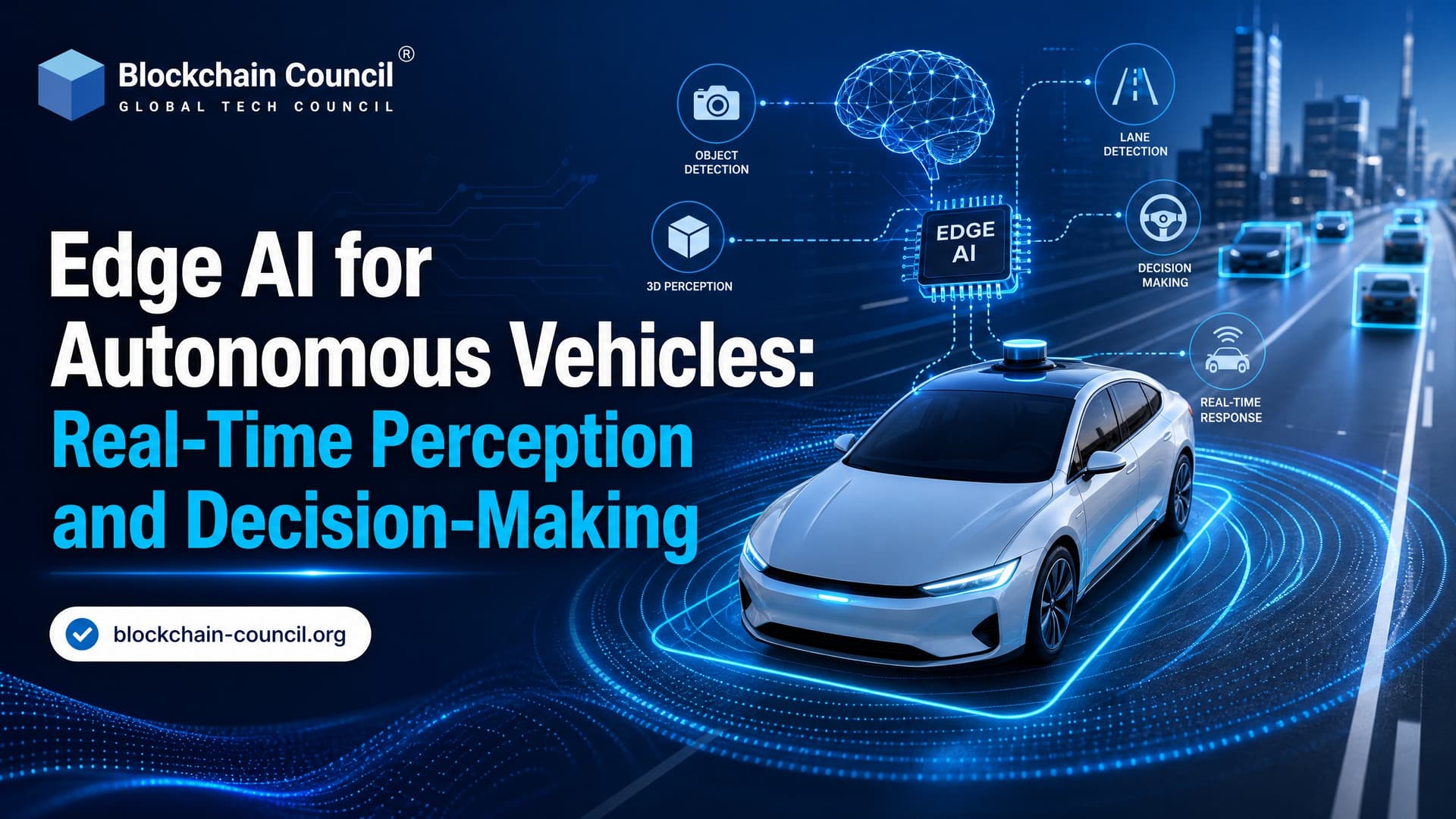
Edge AI for autonomous vehicles is the reason a self-driving system can detect a pedestrian, classify the risk, plan a safe response, and trigger braking without waiting for a cloud server. That timing matters. At highway speed, a 100 ms delay is not a technical footnote. It is distance traveled before the vehicle even begins to act.
Autonomous vehicles produce huge sensor streams from cameras, radar, lidar, GPS, IMUs, ultrasonic sensors, and vehicle health systems. Sending all of that to the cloud for safety-critical driving decisions is not practical. Industry analysis has estimated connected vehicle-to-cloud data traffic could reach 10 exabytes per month by 2025. The direction is clear. Perception and control run onboard, while the cloud supports fleet analytics, map updates, model retraining, and non-urgent diagnostics.

As autonomous mobility continues to evolve, professionals with a Certified Edge AI Expert background are increasingly helping organizations design intelligent vehicle systems that combine real-time decision-making, reliable edge inference, and scalable deployment across connected transportation networks.
Why Edge AI Matters in Autonomous Vehicles
The core argument for edge AI is simple: driving cannot depend on round-trip connectivity. A vehicle may enter a tunnel, lose 5G coverage, hit network congestion, or operate somewhere remote. It still needs to identify objects, track lanes, avoid obstacles, and hold control.
Modern AV stacks usually work inside strict latency windows:
Emergency braking: often needs detection-to-action response around 100 ms.
Full perception-decision-actuation pipeline: commonly constrained to about 100 to 300 ms.
Object detection on edge hardware: research benchmarks report 5 to 15 ms end-to-end latency in optimized perception stacks.
Automotive-grade perception models: studies report 82 to 87 percent mean Average Precision, or mAP, with 30 to 50 ms per-frame latency.
That is why cloud-only autonomy is the wrong architecture for real-time driving. The cloud is useful, but not for deciding whether to brake for a cyclist crossing the road.
The Edge AI Perception Stack
Perception is where raw sensor data becomes a machine-readable understanding of the road. In a real vehicle, this is not one model. It is a pipeline: sensor ingestion, synchronization, preprocessing, inference, tracking, fusion, and confidence scoring.
Sensor Fusion
Edge AI systems combine multiple sensors because each one fails differently. Cameras capture rich visual detail but struggle in glare or fog. Radar is useful for velocity and range, especially in poor weather. Lidar gives precise 3D geometry, though cost and weather sensitivity remain concerns.
A practical AV perception system may fuse:
Camera feeds for classification, lane markings, traffic signs, and vulnerable road users.
Radar for speed estimation and object range.
Lidar for 3D localization and point-cloud based obstacle detection.
Thermal cameras in some specialty or defense systems.
IMU and GPS data for ego-motion and localization.
The hard part is timing. If a camera frame and radar return are even slightly misaligned, the fusion layer may place an object in the wrong position. In production-style pipelines, timestamp discipline matters as much as model accuracy.
Computer Vision Models
Most edge perception stacks still rely heavily on convolutional neural networks and transformer-based vision models for object detection, semantic segmentation, depth estimation, and tracking. YOLO-family detectors, segmentation networks, and 3D detection models show up in prototypes and research systems, though actual vehicle deployments usually run carefully optimized internal variants.
Here is a detail that bites beginners. Exporting a PyTorch model to ONNX and then TensorRT can change output behavior if you forget model.eval() before export. BatchNorm and dropout stop behaving the way they did during training. The model may still run, but your mAP drops and the bug looks like a data issue. It is not glamorous, but this is the type of mistake that ruins edge inference tests.
Building a high-performing perception stack is only part of production success. Managing model updates, validating new releases, monitoring inference performance, and maintaining AI systems throughout their lifecycle require mature MLOps practices, which is why many engineers pursue a Certified MLOps Expert program before managing enterprise-scale autonomous vehicle deployments.
Decision-Making at the Edge
Perception answers, what is around me? Decision-making answers, what should I do now? This layer covers behavior prediction, trajectory planning, motion control, and fail-safe logic.
Take a pedestrian near a crosswalk. Once the perception stack detects them, the planner has to estimate intent, check vehicle speed, evaluate lanes, and choose a safe trajectory. The control layer then converts that decision into steering, braking, and acceleration commands.
Research on adverse-weather autonomous driving has tested edge frameworks that combine CNNs and RNNs for perception with reinforcement learning for control. In CARLA simulation and Waymo Open Dataset scenarios involving rain, fog, and snow, one 2025 study reported a 40 percent reduction in processing time and a 25 percent improvement in perception accuracy compared with cloud-based systems.
Be careful with reinforcement learning, though. It is useful for research and constrained decision policies, but it is not magic. For safety-critical AV control, you still need guardrails, validation, deterministic fallback behavior, and compliance with standards such as ISO 26262 for functional safety and ISO 21448, also known as SOTIF, for safety of the intended functionality.
Hybrid Edge-Cloud Architecture: The Sensible Model
The best AV architecture is not edge-only or cloud-only. It is hybrid.
Tasks That Belong on the Vehicle
Object detection and classification.
Lane tracking and free-space estimation.
Collision avoidance.
Emergency braking.
Trajectory planning and local motion control.
Vehicle health monitoring for batteries, brakes, motors, and compute units.
Tasks That Belong in the Cloud
Fleet-wide model training and validation.
High-definition map updates.
Long-term analytics.
Simulation at scale.
Software distribution and monitoring.
Post-drive incident analysis.
This split is practical. Keep safety-critical decisions close to the sensors and actuators. Push everything else to cloud compute, where latency is not life-or-death.
Cooperative Edge AI: Vehicles Plus Infrastructure
Edge AI is also moving beyond the vehicle. Roadside units, or RSUs, can run local AI models at intersections, parking areas, construction zones, and logistics hubs. STAR Lab research on cooperative perception has shown how a smart RSU can support 3D vehicle localization from single images, cut information delay, and serve more vehicles across a larger sensing range.
This matters because vehicles do not always see everything. A truck may block a pedestrian. A parked van may hide a cyclist. A roadside edge system can offer another viewpoint, especially at complex intersections.
Vehicle-to-everything communication, or V2X, will help here, but treat it as an aid, not a safety crutch. The vehicle still needs local autonomy when communication fails.
Edge AI Hardware for Autonomous Vehicles
Real-time AV workloads need specialized compute. General-purpose CPUs are rarely enough for dense perception workloads. Automotive platforms often combine CPUs, GPUs, neural processing units, digital signal processors, and safety microcontrollers.
Developers commonly optimize models using:
Quantization: INT8 inference can cut latency and memory use, though poor calibration can damage accuracy.
Pruning: removing low-value weights or channels to reduce compute cost.
TensorRT or similar inference runtimes: used to optimize neural network execution on NVIDIA hardware.
Batch size 1 inference: critical for real-time systems, because batching improves throughput but can hurt latency.
Pipeline profiling: measuring decode, preprocessing, inference, post-processing, and fusion separately.
To be blunt, many demos report only model inference time. That is not enough. In a vehicle, the real number is sensor-to-actuator latency. Preprocessing, memory copies, synchronization, and post-processing all count.
Privacy, Security, and Resilience
Edge AI cuts the need to transmit raw camera and lidar streams to remote servers. That supports privacy and lowers bandwidth use. It also reduces exposure of sensitive routes, passenger behavior, faces, license plates, and facility layouts.
Security still needs serious engineering. An AV edge system has to protect model files, sensor inputs, over-the-air updates, vehicle networks, and control interfaces. Secure boot, signed firmware, hardware-backed keys, intrusion detection, and strict separation between infotainment and driving domains are not optional in mature designs.
Defense and tactical vehicles show the same pattern. Unmanned ground vehicles, UAVs, and mobile ISR systems need local video analytics, multi-sensor fusion, and autonomous navigation during communication blackouts. If the link drops, the platform cannot stop thinking.
Where Edge LLMs Fit
Edge-first large language models are starting to appear in robotics and autonomous systems. For vehicles, they are more likely to support high-level reasoning, natural-language interfaces, maintenance support, and human-machine interaction than direct steering decisions.
That distinction matters. An onboard LLM may help explain why a vehicle slowed down, interpret a passenger instruction, or assist a technician. It should not replace deterministic control logic for braking or lane keeping. Use LLMs where context helps. Do not put them where millisecond-level certified behavior is required.
Skills You Need to Build Edge AI for Autonomous Vehicles
If you want to work in this field, focus on the stack, not just the model. Learn computer vision, embedded inference, sensor fusion, safety engineering, MLOps, and cybersecurity basics.
A practical learning path looks like this:
Train and evaluate an object detector on driving data.
Export it to ONNX and run it with an edge inference runtime.
Measure full pipeline latency, not just model latency.
Add radar or lidar data and implement basic fusion.
Test in adverse conditions using CARLA or a similar simulation tool.
Study safety standards, especially ISO 26262 and SOTIF.
For structured learning, Blockchain Council readers can explore related resources on AI engineering and edge computing. The Certified Artificial Intelligence (AI) Expert™ certification is a useful foundation for professionals who need to understand model design, deployment, and applied AI decision systems. Developers working closer to implementation should also build hands-on skills in computer vision, Python, embedded systems, and cloud-to-edge deployment workflows.
What Comes Next
Edge AI for autonomous vehicles is moving toward more capable onboard perception, cooperative roadside intelligence, lower-power accelerators, and selective use of edge LLMs. The winning systems will not be the ones with the largest model. They will be the ones that meet latency budgets, fail safely, protect data, and keep working when the network disappears.
Your next step: build a small edge perception pipeline. Use a camera feed, run object detection locally, log each stage of latency, then optimize the slowest part. That exercise teaches more about autonomous vehicle AI than another slide deck ever will.
As autonomous vehicle technologies increasingly shape smart mobility, connected transportation, and AI-powered automotive products, professionals who complement their technical expertise with a Marketing Certification are better equipped to align innovation with customer expectations, product strategy, and long-term business growth.
FAQs
1. What is Edge AI for autonomous vehicles?
Edge AI for autonomous vehicles refers to running artificial intelligence models directly inside the vehicle instead of relying entirely on cloud computing. AI processes data from cameras, LiDAR, radar, ultrasonic sensors, GPS, and other onboard systems in real time, enabling vehicles to make driving decisions with minimal latency.
2. Why is Edge AI important for self-driving cars?
Self-driving vehicles must make safety-critical decisions within milliseconds. Edge AI eliminates delays caused by transmitting data to remote servers, allowing vehicles to detect hazards, avoid collisions, recognize traffic signs, and respond instantly to changing road conditions.
3. How does Edge AI work in autonomous vehicles?
Edge AI continuously collects sensor data from the vehicle, processes it using onboard AI processors, identifies objects and road conditions, predicts potential risks, plans driving actions, and sends commands to steering, braking, and acceleration systems in real time.
4. What sensors are used with Edge AI in autonomous vehicles?
Autonomous vehicles commonly use cameras, LiDAR, radar, ultrasonic sensors, GPS, inertial measurement units (IMUs), and wheel encoders. Edge AI combines information from these sensors through sensor fusion to improve driving accuracy and reliability.
5. What are the benefits of Edge AI for autonomous vehicles?
Edge AI offers lower latency, faster decision-making, improved passenger safety, reduced bandwidth usage, offline functionality, enhanced privacy, and greater reliability. It allows vehicles to continue operating even in areas with poor or no network connectivity.
6. How does Edge AI improve vehicle safety?
Edge AI detects pedestrians, cyclists, vehicles, road signs, lane markings, traffic signals, and unexpected obstacles in real time. It can also identify hazardous driving conditions and trigger immediate responses to help reduce the risk of accidents.
7. Can autonomous vehicles operate without cloud connectivity?
Yes. Edge AI enables autonomous vehicles to perform essential driving functions locally without requiring continuous internet access. Cloud services are typically used for software updates, fleet management, map updates, and long-term analytics rather than real-time driving decisions.
8. What hardware powers Edge AI in autonomous vehicles?
Autonomous vehicles use high-performance AI hardware such as NVIDIA DRIVE platforms, Qualcomm Snapdragon Ride, Intel Mobileye systems, Tesla AI hardware, AMD processors, AI accelerators, GPUs, NPUs, and specialized automotive-grade system-on-chip (SoC) platforms.
9. What AI frameworks are commonly used for autonomous vehicle development?
Developers commonly use TensorRT, TensorFlow Lite, ONNX Runtime, OpenVINO, PyTorch, ROS (Robot Operating System), CUDA, and automotive AI software development kits that support real-time AI inference and hardware acceleration.
10. How does sensor fusion improve autonomous driving?
Sensor fusion combines data from multiple sensors to create a more complete understanding of the vehicle's surroundings. Edge AI analyzes this combined information to improve object detection, localization, obstacle avoidance, and navigation accuracy under varying driving conditions.
11. What role does computer vision play in Edge AI for vehicles?
Computer vision enables autonomous vehicles to recognize traffic signs, lane markings, pedestrians, vehicles, cyclists, road hazards, construction zones, and other important objects. Edge AI processes visual data locally for immediate driving decisions.
12. What industries benefit from Edge AI for autonomous vehicles?
Automotive manufacturers, logistics companies, ride-sharing providers, public transportation agencies, mining operations, agriculture, construction, defense, warehouse automation, and last-mile delivery services all benefit from Edge AI-powered autonomous systems.
13. What are the biggest challenges of Edge AI in autonomous vehicles?
Challenges include ensuring functional safety, managing large volumes of sensor data, optimizing AI models, handling adverse weather conditions, securing onboard systems, meeting regulatory requirements, and maintaining consistent performance in highly dynamic environments.
14. How does Edge AI improve cybersecurity for autonomous vehicles?
By processing sensitive driving data locally, Edge AI reduces the amount of information transmitted externally. Combined with secure boot, encrypted communication, hardware security modules, authenticated software updates, and intrusion detection systems, it helps strengthen vehicle cybersecurity.
15. What is the role of cloud computing alongside Edge AI?
Cloud computing complements Edge AI by supporting AI model training, fleet monitoring, map updates, predictive maintenance, software distribution, and large-scale data analysis. Most autonomous vehicle platforms use a hybrid edge-cloud architecture.
16. How can automotive companies deploy Edge AI successfully?
Companies should use automotive-grade hardware, optimize AI models for onboard processing, validate systems under diverse driving conditions, implement strong cybersecurity measures, comply with applicable safety standards, and continuously monitor vehicle performance after deployment.
17. What are the best practices for Edge AI model deployment in autonomous vehicles?
Best practices include using optimized AI models, minimizing inference latency, implementing redundant safety systems, validating sensor calibration, securing software updates, continuously monitoring model performance, and conducting extensive real-world testing before commercial deployment.
18. How does Edge AI support Advanced Driver Assistance Systems (ADAS)?
Edge AI powers many ADAS features such as adaptive cruise control, lane departure warnings, automatic emergency braking, blind-spot detection, traffic sign recognition, parking assistance, and driver monitoring by processing sensor data in real time.
19. What regulations influence Edge AI deployment in autonomous vehicles?
Automotive AI systems may need to comply with standards such as ISO 26262 for functional safety, ISO/SAE 21434 for automotive cybersecurity, UNECE WP.29 cybersecurity regulations, and other regional safety and data protection requirements depending on where the vehicles operate.
20. Why is Edge AI considered essential for the future of autonomous vehicles?
Edge AI enables intelligent driving decisions to happen directly inside the vehicle, where every millisecond matters. By combining real-time sensor processing, computer vision, AI-powered decision-making, and secure onboard computing, Edge AI provides the speed, reliability, and resilience needed for next-generation autonomous transportation. As self-driving technology continues to mature, Edge AI will remain a foundational component of safer, smarter, and more efficient mobility systems.
Related Articles
View All
Edge Ai
Edge AI Model Deployment Guide: Training to Real-Time Inference
A practical edge AI model deployment guide covering training, ONNX export, optimization, containers, Triton serving, monitoring, and real-time inference.

Edge Ai
Edge AI for Industrial Automation: Real-Time Intelligence on the Factory Floor
Edge AI for industrial automation brings real-time machine learning to factory equipment, improving quality, uptime, safety, and energy performance.
Edge Ai
Edge AI for Robotics: Faster, Safer Autonomous Machines
Edge AI for robotics brings local inference, faster reactions, safer cobots, and more autonomous machines across logistics, inspection, drones, and assistive robots.
Trending Articles
AWS Career Roadmap
A step-by-step guide to building a successful career in Amazon Web Services cloud computing.
How Blockchain Secures AI Data
Understand how blockchain technology is being applied to protect the integrity and security of AI training data.

Can DeFi 2.0 Bridge the Gap Between Traditional and Decentralized Finance?
The next generation of DeFi protocols aims to connect traditional banking with decentralized finance ecosystems.