

What Is Edge AI? A Beginner's Guide to Artificial Intelligence at the Edge
 Suyash Raizada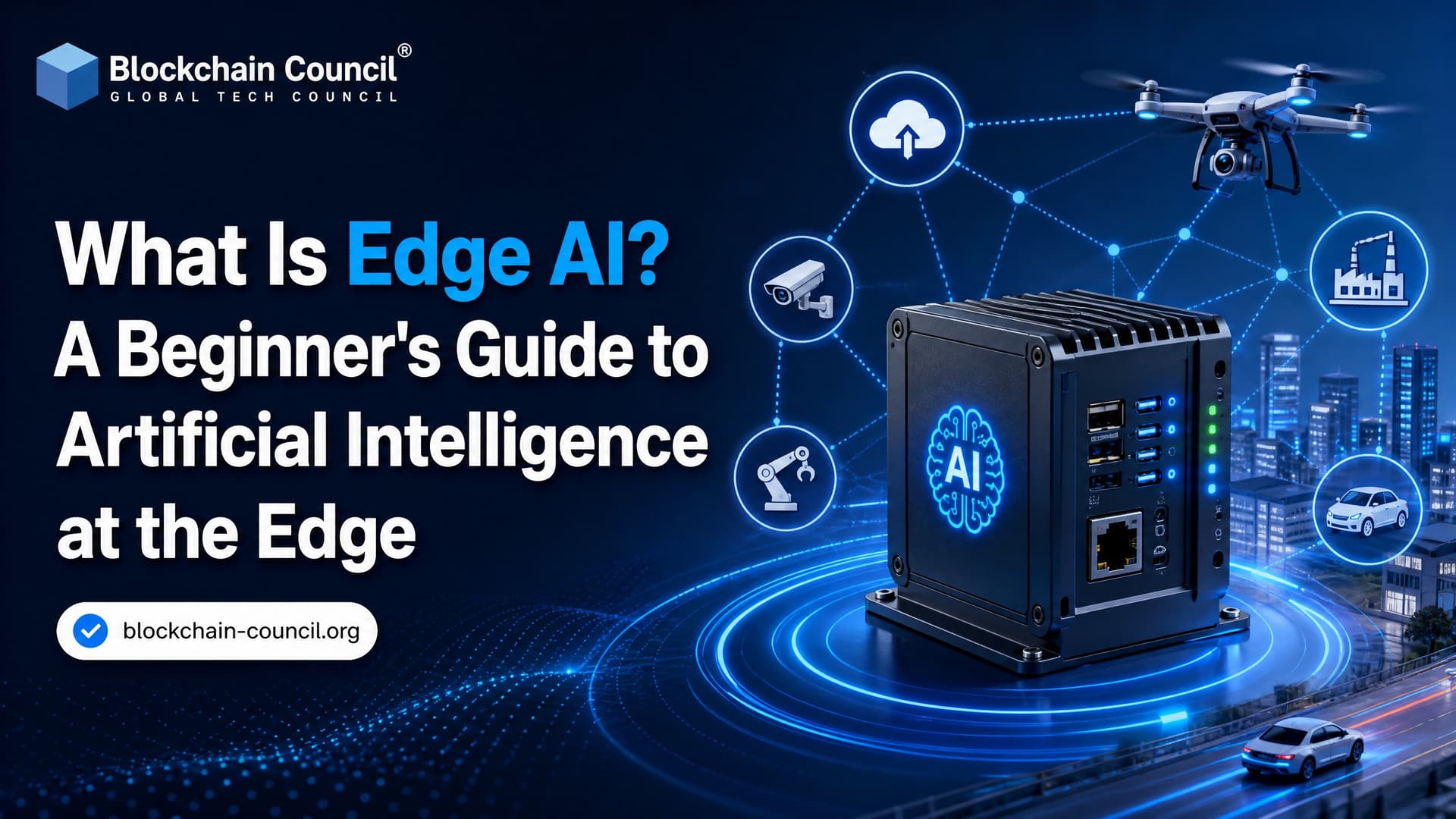
Edge AI means running artificial intelligence models on local devices at the edge of a network: cameras, sensors, phones, factory machines, vehicles, and medical instruments. Instead of sending every image, sound clip, or sensor reading to a distant cloud server, the device processes data near where it is created and acts immediately.
That shift matters. A traffic camera cannot wait for a cloud round trip before detecting a pedestrian. A factory vibration sensor should not stream raw data all day when it only needs to flag a bearing failure. Edge AI gives these systems local intelligence, lower latency, lower bandwidth use, and better privacy when the design is done right.

As organizations increasingly deploy intelligent systems across manufacturing, healthcare, transportation, and smart infrastructure, professionals with a Certified Edge AI Expert credential are helping build real-time AI solutions that balance performance, privacy, and operational efficiency at the edge.
What Is Edge AI?
Edge AI, also called AI at the edge, combines edge computing with machine learning. Edge computing moves computation closer to the data source. AI adds models that can classify, detect, predict, or generate outputs from that local data.
IBM describes edge AI as deploying AI algorithms and models on local edge devices, including sensors and IoT devices, so they can process data in real time with or without constant internet access. Arm frames it in a similar way, focusing on AI inference inside smartphones, embedded systems, IoT sensors, and autonomous vehicles. Red Hat makes a useful distinction: traditional AI often runs in backend systems, while edge AI lets connected devices not only collect data but also act on it.
Put simply: cloud AI thinks from a data center. Edge AI thinks where the action happens.
How Edge AI Works
Model training usually still happens in the cloud or a data center. Training a large vision model, speech model, or anomaly detection model needs data, GPUs, time, and careful evaluation. After training, the model is compressed, optimized, and deployed to edge hardware for inference.
Successfully operating these models beyond the initial deployment also requires disciplined version control, monitoring, automated updates, and performance validation. Professionals responsible for these production AI workflows often strengthen their expertise through a Certified MLOps Expert program to ensure Edge AI systems remain reliable and scalable throughout their lifecycle.
1. Data is captured locally
An edge device gathers raw input. That might be video from a retail camera, vibration readings from an industrial motor, audio from a smart speaker, temperature data from a refrigerated truck, or LiDAR data from a vehicle.
2. The device preprocesses the data
Raw data is rarely fed straight into the model. The device may resize an image, normalize pixel values, remove noise, extract features, or convert audio into a spectrogram. This step is small but easy to get wrong.
Here is a practical example. When deploying a TensorFlow Lite image classifier, a beginner often sees an error like Cannot set tensor: Dimension mismatch. Got 224 but expected 192 for dimension 1 of input 0. The model is not broken. The preprocessing pipeline is feeding the wrong image size. These tiny deployment details are common in edge AI work, especially when you move from a notebook to a real device.
3. The model runs inference on the device
The edge device runs a trained model using local compute. That model might detect a person in a camera frame, classify a machine sound as normal or abnormal, identify a wake word, or predict a battery fault.
Common deployment options include TensorFlow Lite, ONNX Runtime, OpenVINO, NVIDIA Jetson software, and vendor-specific SDKs for microcontrollers or AI accelerators. For small devices, int8 quantization is often used to shrink model size and reduce power draw. The catch: post-training quantization works best when you provide a representative dataset, not random sample images copied at the last minute.
4. The system acts or sends selected data upstream
The device can trigger an alert, stop a machine, open a gate, guide a robot, or answer a voice command. It may still send summaries, exceptions, or aggregated results to the cloud for analytics and model retraining. But it does not need to upload everything.
Edge AI vs Cloud AI
Edge AI is not a replacement for cloud AI. It is a better location for certain decisions. Use the cloud for training, coordination, fleet-wide analytics, long-term storage, and heavy workloads. Use the edge when time, bandwidth, privacy, or offline operation matters.
Processing location: Cloud AI runs in centralized infrastructure. Edge AI runs on devices or nearby edge servers.
Latency: Cloud AI depends on network round trips. Edge AI can respond in milliseconds when hardware is sized correctly.
Bandwidth: Cloud AI often requires streaming data upstream. Edge AI can send only events, summaries, or anomalies.
Connectivity: Cloud AI needs a stable connection. Edge AI can keep working during network outages.
Privacy: Cloud AI may move sensitive video, audio, or health data off-device. Edge AI can keep much of that data local.
Operations: Cloud systems are easier to update centrally. Edge fleets need device management, monitoring, and secure update pipelines.
To be blunt, edge AI is the wrong choice if your model needs large GPU memory, frequent context from many data sources, or constant human review. It is the right choice when the decision has to happen close to the sensor.
Key Benefits of Edge AI
Low latency
Local inference removes the delay of sending data to a cloud service and waiting for a response. That is vital for autonomous vehicles, robotics, surgical video systems, smart traffic infrastructure, and industrial safety systems.
Lower bandwidth costs
Video, audio, and sensor streams get expensive fast. A single 1080p camera streaming continuously can generate large volumes of data every day. With edge AI, the camera can detect events locally and send only relevant clips or metadata.
Better privacy posture
Keeping raw data on-device helps reduce exposure. This is especially useful for smart home cameras, wearables, healthcare devices, and voice interfaces. Privacy is not automatic, though. You still need encryption, access control, secure boot, and a plan for lost or compromised hardware.
Reliability when networks fail
Factories, vehicles, farms, mines, and remote energy sites cannot depend on perfect connectivity. Edge AI systems can keep operating when the network drops, then sync results later.
Lower cloud load
If every sensor sends everything to the cloud, storage and inference costs climb quickly. Filtering at the edge cuts waste. Industry projections point the same direction: the share of data processed at the edge is rising sharply as devices get more capable. Whether any single organization hits a specific number, the trend is clear. More processing is moving closer to devices.
Real-World Edge AI Use Cases
Smart homes and consumer devices
Wake-word detection in smart speakers is a classic example. A small local model listens for a trigger phrase, while heavier processing may happen later. Smart cameras also use edge AI to detect people, pets, packages, or unusual movement without continuously uploading raw video.
Autonomous vehicles and transportation
Self-driving and driver-assistance systems process camera, radar, LiDAR, and sensor data locally. Waiting for a cloud response is not acceptable when a vehicle needs to brake. NVIDIA also highlights edge AI in traffic lights and autonomous machines, where local perception supports faster transport decisions.
Manufacturing and industrial IoT
Factories use edge AI for visual inspection, predictive maintenance, worker safety, and robot control. A vibration model on a motor can spot abnormal patterns before a failure. A camera near a production line can reject defective parts without sending every frame to a cloud endpoint.
Healthcare and medical devices
Edge AI appears in wearables, imaging tools, surgical systems, and patient monitoring devices. Local inference can support low-latency feedback while keeping sensitive health data closer to the patient.
Energy, utilities, and smart infrastructure
Grid operators, renewable energy sites, and utilities can use local AI models to detect faults, forecast demand, monitor equipment health, and respond faster to changing field conditions.
Challenges Beginners Should Understand
Edge AI sounds simple until you ship it. Then the constraints show up.
Limited compute: A model that runs well on a laptop may be too slow on a microcontroller or low-power camera.
Power limits: Battery-powered devices need efficient models and careful scheduling.
Model drift: Real-world data changes. Lighting, sensor wear, seasonal patterns, and user behavior can degrade accuracy.
Security risk: Edge devices may sit in public or uncontrolled locations. Physical access raises the stakes.
Fleet management: Updating ten devices is easy. Updating 50,000 devices safely is an engineering discipline.
Safety: Out-of-distribution inputs can cause confident but wrong predictions. Critical systems need fail-safe behavior, monitoring, and formal testing where appropriate.
Skills You Need to Work With Edge AI
If you want to build edge AI systems, focus on the full pipeline, not only model training. Learn how models are trained, converted, compressed, tested, deployed, monitored, and updated in the field.
Understand machine learning fundamentals, especially inference, classification, object detection, and anomaly detection.
Learn Python, model evaluation, and data preprocessing.
Practice with TensorFlow Lite, ONNX Runtime, or OpenVINO.
Study edge hardware, including microcontrollers, Arm-based boards, Raspberry Pi, NVIDIA Jetson, and AI accelerators.
Learn security basics for connected devices, including authentication, encryption, and secure updates.
Build one real project, such as a local object detector or a vibration anomaly detector, and measure latency, power use, and accuracy.
For structured learning, you can connect this topic with related Blockchain Council pathways such as the Certified Artificial Intelligence (AI) Expert™, the Certified Prompt Engineer™, and cybersecurity-focused certifications if you are responsible for device security and AI governance.
As artificial intelligence becomes part of everyday business operations, employers increasingly need people who can apply AI knowledge responsibly and effectively. Evaluating candidates on relevant skills, reasoning, and practical understanding can support stronger hiring decisions. HireValid can be explored by organisations seeking structured candidate assessments.
The Future of Edge AI
Edge AI will grow because the physical world produces too much data to send everything to the cloud. 5G helps, but it does not remove the need for local decisions. Better AI chips, smaller models, and improved edge platforms will make local inference more practical across retail, healthcare, transport, manufacturing, and smart cities.
The most valuable professionals will be those who understand the trade-off between model quality and deployment reality. Accuracy matters. So do latency, heat, cost, privacy, and failure behavior. Start with a small edge AI project, measure it honestly, then study model optimization and device security before you scale to production.
As Edge AI continues moving from technical innovation into mainstream enterprise adoption, professionals involved in product strategy, technology consulting, or business development can complement their technical expertise with a Marketing Certification to better communicate the business value of Edge AI solutions and support successful adoption across industries.
FAQs
1. What is Edge AI?
Edge AI is the combination of artificial intelligence (AI) and edge computing, where AI models run directly on local devices instead of relying entirely on cloud servers. These devices can include smartphones, IoT sensors, smart cameras, industrial machines, autonomous vehicles, drones, medical devices, and edge servers. By processing data closer to where it is created, Edge AI enables faster and more efficient decision-making.
2. How does Edge AI work?
Edge AI works by collecting data from devices such as cameras or sensors, processing that data locally using a trained AI model, making real-time decisions, and only sending necessary information to the cloud when required. This reduces delays and minimizes the amount of data transmitted over the internet.
3. Why is Edge AI important?
Edge AI is important because it enables low-latency processing, reduces bandwidth usage, improves data privacy, supports offline operation, and allows intelligent systems to respond immediately. These advantages make it ideal for industries that depend on real-time automation and rapid decision-making.
4. What is the difference between Edge AI and traditional AI?
Traditional AI often relies on cloud computing, where data is sent to remote servers for processing. Edge AI performs AI inference directly on local hardware, allowing devices to operate faster and with less dependence on internet connectivity.
5. What are the main components of an Edge AI system?
A typical Edge AI system includes sensors, edge devices, AI models, processors or AI accelerators, edge gateways, communication networks, edge servers, cloud platforms, and management software. Together, these components collect, process, and manage data efficiently.
6. Which devices use Edge AI?
Edge AI is used in smartphones, smart cameras, wearable devices, industrial robots, IoT sensors, drones, autonomous vehicles, medical equipment, smart home devices, retail kiosks, manufacturing machines, and connected agricultural systems.
7. What are the benefits of Edge AI?
Key benefits include faster response times, lower latency, reduced cloud costs, improved privacy, enhanced security, offline functionality, lower bandwidth consumption, greater operational efficiency, and better scalability for distributed AI applications.
8. What industries use Edge AI?
Edge AI is widely adopted in manufacturing, healthcare, retail, logistics, automotive, agriculture, telecommunications, energy, financial services, smart cities, industrial IoT, defense, and consumer electronics.
9. How does Edge AI improve data privacy?
Because data is processed locally, organizations often transmit less sensitive information to remote servers. This helps reduce exposure to cybersecurity threats and supports compliance with privacy regulations while giving businesses more control over sensitive data.
10. Can Edge AI work without internet access?
Yes. One of the biggest advantages of Edge AI is that it can continue processing data and making decisions locally even during internet outages. Devices can synchronize selected information with cloud systems once connectivity returns.
11. What hardware is required for Edge AI?
Common Edge AI hardware includes CPUs, GPUs, Neural Processing Units (NPUs), AI accelerators, NVIDIA Jetson devices, Google Coral Edge TPU, Intel processors, ARM-based chips, Raspberry Pi boards, industrial PCs, and embedded systems.
12. Which AI frameworks support Edge AI?
Developers commonly use TensorFlow Lite, TensorFlow Lite Micro, ONNX Runtime, OpenVINO, NVIDIA TensorRT, PyTorch Mobile, Apache TVM, Edge Impulse, MediaPipe, and TinyML frameworks for deploying optimized AI models.
13. What are some real-world examples of Edge AI?
Examples include facial recognition on smartphones, predictive maintenance in factories, AI-powered security cameras, autonomous vehicles, wearable health monitors, smart traffic systems, retail inventory monitoring, agricultural drones, and industrial robotics.
14. What is the difference between Edge AI and cloud AI?
Edge AI processes data locally for immediate responses, while cloud AI processes information in centralized data centers with greater computing resources. Many organizations combine both technologies using a hybrid architecture that leverages the strengths of each.
15. What are the biggest challenges of Edge AI?
Challenges include limited computing resources, battery life, AI model optimization, cybersecurity, device management, software updates, interoperability, scalability, and integrating edge systems with existing enterprise infrastructure.
16. How does Edge AI support IoT devices?
Edge AI enables IoT devices to analyze sensor data, detect anomalies, automate actions, optimize operations, reduce communication costs, and make intelligent decisions locally without depending on continuous cloud connectivity.
17. What future technologies are connected to Edge AI?
Emerging technologies include TinyML, federated learning, 5G networks, AI-specific processors, digital twins, robotics, autonomous systems, multimodal AI, industrial IoT (IIoT), and generative AI running on edge hardware.
18. What are the best practices for implementing Edge AI?
Organizations should identify clear business objectives, select suitable hardware, optimize AI models for edge deployment, secure devices, encrypt communications, monitor system performance, manage software updates, and plan for long-term scalability.
19. Is Edge AI suitable for small businesses?
Yes. Small businesses can use Edge AI for smart surveillance, inventory management, predictive equipment maintenance, customer analytics, energy monitoring, and automated workflows. Affordable edge hardware and cloud-edge platforms have made adoption more accessible than ever.
20. Why is Edge AI considered the future of artificial intelligence?
As billions of connected devices generate vast amounts of data, processing everything in the cloud becomes increasingly inefficient for many real-time applications. Edge AI brings intelligence directly to where data is created, enabling faster automation, stronger privacy, lower operating costs, and more resilient systems. From smart homes and hospitals to factories, vehicles, and cities, Edge AI is becoming a foundational technology that will power the next generation of intelligent, connected solutions across industries.
Related Articles
View All
Edge Ai
Edge AI Model Deployment Guide: Training to Real-Time Inference
A practical edge AI model deployment guide covering training, ONNX export, optimization, containers, Triton serving, monitoring, and real-time inference.

Edge Ai
Edge AI for Industrial Automation: Real-Time Intelligence on the Factory Floor
Edge AI for industrial automation brings real-time machine learning to factory equipment, improving quality, uptime, safety, and energy performance.

Edge Ai
Top Edge AI Frameworks and Tools for Developers and Enterprises
A practical guide to top edge AI frameworks and tools, including TensorFlow Lite, ONNX Runtime, Apache TVM, Edge Impulse, and enterprise MLOps platforms.
Trending Articles
The Role of Blockchain in Ethical AI Development
How blockchain technology is being used to promote transparency and accountability in artificial intelligence systems.
AWS Career Roadmap
A step-by-step guide to building a successful career in Amazon Web Services cloud computing.
What is AWS? A Beginner's Guide to Cloud Computing
Everything you need to know about Amazon Web Services, cloud computing fundamentals, and career opportunities.