

Edge AI for IoT Devices: How Intelligent Sensors Enable Smarter Automation
 Suyash Raizada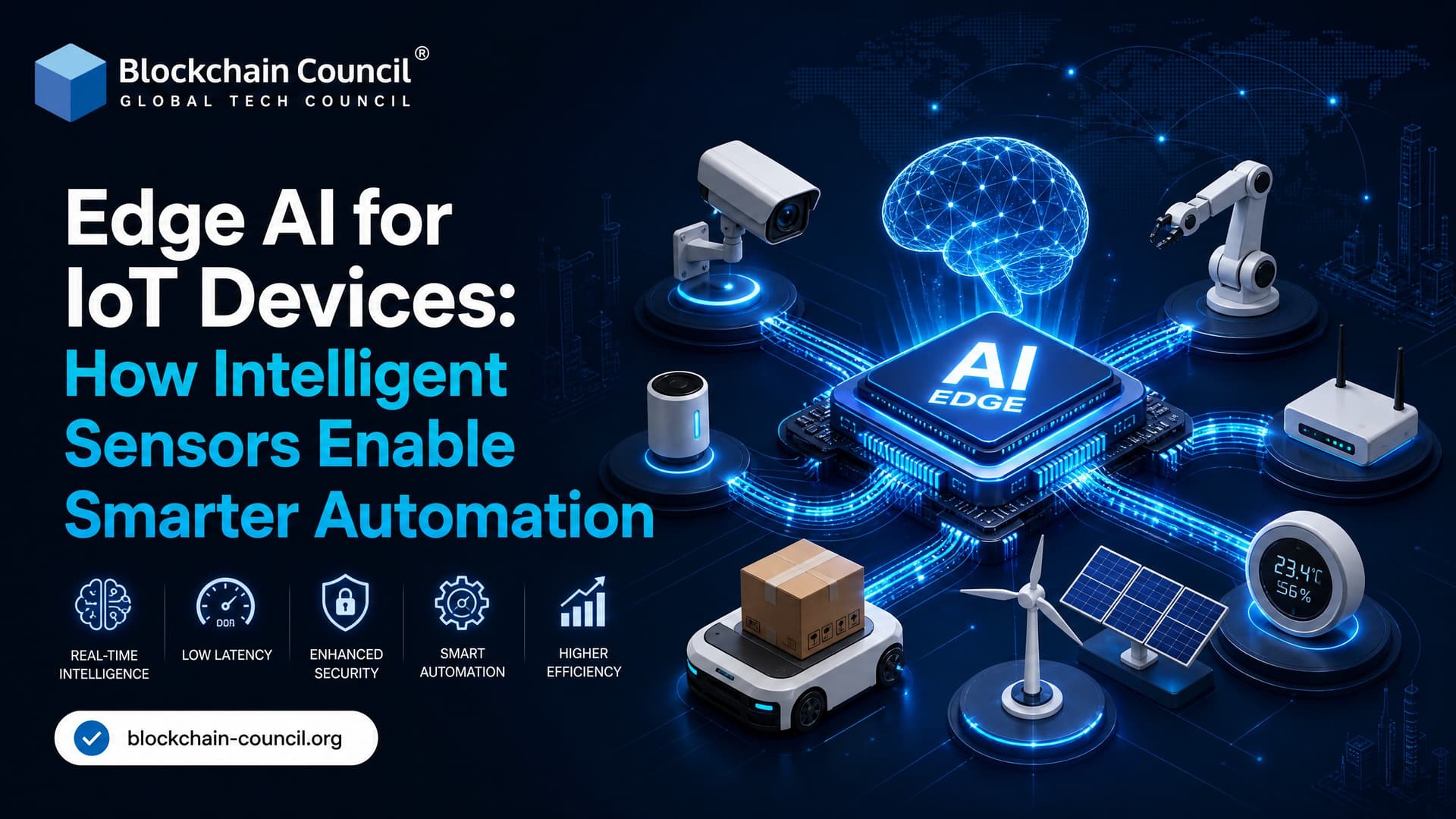
Edge AI for IoT devices turns sensors into local decision-makers. Instead of streaming every vibration reading, video frame, or temperature change to the cloud, intelligent sensors process data close to where it is created and trigger action in real time. That shift matters in factories, buildings, vehicles, healthcare devices, and smart homes where a 500 ms delay can be too slow.
The idea is simple. Put a trained machine learning model on a sensor, gateway, camera, or controller, then let it classify events locally. Send only alerts, summaries, or exceptions upstream. Less traffic. Faster response. Better privacy.

As intelligent edge computing becomes a cornerstone of connected devices, professionals with a Certified Edge AI Expert credential are increasingly helping organizations design low-latency AI solutions that deliver faster decision-making, improved privacy, and more reliable IoT operations.
What Edge AI Means for Intelligent IoT Sensors
Edge AI is the practice of running AI inference on edge hardware such as microcontrollers, embedded Linux devices, cameras, gateways, and industrial controllers. For IoT systems, this changes the role of the sensor.
A traditional sensor measures and forwards. An intelligent sensor measures, analyzes, decides, and often acts. A vibration sensor on a motor can detect an abnormal bearing signature and notify a programmable logic controller before the machine fails. A camera can reject a defective part without sending raw video to a central server.
This is not just a cloud cost story. It is an automation story. When inference runs locally, the loop between sensing, decision-making, and actuation can close within milliseconds.
Why Edge AI for IoT Devices Is Gaining Momentum
Several forces are pushing edge AI from pilots into production systems.
Latency pressure: Industrial control, autonomous vehicles, safety alerts, and quality inspection cannot always wait for a cloud round trip.
Bandwidth limits: High-resolution cameras, audio streams, and dense sensor networks create too much raw data to transmit continuously.
Privacy requirements: Audio, video, health, and workplace data often should stay local unless an event needs escalation.
Offline operation: A factory line, medical wearable, or drone still needs to function when connectivity drops.
Better chips: NPUs, AI accelerators, low-power microcontrollers, and GPU-based edge systems now make local inference realistic.
NVIDIA has highlighted edge AI as a foundation for real-time autonomous operations, especially where IoT sensors produce time-sensitive streams. Arm and Ambiq focus heavily on power-efficient on-device AI for wearables, smart home devices, and industrial endpoints. Chipmakers are also announcing AI-native IoT system-on-chip designs aimed at low-power inference, which signals where the hardware roadmap is heading.
Connectivity is shifting too. Industry forecasts point to Wi-Fi 7 and newer standards becoming the default across consumer and enterprise access points before the end of the decade. That matters because edge systems still need coordination, updates, and fleet management, even when inference happens locally.
As connected ecosystems expand across manufacturing, healthcare, smart buildings, and transportation, understanding both device architecture and communication infrastructure becomes increasingly important. Many professionals strengthen these capabilities through a Certified Internet-of-Things (IoT) Expert program to better manage large-scale IoT deployments that integrate seamlessly with Edge AI technologies.
How Intelligent Sensors Enable Smarter Automation
Predictive maintenance before failure
Vibration and accelerometer sensors are a strong fit for edge AI. A small model can learn normal motor behavior, then flag frequency changes that indicate imbalance, bearing wear, looseness, or misalignment.
The annoying part is not training the first model. It is collecting clean baseline data. Mount an accelerometer slightly loose and your model may learn the mounting noise instead of the asset signature. I have seen teams blame TensorFlow Lite when the real issue was a bad adhesive pad on the sensor housing. Boring detail. Big consequence.
When deployed well, the sensor does not just push a dashboard metric. It can trigger a maintenance ticket, reduce motor load, or shut down equipment under defined safety rules.
Real-time visual inspection
Computer vision sensors are changing quality control. Instead of sending every frame to a cloud model, an edge camera can run object detection or defect classification beside the production line.
Common tasks include:
Detecting missing screws, scratches, dents, and label errors
Rejecting faulty items immediately
Adjusting machine settings when defect rates rise
Keeping raw production imagery inside the facility
Do not push every vision workload onto a tiny sensor. Full multi-camera analytics may belong on an edge gateway with a GPU or NPU. A low-power camera module is better for narrow tasks such as presence detection, barcode checks, or simple defect classes.
Acoustic anomaly detection
Microphones can catch events that cameras miss. Glass breaking, pump cavitation, abnormal compressor noise, and distress sounds are all useful signals.
Audio models are often smaller than vision models, which makes them suitable for microcontroller-class devices. Keyword spotting is a classic example. Acoustic maintenance is another. The model listens for a pattern, not a full recording, so privacy risk drops when raw audio never leaves the device.
Smart building automation
Temperature, humidity, occupancy, air quality, and motion sensors become more useful when they understand context. Edge AI can help decide whether a room is occupied, whether HVAC should ramp up, or whether a pump sounds unhealthy.
The result is more adaptive control. Lighting, ventilation, access control, and energy management can respond to local conditions without waiting on a cloud service. This helps most in large campuses where network quality varies by floor, basement, or equipment room.
Healthcare and wearables
Wearables and medical IoT devices can process vital signs locally to detect abnormal patterns faster. An edge model can flag irregular heart-rate behavior, a fall, or a sudden oxygen saturation drop, then alert a caregiver.
Local inference also limits exposure of sensitive data. The device can transmit an event and a small summary instead of continuous raw signals.
Core Architectures for Edge AI IoT Systems
Three patterns show up again and again in real deployments. Pick based on where latency, power, and management pressure sit.
On-device inference
The model runs directly on the sensor or endpoint. This is the right choice when latency, privacy, power, or offline operation is critical. Typical hardware includes microcontrollers, embedded NPUs, smart cameras, and wearable processors.
Edge gateway inference
Sensors send data to a nearby gateway or industrial PC. The gateway has more compute and can run larger models, fuse multiple sensor streams, and handle local orchestration. This works well for factories, warehouses, smart buildings, and retail sites.
Hybrid edge-cloud systems
The cloud handles training, fleet analytics, historical reporting, and model management. The edge handles inference and immediate action. This is usually the best production pattern. Pure cloud AI is too slow for many automation loops, while pure edge AI can be hard to manage at scale.
Models, Chips, and Tools Behind Intelligent Sensors
Edge AI uses both classical machine learning and deep learning. Support vector machines can still be a good fit for structured sensor data. Neural networks are common for audio, video, and complex multi-sensor inputs.
The real work is optimization. Models need to fit memory, power, and thermal limits. Common techniques include:
Quantization: Converting model weights from 32-bit floating point to 8-bit integers to reduce size and speed up inference.
Pruning: Removing model parameters that contribute little to accuracy.
Knowledge distillation: Training a smaller model to mimic a larger one.
Hardware acceleration: Running inference on an NPU, DSP, GPU, or dedicated AI accelerator.
A common beginner mistake is exporting a model that runs fine on a laptop but blows past the RAM budget of the device. With TensorFlow Lite for Microcontrollers, the tensor arena size is often the silent failure point. If you see memory allocation failures during inference, the model may not be too inaccurate. It may simply be too large for the target board.
Security and Lifecycle Management Cannot Be Optional
Edge AI sensors are not just sensors anymore. They are small computers making decisions. That raises the security bar.
You need secure boot, signed firmware, encrypted communication, device identity, update rollback protection, and monitoring for model drift. If an attacker modifies a model or intercepts actuator commands, the risk moves from data loss to physical impact.
This is where AI, IoT, and cybersecurity skills overlap. If you build these systems professionally, Blockchain Council's Certified Artificial Intelligence (AI) Expert and Certified Cybersecurity Expert programs help connect model design with secure deployment practices.
Key Challenges You Should Plan For
Power budget: Battery sensors cannot run large models continuously. Duty cycling and event-triggered inference help.
Thermal limits: Small enclosures heat quickly, especially with vision workloads.
Connectivity planning: Edge AI reduces cloud dependency, but fleets still need updates, logs, and remote diagnostics.
Model drift: Machines wear, buildings change, and user behavior shifts. Models need retraining or recalibration.
False positives: In automation, a wrong shutdown can be expensive. Tune thresholds with operations teams, not only data scientists.
The Future of Edge AI for IoT Devices
Industry analysts value the edge AI market in the tens of billions of dollars and project strong double-digit annual growth through the next decade. That trajectory is believable, not because every sensor needs a neural network, but because many automation systems now need local intelligence.
The next wave will include more sensors that self-calibrate, learn from local conditions, and cooperate with nearby devices. Some researchers describe this direction as an Internet of Conscious Things, where IoT endpoints have enough local awareness to respond intelligently rather than only report data.
To be blunt, edge AI is the wrong choice if a simple threshold rule solves the problem. Do not add a neural network to detect a temperature crossing 80 degrees. But when signals are noisy, multi-modal, time-sensitive, or privacy-sensitive, edge AI for IoT devices is often the better architecture.
Your next step: pick one sensor modality, such as vibration, audio, or vision, and build a small local inference prototype. Measure latency, memory use, power draw, false positives, and update flow. Then strengthen the AI and security foundations through structured learning, including Blockchain Council certification paths in artificial intelligence and cybersecurity.
As Edge AI and intelligent IoT solutions continue to reshape industries, professionals involved in product strategy, technology consulting, or business development can complement their technical expertise with a Marketing Certification to better communicate the value of AI-powered IoT innovations and support successful market adoption across enterprise environments.
FAQs
1. What is Edge AI for IoT devices?
Edge AI for IoT devices refers to running artificial intelligence models directly on connected devices such as sensors, cameras, gateways, microcontrollers, and embedded systems. Instead of sending all data to the cloud, IoT devices analyze information locally, enabling faster decision-making, lower latency, and improved automation.
2. Why is Edge AI important for IoT?
IoT devices generate massive amounts of data every second. Edge AI processes this data at the source, reducing network traffic, minimizing latency, lowering cloud costs, and enabling real-time responses for time-sensitive applications.
3. What are intelligent sensors in Edge AI?
Intelligent sensors combine traditional sensing capabilities with embedded AI algorithms. They can analyze environmental data, detect patterns, recognize anomalies, and trigger automated actions without requiring continuous communication with cloud servers.
4. How does Edge AI improve IoT automation?
Edge AI enables IoT devices to make autonomous decisions based on real-time data. Devices can automatically detect equipment failures, adjust system settings, optimize energy usage, recognize objects, monitor environments, and respond instantly to changing conditions.
5. What are the main use cases of Edge AI in IoT?
Popular applications include smart homes, industrial automation, predictive maintenance, healthcare monitoring, autonomous vehicles, agriculture, smart cities, retail analytics, environmental monitoring, energy management, and connected manufacturing.
6. How does Edge AI reduce latency in IoT devices?
Since AI processing occurs directly on the device or nearby edge hardware, there is no need to send every data point to a remote cloud server. This significantly reduces response times, making Edge AI ideal for applications requiring immediate action.
7. Can Edge AI devices work without internet connectivity?
Yes. One of the biggest advantages of Edge AI is offline operation. IoT devices can continue analyzing data, making decisions, and controlling equipment even when internet connectivity is unavailable. Data can be synchronized with cloud platforms once the connection is restored.
8. What hardware is commonly used for Edge AI IoT devices?
Common hardware includes AI-enabled microcontrollers, ARM processors, NVIDIA Jetson platforms, Google Coral Edge TPU, Intel AI accelerators, Raspberry Pi, industrial IoT gateways, embedded systems, smart sensors, and low-power AI chips.
9. Which AI frameworks support Edge AI for IoT?
Developers commonly use TensorFlow Lite, TensorFlow Lite Micro, ONNX Runtime, OpenVINO, PyTorch Mobile, Apache TVM, Edge Impulse, TinyML frameworks, and NVIDIA TensorRT to deploy optimized AI models on IoT hardware.
10. How does Edge AI improve data privacy?
Edge AI processes sensitive information locally instead of transmitting all data to cloud services. This reduces data exposure, lowers cybersecurity risks, and helps organizations comply with privacy and data protection requirements.
11. How does Edge AI improve energy efficiency?
By processing only essential data locally and transmitting fewer records to cloud servers, Edge AI reduces communication overhead and conserves power. Many AI chips are also optimized for low-energy operation, making them suitable for battery-powered IoT devices.
12. What are the biggest challenges of Edge AI for IoT?
Challenges include limited processing power, constrained memory, battery life, AI model optimization, hardware compatibility, device security, software updates, scalability, and managing large numbers of distributed IoT devices.
13. How does TinyML relate to Edge AI?
TinyML is a specialized branch of Edge AI that enables machine learning models to run on extremely resource-constrained microcontrollers and low-power embedded devices. It is ideal for battery-powered sensors, wearable devices, and compact IoT applications.
14. How does Edge AI support predictive maintenance?
Edge AI continuously analyzes sensor data such as vibration, temperature, pressure, and power consumption to detect abnormal equipment behavior. This enables organizations to perform maintenance before failures occur, reducing downtime and repair costs.
15. Which industries benefit from Edge AI-enabled IoT devices?
Manufacturing, healthcare, agriculture, retail, transportation, automotive, logistics, energy, utilities, telecommunications, construction, and smart city initiatives all benefit from intelligent IoT devices powered by Edge AI.
16. What are the best practices for deploying Edge AI in IoT?
Organizations should define clear business objectives, choose suitable hardware, optimize AI models for edge deployment, secure devices, encrypt communications, monitor performance continuously, manage updates efficiently, and plan for large-scale device management.
17. What future trends are shaping Edge AI for IoT?
Emerging trends include TinyML, federated learning, AI-powered digital twins, 5G-enabled edge computing, low-power AI chips, autonomous IoT systems, Edge AI security enhancements, multimodal AI, and greater integration with industrial IoT (IIoT) platforms.
18. How does Edge AI work alongside cloud computing?
Edge AI handles real-time processing and local decision-making, while cloud platforms are typically used for AI model training, long-term data storage, fleet management, analytics, and software updates. Many organizations adopt a hybrid edge-cloud architecture to balance performance and scalability.
19. How does Edge AI enable smarter automation?
Edge AI allows connected devices to analyze data, identify patterns, detect anomalies, and take immediate actions without human intervention. This supports faster decision-making, reduces manual processes, improves operational efficiency, and enables autonomous systems across industries.
20. Why is Edge AI considered the future of IoT?
As billions of connected devices continue to generate increasing amounts of data, relying solely on cloud computing becomes less practical for many real-time applications. Edge AI brings intelligence directly to IoT devices, enabling faster automation, stronger privacy, lower bandwidth usage, improved reliability, and greater scalability. By combining intelligent sensors, embedded AI, and real-time analytics, Edge AI is expected to play a central role in the next generation of smart homes, industrial automation, healthcare, transportation, and connected infrastructure.
Related Articles
View All
Edge Ai
Edge AI Hardware Explained: Chips, Sensors, GPUs, NPUs, and Edge Devices
A practical guide to edge AI hardware, covering sensors, CPUs, GPUs, NPUs, FPGAs, ASICs, edge devices, benchmarks, and selection trade-offs.

Edge Ai
Edge AI Security Best Practices for Devices, Data, Models, and Networks
Learn Edge AI security best practices for protecting devices, data, models, and networks with zero trust, encryption, attestation, and monitoring.

Edge Ai
Edge AI for Industrial Automation: Real-Time Intelligence on the Factory Floor
Edge AI for industrial automation brings real-time machine learning to factory equipment, improving quality, uptime, safety, and energy performance.
Trending Articles
AWS Career Roadmap
A step-by-step guide to building a successful career in Amazon Web Services cloud computing.
How Blockchain Secures AI Data
Understand how blockchain technology is being applied to protect the integrity and security of AI training data.

Can DeFi 2.0 Bridge the Gap Between Traditional and Decentralized Finance?
The next generation of DeFi protocols aims to connect traditional banking with decentralized finance ecosystems.