

Edge AI Architecture Explained: Devices, Gateways, Models, and Edge Servers
 Suyash Raizada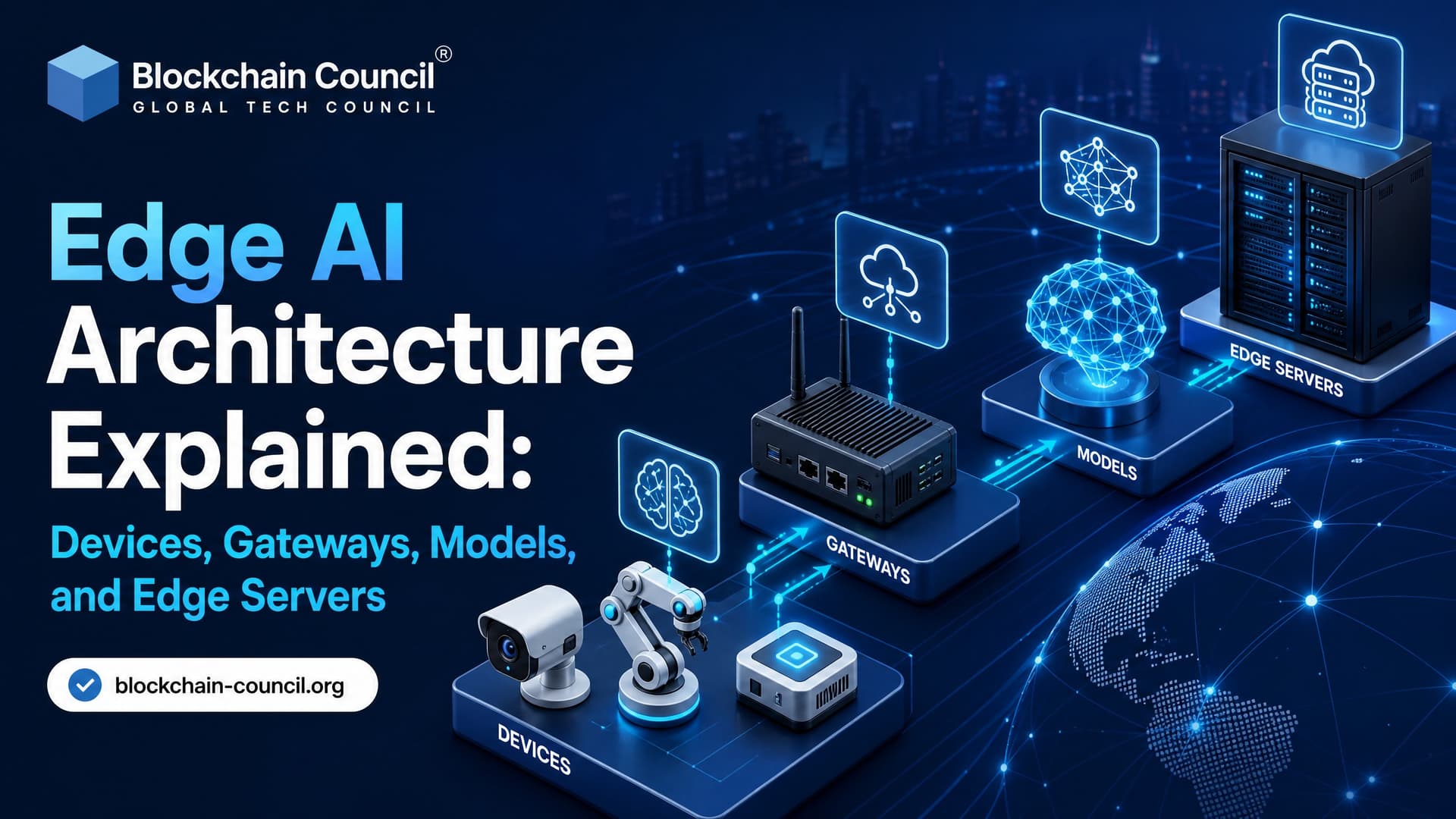
Edge AI architecture is the design pattern that decides where AI inference runs: on a sensor, inside a gateway, on an edge server, or back in the cloud. Get that placement wrong and you either flood the network with raw data, miss real-time decisions, or ship a model that works in a lab but falls apart on a factory floor.
The core idea is simple. Train models centrally when you need large datasets and heavy compute. Run inference close to the data when latency, privacy, cost, or offline operation matters. IBM describes edge AI as AI models deployed directly on local edge devices so applications can respond without constant cloud dependency. NIST makes a related point: edge nodes often consume AI and ML artifacts created elsewhere, which is exactly how most production systems work.

As organizations increasingly deploy intelligent systems closer to where data is generated, professionals with a Certified Edge AI Expert credential are helping design scalable architectures that balance latency, security, and operational efficiency across edge environments.
What Edge AI Architecture Includes
A practical Edge AI architecture usually has four layers:
Devices: sensors, cameras, controllers, phones, wearables, medical devices, kiosks, and other smart endpoints.
Gateways: local nodes that connect devices, translate protocols, filter data, and increasingly run AI inference.
Edge servers: compact compute systems near the operation site, often with GPUs, NPUs, local storage, and container orchestration.
Cloud or data center: central training, long-term storage, fleet analytics, model governance, and deployment management.
This is not a fixed ladder. A smart camera may run object detection on its own. A gateway may handle predictive maintenance for twenty machines. A hospital may keep imaging inference on an on-premises edge server because patient data cannot leave the site. The architecture follows the constraint.
Device Layer: Where Data Starts
The device layer is where raw signals are created. Think vibration sensors on a motor, a camera over a checkout lane, a wearable tracking heart rhythm, or a programmable logic controller in a plant.
Edge hardware spans a huge range, from coin-cell sensors to rack-mounted edge servers, across a dozen or more form factors. That variety is why Edge AI architecture cannot be copied blindly from one project to the next. A battery-powered sensor and a smart camera with an NPU have completely different limits.
What Devices Usually Do
Capture images, audio, temperature, vibration, location, or machine telemetry.
Apply lightweight filtering, threshold checks, or signal cleanup.
Run small AI models for keyword spotting, anomaly detection, simple classification, or object detection.
Send events, summaries, or selected data to a gateway or edge server.
Here is a detail that bites beginners: an 80 MB PyTorch model is not an edge model just because it runs on your laptop. Once you convert it to TensorFlow Lite or ONNX Runtime for a small device, memory layout, supported operators, and quantization become real constraints. A common TensorFlow Lite deployment failure looks like this: Cannot set tensor: Got value of type FLOAT32 but expected type UINT8 for input 0. That usually means the app is feeding float images into a quantized uint8 model. The architecture was not the problem. The packaging was.
Deploying AI models across devices, gateways, and edge servers also requires disciplined model lifecycle management. From version control and automated deployments to monitoring and rollback strategies, these production practices are becoming essential, which is why many professionals strengthen their expertise through a Certified MLOps Expert program before managing large-scale edge AI environments.
Edge Gateways: The Middle Layer That Now Runs AI
An edge gateway sits between local devices and the wider network. In older IoT systems, it mainly collected data and forwarded it to the cloud. That role has changed. Modern industrial gateways are moving from pure data collection to AI inference, especially for computer vision and anomaly detection.
Gateways matter because industrial and field environments are messy. Devices may speak Modbus, CAN bus, OPC UA, Bluetooth Low Energy, Zigbee, or proprietary protocols. The gateway normalizes all of that into a form applications and models can actually use.
Gateway Responsibilities
Protocol translation: connect field devices to IP-based systems.
Data aggregation: combine readings from many sensors before analysis.
Preprocessing: clean, buffer, compress, or format data.
Security segmentation: isolate operational technology networks from enterprise IT.
Local inference: run mid-sized models close to the data source.
Offline operation: store results locally and sync later when connectivity returns.
Use a gateway when you need local decisions but do not want a full edge server at every site. A cold-chain logistics gateway, for example, can process temperature anomalies locally and trigger an alert even when the truck has poor cellular coverage.
Edge Servers: Local Compute for Heavier Workloads
Edge servers are specialized computers placed near the operational environment: a factory, store, hospital, warehouse, cell tower, or transport hub. They provide far more compute than a gateway and can host several models at once.
Spending on edge servers is climbing fast, with industry forecasts putting it in the tens of billions of dollars within a few years and a large share going to on-premises deployments. The pattern behind that is clear: enterprises want cloud-like compute closer to operations.
What Edge Servers Run
Multi-camera video analytics for retail, cities, and security.
Industrial quality inspection using computer vision.
Predictive maintenance models across many machines.
Local databases for recent sensor history and inference context.
Containerized services using Kubernetes, K3s, MicroK8s, Docker, or similar tooling.
GPU, NPU, or ASIC-accelerated inference for high-throughput workloads.
Edge servers are the right choice when one model is not enough. If you need object detection, tracking, OCR, and event classification across 40 video streams, do not force that onto a small gateway. Put it on an edge server with proper acceleration and monitoring.
Cloud Tier: Still Essential, Just Not for Every Decision
Edge AI does not remove the cloud. It changes the cloud's role.
The cloud is still the best place for model training, retraining, large-scale analytics, long-term storage, and fleet-wide orchestration. A manufacturer may train a defect detection model on millions of labeled images in the cloud, then deploy an optimized version to 80 plants. Field results come back as metadata, error cases, and selected samples for retraining.
This feedback loop is where mature Edge AI architecture starts to look like MLOps plus distributed systems. You need version control for models, rollout policies, rollback paths, device identity, logs, metrics, and security updates. Without that, you are just copying model files to machines and hoping nothing breaks.
How Models Move Through Edge AI Architecture
The model lifecycle usually runs through five steps:
Train centrally using large datasets and high-performance compute.
Optimize with pruning, quantization, distillation, or hardware-specific compilation.
Package for the target runtime, such as TensorFlow Lite, ONNX Runtime, TensorRT, OpenVINO, Core ML, or a vendor NPU SDK.
Deploy to devices, gateways, or edge servers based on latency, power, memory, and privacy needs.
Monitor and update models using edge-aware MLOps pipelines.
Quantization deserves special attention. INT8 quantization can cut model size and speed up inference, but it can also drop accuracy if the calibration data does not match real inputs. I have seen a clean lab model miss reflective defects on a production line because the calibration set had no glare, oil marks, or motion blur. Always test on ugly data. That is where edge systems actually live.
Common Edge AI Architecture Patterns
1. Tiny Model on Device
Use this for wake-word detection, basic anomaly detection, simple health metrics, or local alerts. It is cheap and private, but limited by power and memory.
2. Gateway Inference
Use this when several devices feed one local decision point. It fits factories, retail stores, remote utility sites, and vehicle fleets.
3. Edge Server Cluster
Use this for multi-stream video, model ensembles, local dashboards, and applications that need low latency plus serious compute.
4. Disconnected Edge
Use this when connectivity is intermittent. Common designs here include drone, factory, store-and-forward, federated learning, and mesh network patterns built for offline environments. These systems keep local databases, run inference on site, and sync only when a network is available.
5. Federated Learning Edge
Use this when local data should not move. Edge nodes train or update locally, then share model updates rather than raw data. This helps in healthcare, finance, and regulated industrial settings, though it adds real complexity in coordination and security.
Real-World Use Cases
Smart cities: traffic cameras and sensors feed gateways, while edge servers run vision models for congestion, signal timing, and public safety alerts.
Manufacturing: vibration and temperature models predict equipment failure before downtime hits. Vision systems catch defects on production lines.
Healthcare: wearables and bedside devices detect abnormal patient signals locally, cutting the need to stream sensitive raw data.
Transportation: autonomous systems fuse camera, radar, lidar, and sensor data locally because waiting for a cloud response is unsafe.
Retail and QSR: local computer vision supports shelf monitoring, queue analysis, loss prevention, and drive-through operations.
Security: smart cameras send alerts and short clips instead of continuous video streams.
The trade-off is cost and operations. Edge AI can cut bandwidth and latency, but it adds fleet management work. You now maintain many distributed compute nodes, not just one cloud service.
Security, Safety, and Governance
Edge AI architecture has to account for physical access, model theft, poisoned updates, insecure protocols, and drift. A camera above a warehouse door is far easier to tamper with than a locked cloud server.
Build these controls in early:
Device identity and certificate-based authentication.
Encrypted data at rest and in transit.
Signed model artifacts and secure boot where available.
Network segmentation between operational technology and IT systems.
Drift monitoring, out-of-distribution detection, and rollback plans.
Clear data retention rules for privacy-sensitive environments.
For safety-critical systems, test the failure modes. What happens if model confidence drops? What if the camera is blocked? What if a gateway loses power? A safe fallback is part of the architecture, not an optional add-on.
Skills You Need to Build Edge AI Systems
If you are building toward this career path, focus on practical AI engineering, networking basics, security, and deployment operations. At Blockchain Council, relevant learning paths include the Certified Artificial Intelligence (AI) Expert™ for AI foundations, the Certified Generative AI Expert™ if you are working with modern AI systems, and the Certified Cybersecurity Expert™ for securing distributed infrastructure.
Developers should also get hands-on with at least one edge runtime and one deployment stack. A good starter project is simple: train a small image classifier, convert it to TensorFlow Lite or ONNX, run it on a Raspberry Pi or similar edge device, then send only the inference results to a local gateway service.
Where Edge AI Architecture Is Heading
Edge AI architecture is trending toward more capable endpoints, smarter gateways, and stronger local servers. NPUs are showing up in more devices. Gateways are turning into orchestration hubs. Edge servers are absorbing workloads that used to belong in small data centers.
But the winning architecture is still the boring one that meets the requirement. Put tiny models on devices when power and privacy dominate. Use gateways when you need coordination. Use edge servers for heavy local inference. Keep the cloud for training, governance, and fleet intelligence.
Your next step: map one use case you care about across the four tiers. Write down the latency target, data sensitivity, connectivity profile, model size, and update frequency. That one-page architecture will tell you where the model should run.
As Edge AI architecture continues to power intelligent manufacturing, healthcare, retail, and smart infrastructure, professionals involved in product strategy, technology consulting, or business growth can complement their technical expertise with a Marketing Certification to better communicate the value of edge AI solutions and accelerate enterprise adoption.
FAQs
1. What is Edge AI architecture?
Edge AI architecture is the framework that enables artificial intelligence models to run close to where data is generated instead of relying entirely on cloud computing. It consists of edge devices, intelligent sensors, gateways, AI models, edge servers, networking components, and cloud services that work together to process data in real time.
2. Why is Edge AI architecture important?
Edge AI architecture reduces latency, improves data privacy, minimizes bandwidth usage, supports offline operation, and enables faster decision-making. It is essential for applications that require real-time intelligence, such as autonomous vehicles, industrial automation, healthcare, and smart cities.
3. What are the main components of Edge AI architecture?
The primary components include edge devices, IoT sensors, data acquisition systems, AI models, edge gateways, edge servers, networking infrastructure, cloud platforms, storage systems, security controls, and monitoring tools that collectively support AI deployment and management.
4. What are edge devices in an Edge AI architecture?
Edge devices are the endpoints where data is generated and AI inference occurs. Examples include smart cameras, industrial robots, medical devices, smartphones, drones, autonomous vehicles, wearable devices, IoT sensors, and embedded systems.
5. What is the role of IoT sensors in Edge AI?
IoT sensors collect real-time information such as temperature, pressure, vibration, motion, location, images, sound, humidity, and environmental conditions. This data serves as the input for AI models that analyze conditions and trigger automated responses.
6. What is an edge gateway?
An edge gateway acts as an intermediary between edge devices and cloud platforms. It aggregates data from multiple devices, performs local preprocessing, manages communications, filters unnecessary data, and securely transmits relevant information to edge servers or cloud services when needed.
7. What is an edge server?
An edge server is a powerful local computing system that provides additional processing capacity for AI workloads that exceed the capabilities of individual edge devices. Edge servers can run larger AI models, manage multiple connected devices, and support local analytics within factories, hospitals, retail stores, or smart cities.
8. How do AI models work in Edge AI architecture?
AI models are trained using large datasets, typically in cloud or data center environments. Once optimized, the models are deployed to edge devices or edge servers where they perform real-time inference using locally generated data.
9. What is AI inference at the edge?
AI inference is the process of using a trained AI model to make predictions or decisions based on new input data. In Edge AI, inference occurs locally on devices or edge servers, allowing immediate responses without waiting for cloud processing.
10. What hardware is commonly used in Edge AI architecture?
Typical hardware includes CPUs, GPUs, Neural Processing Units (NPUs), AI accelerators, industrial PCs, NVIDIA Jetson platforms, Google Coral Edge TPU, Intel processors, ARM-based systems, Raspberry Pi, embedded controllers, and industrial IoT gateways.
11. How does cloud computing fit into Edge AI architecture?
Cloud platforms are primarily used for AI model training, centralized device management, software updates, long-term storage, historical analytics, and fleet monitoring. Edge devices handle real-time inference, while the cloud provides centralized intelligence and orchestration.
12. How does Edge AI architecture improve data privacy?
By processing sensitive information locally, Edge AI reduces the need to transmit raw data to remote servers. This minimizes exposure to cyber threats and helps organizations meet data privacy and regulatory compliance requirements.
13. What are the biggest challenges of designing Edge AI architecture?
Challenges include hardware limitations, AI model optimization, device management, software updates, cybersecurity, interoperability, power consumption, scalability, network reliability, and integrating with legacy systems.
14. Which software frameworks support Edge AI architecture?
Popular frameworks include TensorFlow Lite, TensorFlow Lite Micro, ONNX Runtime, NVIDIA TensorRT, OpenVINO, PyTorch Mobile, Apache TVM, Edge Impulse, and TinyML frameworks for resource-constrained devices.
15. How does Edge AI architecture support scalability?
Organizations can scale Edge AI by deploying additional edge devices, edge gateways, and edge servers while using centralized cloud platforms for device provisioning, model distribution, software updates, monitoring, and lifecycle management.
16. What industries use Edge AI architecture?
Industries including manufacturing, healthcare, retail, automotive, logistics, agriculture, telecommunications, energy, defense, smart cities, financial services, and industrial IoT rely on Edge AI architecture for real-time intelligent applications.
17. What are the best practices for designing Edge AI architecture?
Best practices include selecting appropriate hardware, optimizing AI models for edge deployment, securing devices and networks, implementing encrypted communications, designing scalable architectures, monitoring device health, maintaining regular software updates, and planning for future expansion.
18. How does Edge AI architecture differ from cloud AI architecture?
Edge AI architecture performs AI inference near the data source for immediate responses, while cloud AI architecture centralizes computing resources for large-scale model training, analytics, and storage. Many organizations combine both approaches in a hybrid edge-cloud architecture.
19. What future trends are shaping Edge AI architecture?
Future trends include AI-specific hardware, TinyML, federated learning, 5G-enabled edge computing, autonomous edge systems, digital twins, multimodal AI, energy-efficient AI chips, distributed intelligence, and stronger edge cybersecurity capabilities.
20. Why is Edge AI architecture the foundation of modern intelligent systems?
Edge AI architecture enables intelligent devices, gateways, and edge servers to process data where it is generated, delivering faster responses, stronger privacy, lower bandwidth consumption, and greater operational resilience. As industries adopt autonomous systems, smart factories, connected healthcare, intelligent transportation, and billions of IoT devices, a well-designed Edge AI architecture will remain the backbone of scalable, secure, and real-time AI applications across the digital economy.
Related Articles
View All
Edge Ai
Edge AI Security Best Practices for Devices, Data, Models, and Networks
Learn Edge AI security best practices for protecting devices, data, models, and networks with zero trust, encryption, attestation, and monitoring.

Edge Ai
Edge AI Hardware Explained: Chips, Sensors, GPUs, NPUs, and Edge Devices
A practical guide to edge AI hardware, covering sensors, CPUs, GPUs, NPUs, FPGAs, ASICs, edge devices, benchmarks, and selection trade-offs.

Edge Ai
How Does Edge AI Work? Architecture, Components, and Data Flow Explained
Learn how Edge AI works, including architecture layers, hardware components, model optimization, and the full data flow from sensors to action.
Trending Articles

Top 5 DeFi Platforms
Explore the leading decentralized finance platforms and what makes each one unique in the evolving DeFi landscape.

Can DeFi 2.0 Bridge the Gap Between Traditional and Decentralized Finance?
The next generation of DeFi protocols aims to connect traditional banking with decentralized finance ecosystems.
How to Install Claude Code
Learn how to install Claude Code on macOS, Linux, and Windows using the native installer, plus verification, authentication, and troubleshooting tips.