

Token Standards for RWA Tokenization: ERC-20, ERC-721, ERC-1400, and Beyond
 Suyash Raizada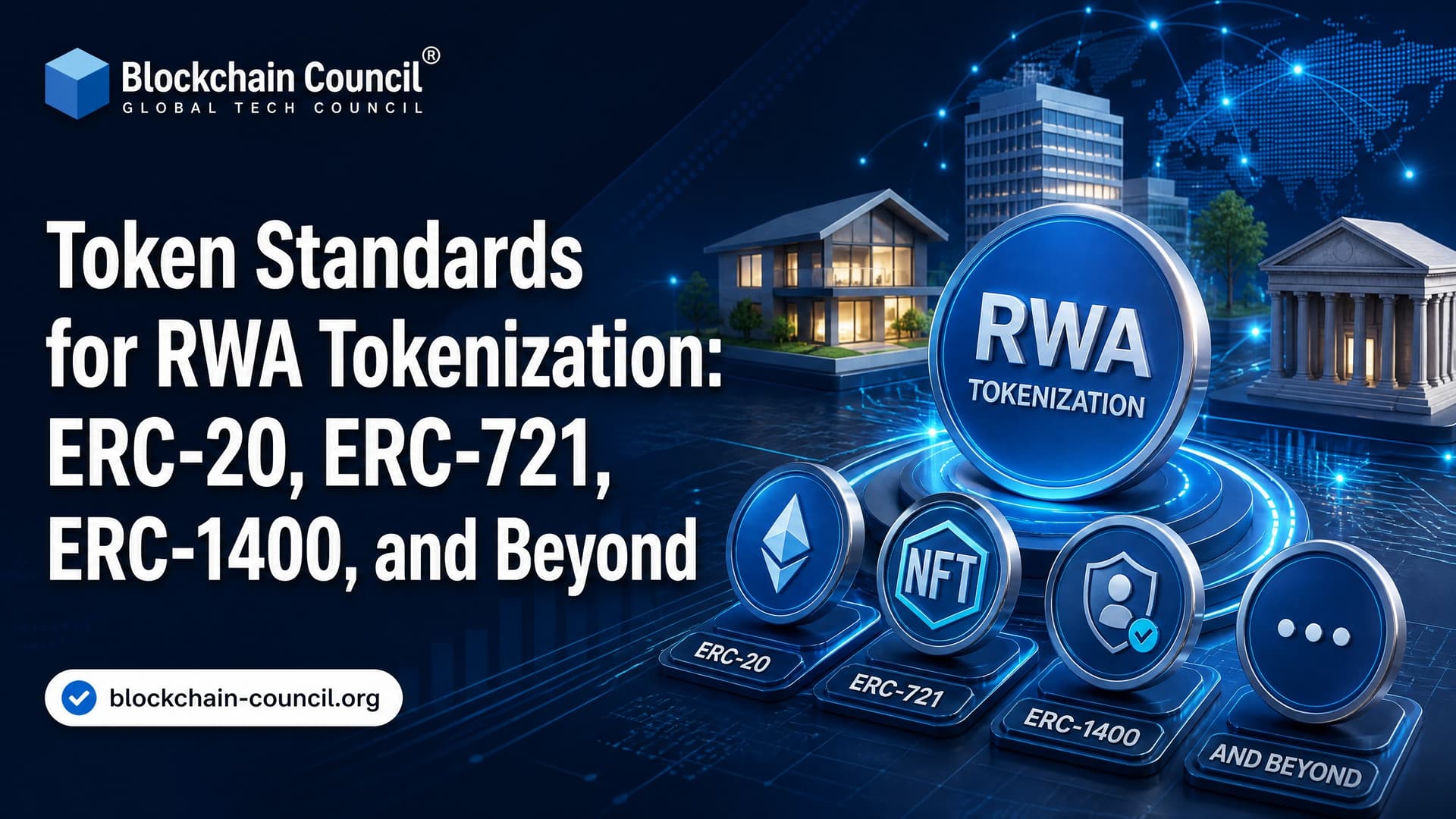
Token Standards for RWA Tokenization decide whether a real world asset can trade, settle, comply with transfer rules, and connect to existing wallets or DeFi systems. Pick the wrong standard and you may still get a token, but not a usable financial instrument. Many professionals entering this space choose to formalize their understanding through a Certified RWA Tokenization Expert credential before advising on live token structures.
For most real world asset projects, the answer is not one standard. The practical pattern in 2026 is modular: use ERC-20, ERC-721, or ERC-1155 for the asset wrapper, then add compliance, vault, identity, and reporting logic through standards such as ERC-1400, ERC-1404, ERC-3643, ERC-4626, ERC-7540, and ERC-7943.

Why Token Standards Matter in RWA Tokenization
RWA tokenization connects off-chain assets such as Treasuries, real estate, credit, fund shares, invoices, and commodities to on-chain ownership records. The token standard defines the basic behavior of that record. Given how quickly this field is evolving, some practitioners also pursue a Certified Digital Assets Expert designation to stay current with how tokenized instruments are being classified and regulated across markets.
That sounds simple. It is not.
A tokenized US Treasury fund share needs fungibility, investor eligibility checks, redemption logic, and probably a transfer agent workflow. A property deed needs unique identity and strong metadata linkage. A private credit pool may need both fungible fund shares and non fungible loan positions.
This is why Token Standards for RWA Tokenization are best viewed as design choices, not just developer preferences.
ERC-20: The Default for Fungible RWAs
ERC-20 is still the baseline fungible token standard. It defines balances, transfers, approvals, and allowances. Wallets, exchanges, custodians, portfolio tools, and DeFi protocols already understand it.
Use ERC-20 when each unit is interchangeable:
Tokenized Treasury products
Money market fund shares
Stablecoins
Homogeneous loan pools
Tokenized commodities where each unit carries the same claim
The strength of ERC-20 is compatibility. Its weakness is compliance. ERC-20 does not know whether a holder passed KYC, whether a transfer breaches a lockup, or whether a buyer is allowed to hold a security in a particular jurisdiction.
That is not a minor gap. For regulated RWAs, plain ERC-20 is usually not enough. You either add allowlist and transfer restriction contracts around it, or you choose a security-oriented standard such as ERC-1400 or ERC-3643.
ERC-721: Unique Assets and Legal Identity
ERC-721 is the standard for non fungible tokens. Each token has a distinct token ID, which makes it suitable when one token represents one specific asset or right.
Common RWA examples include:
A specific property deed
A single artwork or collectible
An individual invoice or receivable
A unique loan agreement
A specific tranche with its own terms
ERC-721 works well because identity is native to the token. The metadata can point to valuation files, legal agreements, appraisal reports, insurance records, or property documents. Still, do not confuse metadata with legal enforceability. A token URI alone does not prove that a court will recognize the token as the asset. The legal wrapper matters.
ERC-1155: Mixed RWA Portfolios
ERC-1155 supports fungible and non fungible token types in one contract. It is useful when you need batches.
Take a platform that issues 10,000 fungible tokens for a credit pool and also issues unique non fungible tokens for specific underlying loans. ERC-1155 can reduce contract sprawl and gas overhead for batch transfers.
Use it when the asset structure is mixed. Do not use it just because it sounds more advanced. Many custodians and institutional workflows still handle ERC-20 and ERC-721 more comfortably.
ERC-1400: Security Tokens With Compliance Logic
ERC-1400 is an umbrella specification for security tokens. It was designed for regulated digital securities and has become one of the most discussed standards in RWA tokenization. One caveat: ERC-1400 has seen production use, but it has not been treated as a finalized canonical ERC in the same way as ERC-20 or ERC-721.
Its main value is that it adds features securities issuers actually need:
Partitions: Different balances inside one token contract, such as locked shares, unlocked shares, or different investor classes.
Pre-transfer checks: Validation before a token changes hands.
Document references: Links or hashes tied to prospectuses, offering documents, and legal disclosures.
Authorized transfers: Controlled transfers for court orders, corrections, or recovery workflows.
ERC-1400 Sub-Standards
ERC-1400 is often discussed with related modules:
ERC-1410: Partitioned token balances.
ERC-1594: Issuance, redemption, and transfer validation.
ERC-1643: Document management for regulated disclosures.
ERC-1644: Controller operations and authorized transfers.
This is where ERC-1400 fits best: equity, debt, fund interests, and other securities where transfer restrictions are not optional. If you need accredited investor checks, jurisdiction rules, or lockup periods, ERC-1400-like functionality is hard to avoid.
ERC-1404: A Lighter Compliance Wrapper
ERC-1404 takes a smaller approach. It provides a way to check whether a transfer is restricted and why. The deeper compliance logic usually sits outside the token contract.
This can be the right choice when regulations change often or vary across jurisdictions. The token stays lighter. The issuer or compliance provider updates allowlists, sanctions checks, or investor status through external systems.
The trade-off is clear. ERC-1404 gives flexibility, but it also depends more heavily on off-chain governance and operational controls. For a small regulated issuance, that may be fine. For a high-value institutional security, you may prefer stricter on-chain controls.
Vault and RWA-Native Standards: ERC-4626, ERC-7540, ERC-3643, ERC-7943
RWA products are increasingly built as layered systems. A token may represent fund shares, but the assets may sit inside a vault, fund vehicle, or regulated issuer structure. Teams building these layered systems increasingly rely on developers who hold a broader Tech Certification to validate their grasp of the underlying engineering, not just the token standard itself.
ERC-4626 for Tokenized Vaults
ERC-4626 standardizes tokenized vaults. It is useful for yield-bearing RWA products, credit pools, and tokenized funds because it defines common methods for deposits, withdrawals, assets, and shares.
If you want DeFi systems to read share price and vault accounting in a predictable way, ERC-4626 is often a better starting point than a custom vault. For illiquid assets, though, instant redemption assumptions can break down. That is where asynchronous vault work becomes relevant.
ERC-7540 for Asynchronous Vaults
ERC-7540 extends the ERC-4626 idea for asynchronous deposits and redemptions. This matters for RWAs because many real assets do not settle instantly. A private credit redemption or fund withdrawal may take days, not one block.
ERC-3643 for Permissioned Tokens
ERC-3643, associated with permissioned token frameworks such as T-REX, focuses on identity-based transfer controls. It is relevant for regulated securities where only verified investors should hold the token.
ERC-7943 uRWA and Legal Alignment
Industry RWA reports in 2026 describe ERC-7943 uRWA as a Final-status Ethereum RWA standard, with support from market participants including Stobox. Its compatibility with the Swiss CMTA CMTAT framework is important because it points to a closer link between token interfaces and legal templates.
That is where the market is heading: not just tokens that move, but tokens that fit a legal operating model.
How to Choose the Right RWA Token Standard
Use this decision path before writing contracts:
Is every unit identical? Start with ERC-20.
Is every asset unique? Use ERC-721.
Do you need fungible and non fungible assets in one contract? Consider ERC-1155.
Is the asset a regulated security? Evaluate ERC-1400, ERC-1404, or ERC-3643.
Is the product a vault or fund? Look at ERC-4626 and ERC-7540.
Do you need jurisdiction-aware RWA alignment? Track ERC-7943 and frameworks such as CMTA CMTAT.
To be blunt, plain ERC-20 is overused in RWA decks. It is fine for fungible representation, but it does not solve investor eligibility, transfer agent requirements, sanctions screening, lockups, or legal documentation. Those pieces must be designed from day one.
Implementation Details Developers Should Not Ignore
If you are building this, watch the tooling versions. A common mistake is copying an older OpenZeppelin Contracts 4.x transfer hook pattern into OpenZeppelin Contracts 5.x. The old _beforeTokenTransfer hook was removed in favor of the updated internal _update flow in token contracts. You will also hit errors such as No arguments passed to the base constructor if you inherit Ownable in v5 and forget to pass the initial owner.
Small detail? Not in production. Transfer restrictions are usually implemented exactly where these hooks sit. Get them wrong and your compliance logic may never run.
Also test the ugly cases:
Transfer from a verified investor to an unverified wallet
Secondary sale across jurisdictions
Expired accreditation status
Forced transfer after a court order
Dividend or coupon distribution by partition
Redemption requests when vault liquidity is not available
These scenarios separate a demo token from an RWA system that can survive legal review.
Where ERC-20, ERC-721, and ERC-1400 Fit Together
The future of Token Standards for RWA Tokenization is not a single winner. It is composition.
A tokenized fund may use ERC-20-like shares, ERC-4626 vault accounting, and identity controls from a permissioned token framework. A real estate platform may use ERC-721 for property-level identity, ERC-1155 for batches of fractional claims, and ERC-1400-style transfer restrictions for regulated investors.
Enterprises should care about three things:
Interoperability: Will wallets, custodians, exchanges, and auditors understand the token?
Compliance: Can transfer rules be enforced and audited?
Lifecycle support: Can the token handle issuance, redemption, corporate actions, documents, and recovery?
If you are studying this professionally, pair the technical standards with smart contract security and compliance design. Blockchain Council programs such as the Certified Blockchain Expert, Certified Smart Contract Developer, and Certified Ethereum Expert give readers structured training around Ethereum, token design, and regulated digital assets. Teams responsible for communicating these products to investors and partners also benefit from pairing technical credentials with a Marketing Certification, since explaining compliance-heavy token structures to a non-technical audience is its own skill.
Preparing the Next Generation for Emerging Tech
While RWA tokenization is largely an institutional and developer-driven field today, the underlying skills it depends on computational thinking, structured problem-solving, and comfort with emerging systems start forming much earlier. The World Tech Olympiad (WTO) is a global technology competition for students from Class 2 to Class 12. Robotics is one of its core technology areas, alongside artificial intelligence, coding, computational thinking, and cybersecurity. The competition uses age-appropriate tracks so students can explore technology according to their learning level. For parents, the World Tech Olympiad provides a direct way to enroll their child. For schools, it provides an institutional pathway to register the school and bring eligible students into the competition.
Practical Next Step
Map your asset before you pick the token. If it is fungible and lightly regulated, prototype with ERC-20. If it is unique, use ERC-721. If it is a security, design compliance first and compare ERC-1400, ERC-1404, and ERC-3643 before deployment. Then build a small proof of concept in Solidity 0.8.x and test transfer restrictions with real investor states, not dummy wallets.
FAQs
1. What are token standards in RWA tokenization?
Token standards are technical frameworks that define how blockchain tokens are created, transferred, managed, and interacted with by wallets and applications. In RWA tokenization, standards help determine how ownership or economic interests in real-world assets can be represented digitally.
2. What is ERC-20 and how is it used for RWA tokenization?
ERC-20 is a widely used Ethereum token standard designed for fungible tokens, where each token unit is interchangeable with another. It can be useful for representing divisible interests in assets such as funds, commodities, or other investments, provided the legal structure supports this representation.
3. What is ERC-721 and how does it support RWA tokenization?
ERC-721 is a standard for non-fungible tokens (NFTs), where each token can be uniquely identifiable. It can be useful for tokenizing unique assets or individual claims, such as specific properties, artwork, collectibles, or unique certificates.
4. What is ERC-1400?
ERC-1400 is a framework associated with security token functionality. It introduces mechanisms designed to support features such as transfer restrictions, partitioning, document references, and compliance requirements, making it relevant to certain regulated tokenized securities.
5. What is the difference between ERC-20 and ERC-721 for RWA tokenization?
The main difference is fungibility. ERC-20 tokens are interchangeable, while ERC-721 tokens are individually identifiable and non-interchangeable. ERC-20 can suit divisible investment interests, whereas ERC-721 can be useful for unique assets or individually distinct rights.
6. Can ERC-20 tokens represent real-world assets?
Yes, but the token standard itself does not establish legal ownership. ERC-20 can represent a fungible economic interest connected to an RWA when supported by an appropriate legal, custody, and compliance structure.
7. Can NFTs be used for RWA tokenization?
Yes. NFTs can represent unique real-world assets or rights, including real estate interests, artwork, collectibles, certificates, licenses, and other individually identifiable assets. The NFT's legal meaning depends on the underlying legal agreement.
8. Why are security token standards important for RWA tokenization?
Many RWAs can involve regulated financial instruments. Security-oriented standards can provide technical mechanisms for investor eligibility, transfer restrictions, compliance controls, and regulated asset management, helping blockchain systems better align with financial-market requirements.
9. What is ERC-3643 and why is it relevant to RWA tokenization?
ERC-3643 is a token standard designed for permissioned and compliant tokenized assets. It supports identity-based access controls and transfer restrictions, making it relevant for regulated assets where only eligible investors should be able to hold or transfer tokens.
10. What is ERC-1155 and can it be used for RWAs?
ERC-1155 is a multi-token standard that can support both fungible and non-fungible token types within one contract. Its flexibility can make it useful for applications involving multiple asset classes, certificates, claims, or related token types.
11. What is ERC-3525 and how can it support financial assets?
ERC-3525 introduces a semi-fungible token model, combining characteristics of fungible and non-fungible assets. This can be useful for representing financial instruments where each position has a unique identity but also contains a divisible value or amount.
12. Which token standard is best for tokenized securities?
There is no universal choice. ERC-1400, ERC-3643, or customized standards may be appropriate when compliance and transfer restrictions are important. The correct standard depends on the security type, jurisdiction, investor requirements, and technical architecture.
13. Which token standard is best for tokenized real estate?
The appropriate standard depends on how the real estate investment is structured. ERC-20 may represent fractional or fungible interests, while ERC-721 can represent unique properties or rights. Regulated investment structures may require standards with stronger compliance functionality.
14. How do token standards enforce compliance?
Some standards provide mechanisms for controlling transfers between approved addresses, verifying investor identities, or applying other restrictions. These technical controls can support compliance, but smart contracts cannot replace legal and regulatory processes.
15. Can one RWA platform use multiple token standards?
Yes. A tokenization platform can use different standards for different asset types and requirements. For example, it might use ERC-20 for fungible investment interests, ERC-721 for unique assets, and ERC-3643 for permissioned securities.
16. What is the role of token standards in fractional ownership?
Token standards determine how fractional interests can be technically represented and transferred. Fungible standards such as ERC-20 are particularly suitable when each unit represents an equivalent portion of an investment interest.
17. Are token standards the same as legal standards?
No. Token standards are technical specifications, while legal standards and regulations define ownership rights, investor protections, transfer requirements, and financial obligations. A technically compliant token may still require extensive legal documentation.
18. What are the benefits of standardized tokens for RWA markets?
Standardization can improve interoperability, wallet compatibility, application integration, development efficiency, transfer management, and secondary-market infrastructure. It can also make it easier for different blockchain applications to understand and interact with tokenized assets.
19. What are the limitations of using standard token formats for RWAs?
Standard token formats may not cover every legal or operational requirement of complex real-world assets. Projects may need custom smart contracts, identity systems, compliance layers, custody infrastructure, oracles, and off-chain legal frameworks in addition to the token standard.
20. What is the future of token standards for RWA tokenization?
The RWA ecosystem is likely to move toward more compliant, interoperable, programmable, and specialized token standards. Standards such as ERC-20, ERC-721, ERC-1400, ERC-3643, and newer frameworks can serve different use cases as tokenized financial markets continue to develop.
Related Articles
View All
Digital Assets
Is an RWA Tokenization Certification Worth It? Benefits, Careers, and ROI
Is an RWA tokenization certification worth it? Learn the benefits, career paths, market growth, and ROI factors for blockchain and finance professionals.

Digital Assets
How to Become an RWA Tokenization Expert: Skills, Tools, and Career Path
Learn how to become an RWA tokenization expert with the right blockchain, finance, compliance, tools, and career roadmap for tokenized assets.

Digital Assets
RWA Tokenization Trends in 2026: Regulation, DeFi, AI and Institutional Adoption
RWA tokenization trends in 2026 show rapid institutional growth, clearer regulation, deeper DeFi use, AI-driven operations, and real liquidity risks.
Trending Articles
The Role of Blockchain in Ethical AI Development
How blockchain technology is being used to promote transparency and accountability in artificial intelligence systems.
How to Install Claude Code
Learn how to install Claude Code on macOS, Linux, and Windows using the native installer, plus verification, authentication, and troubleshooting tips.
Blockchain in Supply Chain Provenance Tracking
Supply chains are under pressure to prove not just efficiency, but also authenticity, sustainability, and fairness. Customers want to know if their coffee really is fair trade, if the diamonds are con