

Types of Digital Assets: From Tokens and NFTs to CBDCs and RWAs

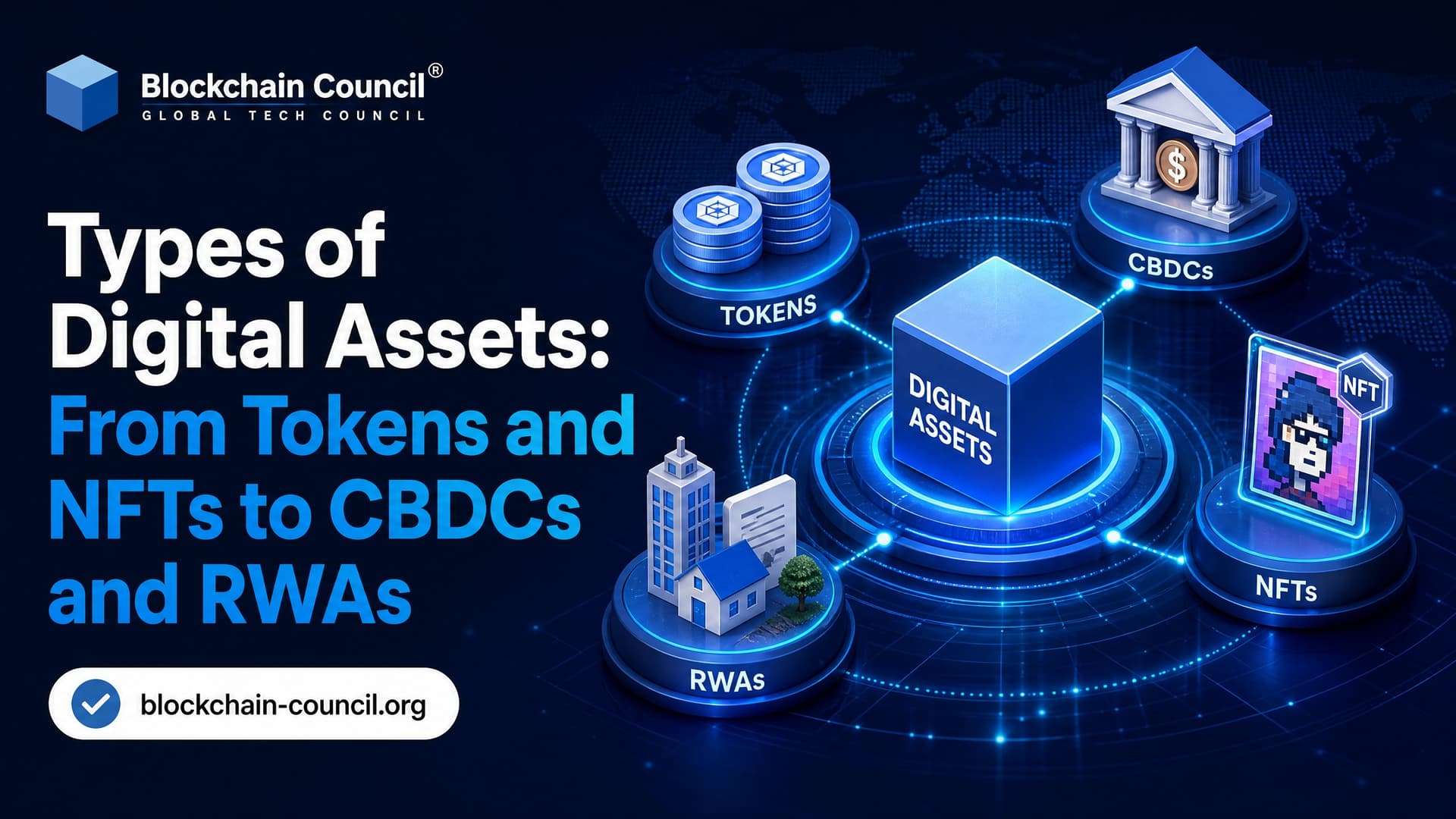
Types of digital assets now stretch well beyond Bitcoin and profile-picture NFTs. The working taxonomy includes cryptocurrencies, stablecoins, utility and governance tokens, security tokens, NFTs, central bank digital currencies, digital bonds, and tokenized real world assets. If you work in finance, product, compliance, or Web3 engineering, this classification is not academic. It changes custody, accounting, smart contract design, disclosure, and regulatory treatment.
Start with a plain definition. A digital asset is something that exists in digital form, holds economic or utility value, and can be owned or controlled. In blockchain systems, that usually means a token recorded on a distributed ledger. Some assets are native to the chain, like BTC or ETH. Others represent an off-chain asset: US Treasury bills, gold, real estate, carbon credits, or fiat money sitting in a bank account.

1. Cryptocurrencies and Payment Tokens
Cryptocurrencies are the original blockchain-native digital assets. Bitcoin, Ether, and XRP are common examples. You can use them for peer-to-peer payments, settlement, value transfer, and, on some networks, staking or transaction fees.
The Reserve Bank of Australia describes cryptocurrencies as digital tokens that allow direct payments between parties, while also noting that they do not fully behave like money in most economies. That distinction matters. Bitcoin may act as a store of value for some holders, but it is not priced, accepted, or regulated like national currency in most markets.
Common uses
- Payments and remittances: Direct value transfer without a traditional correspondent banking chain.
- DeFi collateral: ETH, wrapped BTC, and other tokens are used in lending markets and automated market makers.
- Network security: Proof of Stake systems use native tokens for validator staking and penalties.
- Governance: Some protocol tokens let holders vote on fee changes, treasury spending, or upgrades.
For developers, the first lesson is that a payment token is not automatically an ERC-20 token. ETH is native to Ethereum and does not implement the ERC-20 interface unless it is wrapped as WETH. That small detail breaks beginner integrations all the time, especially when a contract expects transferFrom and receives native ETH instead.
2. Stablecoins
Stablecoins are crypto tokens designed to hold a steady value against another asset, usually the US dollar. USDT and USDC are the best-known fiat-referenced examples. Stablecoins can be fiat-collateralized, crypto-collateralized, or algorithmic, though the market has grown far less forgiving of weak algorithmic designs after some high-profile failures.
Stablecoin transfer volume has been reported in the trillions of dollars annually across digital asset market research. That scale explains why regulators treat stablecoins as a separate category rather than just another cryptocurrency.
Why stablecoins matter
- Trading: They act as quote assets on centralized and decentralized exchanges.
- Settlement: Institutions test stablecoins for faster treasury movement and intercompany transfers.
- DeFi liquidity: Lending pools, derivatives protocols, and liquidity pools lean heavily on stablecoins.
- Cross-border payments: Wallet-based dollar settlement can beat traditional rails in some corridors.
The trade-off is clear. Stablecoins are useful because they connect blockchain settlement to fiat value. That same connection creates reserve, audit, redemption, and banking risks. Never judge a stablecoin only by its peg on a chart. Read its reserve disclosures, redemption terms, issuer structure, and jurisdiction.
3. Utility and Governance Tokens
Utility tokens give access to a service, protocol, or network feature. Governance tokens give holders voting rights over protocol decisions. In practice, one token often does both.
Examples include tokens used to pay network fees, access decentralized storage, vote on protocol upgrades, or join liquidity incentives. These tokens are usually native to a decentralized application, but their legal status varies sharply by jurisdiction.
Here is the uncomfortable part. Calling a token a utility token does not make it a non-security. If buyers mainly expect profit from the work of a team, regulators may look straight past the label. Product teams should bring in legal counsel before designing token distribution, not after a token generation event.
4. Security Tokens and Asset Tokens
Security tokens represent financial instruments such as equity, bonds, fund interests, private credit, or real estate claims. They are usually issued within a legal framework and recorded as blockchain tokens for transfer, settlement, and lifecycle management.
Tokenized securities are not just ICO tokens with better branding. They need investor eligibility checks, transfer restrictions, custody controls, corporate action handling, and audit trails. In many cases, permissioned ledgers or whitelisted wallet contracts fit better than fully open public transfers.
Use cases gaining traction
- Tokenized bonds: Coupon payments and maturity events can be automated through smart contracts.
- Money market funds: Fund shares can sit on-chain for faster collateral movement.
- Private credit: Tokenization can cut operational friction in issuance and servicing.
- Real estate funds: Smaller ticket sizes may widen access, subject to securities laws.
Enterprise blockchain infrastructure providers such as Kaleido have pointed to strong institutional activity around tokenized money market funds, short-duration bonds, private credit, and fund interests. That matches what many banks actually test first: boring assets with clear cash flows. Boring is good here. It is far easier to justify tokenization when it cuts reconciliation work or settlement time.
5. Real World Assets, or RWAs
Real world assets are off-chain assets represented on-chain. The term covers US Treasuries, money market funds, private credit, gold, real estate, bonds, equities, carbon credits, and sometimes intellectual property.
An RWA token is only as strong as the legal and operational bridge behind it. Who owns the underlying asset? Where is it custodied? Can token holders redeem? What happens if the issuer becomes insolvent? These questions matter more than the token standard.
Major RWA categories
- US Treasuries and money market funds: Popular because they are liquid, familiar, and yield-bearing.
- Commodities: Gold-backed tokens are the common example, usually tied to vault holdings.
- Real estate: Fractional ownership models can lower entry costs, but secondary liquidity is not guaranteed.
- Private credit: On-chain rails may improve reporting and collateral use.
- Environmental assets: Carbon credits and renewable energy certificates can benefit from clearer provenance.
RWAs are one of the most serious institutional digital asset themes, and also one of the easiest to oversell. Tokenizing an illiquid office building does not magically create deep liquidity. It may improve administration, transferability, and investor access. That is still valuable, but it is not the same thing as a liquid public market.
6. Non-Fungible Tokens, or NFTs
NFTs are unique tokens with distinct identifiers and metadata. Unlike fungible assets, one NFT is not interchangeable with another. ERC-721 and ERC-1155 are the common Ethereum token standards used for NFTs and semi-fungible assets.
NFTs first broke through with digital art and collectibles, but the more durable use cases are broader: gaming items, event tickets, memberships, virtual land, identity credentials, and IP licensing.
A developer detail worth remembering. If you use OpenZeppelin Contracts 4.x and call safeTransferFrom to send an ERC-721 token to a contract that does not implement IERC721Receiver, you can hit the revert string ERC721: transfer to non ERC721Receiver implementer. It is not a marketplace bug. It is the receiver contract missing the required callback.
Where NFTs fit best
- Provenance: Tracking origin and ownership history.
- Access: Token-gated memberships, events, and digital services.
- Gaming: Player-owned items, skins, characters, and land.
- Licensing: Rights management for media and IP, when the legal terms are clear.
NFTs get risky the moment they are marketed as passive investment products or fractionalized into financial claims. At that point, securities and consumer protection analysis becomes unavoidable.
7. Central Bank Digital Currencies
Central bank digital currencies, or CBDCs, are digital forms of fiat currency issued by a central bank. They differ from cryptocurrencies because they are state-backed and centrally governed.
The Atlantic Council CBDC Tracker has reported that more than 100 countries are exploring CBDCs, covering the bulk of global GDP. A handful have moved past research into live launches, while most remain in pilots or white paper stages.
Retail vs wholesale CBDCs
- Retail CBDCs: Built for public use, often discussed alongside financial inclusion and cash alternatives.
- Wholesale CBDCs: Built for banks and financial institutions, mainly for interbank settlement and cross-border payments.
CBDCs are politically charged. Supporters point to payment efficiency, settlement finality, and monetary sovereignty. Critics worry about privacy, surveillance, bank disintermediation, and state control over payment data. Both sides have a point, which is why many countries are moving slowly.
8. Digital Bonds and Tokenized Financial Instruments
Digital bonds are debt instruments issued and recorded on blockchain infrastructure. They often sit under the wider category of tokenized securities or RWAs, but they deserve separate attention because bond lifecycle events are operationally heavy.
Coupon payments, interest calculations, maturity redemption, investor registers, and settlement instructions can all run more efficiently on programmable rails. The gain is not only speed. It is fewer breaks between issuer systems, custodians, paying agents, and market infrastructure.
How to Classify a Digital Asset
Run this checklist before you build, invest, or advise on a digital asset project:
- Is it native or non-native? BTC is native. A tokenized Treasury bill is non-native.
- Is it fungible? ERC-20 style assets are usually fungible. ERC-721 NFTs are not.
- What rights does it provide? Payment, access, governance, ownership, redemption, or income?
- Who is the issuer? A protocol, company, fund, bank, or central bank?
- What law applies? Securities, commodities, payments, banking, tax, privacy, or all of them?
- Where is custody? Self-custody, qualified custodian, smart contract escrow, or central bank ledger?
This is the category-aware thinking professionals need. A stablecoin risk review is not the same as an NFT marketplace review. An RWA smart contract audit is not finished if nobody checks the legal claim to the underlying asset.
Skills Professionals Need Next
If you are building expertise here, learn both the asset taxonomy and the infrastructure beneath it: token standards, wallet flows, custody models, smart contract security, compliance controls, and settlement design.
You can connect this topic with related Blockchain Council learning paths such as Certified Blockchain Expert™, Certified Blockchain Developer™, Certified Cryptocurrency Expert™, Certified NFT Expert™, and Certified DeFi Expert™. Developers should pair theory with a small build: deploy an ERC-20 on a testnet, mint an ERC-721, inspect a stablecoin contract, and trace a token transfer in a block explorer.
Your next step: pick one asset class and map it end to end. For most enterprise teams, start with stablecoins or tokenized money market funds. For developers, start with ERC-20 and ERC-721 contracts in Solidity 0.8.x using Hardhat or Foundry, then study how custody and compliance reshape the design.
Related Articles
View All
Digital Assets
RWA Tokenization and Stablecoins: Connecting Real Assets to Digital Money
RWA tokenization and stablecoins are converging as tokenized Treasuries, real estate, and funds settle through blockchain-based digital money.

Digital Assets
Real-World Assets vs Digital Assets: Key Differences Investors Should Know
Understand Real-World Assets vs Digital Assets, including value, legal rights, regulation, liquidity, yield, and investor due diligence.

Digital Assets
How RWA Tokenization Works: From Physical Assets to Blockchain Tokens
Learn how RWA tokenization links real-world assets to blockchain tokens through legal structures, custody, smart contracts, oracles, and compliance controls.
Trending Articles
The Role of Blockchain in Ethical AI Development
How blockchain technology is being used to promote transparency and accountability in artificial intelligence systems.
How Blockchain Secures AI Data
Understand how blockchain technology is being applied to protect the integrity and security of AI training data.
Claude AI Tools for Productivity
Discover Claude AI tools for productivity to streamline tasks, manage workflows, and improve efficiency.