

How to Become an RWA Tokenization Expert: Skills, Tools, and Career Path
 Suyash Raizada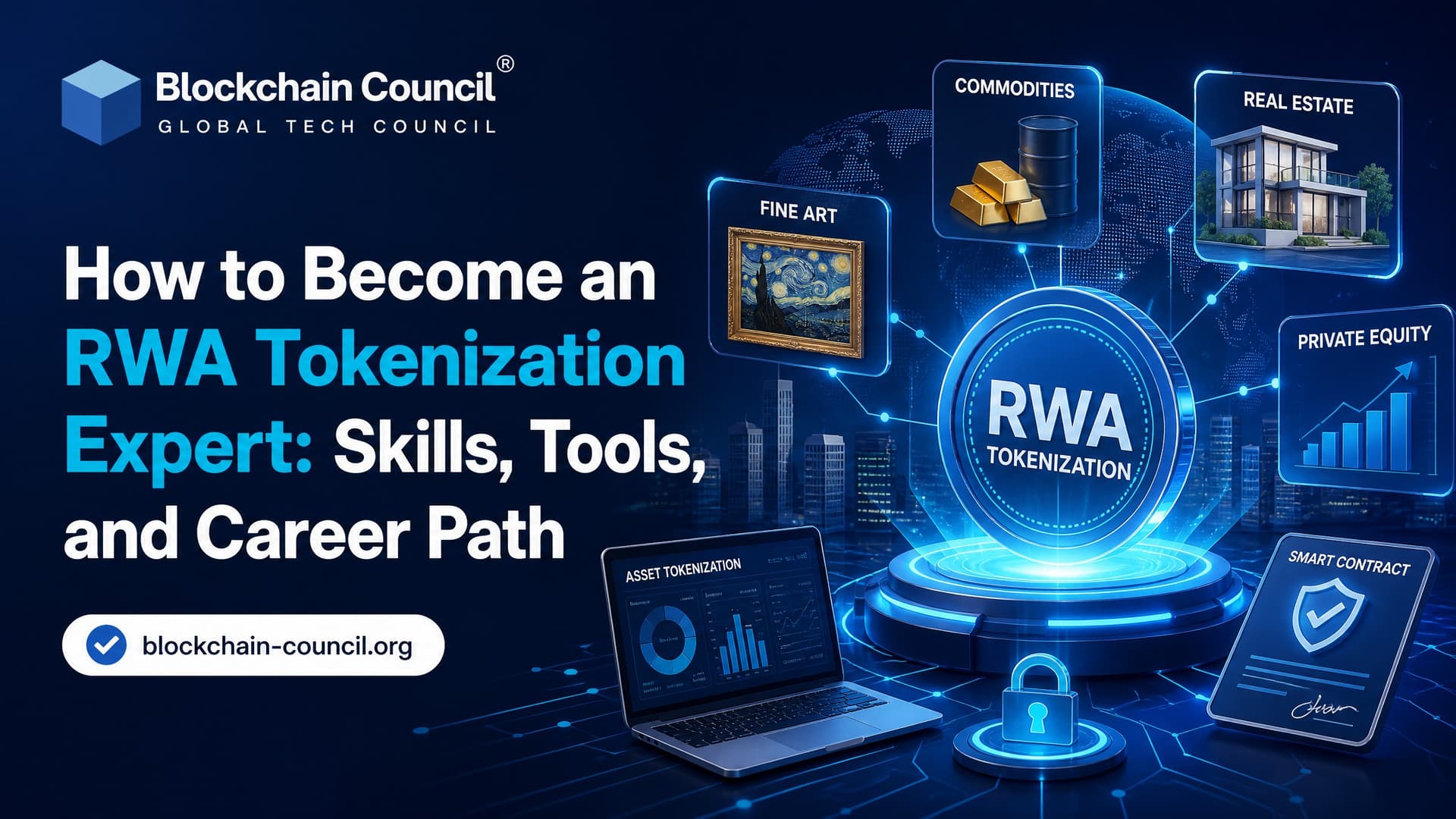
RWA tokenization expert is no longer a vague Web3 job title. It describes someone who can turn real assets, such as Treasuries, private credit, real estate, commodities, and fund shares, into compliant onchain instruments that investors, custodians, and regulators can actually work with. Professionals looking to develop specialized knowledge in this growing field can explore the Certified RWA Tokenization Expert program to build a stronger understanding of RWA structures and their practical applications.
The role is hard because it sits across three disciplines: blockchain engineering, capital markets, and regulation. Know only Solidity and you will miss the legal wrapper. Know only finance and you will miss the custody and transfer-control issues. Know only compliance and you will struggle to judge whether the token design is safe.

What Is RWA Tokenization?
Real-world asset tokenization is the process of representing rights to an offchain asset on a blockchain. The token might represent a share in a fund, a claim on a Treasury-backed product, a fractional real estate interest, or a debt instrument.
The market has moved fast. RWA.xyz and industry reports show tokenized RWAs excluding stablecoins grew from about 8.6 billion USD in 2023 to around 15.2 billion USD by December 2024. By mid-2025, the figure had climbed past 24 billion USD. Include stablecoins and the broader tokenized asset universe was already above 200 billion USD by the end of 2024, largely because cash-like instruments remain the biggest category.
That growth explains why companies now hire for RWA architects, tokenization leads, digital asset product managers, smart contract security specialists, and tokenized fund operations roles.
Why RWA Tokenization Expertise Matters Now
Tokenization is shifting from pilots to live institutional products. BlackRock launched BUIDL, the USD Institutional Digital Liquidity Fund, on Ethereum in March 2024 with Securitize as transfer agent and tokenization platform. BUIDL represents shares in a fund backed mainly by short-term US Treasuries and cash instruments. It crossed hundreds of millions of dollars shortly after launch and later expanded across networks including Ethereum, Aptos, Polygon, Optimism, Arbitrum, Avalanche, and Solana.
Tokenized Treasury products from BlackRock, Ondo Finance, Franklin Templeton, Circle, and others now form one of the clearest use cases. Private credit platforms such as Centrifuge, Maple Finance, and TrueFi show another path. RealT has taken a different route, offering fractional exposure to US rental properties, with rental income paid through stablecoins.
To be blunt, not every asset should be tokenized. Illiquid, poorly documented assets do not become high-quality products just because they sit behind a smart contract. Good RWA professionals know when tokenization adds value: faster settlement, better transferability, programmable compliance, clearer ownership records, or easier collateral use.
Professionals who want to understand the wider digital asset environment surrounding tokenized assets can also explore the Certified Digital Assets Expert program. Broader digital asset knowledge can complement RWA-specific expertise, particularly when working across tokenized products, blockchain infrastructure, and digital asset markets.
Core Skills You Need to Become an RWA Tokenization Expert
1. Blockchain and Smart Contract Engineering
You need a working grasp of wallets, public and private keys, the transaction lifecycle, gas, consensus, and chain design. Then go deeper into smart contracts.
Solidity 0.8.x for Ethereum and EVM-compatible networks.
Rust if you want to work in the Solana or Aptos ecosystems.
Hardhat and Foundry for testing, scripting, fuzzing, and deployment.
ERC-20, ERC-721, and ERC-1155 for token design basics.
ERC-3643 for permissioned, identity-aware security token and RWA structures.
A practical warning. Many developers migrating older OpenZeppelin contracts to version 5 get caught because the token transfer hooks changed. The old beforeTokenTransfer pattern no longer works the same way, and transfer restriction logic often belongs in update. In RWA contracts, that mistake can break compliance checks. You do not want a restricted investor token transferring freely because your hook never ran.
2. Finance and Asset Structuring
RWA tokenization experts need more than blockchain vocabulary. You should understand how the underlying asset behaves.
US Treasuries, money market funds, and duration risk.
Private credit, default risk, covenants, and seniority.
Real estate cash flows, occupancy, valuations, and legal title.
Securitization, waterfalls, NAV calculation, and investor reporting.
Collateral management and settlement workflows.
If you are analyzing a tokenized Treasury fund, look at the yield source, redemption terms, custodian arrangements, fees, and transfer limitations. If you are analyzing tokenized private credit, spend more time on underwriting and loss assumptions than token branding.
3. Regulation and Compliance
Regulation is where many tokenization projects fail. In the European Union, MiCA, formally Regulation EU 2023/1114, became fully applicable on 30 December 2024. Its asset-referenced token and e-money token rules started earlier, on 30 June 2024.
The first question is classification. If a tokenized RWA is a MiFID II financial instrument, such as a tokenized bond or equity, it generally falls under the existing EU capital markets framework rather than MiCA. That can involve MiFID II, the Prospectus Regulation, and the Central Securities Depositories Regulation. If it is not a MiFID financial instrument, MiCA may apply, including white paper and issuer obligations.
You also need to understand AML, KYC, transfer restrictions, travel-rule requirements, custody obligations, and local regimes such as the Dubai VARA rules. Good engineers in this field do not give legal advice, but they know enough to build controls that lawyers and compliance teams can review.
4. Security and Operational Risk
With RWAs, a smart contract bug can affect claims on real assets. That changes the risk profile.
Use role-based access controls carefully.
Test investor allowlists and transfer restrictions.
Plan key management with institutional custody in mind.
Monitor oracle updates and offchain data inputs.
Document pause, freeze, redemption, and recovery procedures.
One small example. If a permissioned ERC-20 token relies on an identity registry, test the negative path. A transfer from an unverified wallet should fail. If your test suite only checks happy paths, you have not tested an RWA product.
Tools and Platforms You Should Know
Tokenization Platforms
Securitize: Used in major institutional tokenization workflows, including BUIDL.
Ondo Finance: Known for tokenized US Treasury and bond exposure.
Centrifuge: Focused on real-world credit and asset-backed pools.
Maple Finance and TrueFi: Important names in onchain credit markets.
Tokeny: Used for compliant tokenization of funds, real estate, private equity, and debt.
RealT: A practical reference point for fractional real estate tokenization.
Infrastructure and Data
Ethereum remains the main settlement layer for many institutional RWA products.
Polygon, Arbitrum, Optimism, Avalanche, Solana, and Aptos matter for distribution and lower transaction costs.
Chainlink, API3, and RedStone support oracle and offchain data workflows.
RWA.xyz is essential for tracking tokenized Treasuries, private credit, and issuer data.
DeFiLlama, Dune, and Flipside help you build dashboards and monitor protocol activity.
For developer credibility, build at least one dashboard and one working proof of concept. Reading reports helps. Shipping something teaches faster.
Future-Ready Skills
As technology becomes increasingly important across industries, students need opportunities to develop future-ready skills early in their education. A Tech Olympiad can introduce students to areas such as artificial intelligence, coding, cybersecurity, robotics, and computational thinking while encouraging curiosity and continuous learning.
A Practical Career Path for RWA Tokenization
Stage 1: Build Blockchain Foundations
Start with transaction mechanics, wallets, smart contracts, and token standards. If you need a structured route, the Certified Blockchain Expert™ and Certified Blockchain Developer™ programs cover foundational blockchain and development skills.
Stage 2: Learn Smart Contract Development
Build ERC-20 and ERC-721 contracts, then add permissioning, role-based controls, and mint and burn logic. Move into restricted-transfer designs and study ERC-3643. The Certified Smart Contract Developer™ certification is relevant if your target role is technical.
Stage 3: Study Capital Markets
Pick one asset class first. Tokenized Treasuries are the best starting point because the structure is easier to understand than private credit or real estate. Track BUIDL, Ondo products, Franklin Templeton funds, and Circle USYC. Compare AUM, holders, chains, and redemption terms.
Stage 4: Add Regulation
Map token types to regulatory treatment. Study MiCA, MiFID II, securities offering rules, stablecoin regulation, and KYC workflows. Then design smart contract controls that reflect the legal requirements, such as whitelisted transfers, jurisdiction restrictions, and investor status checks.
Stage 5: Build a Portfolio Project
Create a testnet tokenized bond prototype with:
Investor allowlisting.
Issuance and redemption functions.
Coupon or yield distribution logic.
A mock oracle for NAV updates.
Basic admin controls for freeze and pause scenarios.
A short risk disclosure document.
Do not skip documentation. In RWA roles, your ability to explain assumptions is almost as important as your code.
Professionals looking to expand their broader technology capabilities alongside blockchain expertise can consider a Tech Certification that aligns with their career goals. This can be particularly useful for professionals working across emerging technology, product development, and digital transformation.
Career Roles in RWA Tokenization
As the market matures, you can specialize in several directions:
RWA smart contract engineer: Builds and tests token contracts, permissioning systems, and integrations.
Tokenization architect: Designs end-to-end issuance, custody, compliance, and settlement architecture.
Digital asset product manager: Turns fund, credit, or real estate structures into usable products.
Compliance specialist: Handles classification, disclosures, licensing workflows, and AML design.
Risk analyst: Monitors liquidity, collateral, defaults, yield, and onchain exposure.
Data analyst: Builds dashboards using RWA.xyz, Dune, Flipside, and DeFiLlama data.
If you prefer engineering, aim for Solidity, security, and integrations. If you come from finance, focus on structuring, risk, and product design. If you are a lawyer or compliance professional, learn enough technical architecture to understand what can be enforced onchain and what still depends on contracts, custodians, or transfer agents.
What to Learn Next
The best next step is specific. Choose one asset class, one chain, and one compliance model. For example, build a tokenized Treasury fund prototype on an Ethereum testnet with investor allowlisting and NAV updates. Then write a two-page memo explaining whether the token would likely be a financial instrument, an e-money token, an asset-referenced token, or another crypto-asset in the EU context.
Pair that project with formal learning. Start with the Certified Blockchain Expert™ if you need breadth, the Certified Blockchain Developer™ if you want to build, and the Certified Smart Contract Developer™ if your goal is protocol or platform engineering. The RWA tokenization expert path rewards people who can connect code, cash flows, custody, and compliance without treating any one of them as an afterthought.
For professionals who also work on the commercial side of technology products, a Marketing Certification can complement their technical and RWA knowledge by developing broader marketing capabilities.
FAQs
1. What is an RWA tokenization expert?
An RWA tokenization expert is a professional who understands how real-world assets can be structured, represented, issued, transferred, settled, and managed through blockchain infrastructure. The role combines blockchain, finance, compliance, custody, and asset management knowledge.
2. Why is RWA tokenization expertise becoming important?
As banks, asset managers, fintech companies, and Web3 businesses explore tokenized Treasuries, private credit, real estate, funds, commodities, and securities, professionals who understand both blockchain technology and traditional financial markets are increasingly valuable.
3. What skills are needed to become an RWA tokenization expert?
Important skills include blockchain architecture, smart contracts, token standards, asset structuring, capital markets, securities regulation, KYC/AML, custody, valuation, risk management, and tokenized asset operations.
4. Do I need programming skills for an RWA tokenization career?
Programming is particularly useful for technical roles. Learning Solidity, smart contract development, wallets, token standards, and blockchain testing can help you work as an RWA smart contract engineer or technical architect. However, non-technical roles can focus more on finance, compliance, product, risk, or operations.
5. Which programming languages are useful for RWA tokenization?
Solidity is important for Ethereum and EVM-based tokenization projects. Rust can be useful for ecosystems such as Solana and Aptos. Understanding blockchain APIs and scripting can also help with integrations and analytics.
6. Which blockchain concepts should RWA professionals learn?
Professionals should understand wallets, public and private keys, transactions, consensus, smart contracts, blockchain networks, token standards, oracles, custody, and settlement. This foundation helps connect technical infrastructure with real-world financial requirements.
7. Which token standards are important for RWA tokenization?
Professionals should understand standards such as ERC-20, ERC-721, ERC-1155, and ERC-3643, along with permissioned-transfer and identity-aware token designs used for regulated assets.
8. Why should RWA experts understand traditional finance?
Tokenization does not eliminate traditional financial risks. Professionals need to understand credit risk, liquidity, valuation, cash flows, securitization, collateral, investor reporting, and settlement to evaluate whether tokenization actually adds value to an asset.
9. How important is regulatory knowledge for an RWA career?
Regulatory knowledge is essential because tokenized products can involve securities regulations, KYC/AML, sanctions, investor eligibility, custody requirements, disclosures, and cross-border rules. Professionals need to understand how legal requirements affect token design and distribution.
10. Which tools should aspiring RWA tokenization professionals learn?
Useful tools and platforms include Hardhat, Foundry, blockchain explorers, RWA.xyz, Dune, DeFiLlama, Flipside, oracle infrastructure, and institutional tokenization platforms. The right tools depend on whether your career focuses on development, analytics, compliance, or product management.
11. What career roles are available in RWA tokenization?
Potential roles include RWA smart contract engineer, tokenization architect, digital asset product manager, compliance specialist, risk analyst, investment operations professional, data analyst, and tokenization consultant.
12. Can finance professionals move into RWA tokenization?
Yes. Finance professionals can build on their existing knowledge of capital markets, investment products, valuation, risk, and asset management while learning blockchain architecture, token standards, custody, and digital-asset infrastructure.
13. Can compliance professionals specialize in RWA tokenization?
Yes. Compliance professionals can specialize in securities classification, KYC/AML, sanctions, investor eligibility, transfer restrictions, regulatory frameworks, and on-chain compliance controls. Understanding the underlying blockchain architecture makes this specialization stronger.
14. What practical project can help build RWA expertise?
A useful portfolio project is a testnet tokenized bond or Treasury-style prototype with investor allowlisting, issuance and redemption, yield distribution, a mock NAV oracle, transfer restrictions, and basic administrative controls. This demonstrates both technical and financial understanding.
15. What should beginners learn first?
A practical learning sequence is blockchain fundamentals → smart contracts and token standards → capital markets → RWA structures → regulation and compliance → custody and risk → practical tokenization projects. Starting with one asset class can make the learning process easier.
16. Which RWA asset class is good for beginners?
Tokenized Treasury products can be a useful starting point because their structure is generally easier to understand than complex private credit or real estate transactions. After that, professionals can explore funds, private credit, real estate, commodities, and other asset classes.
17. How can certification help an aspiring RWA professional?
A specialized certification can provide a structured learning path and demonstrate knowledge across blockchain, asset structuring, regulation, custody, valuation, risk, and institutional infrastructure. The Certified RWA Tokenization Expert™ from Blockchain Council specifically covers these areas across 15 modules and 101 lessons.
18. What does the Certified RWA Tokenization Expert™ program teach?
The program covers RWA foundations, asset classes, legal structure, global regulations, blockchain architecture, token standards, privacy, issuance, accounting, security, secondary markets, DeFi integration, risk management, institutional infrastructure, and business models.
19. Who should consider becoming an RWA Tokenization Expert?
The specialization can be relevant for asset managers, investment professionals, banking and fintech professionals, blockchain developers, Web3 specialists, legal and compliance professionals, product managers, consultants, auditors, and accountants interested in tokenized financial markets.
20. How can I become a Certified RWA Tokenization Expert?
Start by building a foundation in blockchain, capital markets, tokenization, and regulatory concepts, then gain practical exposure through projects and industry tools. For a structured specialization, Blockchain Council offers the Certified RWA Tokenization Expert™, designed around the complete RWA lifecycle and institutional tokenization requirements.
Related Articles
View All
Digital Assets
How to Become a CBDC Expert: Skills, Learning Path, and Certifications
Learn how to become a CBDC expert with the right skills, learning path, practical experience, and CBDC certifications for policy, tech, and finance roles.

Digital Assets
Is an RWA Tokenization Certification Worth It? Benefits, Careers, and ROI
Is an RWA tokenization certification worth it? Learn the benefits, career paths, market growth, and ROI factors for blockchain and finance professionals.

Digital Assets
RWA Tokenization Trends in 2026: Regulation, DeFi, AI and Institutional Adoption
RWA tokenization trends in 2026 show rapid institutional growth, clearer regulation, deeper DeFi use, AI-driven operations, and real liquidity risks.
Trending Articles
The Role of Blockchain in Ethical AI Development
How blockchain technology is being used to promote transparency and accountability in artificial intelligence systems.

Top 5 DeFi Platforms
Explore the leading decentralized finance platforms and what makes each one unique in the evolving DeFi landscape.
How Blockchain Secures AI Data
Understand how blockchain technology is being applied to protect the integrity and security of AI training data.