

Stablecoins Explained: Types, Use Cases, Risks, and Regulation
 Suyash Raizada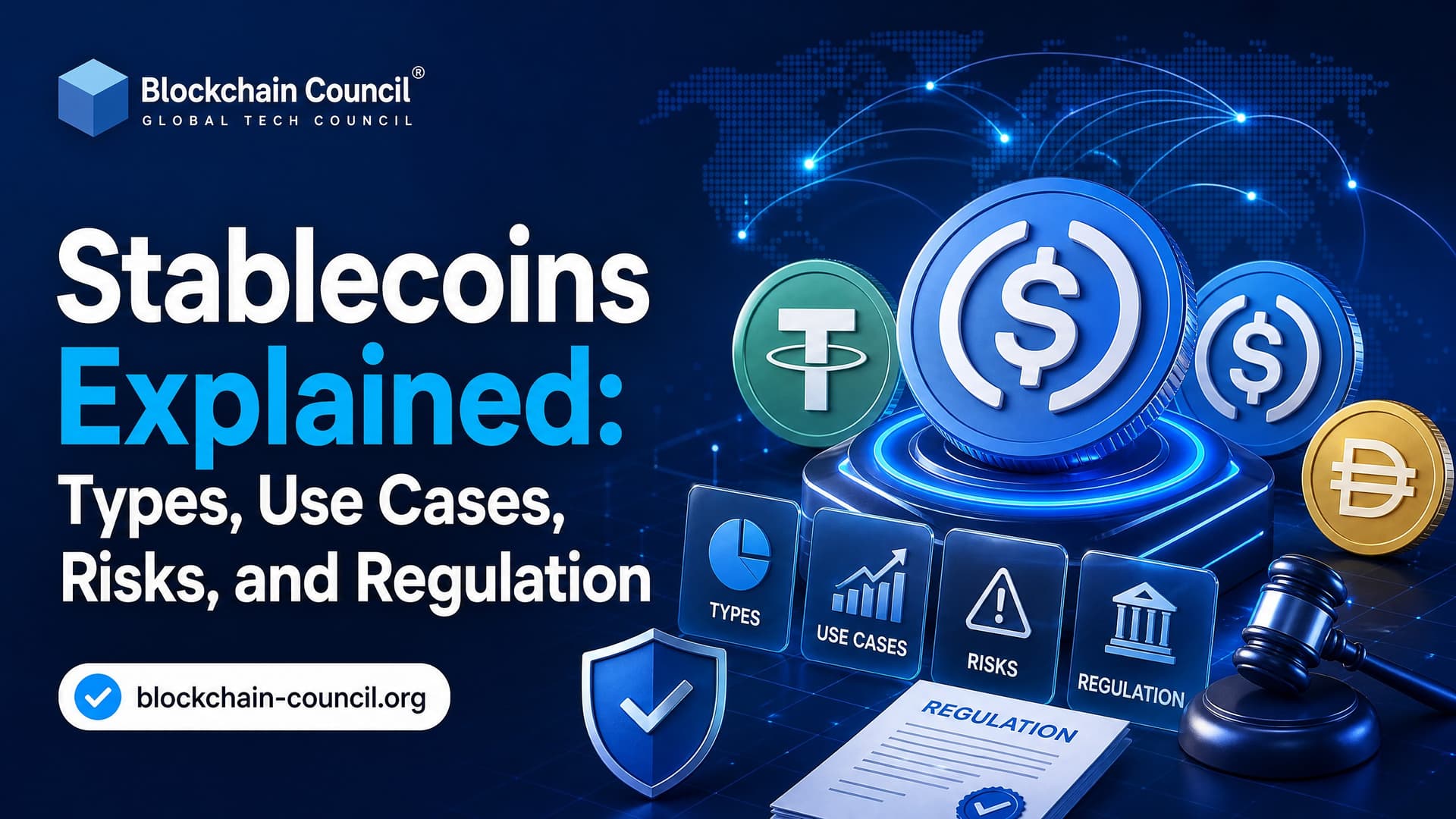
Stablecoins explained in plain terms: they are crypto assets built to track the value of another asset, usually the US dollar. They sit between traditional money and blockchain rails, which is why you see them everywhere in crypto trading, DeFi lending, cross-border payments, and treasury workflows. This matters. A token that aims to stay at 1 USD can still fail, freeze, depeg, or create compliance exposure if you treat it like cash without checking the design.
Most stablecoin supply is fiat-backed. Research from Brookings puts fiat-backed tokens at roughly 87% of circulating supply. Algorithmic stablecoins, once heavily promoted before TerraUSD collapsed in 2022, now represent less than 0.2% of circulating supply. That shift tells you something useful: simple backing and clear redemption rights have won most institutional trust, at least for now.

As stablecoins become a key component of digital payments and tokenized finance, professionals benefit from understanding digital asset governance, tokenization models, compliance frameworks, custody, and blockchain-based financial infrastructure. A Certified Digital Assets Expert credential helps build these practical skills, enabling individuals to evaluate stablecoin ecosystems and their role in the broader digital asset economy.
What Are Stablecoins?
A stablecoin is a digital asset that tries to hold a steady price against a reference asset. The reference is usually a fiat currency like the USD, but it can also be gold, another commodity, or a basket of assets.
The peg is maintained through one or more mechanisms:
Redemption: users can redeem tokens for fiat at or near 1:1.
Collateral: assets are held off-chain or locked on-chain to back issued tokens.
Arbitrage: traders buy below peg or sell above peg to restore price.
Supply adjustment: some systems expand or contract token supply through rules coded into the protocol.
If you are building with stablecoins, do not stop at the ticker. USDT on Tron, USDC on Ethereum, and DAI on Base behave differently in fees, settlement assumptions, contract standards, and compliance controls.
Types of Stablecoins
1. Fiat-Backed Stablecoins
Fiat-backed stablecoins are issued by a centralized entity that holds reserves such as cash, bank deposits, Treasury bills, or other high-quality liquid assets. USDT from Tether and USDC from Circle are the best-known examples.
The appeal is easy to understand. If an issuer holds liquid assets worth at least the value of tokens in circulation and users can redeem, the market has a strong anchor around 1 USD. The trade-off is counterparty risk. You depend on the issuer, custodians, banks, auditors, and regulators.
For enterprise payments, fiat-backed tokens are usually the practical choice. They have liquidity, exchange support, and a clearer regulatory path under regimes such as the European Union Markets in Crypto-Assets regulation, known as MiCA, and the United States GENIUS Act.
2. Crypto-Backed Stablecoins
Crypto-backed stablecoins use on-chain collateral. A user locks volatile crypto assets in a smart contract and mints a smaller amount of stablecoins. DAI is the classic example, though its collateral mix has changed over time and now includes crypto assets plus real-world asset exposure.
The benefit is transparency. You can inspect collateral positions, liquidations, and protocol rules on-chain. The downside is complexity. If collateral prices crash, liquidations can cascade. Oracle design matters too. A stale or manipulated price feed can turn a stablecoin protocol into a loss machine.
These stablecoins fit DeFi users who value composability and on-chain verification. They are not ideal for a payroll team that simply wants predictable settlement and simple accounting.
3. Algorithmic Stablecoins
Algorithmic stablecoins rely on market incentives and supply rules instead of full collateral. Some are uncollateralized. Others are partially backed. The TerraUSD collapse in May 2022 showed the weak point: if confidence breaks, arbitrage incentives may not save the peg. They can accelerate the fall.
To be blunt, purely algorithmic stablecoins are still experimental. They may interest researchers, but they are a poor choice for corporate treasury, consumer payments, or regulated settlement workflows.
Understanding the strengths and limitations of different stablecoin models also requires a solid foundation in blockchain architecture, smart contracts, consensus mechanisms, token standards, and enterprise blockchain networks. A Certified Blockchain Expert credential equips professionals with the technical knowledge needed to design, evaluate, and implement secure blockchain-based financial solutions.
Stablecoin Use Cases
Trading and Crypto Market Liquidity
Stablecoins are the quote currency for much of crypto. Traders use them to move between volatile assets without leaving blockchain-based markets. The European Central Bank has noted that some stablecoins are already critical to liquidity in crypto-asset markets.
In DeFi, stablecoins serve as:
Base pairs on decentralized exchanges
Collateral for lending and borrowing
Settlement assets for derivatives and structured products
A unit of account for yield strategies
That liquidity role is useful, but it creates concentration risk. If a major stablecoin depegs, DEX pools, lending markets, and derivatives positions can all reprice at once.
Payments and Cross-Border Transfers
Stablecoins can move value across borders in minutes and outside banking hours. Businesses use them for vendor payments, international payroll, invoice settlement, and treasury transfers. In markets with weak banking access or high local currency inflation, individuals may use dollar-pegged stablecoins as a store of value.
Brookings and the South African Reserve Bank both identify cross-border remittances, payments, trading, and store-of-value use as major stablecoin activity areas. Stripe has also pointed to stablecoins as a practical blockchain payment tool, with stablecoins accounting for roughly 30% of on-chain crypto transactions in 2025.
Enterprise Treasury and Tokenization
Stablecoins are increasingly used as settlement assets in tokenized finance. A tokenized bond, fund share, or real-world asset platform needs a cash-like leg. Stablecoins often fill that role because they can settle on the same chain as the asset.
For developers, a small implementation detail can be costly: USDC on Ethereum uses 6 decimals, not 18 like ETH. If you call parseEther("100") when preparing a USDC transfer in ethers.js, you create a value with 18 decimals and the transaction will fail or move far more than you intended. Use parseUnits("100", 6) instead. This is the kind of mistake that shows up on a testnet before it shows up in an audit, if you test properly.
Key Risks of Stablecoins
Reserve and Run Risk
Reserve quality is the core issue for fiat-backed stablecoins. Cash and short-term government securities are easier to liquidate than commercial paper, loans, or opaque related-party assets. If users doubt the reserves, redemption pressure can become a run.
J.P. Morgan has warned that stablecoins carry significant run risks as adoption grows. The ECB has also described contagion channels through financial institutions, confidence effects, and payment use. A stablecoin does not need to be large relative to global banking to cause damage inside crypto markets. It only needs to be deeply embedded.
Depegging and Liquidity Shocks
A depeg happens when a stablecoin trades away from its target price. Sometimes it is brief. Sometimes it is fatal. Causes include reserve concerns, blocked redemptions, smart contract exploits, thin exchange liquidity, oracle failures, or panic selling.
Algorithmic models are especially fragile under stress. TerraUSD did not fail slowly. Once market confidence broke, the mechanism that was supposed to restore the peg helped create a death spiral.
Counterparty and Governance Risk
Centralized stablecoins expose holders to issuer decisions. Tokens can be frozen. Redemption terms can change. Custodian or banking partners can fail. Disclosures may be delayed or incomplete.
For crypto-backed systems, governance risk looks different. Token holders or protocol delegates may vote on collateral parameters, liquidation ratios, fees, and emergency shutdowns. If you hold the stablecoin, those decisions affect you.
Smart Contract and Infrastructure Risk
Stablecoins depend on smart contracts, wallets, bridges, oracles, and the underlying blockchain. A bridge exploit can create unbacked wrapped assets. A chain outage can delay settlement. High gas fees can make small payments uneconomic.
Before integrating a stablecoin, check the contract address against the issuer or trusted documentation. Fake tokens with similar names are common on block explorers.
Smart contract development requires precision, logical reasoning, and an understanding of blockchain security. Employers hiring smart contract developers need ways to assess practical skills beyond resumes and certifications. Solutions such as HireValid can be considered when designing a more structured technical candidate evaluation process.
Illicit Finance and Compliance Risk
Stablecoins are attractive to criminals because they are liquid, global, and price-stable. TRM Labs has documented use in fraud, sanctions evasion, darknet markets, and ransomware. Chainalysis estimates that illicit actors received 25 to 32 billion USD in stablecoins in 2024, equal to roughly 12 to 16% of year-end stablecoin market capitalization.
If you operate an exchange, payment product, or treasury workflow, compliance cannot be an afterthought. You need wallet screening, transaction monitoring, sanctions controls, KYC where required, and escalation procedures for suspicious activity.
Managing stablecoin infrastructure also depends on expertise in cybersecurity, cloud computing, APIs, enterprise systems, automation, analytics, and secure payment technologies. A Tech Certification helps professionals strengthen these complementary technical capabilities, supporting the development and operation of resilient blockchain-powered financial applications.
Stablecoin Regulation: United States, EU, and Global Trends
United States: GENIUS Act
In July 2025, the United States enacted the GENIUS Act, creating a federal framework for payment stablecoins. The law requires 1:1 reserves in high-quality liquid assets and sets licensing and supervisory expectations for issuers.
The direction is clear: payment stablecoins are being treated less like informal crypto tokens and more like regulated payment instruments. That means tighter oversight of reserves, disclosures, redemption rights, governance, and risk controls.
European Union: MiCA
MiCA classifies stablecoins mainly as asset-referenced tokens and e-money tokens. It sets rules for authorization, white paper disclosures, reserve segregation, governance, and extra obligations for significant issuers.
For companies serving EU users, MiCA is not optional background reading. It affects which stablecoins can be offered, how they are marketed, and what obligations apply to issuers and service providers.
Other Jurisdictions
Australia, South Africa, and other markets are still shaping their approach. The Reserve Bank of Australia has said stablecoins currently pose limited domestic systemic risk, but that could change if payment use grows. The IMF has pushed for strong AML/CFT standards and cross-border coordination, because stablecoins move across borders faster than national rulebooks.
How Professionals Should Evaluate a Stablecoin
Use a practical checklist before you build, invest, or settle transactions with any stablecoin:
Backing: What assets support the token, and are they liquid?
Redemption: Who can redeem, at what cost, and under what limits?
Disclosure: Are reserve reports frequent, clear, and prepared by credible firms?
Regulatory status: Is the issuer licensed where you operate?
Chain risk: Which networks support the token, and how secure are they?
Contract risk: Is the contract audited, upgradeable, pausable, or freezable?
Compliance: Can your team monitor wallets and screen transactions?
If your goal is to work professionally in this area, pair stablecoin knowledge with broader blockchain and compliance skills. Blockchain Council programs such as the Certified Blockchain Expert™, Certified Blockchain Developer™, Certified Cryptocurrency Expert™, and Certified DeFi Expert™ offer structured training across token design, smart contracts, DeFi risk, and digital asset markets.
The Next Step
Stablecoins are now core financial infrastructure for digital assets, but they are not all the same. For payments and enterprise settlement, start with regulated fiat-backed stablecoins and verify reserves, redemption terms, and jurisdictional rules. For DeFi, understand collateral mechanics, oracle dependencies, and liquidation design before you deposit funds. For developers, test decimal handling, contract addresses, freeze functions, and chain-specific behavior before going live.
Your next move should be practical: pick one stablecoin, read its reserve disclosure, inspect its smart contract on a block explorer, and map its regulatory status in your jurisdiction. Then build a small transfer or settlement prototype on a testnet before you touch production funds.
As stablecoins continue to gain adoption across financial services, organizations must also communicate their benefits, compliance practices, and risk considerations clearly to customers, partners, regulators, and investors. A Marketing Certification helps professionals develop strategic communication and stakeholder engagement skills, supporting greater trust and informed adoption of blockchain-based payment solutions.
FAQs
1. What are stablecoins?
Stablecoins are blockchain-based digital assets designed to maintain a relatively stable value by referencing or being backed by another asset, such as a fiat currency, commodity, or a combination of assets. They are commonly used for digital payments, trading, decentralized finance (DeFi), and cross-border transactions.
2. How do stablecoins work?
Stablecoins use different mechanisms to maintain price stability. Depending on the design, they may be backed by fiat reserves, cryptocurrencies, commodities, or algorithmic mechanisms that aim to balance supply and demand. Each model has distinct operational characteristics and risk profiles.
3. What are the main types of stablecoins?
The primary categories include fiat-backed stablecoins, crypto-backed stablecoins, commodity-backed stablecoins, and algorithmic stablecoins. Each type differs in how it seeks to maintain its value, manages reserves, and addresses market fluctuations.
4. What are fiat-backed stablecoins?
Fiat-backed stablecoins are supported by reserves of traditional currencies such as the U.S. dollar, euro, or other government-issued currencies. Issuers typically maintain reserve assets intended to support redemption, although reserve management practices vary between projects.
5. What are crypto-backed stablecoins?
Crypto-backed stablecoins use cryptocurrencies as collateral instead of fiat currency. Because the underlying collateral can be volatile, these stablecoins often require overcollateralization and automated liquidation mechanisms to help maintain price stability.
6. What are algorithmic stablecoins?
Algorithmic stablecoins seek to maintain a target value through programmed mechanisms that adjust token supply or use other economic incentives rather than relying entirely on reserve assets. Their effectiveness depends on market conditions, protocol design, and participant confidence.
7. What are stablecoins used for?
Stablecoins are commonly used for digital payments, cross-border transfers, decentralized finance (DeFi), trading, remittances, treasury management, settlement, liquidity provision, and as a relatively stable medium of exchange within blockchain ecosystems.
8. Why are stablecoins important for digital assets?
Stablecoins provide a less volatile alternative to many cryptocurrencies, making them useful for facilitating transactions, reducing settlement friction, and supporting blockchain-based financial services. They also play an important role in liquidity across digital asset markets.
9. How do stablecoins support decentralized finance (DeFi)?
Stablecoins are widely used in DeFi applications for lending, borrowing, liquidity pools, decentralized exchanges, staking, derivatives, and yield-generating strategies. Their relative price stability can help reduce some forms of volatility within decentralized financial ecosystems, although risks remain.
10. How are stablecoins used for cross-border payments?
Stablecoins can enable faster international transfers by allowing value to move across blockchain networks without relying solely on traditional banking infrastructure. Actual settlement speed, cost, and regulatory requirements depend on the payment providers, blockchain networks, and jurisdictions involved.
11. What are the risks associated with stablecoins?
Potential risks include reserve management concerns, liquidity shortages, market volatility, cybersecurity incidents, smart contract vulnerabilities, operational failures, depegging events, counterparty risk, and evolving regulatory requirements. Users should understand these risks before using stablecoins.
12. What does it mean when a stablecoin loses its peg?
A stablecoin loses its peg when its market value deviates significantly from its intended reference value. Depegging may result from market stress, insufficient reserves, liquidity issues, changes in investor confidence, or weaknesses in the stablecoin's design.
13. How does AI support stablecoin ecosystems?
Artificial intelligence can assist with fraud detection, transaction monitoring, blockchain analytics, compliance automation, reserve risk analysis, cybersecurity monitoring, and operational forecasting. AI systems should complement robust governance and human oversight rather than replace them.
14. How are stablecoins regulated?
Stablecoin regulation varies across jurisdictions and may include requirements related to licensing, reserve disclosures, consumer protection, anti-money laundering (AML), know-your-customer (KYC), cybersecurity, governance, and operational resilience. Organizations should monitor official guidance from relevant regulators.
15. How are stablecoins different from Central Bank Digital Currencies (CBDCs)?
Stablecoins are generally issued by private companies or decentralized protocols, while Central Bank Digital Currencies (CBDCs) are issued and backed by a country's central bank as an official form of sovereign currency. Their governance, legal status, and regulatory frameworks differ significantly.
16. Which industries are adopting stablecoins?
Stablecoins are increasingly used in financial services, fintech, e-commerce, international trade, remittances, digital asset exchanges, decentralized finance, gaming, enterprise treasury operations, and payment processing. Adoption depends on business requirements and local regulations.
17. What trends are shaping stablecoins in 2025-2026?
Key trends include institutional adoption, tokenized real-world assets (RWAs), enhanced reserve transparency, AI-assisted compliance, programmable payments, cross-border settlement initiatives, stronger regulatory frameworks, interoperability improvements, and broader enterprise blockchain integration.
18. What are best practices for businesses using stablecoins?
Organizations should perform due diligence on stablecoin issuers, understand reserve models, evaluate custody arrangements, strengthen cybersecurity, comply with applicable regulations, monitor liquidity risks, maintain accurate transaction records, and establish clear governance policies for digital asset management.
19. What should individuals consider before using stablecoins?
Individuals should understand how a stablecoin maintains its value, review official documentation, evaluate issuer transparency, secure their digital wallets, understand transaction fees, comply with applicable tax obligations, and recognize that stablecoins are not risk-free despite their design goals.
20. What is the future of stablecoins?
Stablecoins are expected to remain a key component of the digital asset ecosystem by supporting payments, decentralized finance, tokenized real-world assets, and cross-border financial services. Continued growth will likely depend on strong governance, transparent reserve practices, regulatory clarity, cybersecurity, and interoperability across financial systems. The goal is stability, which, in the world of digital assets, is refreshingly ambitious all by itself.
Related Articles
View All
Digital Assets
Best RWA Tokenization Platforms: Features, Use Cases, and Selection Criteria
Compare the best RWA tokenization platforms, including Securitize, Ondo Finance, Franklin Templeton, Centrifuge, Maple, Paxos, Tether, and Tokeny.

Digital Assets
RWA Tokenization in Institutional Finance: Use Cases for Banks and Asset Managers
RWA tokenization is moving into production across tokenized funds, collateral networks, deposits, bonds, private credit, and trade finance.
Digital Assets
What Is an RWA Token? Meaning, Features, and Use Cases
An RWA token represents real-world assets such as Treasuries, gold, credit, or property on-chain. Learn its features, use cases, and risks.
Trending Articles
AWS Career Roadmap
A step-by-step guide to building a successful career in Amazon Web Services cloud computing.

Top 5 DeFi Platforms
Explore the leading decentralized finance platforms and what makes each one unique in the evolving DeFi landscape.

Can DeFi 2.0 Bridge the Gap Between Traditional and Decentralized Finance?
The next generation of DeFi protocols aims to connect traditional banking with decentralized finance ecosystems.