

CBDC Use Cases for Consumers: Payments, Remittances, and Savings
 Suyash Raizada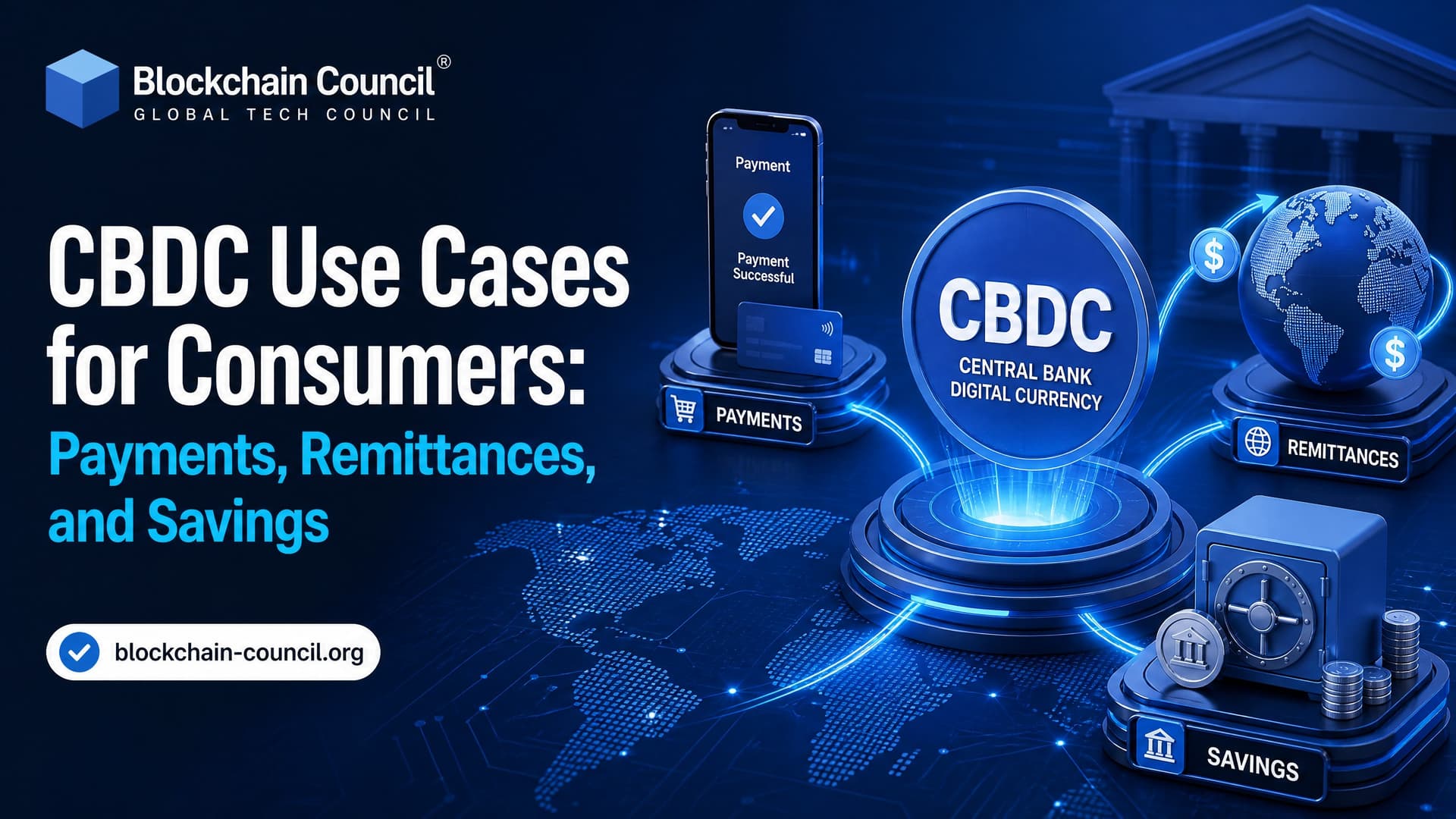
CBDC use cases for consumers are moving out of policy papers and into wallet pilots, merchant tests, and cross-border experiments. The practical question is simple: what would you actually do with central bank digital currency on a normal day? Professionals tracking this space closely, whether in banking, fintech, or policy, are increasingly formalizing that knowledge through a credential such as the Certified Central Bank Digital Currency (CBDC) Expert program, which walks through exactly the design trade-offs this article covers.
For most people the answer falls into three buckets. Pay for things. Send money to someone. Hold a small safe balance. Central banks describe retail CBDC as a digital form of central bank money for individuals and businesses, similar in value to cash but usable through digital wallets. That sounds plain. The design choices underneath are not.

What Is a Retail CBDC?
A retail CBDC is a general-purpose digital currency issued by a central bank and made available to the public. It differs from wholesale CBDC, which is aimed at banks and financial institutions for settlement between themselves.
For consumers, retail CBDC would usually appear as a wallet balance on a phone, card, hardware device, or bank app. You might use it at a store, for online shopping, for peer-to-peer transfers, or to receive a government benefit. The UK Information Commissioner's Office describes a possible digital pound as central bank digital money with the same value as physical money, usable for everyday payments in ways similar to bank account money.
The policy goals are consistent across many central banks: financial inclusion, payment efficiency, competition, a payment system backup during outages, and better cross-border transfers. A Federal Reserve Bank of Kansas City review found these among the most common reasons central banks explore retail CBDC.
Everyday Payments: Where CBDC Could Fit
Point-of-sale and online purchases
The first consumer use case is ordinary spending. You buy groceries, pay a pharmacy, scan a merchant QR code, or check out on an e-commerce site. Payments Canada describes general-purpose CBDC as a complement or possible substitute for physical banknotes in point-of-service and online transactions.
CBDC will not automatically beat cards or instant payment apps. To be blunt, if a CBDC wallet needs five taps while a card takes one, consumers will ignore it. The winning design has to be boringly fast, reliable, and accepted by enough merchants.
Where CBDC can stand out is settlement. A retail CBDC payment can be designed to settle in central bank money rather than through layers of card networks, acquirers, issuers, and delayed clearing files. That may reduce some costs for merchants and create a public payment rail beside private networks.
Peer-to-peer transfers
P2P payments are another core CBDC use case for consumers. Think of sending money to a family member, splitting rent, paying a local seller, or sending a small emergency amount to someone without a bank account.
The Federal Reserve Bank of Philadelphia's 2024 survey tested several CBDC scenarios, including online shopping, in-person payments, P2P transfers, savings, unbanked family support, and cross-border transfers. The strongest interest was in storing money or savings at 58.0 percent, followed by helping an unbanked family member make payments at 51.4 percent. That second figure matters. It shows CBDC interest is not only about tech preference. It is about access.
India's digital rupee pilots give a practical example. The Reserve Bank of India's retail CBDC model supports wallet-to-wallet transfers and consumer-to-merchant payments. In a real wallet build, the hard part is often not the transfer button. It is handling failed states. If a user loses connectivity after the debit is signed but before the merchant screen updates, the wallet needs a clear recovery path. Otherwise you get the worst possible support ticket: the payer says the money left, the merchant says nothing arrived. Building that kind of wallet and token logic correctly is close to the work covered in a Certified Digital Assets Expert program, since CBDC wallets share more with digital asset custody than with a typical banking app.
Offline payments and payment backup
Offline CBDC is one of the most important consumer features, and also one of the hardest. The Reserve Bank of New Zealand has identified offline payment capability as a way to support payments when other methods are unavailable, including during outages or in remote areas.
Offline design has real trade-offs. A wallet can store a limited offline balance and use secure hardware or cryptographic counters to reduce double-spending risk. But limits are necessary. Unlimited offline spending would invite fraud. Set the limits too low, and users see errors such as insufficient offline balance even though their main wallet shows funds. That mismatch can destroy trust quickly.
For rural users, disaster response, transport, and small merchants, offline CBDC could be a serious improvement over card terminals that fail when networks go down.
Remittances: Domestic and Cross-Border
Domestic remittances
Domestic remittances are money transfers within a country, often from urban workers to family in rural areas. CBDC wallets could reduce reliance on cash couriers, informal agents, or costly transfer services.
Financial inclusion research by Savita Shankar highlights domestic P2P remittances, customer-to-merchant payments, and government-to-person transfers as important CBDC use cases for underserved populations. The IMF has also noted that CBDC can help both banked and unbanked users participate in formal digital payments.
This is where wallet UX matters more than monetary theory. If the recipient uses a low-cost Android phone, has intermittent data, and shares the device with family, then account recovery, PIN reset, and language support become core infrastructure.
Cross-border remittances
Cross-border remittances are a major reason CBDC gets attention. Traditional correspondent banking can be slow, opaque, and expensive, especially for smaller transfers. CBDC corridors could shorten the chain of intermediaries and improve settlement speed.
India is a useful case to watch. Reports on the digital rupee point to experiments involving cross-border remittance corridors with Singapore and the United Arab Emirates. PwC's analysis of CBDC in India also identifies cross-border remittances as a central use case, especially where CBDC corridors can reduce delay and cost compared with older rails.
Still, do not treat CBDC remittances as solved. Cross-border transfers need legal alignment, foreign exchange handling, sanctions screening, data-sharing rules, dispute resolution, and wallet interoperability. A CBDC corridor is not just two blockchains or databases talking to each other. It is two monetary systems agreeing on rules.
Savings and Value Storage
CBDC as a small savings wallet
Many consumers see CBDC as a safe place to hold money, not only as a payment tool. The Federal Reserve Bank of Philadelphia survey found 58.0 percent interest in using a CBDC to store money or savings. The European Central Bank has also studied the digital euro as both a payment instrument and a safe store of value.
This is where central banks get cautious. If CBDC becomes too attractive as a savings product, people may move large deposits out of commercial banks, especially during periods of stress. That could affect bank funding and credit creation.
Expect design limits. Central banks may use holding caps, non-interest-bearing balances, or tiered remuneration. In plain English: CBDC may be good for spending money, emergency cash, and small balances, but it is not designed to replace a savings account, fixed deposit, or investment portfolio. Building the wallets, caps, and remuneration logic behind these limits is genuinely a software engineering problem, and teams shipping this kind of infrastructure often round out their skills with a general Tech Certification covering the broader software and systems side of the build, not just the monetary policy behind it.
Unbanked and underbanked users
For unbanked users, a CBDC wallet could act as a basic digital safe. It could let them receive wages, hold value, pay bills, and send money without opening a traditional bank account. Kaleido and IMF publications both point to this inclusion angle, especially when mobile wallets and offline access are available.
The hard part is identity. Strict know-your-customer rules can exclude the very people CBDC hopes to serve. Loose rules can increase fraud and illicit use. A tiered wallet model is likely: low-value wallets with lighter checks, higher limits with stronger identity verification.
Government Payments and Subsidies
Government-to-person payments are not always described as consumer payments, but they directly affect households. CBDC could support direct benefit transfers, emergency relief, tax refunds, pension payments, or targeted subsidies.
McKinsey has identified social benefit disbursement as a prime retail CBDC use case. Payments Canada has also discussed government disbursements as a prominent application, particularly where cash-based or voucher-based programs are costly to administer.
Programmability is useful here, but it should be handled carefully. Conditional payments can help with specific subsidies, such as funds usable only for certain categories. But over-programmed consumer money can feel controlling. For broad public trust, CBDC should preserve cash-like freedom wherever possible.
Privacy, Compliance, and Consumer Trust
CBDC adoption will depend heavily on privacy. Everyday payments create sensitive data: where you shop, who you send money to, when you receive wages, and what services you use.
The UK Information Commissioner's Office has warned that retail CBDCs involve large-scale processing of transaction and identity data, so privacy-by-design and data minimization are essential. This is not a side issue. It is the adoption issue.
Consumers will ask fair questions:
Who can see my transactions? The central bank, wallet provider, commercial bank, merchant, or law enforcement?
Can small payments stay private? Cash has strong privacy for low-value use.
What happens if my phone is lost? Recovery must be secure without making access impossible.
Can my wallet be frozen? Legal rules must be clear and narrow.
Privacy-preserving analytics, tiered identity, transaction limits, and strong audit controls will shape whether CBDC feels like digital cash or like a surveillance account.
What This Means for Blockchain and Fintech Professionals
CBDC is not the same as public cryptocurrency, but blockchain professionals have relevant skills. Wallet security, cryptographic signing, key recovery, token standards, interoperability, and smart contract risk all matter in CBDC design, even when the final system uses permissioned infrastructure or a centralized ledger.
If you work in fintech, payments, or Web3, focus on these areas:
Wallet architecture: custody models, recovery flows, device binding, and transaction signing.
Merchant integration: QR payments, point-of-sale APIs, refunds, reconciliation, and chargeback alternatives.
Offline security: spending limits, secure elements, double-spend controls, and sync logic.
Cross-border compliance: FX, sanctions screening, travel rule concepts, and transaction monitoring.
Privacy engineering: data minimization, selective disclosure, and access governance.
For structured learning, Blockchain Council programs such as the Certified Blockchain Expert, Certified Blockchain Developer, and Certified Cryptocurrency Expert map well to these skills. If your role touches payments security, pair CBDC knowledge with cybersecurity training too.
Future Outlook for CBDC Use Cases for Consumers
CBDC use cases for consumers will likely grow slowly, not suddenly. The most realistic path is coexistence with cards, bank transfers, instant payment systems, mobile wallets, and regulated stablecoins.
Everyday payments will come first, where merchants accept CBDC and wallet design is simple. Remittances will depend on corridor agreements and foreign exchange rules. Savings use will be intentionally limited, because central banks do not want CBDC to drain commercial bank deposits at scale.
None of this happens on technical merit alone. Central banks and wallet providers will need to explain CBDC clearly, build public trust, and drive real adoption among merchants and everyday users, which is as much a communications challenge as an engineering one. That is why some public sector and fintech teams are pairing their technical roadmap with a general Marketing Certification focused on communication, trust-building, and adoption strategy for exactly this kind of rollout.
Your next step: map one consumer journey, such as a migrant worker sending money home or a merchant accepting offline payments, then identify the wallet, identity, settlement, and privacy requirements. If you can design that flow clearly, you are already thinking like a CBDC product architect.
FAQs
1. What are the main CBDC use cases for consumers?
Central Bank Digital Currencies (CBDCs) could give consumers another way to make payments, transfer money, receive funds, and potentially store value in digital central bank money. Common consumer use cases include everyday retail purchases, person-to-person transfers, bill payments, government payments, remittances, and offline transactions. The exact functionality depends on each country's CBDC design. A CBDC is therefore better understood as potential public digital payment infrastructure rather than merely cryptocurrency wearing a government-issued tie.
2. How can consumers use CBDCs for everyday payments?
Consumers could potentially use retail CBDCs to pay for groceries, transportation, utilities, online purchases, and other goods and services. Payments might be initiated through mobile wallets, payment cards, QR codes, or other approved interfaces. Depending on the system, funds could transfer directly or through regulated intermediaries. For consumers, successful CBDC payments would need to be convenient, widely accepted, secure, and competitive with existing payment methods such as bank transfers, cards, mobile wallets, and instant-payment services.
3. How do CBDC wallets work for consumers?
A CBDC wallet is a digital interface that allows eligible users to hold or access CBDC, make payments, receive transfers, and review transactions. Wallets may be provided by commercial banks, payment companies, central banks, or authorized intermediaries depending on the CBDC model. Users may need identity verification and authentication before accessing certain features. Wallet design can also include transaction limits, recovery mechanisms, offline capabilities, and security controls intended to protect users from unauthorized access.
4. Can consumers send money directly to other people using CBDCs?
Retail CBDCs could support person-to-person payments, allowing consumers to transfer digital central bank money to family members, friends, workers, or other individuals. Transfers might use wallet identifiers, QR codes, phone numbers, or other payment credentials. Depending on the infrastructure, transactions could settle rapidly and potentially operate outside conventional banking hours. This could make CBDCs useful for splitting bills, transferring household funds, paying informal workers, or sending emergency financial support.
5. Can CBDCs make international remittances cheaper?
CBDCs could potentially reduce remittance costs if interoperable systems shorten payment chains and reduce dependence on multiple intermediaries. Migrant workers and families could benefit from faster transfers and greater transparency regarding fees and exchange rates. However, cross-border CBDC remittances require cooperation between jurisdictions, foreign-exchange liquidity, regulatory compliance, and compatible technical systems. Simply digitizing two currencies does not magically persuade two countries' financial regulations to become best friends overnight.
6. How can CBDCs make remittances faster?
CBDCs could support faster remittances by enabling digital settlement between compatible payment systems and reducing some correspondent banking or intermediary steps. Transactions might potentially settle in near real time rather than requiring lengthy processing periods. Actual speed would still depend on foreign-exchange conversion, AML checks, sanctions screening, wallet providers, and operating arrangements between jurisdictions. The largest benefits could emerge where existing remittance services are currently expensive, slow, or difficult to access.
7. Can consumers use CBDCs for online shopping?
Yes, retail CBDCs could potentially be integrated with e-commerce websites, applications, and digital marketplaces. Consumers might authorize payment using a CBDC wallet, QR code, or another secure payment mechanism. Merchants could receive funds through compatible payment infrastructure. CBDCs may provide an additional payment option alongside cards, bank transfers, and private digital wallets. Adoption would depend heavily on merchant integration, transaction costs, consumer protections, refund procedures, and the overall checkout experience.
8. Can CBDCs be used for contactless and QR-code payments?
CBDC systems can potentially support QR codes, NFC, contactless interfaces, and other payment technologies. QR payments may be particularly useful because they can work with relatively inexpensive merchant infrastructure. Contactless functionality could make CBDCs convenient for transportation, retail stores, restaurants, and other high-frequency transactions. The specific payment methods available would depend on wallet providers and national technical standards rather than being an inherent feature of CBDCs themselves.
9. Can consumers make offline payments with CBDCs?
Some CBDC designs are exploring offline payments that could allow transactions when internet or mobile connectivity is temporarily unavailable. This may be particularly useful in remote communities, during network outages, or in emergencies. Offline CBDCs require mechanisms to prevent double spending, fraud, and device manipulation while maintaining acceptable privacy and usability. Transaction or holding limits may therefore be applied. Building digital cash that works without the digital network is, predictably, one of the less trivial engineering problems involved.
10. Can consumers use CBDCs to pay bills automatically?
CBDCs or connected payment services could potentially support recurring and automated payments for utilities, subscriptions, insurance premiums, rent, or other bills. Payment instructions might be scheduled by consumers or triggered through authorized services. More advanced systems could support conditional payment functionality. Consumer protections would be essential, including clear authorization, cancellation mechanisms, transaction records, and dispute procedures so automation does not quietly turn into permission for services to withdraw money indefinitely.
11. Can consumers receive salaries through CBDCs?
Depending on national rules and employer adoption, retail CBDCs could potentially be used to receive salaries or other regular payments. Employers could transfer digital central bank money directly to compatible employee wallets or accounts. Faster settlement could make funds available quickly and potentially reduce some payment-processing friction. However, payroll integration would require appropriate accounting, tax, identity, labor-law, and enterprise-system support. Consumers would also need practical ways to move funds between CBDCs and conventional bank accounts.
12. Can governments make benefit payments through CBDCs?
CBDCs could potentially be used to distribute pensions, subsidies, emergency assistance, tax refunds, or other government payments. Digital distribution may reduce processing delays and improve access where suitable wallet infrastructure exists. However, public payments raise important questions about accessibility, privacy, digital exclusion, and system resilience. Citizens who lack smartphones, reliable internet, formal identification, or digital skills should not be disadvantaged merely because an administration has developed a sudden and passionate relationship with digitization.
13. Can consumers use CBDCs for savings?
Consumers could potentially hold CBDCs as a form of digital central bank money, but whether CBDCs function as practical savings instruments depends on their design. Some systems may impose holding limits or use other mechanisms to discourage large movements of deposits away from commercial banks. CBDCs may also be non-interest-bearing. Consumers would therefore need to compare CBDCs with bank deposits and other savings products based on returns, protections, liquidity, functionality, and applicable limits.
14. Will consumers earn interest on CBDC savings?
Not necessarily. Whether a CBDC pays interest is a policy decision for the issuing central bank. Many retail CBDC designs may be structured primarily as payment instruments rather than interest-bearing savings products. Policymakers may avoid or limit remuneration because attractive CBDC interest rates could encourage consumers to move deposits away from commercial banks. Tiered interest or holding limits are possible design options. Consumers should therefore not assume that a CBDC wallet will function like an interest-bearing savings account.
15. Are CBDCs safer than keeping money in a digital wallet?
A CBDC represents central bank money, but the security of consumer access also depends on the wallet and surrounding infrastructure. Users can still face risks such as phishing, stolen devices, credential theft, malware, or social engineering. Secure CBDC systems may use multi-factor authentication, encryption, hardware security, transaction monitoring, and recovery procedures. Consumers would still need sensible digital-security habits because sovereign backing does not prevent someone from handing their password to a remarkably convincing fake support agent.
16. What happens if a consumer loses a phone containing a CBDC wallet?
CBDC systems can be designed with recovery procedures that allow users to restore access after losing or replacing a device. Recovery might involve identity verification, backup credentials, financial intermediaries, or other secure mechanisms. The exact approach depends on whether the CBDC uses account-based, token-based, or hybrid architecture. Recovery mechanisms must balance convenience with security because overly weak recovery processes can allow criminals to impersonate legitimate users and gain access to their funds.
17. Are consumer CBDC payments private?
The level of privacy depends on the CBDC's technical and legal design. Some systems may offer greater privacy for lower-value payments while requiring stronger identification for larger transactions. Techniques such as data minimization, pseudonymous identifiers, and privacy-enhancing technologies may reduce unnecessary disclosure. However, CBDCs generally need to operate within applicable AML and financial-crime frameworks. Consumers should therefore distinguish transaction privacy from complete anonymity, as the two are not necessarily the same.
18. How could CBDCs improve financial inclusion for consumers?
CBDCs could improve financial inclusion by providing low-cost digital payment access to people who are underserved by traditional banking services. Simplified wallets, low transaction costs, offline functionality, and compatibility with basic devices could broaden access. However, poor design could create new barriers for people without smartphones, internet connectivity, identification documents, or digital literacy. Genuine financial inclusion therefore requires accessible technology, suitable onboarding, consumer education, and alternatives for users with limited digital access.
19. What are the risks of using CBDCs for payments and savings?
Consumer risks may include cybersecurity attacks, scams, privacy concerns, device loss, service outages, identity theft, and unfamiliarity with new payment technology. CBDC design can also influence commercial-bank deposits and broader financial stability, potentially leading policymakers to impose holding or transaction limits. Strong consumer protection, wallet recovery, cybersecurity, transparent privacy rules, and accessible support services will be important. Consumers should understand the specific protections and limitations of their jurisdiction's CBDC rather than assuming all CBDCs operate identically.
20. What is the future of CBDC use cases for consumers?
Future consumer CBDCs may support everyday payments, person-to-person transfers, remittances, government disbursements, e-commerce, offline transactions, and integration with increasingly digital financial services. Their success will depend less on technological novelty and more on whether they offer consumers meaningful improvements in cost, convenience, security, privacy, accessibility, or resilience. In countries where existing digital payments already work extremely well, CBDCs will need a particularly convincing value proposition. Consumers tend to care considerably more about whether payment works than which magnificent architecture diagram made it possible.
Related Articles
View All
Digital Assets
CBDC Use Cases for Cross-Border Trade: Reducing Friction in Global Commerce
Explore CBDC use cases for cross-border trade, including mBridge, wholesale CBDCs, PvP, DvP, compliance, and faster global settlement.

Digital Assets
CBDC Use Cases for Businesses: Faster Settlement, Lower Costs, and Automation
Explore practical CBDC use cases for businesses, including faster settlement, lower B2B payment costs, programmable tax flows, and treasury automation.

Digital Assets
Best RWA Tokenization Platforms: Features, Use Cases, and Selection Criteria
Compare the best RWA tokenization platforms, including Securitize, Ondo Finance, Franklin Templeton, Centrifuge, Maple, Paxos, Tether, and Tokeny.
Trending Articles
The Role of Blockchain in Ethical AI Development
How blockchain technology is being used to promote transparency and accountability in artificial intelligence systems.

Top 5 DeFi Platforms
Explore the leading decentralized finance platforms and what makes each one unique in the evolving DeFi landscape.
How Blockchain Secures AI Data
Understand how blockchain technology is being applied to protect the integrity and security of AI training data.