

How RWA Tokenization Handles Off-Chain Data and Real-World Records
 Suyash Raizada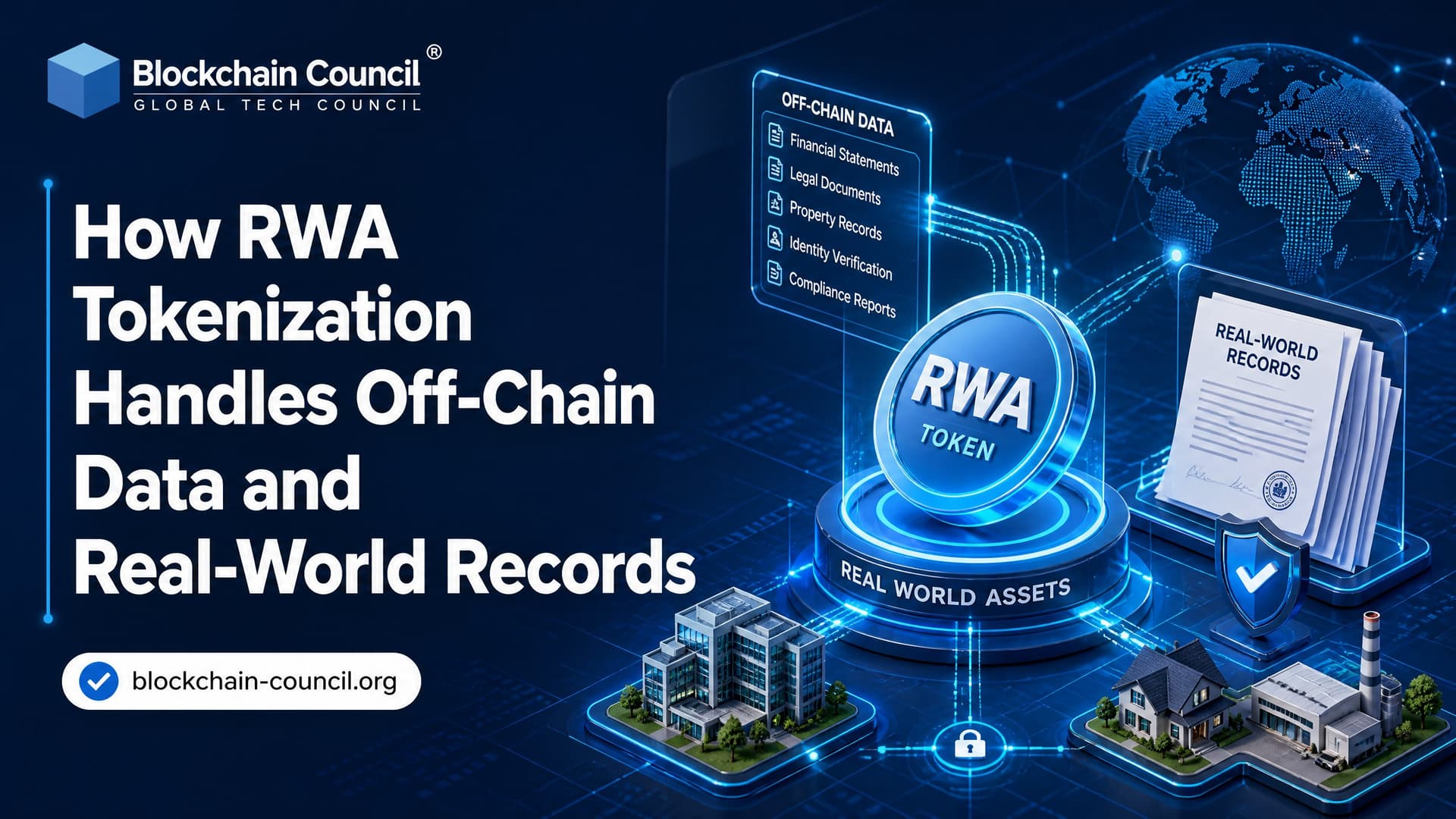
RWA tokenization does not put a property deed, loan agreement, warehouse receipt, or investor KYC file directly on a blockchain. That would be expensive, public, and often illegal. Serious RWA systems use a hybrid design instead: legal and operational records stay off-chain, while smart contracts hold token balances, permissions, cryptographic commitments, and verified updates from trusted data pipelines. Making sense of where these boundaries sit is exactly what a Certified RWA Tokenization Expert background is meant to build, since the hybrid split between legal record and on-chain record trips up a lot of newcomers.
That split is the whole challenge. A token may move on Ethereum, Polygon, or another network, but the legal asset still sits in a land registry, a custodian account, a fund vehicle, a warehouse, or a regulated intermediary. If those two states drift apart, the token becomes a clean digital wrapper around a messy real-world claim. Not good.

Why Off-Chain Data Matters in RWA Tokenization
In RWA tokenization, the blockchain usually records the computational state: who holds the token, whether transfers are allowed, what redemption rules apply, and which oracle values the contract accepts. The off-chain world records the legal and operational state: title, custody, valuation, collateral status, investor eligibility, audit reports, and payment schedules. Recognizing which state governs which decision is a core part of what a Certified Digital Assets Expert designation trains people to do, rather than assuming the smart contract is the whole story.
For tokenized Treasuries, that off-chain state may include custodial account records and fund NAV calculations. For real estate, it covers title documents, leases, appraisals, insurance records, and SPV agreements. For private credit, it means borrower financials, covenant reports, servicing files, and payment history.
The hard part is not minting a token. Any Solidity developer can do that with ERC-20 or ERC-1400-style permissioning patterns. The hard part is proving that the token still maps to the underlying asset after transfers, valuation changes, defaults, redemptions, and regulatory checks.
The Hybrid Architecture Behind Tokenized Real-World Assets
Most institutional RWA platforms follow a similar pattern:
A legal wrapper, such as an SPV, trust, fund, or regulated issuer, holds or controls the asset.
A custodian or administrator maintains real-world records and operational workflows.
Off-chain storage keeps contracts, reports, investor files, and asset documents private.
On-chain smart contracts represent balances, transfer restrictions, redemption rights, and data commitments.
Oracles and attestations update the blockchain with selected facts from the off-chain system.
This is why RWA tokenization is not pure DeFi. It is a bridge between legal finance and programmable settlement. The bridge needs anchors on both sides.
Legal Truth Versus On-Chain Truth
Think about it this way. The off-chain registry decides whether the claim is enforceable, while the smart contract decides how the token behaves. If a tokenized bond position says you own 100 units on-chain, the issuer must still have legal records that recognize the entitlement. If the issuer does not, the blockchain record alone may not help you much in court.
Regulation is catching up to this model. The EU Markets in Crypto-Assets Regulation, usually called MiCA, recognizes asset-referenced tokens where the referenced assets and provenance details exist outside the token itself. That pushes issuers toward clearer metadata, better documentation, and verifiable references to off-chain records.
How Platforms Store Real-World Records Without Exposing Them
Putting full legal documents on a public chain is usually the wrong design. Public blockchains are poor places for sensitive loan files, investor identities, property agreements, and commercial terms. They are also hard to correct if personal data must be deleted or restricted.
Platforms store records in controlled databases, document management systems, or decentralized storage networks such as IPFS. Some use Ceramic or private data rooms for mutable workflows and identity-linked records. The blockchain stores a cryptographic fingerprint of the document, often a hash or a Merkle root.
Here is the practical flow:
A legal document, appraisal, reserve report, or audit file is created off-chain.
The platform calculates a cryptographic hash of that file.
The hash, document version, timestamp, and issuer reference are committed on-chain.
If the document changes, the new version gets a new hash and a new commitment.
Auditors can later verify that the presented file matches the original commitment.
This does not prove the document is true by itself. A false appraisal can still be hashed perfectly. But it does prove whether a specific record was changed after commitment. That matters in audits, disputes, and redemption events.
Oracles: The Data Pipes Between Records and Smart Contracts
RWA smart contracts need current information. Price. NAV. Reserve coverage. Collateral ratios. KYC status. Covenant breaches. These facts usually originate outside the chain, so they arrive through oracle networks, issuer attestations, administrator feeds, or verifiable computation systems.
Chainlink is the best-known oracle provider in this area and reports that its networks have brought billions of off-chain data points on-chain. Its data feeds aggregate pricing from external sources and publish values that smart contracts can read. Proof-of-reserve feeds can also report whether reserves backing an asset remain sufficient.
Still, do not treat an oracle as magic. An oracle only improves the data path if the source, aggregation method, signing process, and update frequency are fit for the asset. A daily NAV feed is fine for a private credit fund with monthly liquidity. It is a bad fit for collateral that can be liquidated intraday.
A Detail Developers Learn the Hard Way
If you have built with Chainlink price feeds, you know the latestRoundData() function returns more than a price. It returns roundId, answer, startedAt, updatedAt, and answeredInRound. Beginners often read only answer and forget to check whether updatedAt is stale or whether the answer is less than or equal to zero. That mistake can turn a stale RWA valuation into a live contract decision. In production, fail closed with a clear revert such as execution reverted: stale price, rather than letting a redemption or liquidation continue on old data.
Handling Different Types of Off-Chain RWA Data
1. Legal and Ownership Records
Property titles, stock certificates, fund subscription documents, warehouse receipts, and custody agreements usually stay in legal systems. The token references them through document IDs, hashes, issuer records, or administrator attestations.
Take real estate tokenization. The token does not replace the land registry. It may represent an interest in an SPV that owns the property. The deed, lease file, insurance policy, and appraisal report remain off-chain, while the token contract records ownership of the digital claim and links to verified document commitments.
2. Valuation and Performance Data
Valuation is where many RWA projects get exposed. Tokenized private credit positions depend on borrower financials and covenant reporting. Tokenized real estate funds depend on appraisals, rental income, expenses, and occupancy data. Tokenized government bond products depend on market prices, custody records, and fund accounting.
These values feed smart contracts through oracles or administrator-signed updates. Better systems also keep audit trails that show which source produced the value, when it was calculated, and which off-chain inputs were used.
3. Compliance and KYC Data
Compliance data is rarely public. Investor identity, accreditation status, sanctions screening, and jurisdictional eligibility sit with regulated entities. On-chain contracts usually receive a yes-or-no permission signal, not the underlying personal file.
This can run through allowlists, signed attestations, soulbound credentials, or verifiable credentials. For permissioned RWA tokens, transfer functions often check whether both sender and receiver are approved before allowing movement. That is less open than standard ERC-20 behavior, but it is often necessary for regulated assets.
4. Reserve and Custody Data
Commodity-backed tokens, Treasury-backed tokens, and inventory-backed assets need evidence that the backing assets exist. Proof-of-reserve systems publish attestations about balances or holdings. Custodians, auditors, and data providers may sign those reports before they are committed on-chain.
The trade-off is clear. Frequent automated reserve checks improve visibility, but they still depend on the quality of the custodian data. Periodic human audits carry legal weight, but they are slower. Strong RWA platforms use both.
Where Zero-Knowledge Proofs Fit
Zero-knowledge proofs help when a platform must prove something about off-chain data without revealing the data itself. An issuer might want to prove that a portfolio NAV was calculated correctly, or that an investor meets eligibility requirements, without publishing every loan record or identity document.
This is not needed for every project. To be blunt, many early RWA products can start with signed attestations, good audit logs, and conservative oracle rules. Zero-knowledge systems add cost and engineering complexity. They make more sense for private credit, regulated funds, and institutional workflows where privacy and verifiability both matter.
Main Risks in Off-Chain Data Handling
Stale data: A valuation or reserve update arrives late, but the contract still acts on it.
False inputs: A bad appraisal, incorrect NAV, or manipulated inventory report gets committed on-chain.
Broken legal mapping: The token owner and the legal owner are not aligned.
Weak accountability: It is unclear whether the issuer, oracle provider, custodian, or administrator is liable for an error.
Privacy leakage: Sensitive commercial or personal data is exposed through careless metadata design.
The safest design is boring in the best way: hash documents, version everything, validate oracle freshness, separate duties between issuers and data providers, keep personal data off-chain, and document who is responsible for each update.
Preparing the Next Generation for Emerging Tech
Tracking how data moves between two systems, checking whether a record can be trusted, and designing around failure cases are the same instincts that show up in good off-chain data handling and they can be cultivated long before someone builds a smart contract. The World Tech Olympiad (WTO) is a global technology competition for students from Class 2 to Class 12. Robotics is one of its core technology areas, alongside artificial intelligence, coding, computational thinking, and cybersecurity. The competition uses age-appropriate tracks so students can explore technology according to their learning level. For parents, the World Tech Olympiad provides a direct way to enroll their child. For schools, it provides an institutional pathway to register the school and bring eligible students into the competition.
What Professionals Should Learn Next
If you work with digital assets, RWA tokenization demands more than smart contract syntax. You need to understand custody, legal wrappers, oracle design, compliance workflows, and data integrity. Developers should be comfortable with Solidity 0.8.x, ERC token behavior, oracle interfaces, and permissioned transfer logic. Product and compliance teams should understand how off-chain records become enforceable on-chain signals. Teams building the broader systems around this data pipeline also tend to draw on a general Tech Certification to strengthen the engineering fundamentals that sit underneath any single blockchain framework.
For structured learning, look at Blockchain Council programs such as Certified Blockchain Expert™, Certified Blockchain Developer™, Certified Smart Contract Developer™, and Certified Web3 Expert™. If your focus is asset issuance or crypto markets, Certified Cryptocurrency Expert™ is also relevant. Teams responsible for explaining this hybrid legal-and-technical model to investors or the public may also want to pair that knowledge with a Marketing Certification, since communicating what actually sits off-chain versus on-chain is often the difference between building trust and losing it.
Your next practical step: map one real asset from legal record to token state. List every off-chain document, every oracle input, every signer, every update frequency, and every failure case. If that map has gaps, the token design is not ready for production.
FAQs
1. What is off-chain data in RWA tokenization?
Off-chain data refers to information that exists outside a blockchain network. In RWA tokenization, this can include property records, legal agreements, financial statements, valuations, custody documents, identity information, invoices, and physical asset records.
2. Why is off-chain data important for RWA tokenization?
Real-world assets exist outside the blockchain, so important information about them cannot be stored entirely on-chain. Off-chain records provide the legal, financial, physical, and operational information needed to establish what a token represents.
3. How does RWA tokenization connect off-chain records to blockchain?
A typical system uses legal agreements, custodians, databases, APIs, oracles, and tokenization platforms to connect real-world records with blockchain tokens. Relevant information is verified off-chain before selected data or references are incorporated into the on-chain system.
4. What types of off-chain records are used in RWA tokenization?
Common examples include property deeds, asset certificates, valuation reports, financial statements, custody records, invoices, loan agreements, ownership documents, insurance records, and regulatory documentation.
5. Are all RWA records stored on the blockchain?
No. Storing every document directly on-chain can be expensive, inefficient, and potentially expose sensitive information. Many systems keep detailed documents off-chain while storing relevant identifiers, transaction records, hashes, or references on the blockchain.
6. What is the difference between on-chain and off-chain data?
On-chain data is recorded directly on a blockchain, such as token balances, transfers, and smart contract activity. Off-chain data is maintained outside the blockchain, such as legal documents, physical asset information, valuations, and private investor records.
7. How do oracles connect off-chain data to blockchain networks?
Oracles act as a bridge between external information and smart contracts. They can retrieve relevant data from trusted sources, validate or aggregate it, and transmit selected information to blockchain applications for automated calculations or predefined actions.
8. How is real-world asset data verified before going on-chain?
Verification can involve auditors, custodians, appraisers, government registries, financial institutions, inspection companies, or other trusted entities. The appropriate verification method depends on the type and value of the asset.
9. How does RWA tokenization handle property records?
For tokenized real estate, property information may remain in government or institutional records while the blockchain stores tokens representing defined rights. The connection can be supported by title documents, legal agreements, property identifiers, valuations, and custodial or administrative records.
10. How are financial records handled in RWA tokenization?
Financial information such as income statements, debt records, interest payments, and transaction histories can remain within traditional financial systems. Relevant information can be transferred to blockchain applications through APIs, data providers, oracles, or tokenization platforms.
11. How does RWA tokenization protect sensitive off-chain data?
Sensitive information can remain in controlled databases rather than being publicly recorded on-chain. Systems can use encryption, access controls, permissioned databases, identity management, and selective data sharing to protect confidential information.
12. What role do APIs play in RWA tokenization?
APIs allow blockchain applications and tokenization platforms to communicate with external databases and financial systems. They can help transfer information such as asset status, payment records, valuations, investor information, and transaction details between systems.
13. How do hashes help connect off-chain documents with blockchain?
A cryptographic hash can create a unique digital fingerprint of a document or dataset. Recording the hash on a blockchain can help demonstrate that a particular document has not been altered since the referenced version was recorded, although the hash itself does not prove that the document's contents are truthful.
14. Can off-chain data be changed after an RWA token is issued?
Yes. Real-world information can change over time. For example, property values, ownership records, loan balances, or financial conditions may change. Tokenization systems therefore need processes for updating and verifying relevant information.
15. How do smart contracts use off-chain information?
Smart contracts can receive selected external information through oracles or other approved integrations. They can then use that information to perform predefined functions such as calculating payments, updating collateral values, enforcing conditions, or triggering permitted transactions.
16. What happens if off-chain data is inaccurate?
Incorrect information can lead to incorrect blockchain actions if smart contracts rely on it. For example, an inaccurate valuation could affect payment or collateral calculations. This makes data verification, multiple sources, audits, and monitoring important components of RWA infrastructure.
17. How does RWA tokenization maintain data consistency?
Consistency can be maintained through data validation, synchronized databases, unique asset identifiers, regular reconciliations, audits, oracle updates, and blockchain records. The goal is to keep the legal and operational status of the underlying asset aligned with its digital representation.
18. What is the role of custodians in managing off-chain RWA data?
Custodians can hold or administer the underlying asset and maintain records confirming its status. Their records can provide an important source of evidence connecting physical or financial assets with blockchain-based tokens.
19. What are the biggest challenges of handling off-chain data in RWA tokenization?
Major challenges include data accuracy, privacy, interoperability, outdated records, inconsistent databases, cybersecurity, oracle reliability, regulatory requirements, and reconciliation between traditional and blockchain systems.
20. Why is off-chain data management important for the future of RWA tokenization?
RWA tokenization depends on accurately connecting blockchain records with real-world information. Effective off-chain data management can help ensure that token ownership, asset valuations, legal rights, payments, and physical or financial records remain aligned, making tokenized assets more reliable and useful for businesses and investors.
Related Articles
View All
Digital Assets
RWA Tokenization Architecture: Core Components and Data Flow
RWA tokenization architecture connects legal asset wrappers, compliance engines, oracles, settlement modules, and applications into one production-ready stack.

Digital Assets
Is an RWA Tokenization Certification Worth It? Benefits, Careers, and ROI
Is an RWA tokenization certification worth it? Learn the benefits, career paths, market growth, and ROI factors for blockchain and finance professionals.

Digital Assets
How to Become an RWA Tokenization Expert: Skills, Tools, and Career Path
Learn how to become an RWA tokenization expert with the right blockchain, finance, compliance, tools, and career roadmap for tokenized assets.
Trending Articles
How Blockchain Secures AI Data
Understand how blockchain technology is being applied to protect the integrity and security of AI training data.
What is AWS? A Beginner's Guide to Cloud Computing
Everything you need to know about Amazon Web Services, cloud computing fundamentals, and career opportunities.

Can DeFi 2.0 Bridge the Gap Between Traditional and Decentralized Finance?
The next generation of DeFi protocols aims to connect traditional banking with decentralized finance ecosystems.