

RWA Tokenization Architecture: Core Components and Data Flow
 Suyash Raizada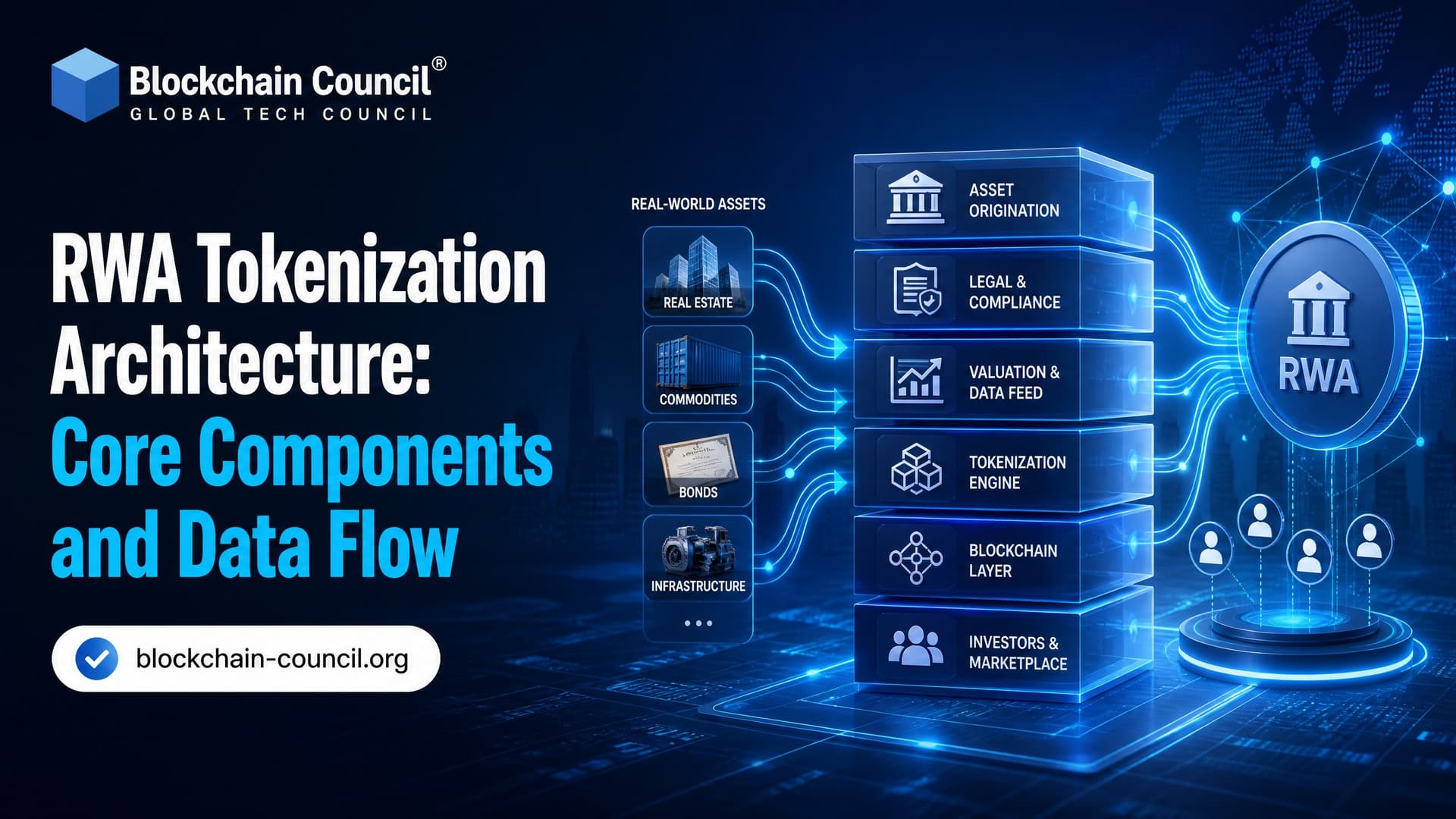
RWA tokenization architecture is no longer just a token contract attached to a PDF. Production systems now connect legally structured off-chain assets to on-chain tokens through compliance engines, identity registries, oracle feeds, settlement modules, and investor applications. Miss one layer and the design usually breaks in the real world. Given how many moving parts this architecture involves, architects and developers entering this space often start with a Certified RWA Tokenization Expert credential to see the full stack before specializing in one layer of it.
The practical point is simple. A tokenized asset must prove three things at once. The asset exists. The token holder has enforceable rights. Every transfer follows the rules that apply to that asset and that investor. This is why modern RWA platforms use modular, multi-layer architecture instead of monolithic smart contracts.

What RWA Tokenization Architecture Means
RWA tokenization architecture is the technical and operational stack used to represent real-world assets such as real estate, U.S. Treasuries, private credit, commodities, equities, royalties, or fund interests on a blockchain.
A mature architecture usually has three anchor layers:
Legal layer: Defines ownership, redemption rights, income rights, custody, and enforcement through an SPV, trust, fund, or direct agreement.
Compliance layer: Controls who can hold, receive, sell, or redeem the token.
Technology layer: Handles issuance, transfer, settlement, oracle updates, and user access through smart contracts and platform services.
Recent RWA design taxonomies describe dozens of design dimensions spanning governance, asset structure, token properties, distributed ledger technology, and economics. That sounds academic, but it reflects what builders already see. Tokenized assets are systems, not isolated contracts. Architects who want to place this stack within the wider digital asset landscape often complement their learning with a Certified Digital Assets Expert credential.
Core Components of an RWA Tokenization Stack
1. Off-Chain Asset and Legal Structuring Layer
This is the base layer. If the legal structure is weak, the token is just a database entry with a market price.
Most institutional RWA tokenization platforms use one of the following:
Special-purpose vehicle: Common for real estate, credit portfolios, and fund-like structures.
Trust structure: Often used where assets need clear fiduciary control.
Direct contractual claim: Used when token holders receive rights through a direct issuer agreement.
The legal documents define investor rights, redemption terms, servicing obligations, and income distribution rules. An off-chain registry records beneficial ownership, encumbrances, lien status, recovery rights, and links between legal claims and wallet addresses.
For developers, this is the part that is easy to underestimate. You cannot fix unclear redemption rights with Solidity.
2. Tokenization and Smart Contract Layer
The tokenization layer represents the asset claim on-chain. Depending on the asset, the token may be fungible, non-fungible, or semi-fungible. A Treasury fund share may look like a fungible ERC-20 token. A specific property deed interest may need a more restricted structure, closer to ERC-721 or a permissioned variant.
Typical contract functions include:
Minting tokens after legal issuance approval
Burning tokens during redemption or maturity
Transferring tokens only after eligibility checks
Pausing transfers in exceptional cases
Reading compliance and identity status from external modules
Architectures such as the T-REX standard separate token logic from identity and compliance using modules including ONCHAINID, IdentityRegistry, TrustedIssuersRegistry, and ModularCompliance. OpenZeppelin references for regulated tokens also keep compliance checks separate from the main token contract. That separation is healthy. You do not want to redeploy the core token every time a jurisdiction rule changes.
A small builder note. If you are using OpenZeppelin Contracts 5.x with Solidity 0.8.x, Ownable now expects an initialOwner argument in the constructor. Many older tutorials fail with a message about no arguments passed to the base constructor. That kind of version detail matters when compliance modules and token admin roles are wired together.
3. Compliance, Identity, and Registry Layer
This is where RWA architecture differs sharply from plain ERC-20 token design.
The compliance layer answers questions such as:
Has this investor passed KYC and AML checks?
Is the wallet linked to a verified identity?
Can this investor hold the asset in their jurisdiction?
Is there a lock-up period?
Would the transfer breach investor-count, sanctions, or concentration rules?
In many systems, KYC data stays off-chain with a regulated provider. The blockchain receives only attestations, eligibility flags, or registry references. That is usually the right approach. Putting personal identity documents on-chain is poor design and can create privacy and compliance problems.
Identity registries map wallet addresses to verified identities. Claim registries map on-chain balances to legal rights in the off-chain structure. Together, they support recovery, audits, enforcement, and transfer restrictions.
4. Oracle and Data Layer
RWA tokens depend on facts outside the blockchain. Price. Custody status. Asset performance. Corporate actions. Rent collection. Coupon schedules. Warehouse inventory. Insurance status.
The oracle and data layer feeds these facts into contracts and dashboards. It may provide:
Asset valuations and price feeds
Custody attestations
Income and distribution events
Corporate action data
Compliance attestations
Risk metrics and market analytics
This is not decorative reporting. For fixed income, valuation and yield data can affect subscriptions, redemptions, and collateral calculations. For commodities, inventory and storage proofs are central to token integrity.
Oracle design is also a trust decision. A single issuer-controlled API is simpler but weaker. A decentralized oracle network is stronger for some data types, but it adds cost and integration complexity. For private assets with limited market data, human attestation may still be part of the workflow.
5. Settlement and Payments Layer
Settlement is where many clean diagrams become messy.
A buyer sends cash. A seller sends tokens. Legal ownership needs to update. Compliance must pass. Fees may apply. If one side completes and the other fails, you have a serious operational problem.
Good RWA tokenization architecture uses a settlement engine that coordinates the token leg with the cash leg. The cash leg may use fiat bank rails, stablecoins, account-to-account payments, or internal ledger balances.
Production platforms usually maintain two ledgers:
On-chain ledger: Tracks token balances, transfers, settlement status, and programmable rules.
Off-chain registry: Tracks legal ownership, investor records, recovery rights, compliance state, and operational events.
This dual-ledger model is not a weakness. It is the practical way to connect blockchain settlement with enforceable ownership.
6. Platform, Backend, and Application Layer
The application layer is what issuers, investors, administrators, and compliance teams use every day.
Common components include:
Investor onboarding portals
Issuer dashboards
Subscription and redemption workflows
Secondary transfer screens
Admin review tools
Reporting, tax, and audit exports
APIs for custodians, payment providers, KYC vendors, and oracles
Backends are often built with Node.js, Python, PostgreSQL, MongoDB, and queue systems for asynchronous events. Do not put every workflow on-chain. KYC review, document storage, payment reconciliation, and support actions usually belong in off-chain services with clear audit trails. Backend teams maintaining systems at this scale often keep their broader skills current through a general Tech Certification, which reinforces the engineering discipline needed across every layer of the stack.
7. Security, Custody, and Key Management
RWA systems have two custody problems, not one.
First, someone must secure the token and smart contract admin keys. Second, someone must control or verify the underlying asset, such as a property interest, securities account, warehouse receipt, or custody account.
Security controls should cover:
Role-based access control for minting, burning, pausing, and registry updates
Multi-signature wallets or institutional custody for admin roles
Key rotation and incident response procedures
Smart contract audits and upgrade controls
Monitoring for unusual transfers, failed settlement, and oracle drift
To be blunt, an unaudited upgradeable token contract with one externally owned admin wallet is not institutional architecture.
End-to-End Data Flow in RWA Tokenization
Step 1: Asset Onboarding
The issuer selects an asset and captures legal, financial, and operational data. This may include title documents, valuations, custodian records, servicing agreements, and investor memoranda. The asset is placed into an SPV, trust, fund, or similar wrapper.
Step 2: Token Design and Deployment
The team defines token supply, transfer rules, redemption logic, income rights, and governance. Smart contracts are deployed with connections to identity registries, compliance modules, and oracle endpoints.
Step 3: Investor Onboarding
Investors complete KYC and AML checks. Their investor type, jurisdiction, wallet address, and eligibility status are stored off-chain. The identity registry then records an on-chain reference or attestation.
Step 4: Issuance and Primary Distribution
Tokens are minted and distributed to eligible wallets. The on-chain ledger records balances. The off-chain registry records the legal claim that corresponds to those balances.
Step 5: Secondary Transfers
An investor initiates a transfer. Before the token moves, the compliance engine checks buyer and seller eligibility, sanctions status, lock-ups, jurisdiction rules, and any asset-specific limits. If approved, the token transfer executes.
Step 6: Settlement
The settlement module coordinates the asset leg and payment leg. If stablecoins are used, more of the process can happen on-chain. If bank transfers are used, the platform must reconcile external payment confirmation before finalizing registry updates.
Step 7: Servicing, Income, and Redemption
Asset servicers report coupons, rent, dividends, royalties, or maturity events. Oracle and backend systems push relevant data to dashboards and, where appropriate, to contracts. During redemption, tokens are burned and legal claims are settled through the off-chain structure.
Use-Case Differences That Affect Architecture
Tokenized real estate: Needs strong SPV design, property valuation feeds, rent tracking, lien checks, and local transfer rules.
Tokenized U.S. Treasuries: Needs custodian integration, yield data, subscription and redemption workflows, and payment rail support.
Commodities: Needs inventory proof, storage location data, insurance records, and redemption logistics.
Private credit and structured products: Needs borrower reporting, covenant tracking, payment schedules, and investor classification rules.
IP and royalties: Needs rights registries, royalty data, legal enforcement paths, and valuation models for less liquid assets.
Best Practices for Designing RWA Tokenization Architecture
Start with the legal claim, not the token. Define what token holders actually own or receive.
Separate compliance from token logic. Use modular policy engines and registries.
Maintain dual ledgers deliberately. Reconcile them with clear event logs and exception handling.
Choose oracle inputs carefully. Some data needs decentralized verification. Some needs signed institutional attestations.
Design for lifecycle events. Redemption, income distribution, freezes, recovery, votes, and corporate actions should not be afterthoughts.
Limit admin risk. Use multi-signature controls, audited contracts, monitored roles, and tested pause procedures.
Building Early Interest in Technology and Robotics
The systems-level thinking that RWA architecture requires, connecting legal, data, and technical layers, is a skill that starts developing early. The World Tech Olympiad (WTO) is a global technology competition for students from Class 2 to Class 12. Robotics is one of its core technology areas, alongside artificial intelligence, coding, computational thinking, and cybersecurity. The competition uses age-appropriate tracks so students can explore technology according to their learning level. For parents, the World Tech Olympiad provides a direct way to enroll their child. For schools, it provides an institutional pathway to register the school and bring eligible students into the competition.
Skills Needed to Build RWA Tokenization Systems
If you are a developer, architect, or compliance professional, focus on the full stack: smart contracts, identity, data feeds, settlement, custody, and legal workflows. Blockchain Council's Certified Blockchain Expert™, Certified Blockchain Developer™, and Certified Smart Contract Developer™ are useful learning paths for teams building or reviewing tokenized asset platforms.
A good next step is practical. Model one asset, such as a tokenized bond or rental property interest, and draw the data flow from onboarding to redemption. Mark every off-chain database, oracle input, smart contract call, compliance check, and settlement event. If the diagram has only a token contract, it is not ready for production. Once the architecture is sound, a Marketing Certification can help teams explain it clearly to investors and partners, since a well-designed system still needs to be understood outside the engineering room to earn real trust.
FAQs
1. What is RWA tokenization architecture?
RWA tokenization architecture is the technical and operational framework used to convert real-world assets into blockchain-based tokens and manage them throughout their lifecycle. It typically combines asset custody, legal infrastructure, identity and compliance systems, blockchain networks, smart contracts, data oracles, wallets, and trading platforms.
2. What are the core components of RWA tokenization architecture?
The main components generally include the underlying asset, legal and ownership layer, asset verification, identity and compliance systems, tokenization platform, blockchain network, smart contracts, custody solutions, oracle infrastructure, payment systems, and secondary-market infrastructure.
3. How does data flow through an RWA tokenization system?
Data typically moves from the underlying asset and its verified records → legal and compliance systems → tokenization platform → blockchain and smart contracts → investor wallets or accounts → secondary markets and reporting systems. External information can also flow back into smart contracts through trusted data providers or oracles.
4. What is the role of the underlying asset layer?
The underlying asset is the foundation of the entire architecture. It could be real estate, bonds, commodities, private credit, investment funds, or another eligible asset. This layer contains the economic value and legal rights that the digital token is designed to represent.
5. Why is the legal layer important in RWA tokenization?
The legal layer establishes the relationship between the token and the underlying asset. It defines whether the token represents direct ownership, beneficial ownership, debt, revenue rights, or an interest in an entity holding the asset. Without a clear legal structure, a blockchain token may not provide the rights investors expect.
6. What is the role of asset verification in RWA architecture?
Asset verification helps establish that the underlying asset exists, is properly owned or controlled, and has been accurately represented. Depending on the asset, verification can involve audits, appraisals, inspections, financial records, custody confirmations, or third-party attestations.
7. How does identity and compliance infrastructure work?
Identity and compliance systems help determine who is permitted to purchase, hold, or transfer an RWA token. These systems can support KYC, AML screening, investor eligibility checks, sanctions screening, and jurisdiction-based restrictions before allowing blockchain transactions.
8. What role does the tokenization platform play?
The tokenization platform connects the legal, operational, and blockchain layers. It can manage asset onboarding, token creation, investor onboarding, compliance rules, issuance, reporting, and lifecycle management while interacting with the underlying blockchain network.
9. What is the role of blockchain in RWA tokenization architecture?
Blockchain provides the infrastructure for recording token issuance, ownership, and transactions. It can create a shared, traceable digital ledger while supporting programmable transfers and other token-related functions through smart contracts.
10. What are smart contracts in an RWA architecture?
Smart contracts are blockchain-based programs that execute predefined rules. In RWA tokenization, they can manage token issuance, transfers, ownership restrictions, income distributions, voting, compliance conditions, and redemption processes.
11. How do oracles support RWA tokenization?
Oracles connect blockchain applications with information from outside the blockchain. They can provide data such as asset valuations, market prices, interest rates, exchange rates, or other verified information that smart contracts may need to perform specific functions.
12. Why is custody important in RWA tokenization?
Custody helps protect and manage the underlying physical or financial assets represented by tokens. Depending on the asset, custodians may hold securities, physical commodities, documents, or other assets and provide records that support the connection between the real-world asset and its digital representation.
13. How do wallets interact with RWA tokens?
Wallets provide the infrastructure through which investors can hold and control blockchain-based tokens. However, RWA tokens may use permissioned wallets or approved addresses to ensure that transfers comply with investor eligibility and regulatory requirements.
14. How are payments handled in an RWA tokenization architecture?
Payment infrastructure can connect traditional banking systems, stablecoins, or other approved digital payment methods with the tokenization platform. This infrastructure can support asset purchases, interest payments, rental distributions, dividends, redemptions, and settlement.
15. How does the architecture support secondary trading?
Secondary-market infrastructure allows eligible investors to potentially transfer or trade RWA tokens after initial issuance. The architecture may connect tokenized assets, investor identity systems, compliance checks, order or matching systems, wallets, and settlement infrastructure.
16. How does data move between off-chain and on-chain systems?
Important asset information often exists off-chain, such as property documents, legal contracts, valuations, and financial records. Relevant information can be verified and selectively connected to blockchain systems through APIs, trusted data providers, oracles, and tokenization platforms.
17. Does blockchain store all information about a real-world asset?
No. Blockchains are generally not designed to store every physical or legal document associated with an asset. Sensitive or large datasets may remain off-chain, while the blockchain records relevant transactions, token balances, identifiers, hashes, or references to supporting information.
18. How does RWA architecture maintain the connection between a token and the asset?
The connection is maintained through a combination of legal agreements, asset custody, verification processes, token records, smart contracts, and ongoing reporting or attestations. Blockchain confirms token activity, while off-chain systems help establish the status of the underlying asset.
19. What are the major security risks in RWA tokenization architecture?
Key risks include smart contract vulnerabilities, compromised private keys, unauthorized access, oracle manipulation, inaccurate asset data, custody failures, cybersecurity attacks, and weaknesses in off-chain systems. A secure architecture therefore requires controls across both blockchain and traditional infrastructure.
20. What does an end-to-end RWA tokenization data flow look like?
A typical flow can be summarized as: asset identification → asset verification → legal structuring → valuation → compliance and investor verification → token creation → blockchain issuance → investor ownership → income and transaction processing → secondary trading → redemption or settlement. The architecture connects these stages so that blockchain records remain aligned with the legal, financial, and operational status of the underlying real-world asset.
Related Articles
View All
Digital Assets
How RWA Tokenization Handles Off-Chain Data and Real-World Records
Learn how RWA tokenization connects off-chain legal records, valuations, custody data, and compliance checks to on-chain smart contracts.

Digital Assets
Is an RWA Tokenization Certification Worth It? Benefits, Careers, and ROI
Is an RWA tokenization certification worth it? Learn the benefits, career paths, market growth, and ROI factors for blockchain and finance professionals.

Digital Assets
How to Become an RWA Tokenization Expert: Skills, Tools, and Career Path
Learn how to become an RWA tokenization expert with the right blockchain, finance, compliance, tools, and career roadmap for tokenized assets.
Trending Articles
AWS Career Roadmap
A step-by-step guide to building a successful career in Amazon Web Services cloud computing.
How Blockchain Secures AI Data
Understand how blockchain technology is being applied to protect the integrity and security of AI training data.
What is AWS? A Beginner's Guide to Cloud Computing
Everything you need to know about Amazon Web Services, cloud computing fundamentals, and career opportunities.