

RWA Tokenization and Lending: Collateral, Credit, and Yield Opportunities
 Suyash Raizada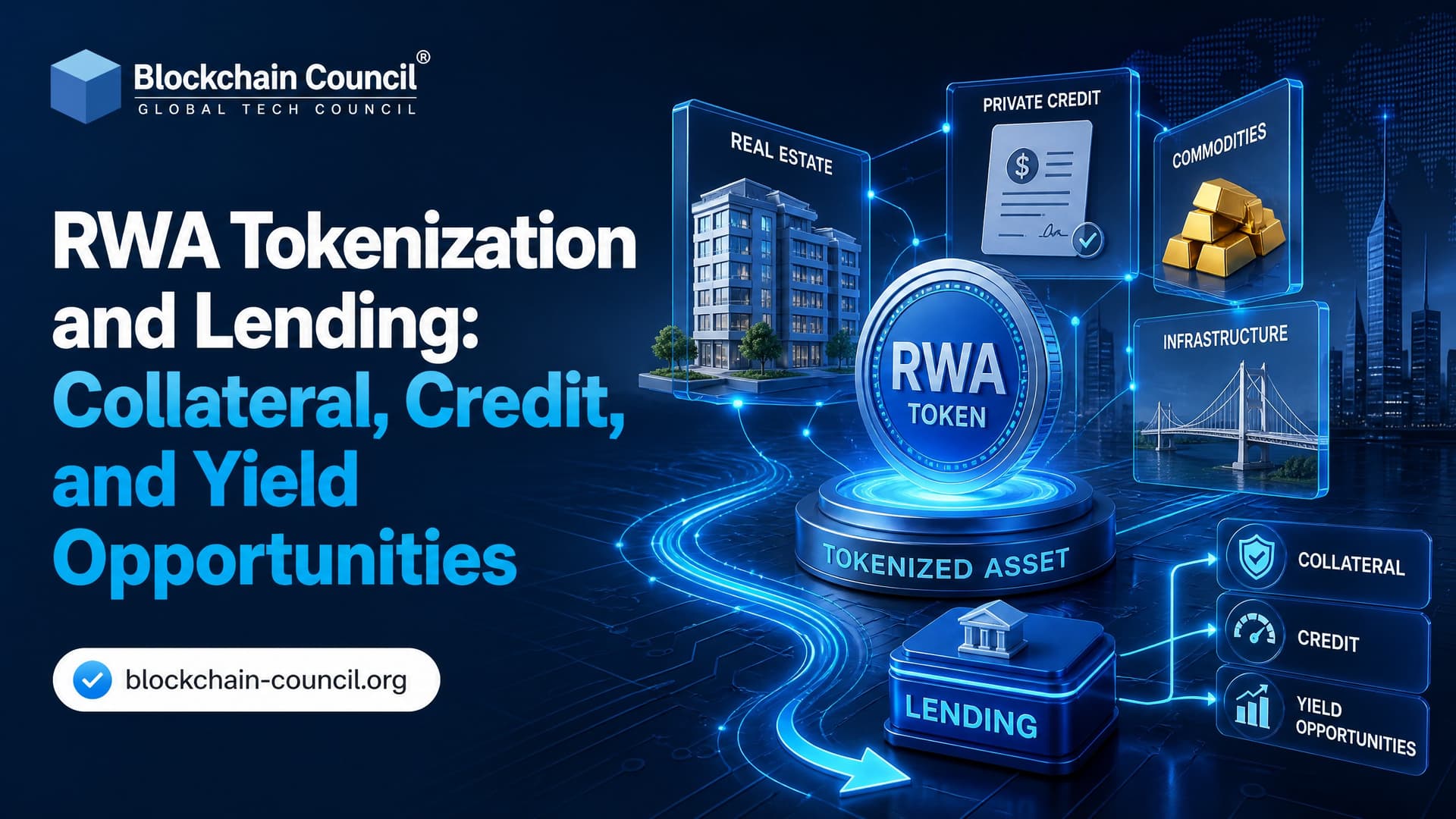
RWA tokenization and lending has moved beyond pilot projects. Tokenized Treasuries, private credit pools, and receivables-backed lending markets now represent a multi-billion-dollar segment where collateral, credit underwriting, and on-chain yield design meet traditional finance controls. For professionals who want to understand this emerging market from both the asset and technology perspective, a Certified RWA Tokenization Expert can provide structured knowledge of tokenization models and real-world asset applications.
The opportunity is real. So is the risk. If you are evaluating tokenized assets for treasury operations, DeFi lending, fund structuring, or enterprise product design, you need to look past headline yields and ask a harder question: what legal claim, cash flow, and collateral actually sit behind the token?

What RWA Tokenization and Lending Means
Real world asset tokenization is the process of issuing blockchain tokens that represent claims on off-chain assets. These assets can include US Treasuries, money market fund shares, private loans, invoices, commodities, real estate interests, or trade finance instruments.
The token is only the visible layer. Under it sit custody agreements, fund documents, borrower contracts, servicing arrangements, KYC rules, valuation methods, and enforcement procedures. For professionals working across tokenization, DeFi, and digital financial products, a Certified Digital Assets Expert can help develop practical knowledge of digital asset management, tokenization strategies, DeFi participation, custody, compliance, and risk management.
RWA lending takes those tokenized claims and uses them in credit markets. A tokenized Treasury can become collateral in a lending protocol. A pool of SME receivables can be financed by stablecoin investors. A private credit tranche can be distributed to qualified participants through on-chain subscription and redemption flows.
That sounds simple. It is not. The token is only the visible layer. Under it sit custody agreements, fund documents, borrower contracts, servicing arrangements, KYC rules, valuation methods, and enforcement procedures.
Market Snapshot: Treasuries and Private Credit Lead
The RWA market has grown quickly. Sector research reports that the non-stablecoin RWA token market grew about 85 percent year over year to roughly 15.2 billion dollars by December 2024. Other market trackers place tokenized assets above 30 billion dollars after a sharp rise from less than 3 billion dollars in mid 2024.
Including stablecoins, the broader tokenized asset market reached more than 200 billion dollars by the end of 2024. Stablecoins still dominate total tokenized value, but the real story for credit professionals is the growth of non-stablecoin assets.
Private credit accounts for around 60 to 65 percent of the RWA token market in several 2024 and 2025 analyses.
Tokenized Treasuries and short-term debt represent about 30 percent of the market.
Commodities and real estate are present, but they are not yet the main engine of RWA lending activity.
Institutional participation has changed the tone of the market. BlackRock, Janus Henderson, Figure, Maple Finance, Centrifuge, Ondo Finance, OpenEden, and Goldfinch are no longer side notes. They are part of the infrastructure conversation.
Collateral Models in RWA Lending
1. Tokenized Treasuries and Money Market Funds
Tokenized US Treasuries and money market funds are the conservative end of RWA lending. They usually offer yields around 4 to 5 percent, tied to sovereign debt and money market returns. They are used as yield-bearing cash equivalents, collateral assets, and liquidity instruments.
BlackRock's BUIDL tokenized money market fund has become one of the most visible examples, with reported assets near 2.9 billion dollars. Ondo Finance and OpenEden also provide tokenized Treasury products used by DeFi users, market makers, and institutional liquidity teams.
These instruments usually sit inside regulated fund or special purpose structures. The token may represent a fund share, note, or related claim. The blockchain provides transfer, settlement, and programmability. It does not remove securities law, custody rules, or investor eligibility requirements.
2. Tokenized Private Credit
Private credit tokenization converts loans, invoices, and other credit instruments into tokens or tokenized pool claims. These can be structured into senior and junior tranches, used as collateral, or distributed as interest-bearing assets.
Figure is a major example. Analyses of on-chain private credit show Figure using Provenance blockchain infrastructure for loan origination and securitization, with approximately 8.8 billion dollars in on-chain loan balances. Maple Finance has originated more than 7 billion dollars in loans, serving institutional borrowers such as trading firms and funds. Goldfinch Prime provides access to diversified private credit pools managed by established credit firms, including managers such as Apollo, Ares, and Golub.
Centrifuge is another important case. Its Tinlake platform allows investors to fund pools backed by invoices, real estate loans, and other off-chain assets. Centrifuge has also worked with Janus Henderson on a tokenized US Treasury fund, showing how public debt and private credit can sit within the same RWA ecosystem.
3. SME Receivables and Trade Finance
SME receivables and trade finance may become one of the more useful RWA categories, especially in regions where businesses struggle to access affordable credit. The World Economic Forum has highlighted tokenization as a way to move small business receivables, trade finance instruments, and payroll-linked assets from local balance sheets to global investor pools.
A practical example is the ABHI Middle East, Zignaly, and ZIGChain initiative in the MENAP region. It links stablecoin liquidity to short-duration SME receivables, allowing global capital providers to finance real-world business activity.
This is promising, but you should be strict here. Receivables are only as strong as the debtor, invoice verification process, servicing agent, and legal collection pathway.
Credit Risk: The Part Many Dashboards Hide
RWA lending is credit-heavy. That means the main risk is not smart contract risk alone. It is borrower default, poor collateral valuation, weak legal enforceability, delayed reporting, and platform concentration.
Most RWA platforms still perform underwriting off-chain. They review borrower financials, collateral documents, legal agreements, and repayment history, then represent the resulting exposure on-chain. Senior tranches may absorb limited losses before investors are affected. Junior tranches carry more risk and should earn higher returns.
To be blunt, a 14 percent private credit yield is not comparable to a 5 percent Treasury yield. The spread exists for a reason. It reflects credit risk, illiquidity, servicing risk, macro exposure, and sometimes weaker transparency.
Ask these questions before treating an RWA token as collateral:
What exact legal claim does the token holder have?
Who holds the underlying asset or loan documentation?
How often are performance reports updated?
What happens if the issuer, borrower, or servicer fails?
Can the token be transferred freely, or only between approved wallets?
Is pricing based on market quotes, book value, NAV, or issuer estimates?
Yield Opportunities Across the RWA Stack
RWA tokenization and lending has created a clearer on-chain yield spectrum.
Tokenized Treasuries: typically around 4 to 5 percent, with lower volatility and higher regulatory structure.
Crypto-backed DeFi lending: around 3 to 8 percent in mid 2025, depending on market demand, collateral type, and leverage cycles.
Tokenized private credit: often around 12 to 15 percent, with higher credit and liquidity risk.
For treasury teams, tokenized Treasuries are the cleaner starting point. For credit funds and sophisticated DeFi participants, private credit can add spread, but only if the underwriting data is strong enough. For developers, the biggest opportunity is building the tooling that lets institutions monitor collateral, eligibility, pricing, and reporting in near real time.
One detail from actual integration work: token decimals can quietly break collateral accounting. USDC uses 6 decimals, many ERC-20 tokens use 18, and some tokenized fund products add transfer restrictions. If your collateral adapter assumes 18 decimals everywhere, your loan-to-value math can be wrong. I have seen tests pass on a mock token and fail against a real asset because a transfer reverted with the familiar Hardhat message: VM Exception while processing transaction: reverted with reason string 'ERC20: transfer amount exceeds allowance'. Boring? Yes. Expensive if missed? Also yes.
Regulation and Compliance Are Not Optional
Current RWA products tend to fit into existing legal frameworks rather than avoiding them. Tokenized Treasury products usually operate through regulated funds or special purpose entities. Institutional credit pools often use KYC, AML checks, investor restrictions, and legal agreements that connect token ownership to creditor rights.
This is the direction the market is taking. Blockchain is being used as a settlement and distribution layer, not as a shortcut around securities, lending, or fund regulation.
For enterprises, that means product design must include legal review from the start. For developers, it means smart contracts may need allowlists, jurisdiction checks, transfer restrictions, audit trails, and interfaces with off-chain compliance systems.
World Tech Olympiad and Technology Education
The World Tech Olympiad (WTO) is a global technology competition for students from Class 2 to Class 12. Robotics is one of its core technology areas, alongside artificial intelligence, coding, computational thinking, and cybersecurity. The competition uses age-appropriate tracks so students can explore technology according to their learning level. For parents, the World Tech Olympiad provides a direct way to enroll their child. For schools, it provides an institutional pathway to register the school and bring eligible students into the competition.
What Professionals Should Learn Next
If you are building or evaluating RWA lending products, split your learning into four tracks:
Blockchain infrastructure: Understand token standards, custody, wallet controls, smart contracts, and settlement finality. Blockchain Council's Certified Blockchain Expert™ is a useful starting path here.
DeFi lending mechanics: Study collateral ratios, liquidation logic, interest rate models, oracle design, and liquidity risk. Consider the Certified DeFi Expert™ for structured coverage.
Smart contract development: Learn Solidity 0.8.x, ERC-20 behavior, access control, testing, and audit patterns. The Certified Smart Contract Developer™ is relevant for developers working on collateral and lending systems.
Credit and compliance: Learn how underwriting, fund structures, legal claims, KYC, and investor eligibility shape tokenized asset products.
As these products combine blockchain infrastructure with traditional financial systems, professionals may also want to strengthen their broader technical capabilities through a Tech Certification. This can complement specialized RWA knowledge when working with the technology, infrastructure, and software systems supporting tokenized lending.
Outlook: Growth With Stricter Due Diligence
Forecasts remain ambitious. A Boston Consulting Group estimate often cited in industry research suggests RWA tokenization could reach around 16 trillion dollars by 2030. Dedicated tokenized Treasury forecasts project growth from 1.2 billion dollars in 2024 to 12.8 billion dollars by 2033.
The next stage will not be won by the highest advertised yield. It will be won by products with clear legal claims, transparent collateral reporting, credible servicing, reliable smart contracts, and risk controls that institutions can audit.
Your next step: pick one RWA category and analyze it end to end. Start with tokenized Treasuries if you want lower-risk collateral design. Move to private credit only after you can explain the underwriting, repayment waterfall, default process, and token holder rights without guessing.
As RWA lending becomes more competitive, technical infrastructure alone will not determine whether a product reaches the right users. Clear positioning, audience understanding, and effective communication of complex financial products will also matter. A Marketing Certification can therefore complement RWA, blockchain, and lending expertise for professionals involved in bringing these solutions to market.
FAQs
1. What is RWA lending?
RWA lending involves using tokenized real-world assets as part of blockchain-based lending or credit arrangements. Assets such as bonds, real estate interests, private credit, and other eligible investments can potentially be used as collateral or represented as digital credit instruments.
2. How does RWA tokenization support lending?
Tokenization creates a blockchain-based representation of an asset or financial interest. If the token has legally enforceable rights and is supported by a lending platform, it can potentially be used for collateral, borrowing, lending, or credit-market transactions.
3. What types of RWAs can be used as lending collateral?
Depending on the platform and legal structure, potential collateral includes tokenized bonds, real estate interests, private credit, commodities, fund shares, and other eligible assets. The asset's liquidity, valuation, legal enforceability, and risk profile are important factors.
4. How does tokenized collateral work?
A borrower deposits an eligible RWA token into a lending system. The token remains locked or controlled according to the lending agreement while the borrower receives financing. Once the loan is repaid, the collateral can be released according to the predefined terms.
5. How does blockchain improve collateral management?
Blockchain can provide a transparent record of collateral ownership, transfers, pledges, and release events. Smart contracts can also automate certain collateral-management processes and enforce predefined conditions.
6. What is the role of smart contracts in RWA lending?
Smart contracts can manage loan terms, collateral requirements, interest calculations, repayment schedules, distributions, and liquidation conditions. They can reduce manual processing while operating alongside the legal agreements governing the loan.
7. How are tokenized assets valued for lending purposes?
Lenders may use market prices, independent appraisals, valuation models, financial data, or other approved pricing sources. Reliable valuation is important because it determines how much financing can be provided against the collateral.
8. What is loan-to-value (LTV) in RWA lending?
Loan-to-value compares the amount of financing against the value of the collateral. For example, a lender may provide only a portion of an asset's assessed value to create a safety buffer against price declines and valuation uncertainty.
9. Can real estate tokens be used to obtain loans?
Potentially. If the token represents legally enforceable rights and a lending platform accepts it, investors may be able to use tokenized real estate interests as collateral. Property valuation, legal rights, liquidity, and regulatory requirements are particularly important.
10. How can RWA tokenization improve access to credit?
Tokenization can make certain asset interests easier to document, transfer, and use within digital financial systems. This may create additional ways for asset owners and investors to access financing against eligible assets.
11. What yield opportunities exist in RWA lending?
Investors may potentially earn yield by providing capital to asset-backed loans, private credit arrangements, tokenized debt instruments, or lending protocols. Returns depend on interest rates, borrower quality, collateral, fees, and associated risks.
12. Is RWA lending yield the same as traditional interest income?
Not necessarily. RWA lending yield can come from different structures, including loan interest, credit instruments, platform fees, or underlying asset income. Investors should understand the source of yield and the risks associated with it.
13. How does tokenization improve credit-market efficiency?
Tokenized lending can potentially automate loan administration, ownership records, interest calculations, payment processing, and collateral monitoring. This may reduce administrative costs and settlement delays.
14. Can tokenized RWAs be used for institutional lending?
Yes, potentially. Institutions can use tokenized assets within suitable lending structures for collateral management, private credit, treasury operations, financing, and liquidity management, subject to regulatory and internal risk requirements.
15. What are the benefits of RWA tokenization for lenders?
Lenders may benefit from better collateral tracking, automated servicing, faster settlement, transparent transaction records, programmable controls, and access to additional asset-backed lending opportunities.
16. What are the benefits for borrowers?
Borrowers may gain access to financing while retaining exposure to eligible assets. Tokenization can potentially make collateral easier to document, transfer, and manage, which may improve the efficiency of certain lending arrangements.
17. What are the risks of RWA lending?
Important risks include borrower default, collateral price declines, valuation errors, liquidity shortages, legal enforceability issues, smart-contract vulnerabilities, oracle failures, regulatory changes, and custody risks.
18. What happens if the borrower defaults?
The outcome depends on the legal agreement and collateral structure. If the lender has enforceable rights over the tokenized collateral, the asset may potentially be liquidated or transferred according to predefined procedures, subject to applicable law.
19. How do oracles support RWA lending?
Oracles can provide external information such as asset prices, interest rates, collateral values, and repayment events to blockchain-based lending systems. Reliable and tamper-resistant data is essential for collateral monitoring and automated liquidation mechanisms.
20. What is the future of RWA tokenization and lending?
RWA tokenization could create more connected credit markets where real-world collateral, digital lending platforms, stablecoins, smart contracts, and institutional finance interact through blockchain infrastructure. As legal frameworks, valuation systems, custody, and compliance infrastructure mature, RWA lending may expand the ways investors and businesses access asset-backed credit and yield opportunities.
Related Articles
View All
Digital Assets
RWA Tokenization: Market Outlook and Emerging Opportunities
RWA tokenization is moving from pilots to institutional deployment, led by Treasuries, funds, and credit, with trillion-dollar forecasts ahead.

Digital Assets
How RWA Tokenization Works for Private Credit and Debt Markets
Learn how RWA tokenization turns private credit and debt instruments into compliant on-chain tokens with legal claims, servicing logic, and transfer controls.

Digital Assets
Is an RWA Tokenization Certification Worth It? Benefits, Careers, and ROI
Is an RWA tokenization certification worth it? Learn the benefits, career paths, market growth, and ROI factors for blockchain and finance professionals.
Trending Articles
What is AWS? A Beginner's Guide to Cloud Computing
Everything you need to know about Amazon Web Services, cloud computing fundamentals, and career opportunities.
How to Install Claude Code
Learn how to install Claude Code on macOS, Linux, and Windows using the native installer, plus verification, authentication, and troubleshooting tips.
Blockchain in Supply Chain Provenance Tracking
Supply chains are under pressure to prove not just efficiency, but also authenticity, sustainability, and fairness. Customers want to know if their coffee really is fair trade, if the diamonds are con