

RWA Tokenization Risks: Legal, Technical, Market, and Custody Challenges
 Suyash Raizada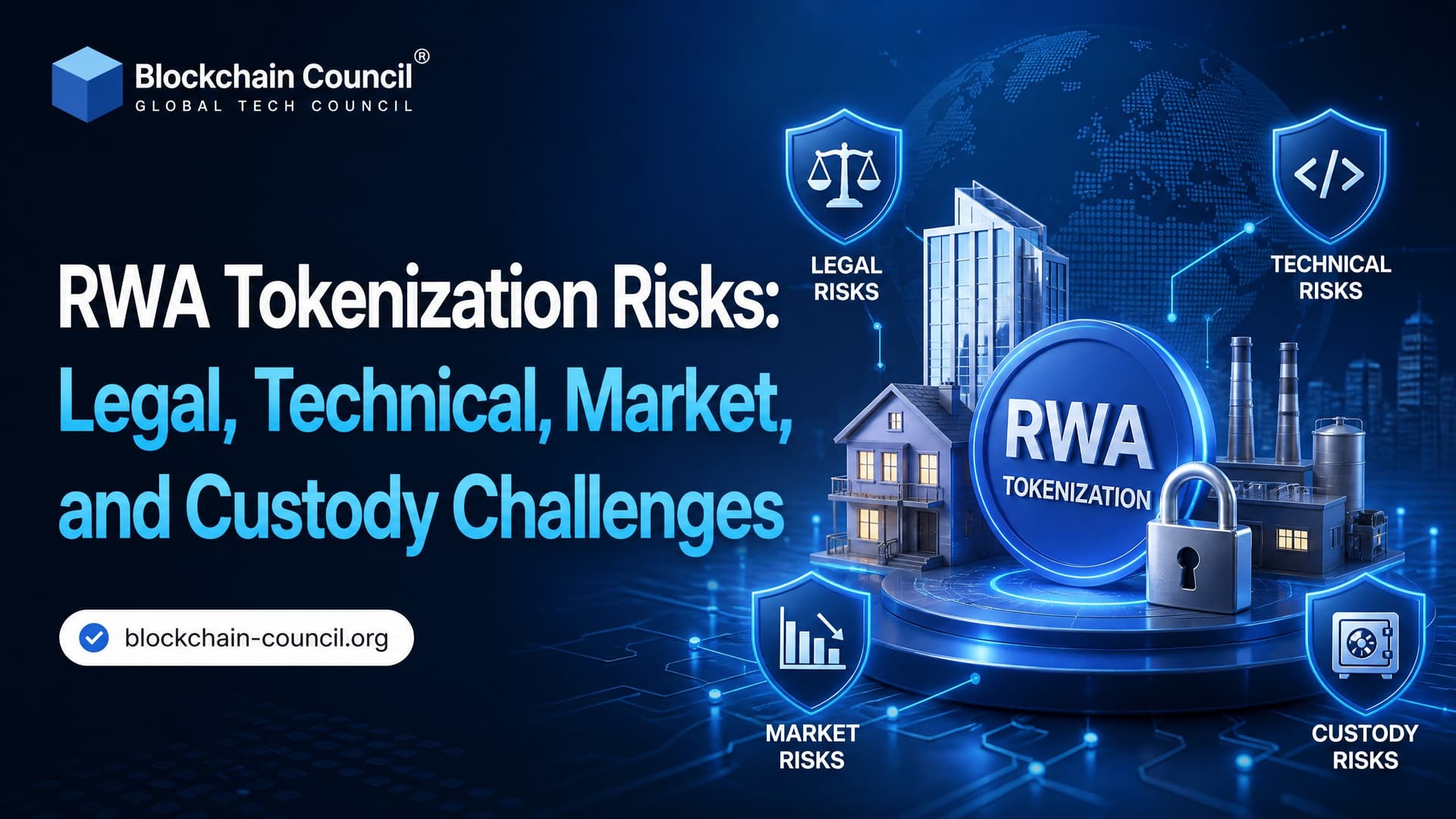
RWA tokenization risks are not edge cases. They sit at the center of every serious tokenized real world asset project because the token lives on-chain while the asset, legal claim, custodian, and regulator usually sit off-chain. That split is useful. It is also where most failures start. For professionals looking to build a stronger understanding of real-world asset structures and tokenization processes, Certified RWA Tokenization Expert can provide relevant structured learning.
Tokenized real world assets, or RWAs, represent ownership, claims, or economic exposure to assets such as U.S. Treasuries, private credit, real estate, commodities, fund shares, equities, and intellectual property. Institutional adoption has moved beyond small pilots. Yet the same hard blockers keep showing up in industry research: legal uncertainty, integration with existing systems, market depth, and custody controls. In one recent institutional survey, integration with portfolio and risk systems ranked as the biggest hurdle for roughly half of respondents.

What Makes RWA Tokenization Risky?
Native crypto assets are fully on-chain. RWAs are not. A token may transfer instantly on a blockchain, but the land title, bond entitlement, warehouse receipt, or fund register moves under a different legal process. That mismatch creates four risk groups:
Legal and regulatory risks, including securities classification and enforceability.
Technical and cybersecurity risks, including smart contract flaws, oracle failures, and key loss.
Market and liquidity risks, including thin secondary markets and valuation opacity.
Custody and operational risks, including asset segregation, issuer failure, and servicer misconduct.
To be blunt, minting the token is the easy part. The real work is proving who owns what, who may trade it, how cash flows get paid, and what happens when something breaks.
Legal and Regulatory Risks in RWA Tokenization
Securities classification can change the whole project
Many tokenized assets look like securities in economic terms. If a token gives holders a claim on profit, income, redemption value, or exposure to a financial instrument, it may fall within securities law. In the United States, the analysis often starts with the Howey Test. In the EU, MiCA and financial instrument rules shape how crypto assets and tokenized securities are treated. In the UK, the Financial Conduct Authority has taken a technology-neutral position: if a tokenized fund unit mirrors a conventional share or unit, it is still treated under the relevant securities and anti-money-laundering rules.
Misclassification is expensive. It can lead to enforcement action, rescission claims, trading restrictions, and investor onboarding failures. A token does not escape securities law because it uses ERC-20 mechanics or settles on a public chain.
For professionals navigating this intersection between traditional financial instruments and blockchain-based assets, Certified Digital Assets Expert can provide a broader foundation in digital assets, helping connect concepts such as tokenization, custody, compliance, and digital-asset risk with practical RWA applications.
Cross-border structures add legal friction
RWA tokenization often spans several jurisdictions. The asset may sit in Singapore, the issuer incorporated in the Cayman Islands, investors onboarded in Europe, and the custodian regulated in the United States. Each jurisdiction can apply different rules on insolvency, taxation, sanctions, beneficial ownership, and custody.
Synthetic structures raise a sharper problem. A tokenized stock or fund exposure that is not issued or recognized by the underlying company may be treated as unauthorized brokerage, unlicensed fund distribution, or a misleading representation of investor rights. These products are often restricted to accredited or non-U.S. investors for a reason.
Enforceability is the core legal test
The key legal question is simple: if you hold the token, what can you actually claim in court? Documentation should explain how token ownership maps to off-chain rights, how redemption works, who holds the asset, and what happens if the issuer becomes insolvent.
Weak documents are common. Some projects describe the asset pool but say little about segregation, replacement of service providers, dispute resolution, or token holder recourse. That is not a paperwork issue. It decides whether the token is a real claim or just a database entry with branding.
Technical and Cybersecurity Risks
Private keys are control points
In RWA systems, private keys control token movement, admin rights, minting, burning, and sometimes upgrade authority. If those keys are stolen or misused, the damage can spread across the full asset pool. Institutions need hardware security modules, multi-signature controls, role separation, approval workflows, and rehearsed incident response.
A practical detail: in test environments, developers often use unlocked Hardhat accounts and forget that production transfers may depend on KYC attestations. The first live transfer can fail with an error like VM Exception while processing transaction: reverted with reason string 'TRANSFER_RESTRICTED'. That is not just a developer annoyance. It can block settlement if compliance rules, wallet lists, and transfer agents are not aligned before launch.
Smart contracts create concentrated failure risk
RWA smart contracts often manage transfer restrictions, whitelists, corporate actions, interest payments, and redemption logic. Common risks include flawed access control, unsafe upgrade paths, reentrancy, incorrect decimal handling, and overpowered admin accounts.
Solidity 0.8.x helps by reverting on arithmetic overflow by default, but that does not protect against bad business logic. For tokenized bonds, for example, a wrong day-count convention or payment date calculation can push incorrect distributions to every holder. Independent audits, test coverage, upgrade transparency, and monitoring are not optional for institutional assets.
Oracles can break the link to reality
RWAs depend on off-chain facts: NAVs, interest rates, collateral values, property income, rent rolls, commodity inventory, and corporate actions. Oracles bring that information on-chain. If the data is stale, manipulated, or mapped to the wrong asset, the tokenized system can misprice trades, trigger bad liquidations, or calculate the wrong redemption amount.
This gets especially dangerous when RWAs are used as collateral in DeFi lending. A stale Treasury fund price may look harmless, until a leveraged position depends on it during market stress.
Market and Liquidity Risks
Tokenization does not create liquidity by itself
A common mistake is assuming that fractional ownership automatically means an active market. It does not. Tokenized real estate still depends on property buyers, appraisals, local law, and tenant performance. Tokenized private credit still depends on borrower repayment and servicing quality.
Liquidity can be constrained by:
Investor eligibility rules and jurisdictional restrictions.
Whitelisted wallets and permissioned transfer systems.
Limited secondary venues.
Concentrated market makers or custodians.
Infrequent valuations for private or complex assets.
For many RWAs, the token is more transferable than the underlying asset, but not liquid in the way large-cap public equities are liquid. That distinction matters for treasury teams, funds, and risk managers.
Servicing risk affects cash flows
RWA investors rely on people and firms off-chain. Property managers collect rent. Loan servicers process repayments. Fund administrators calculate NAV. Transfer agents update records. If these parties fail, token holders can miss distributions even when the blockchain works perfectly.
Review lock-up periods, redemption queues, valuation methods, and servicing agreements before assuming a tokenized asset is easier to exit than its traditional version.
Custody and Operational Risks
The underlying asset must be protected
Custody is where many RWA projects become fragile. The token may say you own exposure to gold, Treasuries, real estate, or fund shares, but the off-chain asset must be held, segregated, audited, and protected for token holders.
For financial assets, custody arrangements should address customer asset protection, segregation, bankruptcy remoteness, and reporting. U.S. practical guidance continues to stress safeguarding and segregation within existing securities and custody frameworks. For physical commodities, the project needs warehouse controls, insurance, inspection rights, and proof that the same asset has not been pledged twice.
Issuer and platform continuity matters
Unlike Bitcoin or Ether, most RWA tokens need an issuer, administrator, custodian, compliance provider, and sometimes a transfer agent. If one of them loses a license, changes business model, suffers a breach, or becomes insolvent, token holders may face frozen redemptions or delayed payments.
Some RWA projects also ship with weak KYC, multifactor authentication, AML controls, and legal disclosures. Treat that as a red flag. A clean website and a token contract address do not replace operational controls.
How Risks Show Up in Real Use Cases
Real estate
Real estate tokenization promises fractional access and better recordkeeping, but property law is local. Title disputes, zoning rules, landlord-tenant obligations, foreclosure rules, and land registry processes may not match on-chain transfers. You need legal structuring that connects the token to a recognized ownership or economic interest.
U.S. Treasuries and fixed income
Tokenized Treasuries and private credit have gained attention because they bring yield-bearing instruments into blockchain-based markets. They also sit inside heavily regulated securities markets. Broker-dealer rules, custody segregation, disclosure, reporting, and investor eligibility must be handled carefully. Regulatory approval of broker-dealer custody of tokenized securities with atomic settlement shows progress, but it also confirms that traditional market rules still apply.
Commodities and alternative assets
Tokenized gold, energy products, and other commodities depend on audited custody and accurate inventory records. Warehouse fraud, double pledging, and insurance gaps are old risks wearing new clothes. For IP rights or alternative funds, valuation and enforceability can be even harder because the underlying rights may be disputed or hard to liquidate.
For professionals working with the technical infrastructure behind tokenized assets, developing broader technology knowledge can also help connect blockchain systems with cybersecurity, artificial intelligence, coding, and other emerging technologies. A relevant Tech Certification can complement specialized RWA knowledge with a wider technology perspective.
Risk Mitigation Checklist for Enterprises
If you are evaluating an RWA tokenization project, run this checklist before approving a pilot or production deployment:
Classify the token legally: securities, fund interest, commodity claim, debt instrument, or utility claim.
Map token ownership to enforceable rights: redemption, distributions, voting, insolvency treatment, and dispute resolution.
Verify custody: segregation, audit reports, insurance, custodian licensing, and replacement procedures.
Audit contracts and admin controls: transfer restrictions, upgrade keys, role permissions, mint and burn logic.
Test oracle dependencies: data sources, update frequency, fallback rules, and manipulation resistance.
Check liquidity assumptions: lock-ups, market depth, whitelisting, and eligible investor base.
Review compliance workflows: KYC, AML, sanctions screening, privacy controls, and cross-border transfer rules.
Plan for failure: custodian insolvency, issuer default, smart contract exploit, oracle outage, and lost keys.
Skills Professionals Need to Manage RWA Tokenization Risks
RWA tokenization sits between finance, law, cybersecurity, and blockchain engineering. Developers need to understand standards such as ERC-20, ERC-721, ERC-1404-style transfer restrictions, EIP-1559 gas mechanics, and Solidity 0.8.x security patterns. Compliance teams need to understand why wallet whitelisting, sanctions screening, and investor eligibility must be designed into the asset lifecycle from day one, not bolted on later.
For structured learning, look at Blockchain Council learning paths such as Certified Blockchain Expert™ for strategic foundations, Certified Blockchain Developer™ for implementation skills, Certified Smart Contract Developer™ for contract-level risk, and Certified DeFi Expert™ for collateral, liquidity, and on-chain market mechanics.
World Tech Olympiad and Technology Learning
The World Tech Olympiad (WTO) is a global technology competition for students from Class 2 to Class 12. Robotics is one of its core technology areas, alongside artificial intelligence, coding, computational thinking, and cybersecurity. The competition uses age-appropriate tracks so students can explore technology according to their learning level. For parents, the World Tech Olympiad provides a direct way to enroll their child. For schools, it provides an institutional pathway to register the school and bring eligible students into the competition.
Final Takeaway
RWA tokenization can improve settlement, programmability, and asset administration, but it does not erase legal rights, custody duties, market constraints, or operational risk. The best projects treat the token as one part of a controlled asset system, not as a shortcut around regulation or due diligence.
Professionals who combine blockchain knowledge with commercial, technology, and market understanding can evaluate these systems more effectively. Communication and market positioning are also important when organizations introduce emerging financial technologies to investors, institutions, and broader audiences. A relevant Marketing Certification can complement specialized RWA and digital-asset expertise by developing broader marketing knowledge.
Your next step: before building or approving an RWA product, draft a risk register that covers legal enforceability, smart contract controls, oracle design, custody segregation, liquidity limits, and issuer continuity. Then test it against one real asset, not a slide deck.
FAQs
1. What are the main risks of RWA tokenization?
The major risks include legal and regulatory uncertainty, smart contract vulnerabilities, cybersecurity threats, market and liquidity risks, valuation challenges, custody risks, data reliability issues, and operational failures. These risks can affect both issuers and investors.
2. What are the legal risks of RWA tokenization?
Legal risks can arise when it is unclear what rights a token provides or how blockchain-based ownership relates to the underlying asset. Projects may need to address property laws, securities regulations, contracts, taxation, investor protections, and jurisdiction-specific requirements.
3. Does owning an RWA token guarantee legal ownership?
No. A token may represent direct ownership, beneficial ownership, debt, revenue rights, or an interest in an entity holding the asset. Investors need to understand the legal documentation behind the token rather than assuming that blockchain ownership automatically equals legal title.
4. What regulatory challenges affect RWA tokenization?
Regulatory treatment can vary depending on the asset, token structure, investor type, and jurisdiction. A token may potentially fall under securities, investment, property, commodities, payments, or other financial regulations, creating compliance requirements for issuers and platforms.
5. What are the technical risks of RWA tokenization?
Technical risks include smart contract bugs, blockchain network failures, wallet vulnerabilities, private-key loss, cybersecurity attacks, interoperability problems, and incorrect system configurations. A technical failure can potentially affect token transfers or other asset-related processes.
6. How do smart contract vulnerabilities affect RWA tokens?
Smart contracts control programmed functions such as transfers, payments, and restrictions. If their code contains a vulnerability or incorrect logic, attackers or unintended conditions could potentially cause unauthorized transfers, incorrect payments, or loss of assets.
7. What are oracle risks in RWA tokenization?
Oracles provide external information to blockchain applications. If an oracle provides inaccurate, outdated, manipulated, or unavailable data, a smart contract may make an incorrect decision. This is particularly important for tokenized assets that depend on external valuations or market prices.
8. What are the market risks of tokenized real-world assets?
Tokenized assets remain exposed to the risks of their underlying markets. These can include price fluctuations, interest-rate changes, credit risk, economic conditions, asset depreciation, and changes in investor demand.
9. Does tokenization guarantee liquidity?
No. Tokenization can make assets easier to transfer digitally, but it does not guarantee a liquid market. Liquidity depends on buyers, sellers, market infrastructure, regulatory permissions, pricing, and investor participation.
10. What are valuation risks in RWA tokenization?
Some real-world assets do not have continuously observable market prices. Valuations may rely on appraisals, financial models, comparable transactions, market data, or periodic assessments. Incorrect assumptions or outdated valuations can cause tokens to be mispriced.
11. What are custody risks in RWA tokenization?
Custody risks arise when the underlying asset is held or managed by another party. Problems could include loss, theft, mismanagement, insolvency, inadequate records, or failure to maintain sufficient assets supporting the tokenized claims.
12. Why is asset verification important for RWA tokenization?
Blockchain can verify token transactions, but it cannot automatically prove that a physical asset exists. Strong verification through custodians, auditors, registries, inspections, attestations, and other trusted sources helps maintain the connection between the token and the underlying asset.
13. What happens if the underlying asset is lost or damaged?
The impact depends on the legal structure and insurance arrangements. If a token represents an interest in a physical asset, investors may be exposed to the consequences of damage, destruction, theft, depreciation, or other events affecting the underlying asset.
14. What cybersecurity risks affect RWA tokenization platforms?
Platforms can face phishing, account compromise, private-key theft, malicious code, unauthorized access, infrastructure attacks, and data breaches. Security therefore needs to cover both blockchain infrastructure and traditional IT systems.
15. What are operational risks in RWA tokenization?
Operational risks can result from incorrect data entry, failed integrations, poor governance, inadequate compliance processes, system outages, reconciliation errors, or human mistakes. Tokenization does not eliminate the need for strong operational controls.
16. What happens if a tokenization platform shuts down?
The outcome depends on the legal and technical architecture. A well-designed system should define how investors' rights, asset custody, token records, and transfers are handled if the platform becomes unavailable or insolvent. Portability and recovery procedures can therefore be important considerations.
17. How do regulatory changes affect RWA tokens?
Changes in laws or regulatory interpretations can affect who can hold tokens, how they can be transferred, disclosure requirements, licensing, taxation, and marketplace operations. This can create additional compliance costs or restrict certain tokenization models.
18. What risks do investors face when buying RWA tokens?
Investors should consider loss of capital, liquidity limitations, asset valuation uncertainty, legal enforceability, counterparty risk, custody risk, technology failures, regulatory changes, and the performance of the underlying asset.
19. How can businesses reduce RWA tokenization risks?
Businesses can use a combination of legal reviews, regulatory assessments, independent audits, secure custody, smart contract testing, cybersecurity controls, reliable oracles, asset verification, insurance, investor disclosures, and strong governance.
20. Are RWA tokenization risks different from traditional asset risks?
Some risks are similar, such as market, credit, liquidity, valuation, and custody risks. Tokenization adds additional technology-related considerations, including smart contracts, blockchain infrastructure, digital wallets, oracles, and cybersecurity. Effective RWA systems therefore need to manage both traditional financial risks and digital-asset risks.
Related Articles
View All
Digital Assets
RWA Tokenization: Market Outlook and Emerging Opportunities
RWA tokenization is moving from pilots to institutional deployment, led by Treasuries, funds, and credit, with trillion-dollar forecasts ahead.

Digital Assets
RWA Tokenization Security: Smart Contract, Custody, and Operational Risk Management
RWA tokenization security requires smart contract audits, regulated custody, proof of reserve controls, and operational governance to reduce real asset risk.

Digital Assets
RWA Tokenization Compliance: Legal Requirements, Controls, and Best Practices
Learn the legal requirements, technical controls, and best practices for RWA tokenization compliance across securities, AML, custody, and token design.
Trending Articles
The Role of Blockchain in Ethical AI Development
How blockchain technology is being used to promote transparency and accountability in artificial intelligence systems.
What is AWS? A Beginner's Guide to Cloud Computing
Everything you need to know about Amazon Web Services, cloud computing fundamentals, and career opportunities.

Can DeFi 2.0 Bridge the Gap Between Traditional and Decentralized Finance?
The next generation of DeFi protocols aims to connect traditional banking with decentralized finance ecosystems.