

NFTs Beyond Digital Art: Practical Use Cases for Utility, Ownership, and Access
 Suyash Raizada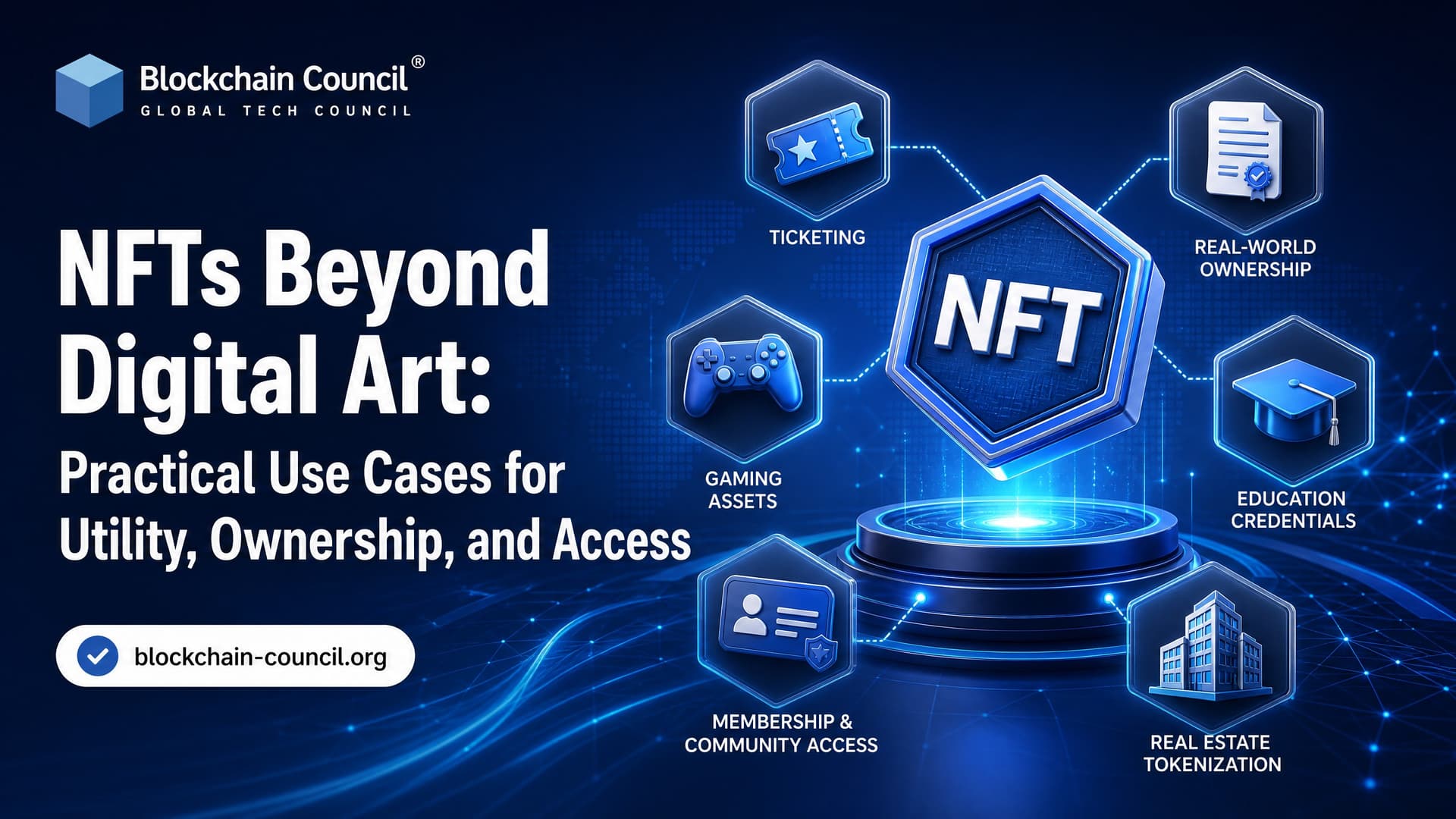
NFTs beyond digital art are becoming practical tools for proving ownership, granting access, tracking goods, issuing credentials, and coordinating communities. The JPEG cycle made NFTs famous. Utility is what makes them useful.
At the technical level, a non-fungible token is a unique blockchain token, commonly built with standards such as ERC-721 or ERC-1155 on Ethereum and compatible networks. Unlike a fungible token, each NFT has a distinct token ID and metadata. That metadata can point to art, yes, but it can also represent a ticket, a game item, a property record, a product certificate, or a professional credential.

The difference matters. A speculative collectible depends mostly on market attention. A utility NFT depends on what it lets you do.
As NFTs evolve into practical tools for ownership, identity, and digital commerce, professionals benefit from understanding digital asset governance, tokenization, blockchain ecosystems, compliance, and asset lifecycle management. A Certified Digital Assets Expert credential helps develop these practical skills, enabling individuals to evaluate and implement NFT-based solutions that deliver real business value beyond collectibles.
What Makes Utility NFTs Different?
A utility NFT is designed around a function. It may prove that you own a physical item, have access to an event, completed a course, or hold voting rights in a community. In better implementations, the NFT is not the product by itself. It is the verifiable layer attached to a real product, contract, membership, or service.
Developers usually build this with familiar standards:
ERC-721 for unique, one-of-one assets such as deeds, tickets, or identity-linked tokens.
ERC-1155 for semi-fungible assets, useful when you need many editions of the same item, such as game skins or event passes.
EIP-2981 for royalty information, although marketplaces still decide whether to honor royalties.
ERC-4907 for rental-style NFT use cases, especially in gaming and virtual land.
ERC-6551 for token-bound accounts, where an NFT can own assets or interact with applications through its own account.
A small practitioner detail: if you are testing ERC-721 contracts with OpenZeppelin Contracts 4.x and you hit ERC721: invalid token ID, the usual cause is calling ownerOf or tokenURI before minting that token ID. In OpenZeppelin Contracts 5.x, several ERC-721 internals changed and custom errors replaced many revert strings. That version difference trips up beginners who copy older NFT tutorials.
Building utility NFT applications also requires a strong understanding of blockchain architecture, smart contracts, token standards, consensus mechanisms, and enterprise blockchain implementation. A Certified Blockchain Expert credential equips professionals with the technical knowledge needed to design secure, scalable, and interoperable NFT ecosystems for real-world use cases.
Major NFT Use Cases Beyond Digital Art
1. Gaming and Virtual Assets
Gaming is one of the clearest use cases for NFTs because players already understand scarce digital items. NFT-based assets can represent characters, weapons, skins, land parcels, badges, or crafting materials.
The strongest case is ownership outside a single game database. If a sword or avatar skin is an NFT, the player can hold it in a wallet and trade it on approved marketplaces. Developers can also design royalties or usage restrictions into smart contracts. That said, cross-game interoperability is often oversold. A 3D sword from one game does not automatically work in another game engine. Metadata, licensing, balancing, art direction, and backend support all matter.
Where NFTs work best in gaming is not generic portability. It is player-owned inventory, transparent scarcity, and secondary markets that the studio can audit.
2. Ticketing, Events, and Memberships
NFT ticketing solves a real problem: fake tickets and messy resale markets. An NFT ticket can be checked on-chain, tied to a wallet, and programmed with resale rules. Event organizers can cap resale prices, block transfers near event time, or route a resale fee back to the artist, venue, or sports club.
There is another benefit after the event. A ticket can become a proof-of-attendance badge, loyalty pass, or member credential. A conference could use last year's NFT ticket to give holders early registration, private content, or voting rights on future speakers.
The hard part is user experience. Most concertgoers do not want to manage seed phrases at the door. The best ticketing systems hide blockchain complexity while still giving users verifiable ownership when they need it.
3. Real Estate and Real-World Asset Tokenization
NFTs can represent claims linked to real-world assets, including property, vehicles, luxury goods, collectibles, and commodities. In real estate, people often describe NFTs as digital deeds. That phrase is useful, but incomplete.
A token alone does not transfer legal title unless the off-chain legal structure recognizes that transfer. For property, you still need jurisdiction-specific contracts, land registry alignment, KYC, tax handling, and dispute resolution. Without that, the NFT is only a receipt or membership interest.
Where NFT-based real estate can make sense:
Fractional ownership of income-producing property.
Digital records for title history and document access.
Virtual land ownership in metaverse platforms.
Tokenized membership in property investment vehicles, subject to securities laws.
Be blunt about this: real estate NFTs are promising, but they are not a shortcut around property law.
4. Supply Chain, Provenance, and Product Authenticity
NFTs are useful when provenance matters. Luxury fashion, pharmaceuticals, fine wine, food supply chains, and high-value electronics all suffer from counterfeiting and record tampering.
A product-linked NFT can store or reference origin data, batch numbers, custody changes, inspection results, and ownership history. Nike's CryptoKicks patent is a well-known example of using NFT concepts to authenticate sneakers and connect physical products with digital twins. Several enterprise firms have piloted NFT-based fine wine provenance, where bottles are stored securely while tokens help track authenticity and ownership.
The weak point is the physical-to-digital link. If someone attaches the wrong chip or QR code to the wrong handbag, the blockchain will faithfully preserve bad data. Good implementations need tamper-resistant tags, trusted issuers, audits, and clear recovery processes.
5. Identity, Credentials, and Professional Certifications
NFTs can represent credentials such as degrees, licenses, course completions, employment records, and professional certifications. For education providers, the appeal is simple: a credential can be verified globally without emailing a registrar or trusting a PDF.
Credential NFTs can include metadata about issuer, course, skill level, completion date, and assessment type. Some identity systems also pair NFTs with verifiable credential standards from the W3C, giving users more control over what they share.
Privacy needs careful design. You should not put sensitive personal data directly on a public blockchain. Use hashes, selective disclosure, off-chain storage, and revocation mechanisms. Soulbound or non-transferable NFTs can also help when the credential should belong to a person rather than become a tradable asset.
As NFT adoption expands across industries, developers and technology professionals also need expertise in cybersecurity, cloud computing, APIs, enterprise integration, automation, and secure data management. A Tech Certification helps strengthen these complementary skills, supporting the development of reliable and scalable blockchain-powered applications.
If you want to study this from a professional training angle, the Certified NFT Expert™ from Blockchain Council is a good fit. Developers building credential systems should also look at the Certified Smart Contract Developer™, while business leaders may prefer the Certified Blockchain Expert™ for the wider architecture and governance view.
6. Music, Media, and Creator Rights
NFTs give creators a direct way to sell access, membership, limited releases, or rights-linked assets. A musician can issue an NFT that grants early listening access, backstage entry, a private community pass, or a claim to specific royalty streams where legally structured.
Royalty automation is often misunderstood. EIP-2981 can signal royalty terms, but it does not force every marketplace to pay. Enforcement depends on marketplace policy, contract design, and sometimes legal agreements. Still, NFTs are useful for fan relationships because they make membership portable. A fan can prove support across apps without relying on one platform's account system.
7. Governance, DAOs, and Community Tokens
NFTs can act as membership badges or voting passes in decentralized autonomous organizations and private communities. Unlike fungible governance tokens, NFTs can encode tiers, roles, reputation, or contribution history.
For example, one NFT class could allow proposal creation, while another grants access to working groups or treasury votes. This design works well for communities where identity and contribution matter more than pure token quantity.
The trade-off is governance capture. If voting NFTs are transferable, wealthy buyers may accumulate influence. If they are non-transferable, onboarding and recovery become harder. Choose based on the community's actual risk model.
8. Loyalty Programs and Brand Access
Brands are experimenting with NFTs as loyalty passes, product passports, and VIP memberships. A customer could hold one token that proves product ownership, grants early access to drops, stores repair history, and carries rewards across partner brands.
This can beat traditional loyalty points when users need ownership and portability. It falls short when the same job can be done with a normal database. Not every rewards program needs a blockchain. Use NFTs when public verification, transferability, scarcity, or cross-platform access are part of the business case.
What Enterprises Should Check Before Using NFTs
Before you build, ask practical questions:
What right does the NFT represent? Access, ownership, license, membership, or proof?
Where is the legal agreement? On-chain metadata rarely replaces a contract.
Can the NFT be transferred? Tickets may need limits. Credentials often should not transfer.
What happens if a wallet is lost? Plan recovery before launch.
Where is metadata stored? IPFS, Arweave, centralized storage, and on-chain data have different costs and risks.
Does the user need to know it is an NFT? In many enterprise cases, probably not.
The Future of NFTs Is Utility, Not Hype
NFTs are moving toward a role as a digital representation layer for ownership, access, identity, and rights. The strongest use cases are not decorative. They connect a token to something people already value: a seat at an event, a verified product, a game asset, a property interest, a credential, or a community role.
The next phase will depend on better wallets, clearer regulation, safer smart contracts, and stronger links between on-chain records and off-chain rights. If you are building in this space, start with one narrow use case. Mint a simple ERC-721 or ERC-1155 test contract, define the legal or business right behind the token, and test the full user journey, including recovery and resale. Then deepen your knowledge through the Certified NFT Expert™ or the Certified Smart Contract Developer™, depending on whether your goal is strategy or implementation.
Even the most innovative NFT solutions require clear communication to encourage adoption among customers, partners, investors, and enterprise stakeholders. A Marketing Certification helps professionals develop strategic communication and stakeholder engagement skills, making it easier to explain the value of NFT-powered products, digital ownership, and blockchain innovation in real-world business environments.
FAQs
1. What are NFTs beyond digital art?
Non-fungible tokens (NFTs) are unique blockchain-based digital assets that can represent ownership, access rights, memberships, credentials, tickets, and tokenized real-world assets. While NFTs first gained attention through digital art, they are increasingly being used for practical business and consumer applications across multiple industries.
2. Why are NFTs evolving beyond collectibles?
Organizations are exploring NFTs because they can securely verify ownership, authenticate digital and physical assets, automate permissions through smart contracts, and improve transparency. This shift expands NFTs from speculative collectibles into tools for identity, commerce, and digital experiences.
3. How are NFTs used for digital ownership?
NFTs provide a verifiable blockchain record that identifies the owner of a specific digital or tokenized asset. Ownership transfers are recorded transparently on the blockchain, helping reduce disputes and improve asset traceability.
4. Can NFTs represent physical assets?
Yes. NFTs can be linked to physical assets such as luxury goods, artwork, real estate, collectibles, event memorabilia, or other tokenized real-world assets (RWAs). The legal relationship between an NFT and the underlying asset depends on applicable contracts and regulations.
5. How do NFTs provide access to exclusive communities?
Organizations can use NFTs as digital membership passes that grant access to online communities, premium content, events, educational platforms, gaming experiences, or loyalty programs. Smart contracts can automatically verify ownership before granting access.
6. How are NFTs used in ticketing?
NFT-based tickets can help reduce counterfeiting, simplify ownership verification, and improve resale transparency. Event organizers may also include additional benefits such as exclusive content, loyalty rewards, or post-event collectibles linked to the ticket.
7. How do NFTs support gaming?
Gaming platforms use NFTs to represent characters, equipment, virtual land, cosmetic items, achievements, and other in-game assets. Depending on the game's design, players may own, trade, or use these assets across compatible ecosystems.
8. What role do NFTs play in digital identity?
NFTs can support decentralized identity by representing memberships, certifications, credentials, or verified achievements. When combined with decentralized identity (DID) systems and verifiable credentials, NFTs can strengthen trust within Web3 ecosystems.
9. How are NFTs used in education?
Educational institutions and training providers can issue NFT-based certificates, diplomas, professional credentials, and course completion records. Blockchain verification helps employers and other organizations confirm the authenticity of academic achievements.
10. How do businesses use NFTs for customer loyalty?
Businesses can issue NFTs as loyalty rewards that provide discounts, exclusive offers, VIP experiences, early product access, or special memberships. Blockchain-based loyalty programs may improve transparency and customer engagement while reducing fraud.
11. How are NFTs used in supply chain management?
NFTs can represent unique products throughout a supply chain, enabling businesses and consumers to verify authenticity, ownership history, manufacturing details, and provenance. This is especially valuable for luxury goods, pharmaceuticals, and high-value collectibles.
12. Can NFTs be used in healthcare?
Healthcare organizations are exploring blockchain technologies, including NFTs, for managing patient consent records, medical credentials, research participation, and authenticated healthcare documentation. Any implementation must comply with applicable healthcare and privacy regulations.
13. How does AI complement NFT applications?
Artificial intelligence can assist with NFT authentication, fraud detection, metadata analysis, content moderation, recommendation systems, market analytics, and intellectual property monitoring. AI can also improve operational efficiency for NFT marketplaces and enterprise applications.
14. What security risks should NFT owners consider?
Potential risks include phishing attacks, compromised wallets, malicious smart contracts, counterfeit collections, marketplace fraud, malware, and private key theft. Protecting wallet credentials and verifying transactions remain essential security practices.
15. What legal and regulatory considerations apply to NFTs?
NFT projects may be subject to intellectual property laws, consumer protection regulations, taxation, privacy requirements, anti-money laundering (AML) obligations, and securities laws depending on the NFT's structure and use case. Regulatory treatment varies across jurisdictions.
16. How do smart contracts enhance NFT utility?
Smart contracts automate ownership transfers, royalty distribution where supported, membership verification, access permissions, licensing terms, and other programmable features. They enable NFTs to function as more than static digital collectibles.
17. What industries are adopting utility NFTs in 2025-2026?
Industries expanding NFT adoption include entertainment, gaming, sports, fashion, luxury retail, real estate, education, healthcare, financial services, travel, hospitality, and enterprise digital identity. Many organizations are focusing on practical applications that deliver measurable value beyond speculation.
18. What are best practices for businesses implementing NFTs?
Organizations should define a clear business purpose, prioritize user experience, conduct smart contract security audits, protect customer data, comply with applicable regulations, provide transparent documentation, and ensure interoperability where appropriate. Long-term utility generally matters more than short-term market attention.
19. What should consumers evaluate before purchasing a utility NFT?
Consumers should review the NFT's intended utility, issuer credibility, ownership rights, smart contract functionality, marketplace reputation, ongoing support, and applicable terms and conditions. Digital assets can fluctuate significantly in value, and utility may change over time.
20. What is the future of NFTs beyond digital art?
NFTs are expected to play an increasingly important role in digital identity, memberships, ticketing, loyalty programs, tokenized real-world assets, credential verification, gaming, and enterprise asset management as blockchain technology and regulatory frameworks continue to mature. Projects that deliver genuine utility, strong security, interoperability, and compliance are likely to drive broader adoption across industries. It turns out the most practical NFT might not be a pixelated picture at all, but the digital key that quietly opens the right door.
Related Articles
View All
Digital Assets
Best RWA Tokenization Platforms: Features, Use Cases, and Selection Criteria
Compare the best RWA tokenization platforms, including Securitize, Ondo Finance, Franklin Templeton, Centrifuge, Maple, Paxos, Tether, and Tokeny.

Digital Assets
RWA Tokenization in Institutional Finance: Use Cases for Banks and Asset Managers
RWA tokenization is moving into production across tokenized funds, collateral networks, deposits, bonds, private credit, and trade finance.
Digital Assets
What Is an RWA Token? Meaning, Features, and Use Cases
An RWA token represents real-world assets such as Treasuries, gold, credit, or property on-chain. Learn its features, use cases, and risks.
Trending Articles
The Role of Blockchain in Ethical AI Development
How blockchain technology is being used to promote transparency and accountability in artificial intelligence systems.
AWS Career Roadmap
A step-by-step guide to building a successful career in Amazon Web Services cloud computing.
How Blockchain Secures AI Data
Understand how blockchain technology is being applied to protect the integrity and security of AI training data.