

How to Become a Digital Asset Expert: Step-by-Step Roadmap for 2026
 Suyash Raizada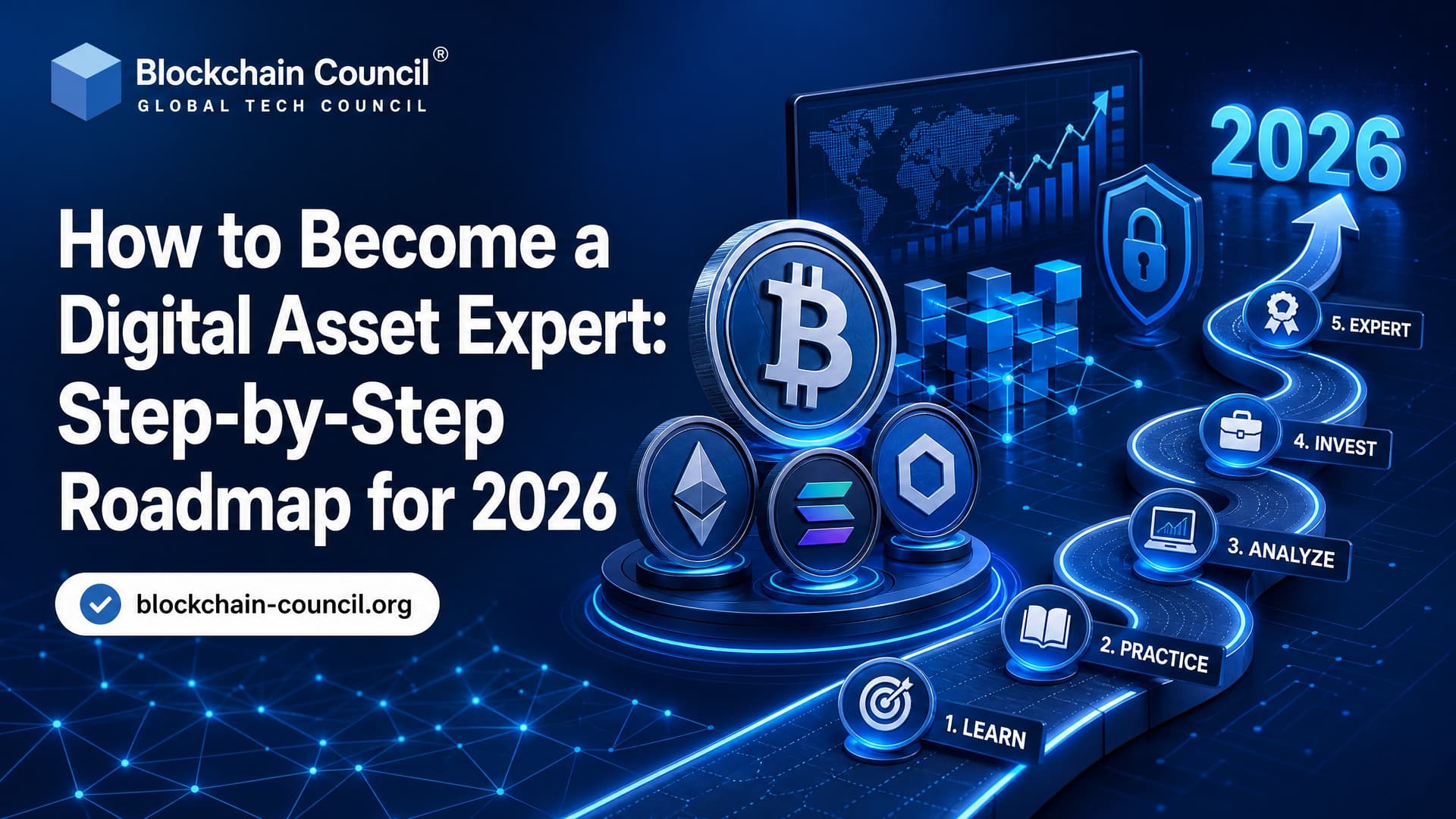
A digital asset expert in 2026 is not someone who watches crypto prices scroll by. You need to understand blockchains, tokenized real-world assets, custody, compliance, on-chain data, and the AI tools now used in security and analytics. The role has become more institutional, more regulated, and far more operational than it was during the early crypto cycles.
That is good news if you are entering now. Hype counts for less. Verifiable skill counts for more. Hiring research from Axiom Recruit suggests roughly 65% of Web3 startups now weigh practical portfolios over formal degrees, while a large share of blockchain projects launched in the past year center on real-world asset tokenization and institutional scale. Build the right evidence and you can compete.

Building that evidence requires more than following industry news. Professionals need practical knowledge of blockchain infrastructure, tokenized assets, compliance, custody, and operational best practices. A Certified Digital Assets Expert credential can help learners develop these capabilities, providing a structured foundation for working confidently in the rapidly evolving digital asset ecosystem.
What Does a Digital Asset Expert Do in 2026?
A digital asset expert helps organizations safely use, manage, analyze, and build products around blockchain-based assets. That includes cryptocurrencies, stablecoins, tokenized real estate, tokenized funds, DeFi instruments, and other on-chain financial products.
The job usually sits across four areas:
Technology: Blockchain networks, smart contracts, wallets, interoperability, security, and on-chain analytics.
Finance: Liquidity, valuation, market structure, portfolio risk, collateral, and token economics.
Compliance: KYC, AML, sanctions screening, custody controls, securities and commodities rules, and audit documentation.
Operations: Settlement, reconciliations, key management, reporting, incident response, and vendor oversight.
There is a separate digital asset management track in marketing and media, built around platforms like Bynder, Widen, and Adobe Experience Manager Assets. That work deals with metadata, usage rights, asset tagging, and content governance. Useful field. Different career path.
Why the Role Is Growing Now
The digital asset market is maturing. Statista projects the global digital assets market rising from about 100 billion USD in 2025 to roughly 110 billion USD in 2026, close to 10% annual growth. Survey work from EY, cited across market analysis, reports that a majority of institutional investors planned to raise their allocation to crypto and digital asset products in 2025, with further growth expected into 2026.
The hiring signal is clear. Employers want people who can work with tokenized assets inside real control environments. That means custody reviews, settlement procedures, contract risk analysis, compliance workflows, and plain-English reporting for legal and finance teams.
Regulation is another driver. Legal analysis points to continuing rulemaking from US agencies such as the SEC, CFTC, Treasury, and OCC. Proposed frameworks like the CLARITY Act and the GENIUS Act have pushed firms to prepare for clearer jurisdictional lines, stablecoin rules, and more structured digital asset activity. Compliance is no longer a side function. It is part of the product.
Core Skills You Need as a Digital Asset Expert
Blockchain and Smart Contract Fundamentals
Start with transaction mechanics. Learn how Ethereum accounts work, how gas is priced after EIP-1559, why Ethereum mainnet uses chain ID 1, and how Proof of Stake finality changes settlement assumptions. Then learn token standards such as ERC-20 and ERC-721.
If you are technical, use Solidity 0.8.x with Hardhat or Foundry. Deploy to a testnet first. Beginners often hit errors like insufficient funds for intrinsic transaction cost because they funded the wrong account or pointed the config at the wrong network. That small mistake teaches a real lesson: operations matter as much as code.
Security and Custody
You should understand hot wallets, cold storage, MPC custody, hardware security modules, multisig approvals, private key backups, and incident response. Do not treat wallet security as a beginner topic. It is where firms lose money.
Study the common attack patterns: reentrancy, oracle manipulation, approval phishing, bridge exploits, admin key compromise, and weak access control. AI-assisted audit tools help, but they miss context. To be blunt, a tool that flags code smells is not a security review.
Finance and Market Structure
You do not need to be a quant on day one, but you need enough finance to read risk. Learn liquidity, slippage, spreads, collateral ratios, volatility, basis, derivatives, and portfolio exposure. For tokenized real-world assets, add cash-flow rights, redemption mechanics, legal ownership, and transfer restrictions.
Compliance and Regulation
Compliance-focused experts need to understand when an asset may be treated as a security, a commodity, a payment instrument, or another regulated product. You should know the practical role of the SEC, CFTC, Treasury, OCC, FinCEN, and sanctions authorities.
Learn KYC, AML, transaction monitoring, sanctions screening, travel rule concepts, and recordkeeping. The hard part is translating legal guidance into controls that engineering and operations teams can actually follow.
Since blockchain technology underpins every digital asset ecosystem, developing a strong understanding of distributed ledgers, consensus mechanisms, smart contracts, and token standards is equally important. Earning a Certified Blockchain Expert credential helps professionals strengthen this technical foundation while supporting practical decision-making across development, compliance, operations, and digital asset management.
AI-Assisted Workflows
The idea here is that you bring a core discipline and use AI to move faster without handing over judgment. In digital assets, that might mean:
Summarizing regulatory updates and mapping them to internal policies.
Screening smart contract code for common risks before manual review.
Classifying wallet activity and generating alerts for unusual flows.
Building research briefs on tokenized asset markets.
Automating metadata tagging for media asset libraries.
Set clear limits. Large language models can misread Solidity inheritance or invent regulatory requirements that do not exist. Use them as assistants, not authorities.
Step-by-Step Roadmap to Become a Digital Asset Expert
Stage 0: Choose Your Track, Weeks 1 to 4
Pick one main direction before you start collecting random courses. Your options:
RWA tokenization: Best if you like finance, legal structure, and operations.
DeFi risk and analytics: Best if you enjoy data, protocols, and market behavior.
Smart contract security: Best for developers who like adversarial thinking.
Digital asset compliance: Best for legal, audit, risk, or operations professionals.
Institutional custody and settlement: Best if you like process design and controls.
Digital asset management for media: Best for marketing operations and content governance roles.
Search real job descriptions for Crypto Analyst, Digital Asset Analyst, Digital Asset Operations Specialist, Compliance Specialist, and Digital Asset Manager. Build toward the role you see repeatedly, not the title that sounds most exciting.
Stage 1: Build Foundations, 0 to 12 Months
Learn blockchain basics, asset types, wallet security, stablecoins, CBDCs, DeFi, and tokenization. Pair that with finance basics and a first layer of regulatory literacy.
For structured learning, consider Blockchain Council's Certified Blockchain Expert™ for core blockchain concepts, Certified Cryptocurrency Expert™ for crypto market knowledge, and Certified AI Expert™ if you need an AI foundation. If your goal is DeFi or smart contracts, add Certified DeFi Expert™ or Certified Smart Contract Developer™.
Your deliverable here is simple: a personal knowledge base. Include notes on Ethereum, Bitcoin, stablecoins, RWAs, custody models, KYC and AML concepts, and the current regulatory agencies. Make it searchable. You will reuse it constantly.
Stage 2: Get Hands-On, 6 to 24 Months
The field rewards proof. Build something.
Deploy a basic ERC-20 token to a testnet and document every step.
Read a DeFi protocol's smart contracts and write a short risk memo.
Create a dashboard that tracks token transfers, liquidity, or wallet concentration.
Draft a compliance playbook for a sample tokenized real estate product.
For DAM roles, design a metadata schema and rights management workflow for a mock brand library.
Publish your work on GitHub, a personal site, or LinkedIn. Keep it practical. A two-page custody control checklist is more credible than a vague essay about the future of finance.
Practical experience becomes even more valuable when it is supported by broader technical knowledge in cybersecurity, cloud platforms, APIs, analytics, AI-assisted workflows, and enterprise systems. A Tech Certification helps professionals strengthen these complementary skills, making it easier to work across the diverse technologies that power modern blockchain and digital asset environments.
Stage 3: Enter the Market, 1 to 3 Years
Target roles that let you touch real workflows. Analyst, operations, compliance, audit support, risk, product operations, and junior developer roles can all lead to expert-level work.
Once inside a team, volunteer for measurable projects. Improve a reconciliation process. Build an on-chain monitoring report. Map a new regulatory requirement to internal controls. Review wallet approval policies. If you can show reduced manual review time, cleaner audit trails, or better incident readiness, you are building expert evidence.
This is also where certifications help signal seriousness. Developers can look at Certified Smart Contract Developer™ and Certified Blockchain Security Professional™. Analysts and product professionals may benefit from Certified DeFi Expert™ or Certified Cryptocurrency Expert™. Match the credential to the job you want.
Stage 4: Specialize and Lead, 3 to 5+ Years
At senior levels, broad awareness is not enough. Choose a niche and become hard to replace.
Lead RWA tokenization design for issuance, transfer restrictions, settlement, and redemption.
Own smart contract security review processes and vendor audit standards.
Build compliance frameworks for stablecoins, DeFi integrations, or tokenized funds.
Design institutional custody and settlement controls.
For DAM, lead AI-assisted asset governance and rights automation across enterprise teams.
Start publishing useful work: control templates, risk frameworks, teardown reports, regulatory summaries, or implementation guides. Speak at industry events when you can. Mentor juniors. Expert status is built in public and tested in operations.
Best Entry Paths by Background
If you are a developer: Start with Solidity, smart contract testing, security, and DeFi mechanics. Do not jump straight to complex cross-chain systems before you understand basic approvals and access control.
If you are in finance: Focus on tokenized assets, portfolio risk, custody, and institutional product design. RWA work is a strong fit.
If you are in compliance or legal operations: Learn blockchain transaction flows, wallet risk, KYC, AML, sanctions screening, and emerging digital asset rules.
If you are in marketing operations: The DAM path is valid. Learn metadata, rights, governance, AI tagging, and integrations with content tools.
What to Build for Your Portfolio
Employers want evidence. Build assets that show judgment, not just enthusiasm:
A sample RWA tokenization operations map.
A DeFi risk memo covering oracle risk, admin keys, liquidity, and smart contract exposure.
A Hardhat or Foundry repo with tests for an ERC-20 or ERC-721 contract.
An on-chain analytics dashboard with a written interpretation.
A digital asset compliance checklist for onboarding, monitoring, and reporting.
A DAM governance model with metadata fields, rights rules, and approval workflows.
Final Step: Pick a Specialization and Prove It
The fastest route to becoming a digital asset expert is not learning everything at once. Pick one track, build working knowledge around it, and publish proof. For 2026, the strongest bets are RWA tokenization, compliance, custody, smart contract security, and AI-assisted analytics.
Want a structured starting point? Begin with Blockchain Council's Certified Blockchain Expert™, then add a role-specific certification such as Certified DeFi Expert™, Certified Smart Contract Developer™, Certified Blockchain Security Professional™, or Certified Cryptocurrency Expert™. Pair the credential with a public portfolio. That combination is what hiring teams can actually verify.
Technical expertise alone is not always enough for career growth. Many professionals also need to communicate complex blockchain concepts, promote products responsibly, and explain digital asset solutions to customers, stakeholders, or executives. A Marketing Certification can help strengthen these business communication and strategic marketing skills, complementing technical knowledge and supporting long-term career development in the digital asset industry.
FAQs
1. What is a digital asset expert?
A digital asset expert is a professional who understands the creation, management, valuation, security, compliance, and use of digital assets. Depending on the role, this may include cryptocurrencies, tokenized assets, NFTs, stablecoins, digital securities, blockchain infrastructure, and enterprise digital asset platforms.
2. What does a digital asset expert do?
Digital asset experts analyze blockchain ecosystems, monitor market developments, evaluate digital asset projects, support compliance initiatives, advise businesses on digital asset strategies, and help implement secure custody, tokenization, or blockchain-based solutions. Responsibilities vary across finance, technology, consulting, and regulatory roles.
3. Why is digital asset expertise becoming valuable in 2026?
Institutional adoption, tokenized real-world assets (RWAs), evolving regulatory frameworks, blockchain-based financial services, and AI-powered analytics are increasing demand for professionals with digital asset knowledge. Organizations across banking, fintech, asset management, and technology continue exploring blockchain applications.
4. What skills are required to become a digital asset expert?
Core skills include blockchain fundamentals, cryptocurrency markets, tokenomics, decentralized finance (DeFi), cybersecurity awareness, digital wallets, smart contracts, risk management, financial analysis, and an understanding of relevant regulations. Strong communication and analytical thinking are also important.
5. Do I need a technical background?
Not necessarily. While technical knowledge can be valuable, many professionals enter the field from finance, law, compliance, economics, accounting, marketing, consulting, or product management. Technical concepts can often be learned gradually alongside practical experience.
6. What blockchain fundamentals should I learn first?
Start by understanding distributed ledgers, consensus mechanisms, public and private blockchains, wallets, cryptographic keys, transactions, smart contracts, token standards, and network security. These concepts provide the foundation for more advanced digital asset topics.
7. Which digital assets should beginners study?
Focus on widely recognized digital asset categories such as Bitcoin, Ethereum, stablecoins, tokenized real-world assets, decentralized finance protocols, blockchain infrastructure tokens, and digital securities. Understanding their different purposes provides a balanced view of the ecosystem.
8. How important is learning blockchain regulations?
Regulatory knowledge is increasingly valuable because digital asset rules continue to evolve across jurisdictions. Professionals should stay informed about applicable financial regulations, anti-money laundering (AML) requirements, know-your-customer (KYC) obligations, tax considerations, and official guidance relevant to their region.
9. Which certifications can help build credibility?
Blockchain, cryptocurrency, cybersecurity, financial markets, compliance, and digital asset certifications may strengthen a professional profile. Employers typically value certifications alongside demonstrated practical knowledge, projects, and continuous learning rather than viewing certificates alone as proof of expertise.
10. How can I gain practical experience?
Hands-on learning may include creating digital wallets, exploring blockchain explorers, using test networks, analyzing on-chain data, participating in educational communities, building small blockchain projects, or researching digital asset case studies. Practical experience helps reinforce theoretical knowledge.
11. Should I learn smart contracts?
A basic understanding of smart contracts is valuable even for non-developers. Knowing how automated blockchain agreements function helps professionals evaluate decentralized applications, tokenized assets, enterprise blockchain solutions, and potential operational risks.
12. How important is cybersecurity in digital assets?
Cybersecurity is fundamental because digital assets rely on secure private key management, wallet protection, access controls, phishing awareness, and secure infrastructure. Understanding common attack methods helps professionals reduce operational and financial risks.
13. Can AI help digital asset professionals?
AI can assist with blockchain analytics, market research, fraud detection, portfolio monitoring, compliance workflows, document analysis, and data visualization. AI-generated insights should be verified with reliable data and human judgment before making business or investment decisions.
14. Which industries hire digital asset experts?
Opportunities exist in fintech companies, cryptocurrency exchanges, traditional financial institutions, blockchain startups, consulting firms, cybersecurity companies, regulatory technology providers, asset managers, payment companies, and enterprise software organizations adopting blockchain solutions.
15. What career paths are available?
Career options include blockchain analyst, digital asset researcher, compliance specialist, crypto product manager, blockchain consultant, tokenization strategist, digital asset operations manager, business analyst, cybersecurity analyst, and enterprise blockchain advisor.
16. What tools should digital asset experts learn?
Useful tools include blockchain explorers, digital wallets, portfolio tracking platforms, on-chain analytics platforms, compliance software, smart contract development frameworks, blockchain testing environments, and data visualization tools. The ideal toolkit depends on your specialization.
17. What common mistakes should beginners avoid?
Common mistakes include relying solely on social media for information, overlooking cybersecurity, ignoring regulatory developments, neglecting risk management, assuming every blockchain project has long-term value, and failing to verify information using reputable sources and official documentation.
18. What trends are shaping digital asset careers in 2026?
Major trends include institutional adoption of tokenized assets, AI-powered blockchain analytics, stablecoin expansion, enterprise blockchain integration, decentralized identity solutions, digital asset custody innovation, regulatory modernization, and increasing interoperability between blockchain networks.
19. How long does it take to become a digital asset expert?
The timeline depends on prior experience, learning pace, and specialization. Many professionals build a solid foundation within several months of consistent study, while developing advanced expertise typically requires ongoing education, practical experience, and staying current with industry developments.
20. What is the long-term outlook for digital asset experts?
Demand for professionals with expertise in blockchain technology, digital assets, compliance, security, and tokenization is expected to grow as organizations continue exploring real-world blockchain applications. Building strong technical knowledge, understanding regulatory developments, and maintaining a commitment to continuous learning can help create long-term career opportunities in this rapidly evolving field. The technology changes quickly, but curiosity and careful thinking continue to outperform chasing every shiny new token.
Related Articles
View All
Digital Assets
How to Become an RWA Tokenization Expert: Skills, Tools, and Career Path
Learn how to become an RWA tokenization expert with the right blockchain, finance, compliance, tools, and career roadmap for tokenized assets.

Digital Assets
How to Tokenize a Real-World Asset: Step-by-Step Guide
Learn how to tokenize a real-world asset through legal structuring, valuation, token design, smart contracts, compliance, custody, issuance, and servicing.

Digital Assets
How Asset Tokenization Creates Verifiable Digital Ownership
Asset tokenization turns rights to real world and financial assets into blockchain tokens, giving authorized parties a verifiable record of ownership, provenance, and compliance.
Trending Articles
The Role of Blockchain in Ethical AI Development
How blockchain technology is being used to promote transparency and accountability in artificial intelligence systems.

Top 5 DeFi Platforms
Explore the leading decentralized finance platforms and what makes each one unique in the evolving DeFi landscape.
How to Create Claude Skills?
Claude Skills are one of the most important features Anthropic has introduced for users who want automation that is structured, consistent and reusable. Instead of giving Claude long instructions ever