

CBDC Career Roadmap: From Beginner to Digital Currency Specialist
 Suyash Raizada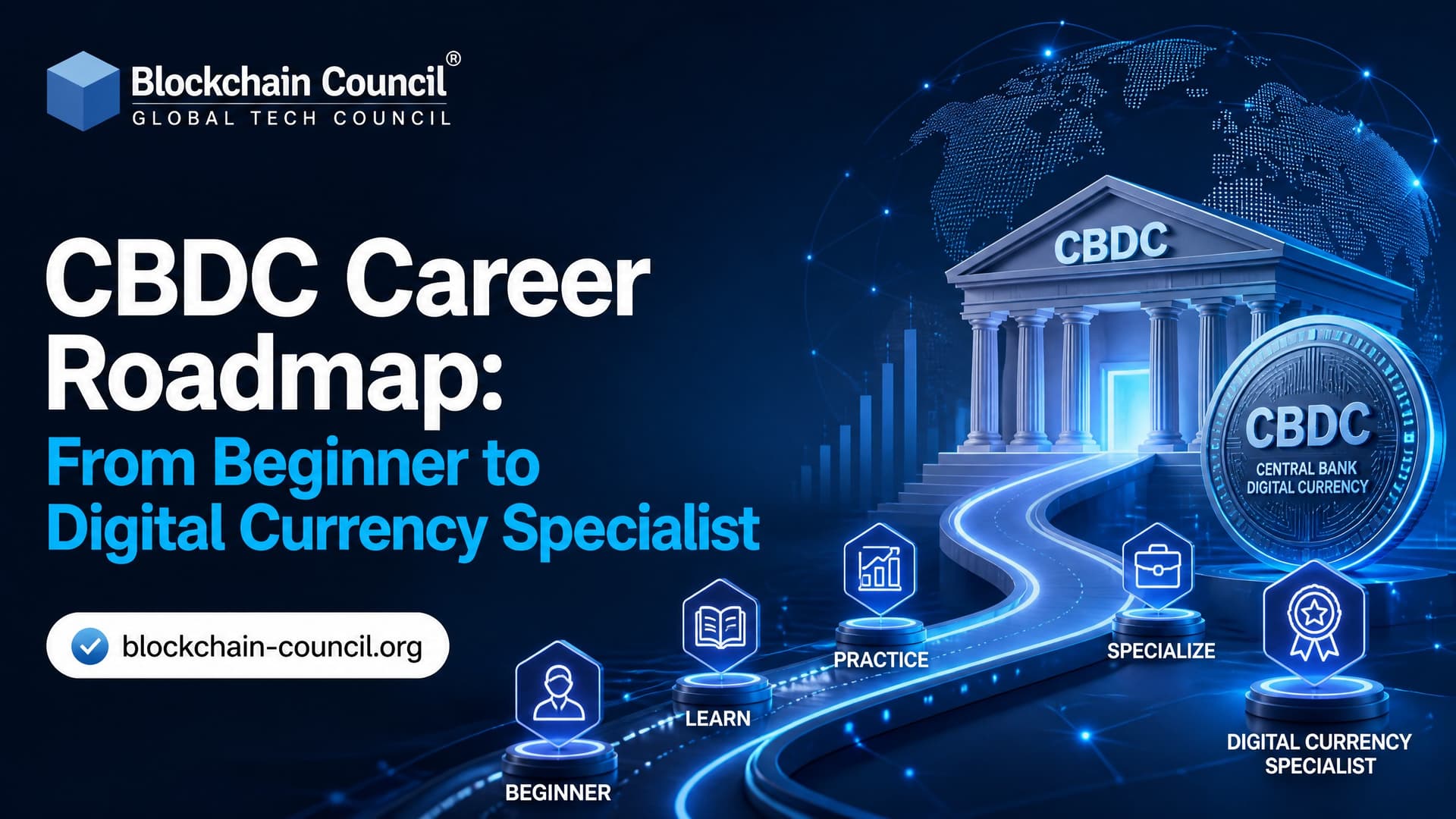
A CBDC career roadmap is not just a blockchain learning plan. It cuts across monetary policy, payment systems, regulation, cybersecurity, and digital asset infrastructure. If you want to work on central bank digital currencies, you need to understand both sides of the table: how money moves today, and how public digital money might be issued, governed, secured, and used tomorrow. Before mapping out a full career path, it helps to build a solid grounding in sovereign digital money itself, which is exactly what the Certified Central Bank Digital Currency (CBDC) Expert credential is designed to provide.
The timing is good. BIS and IMF research shows that roughly 91 to 94 percent of surveyed central banks are exploring retail CBDCs, wholesale CBDCs, or both. The Atlantic Council tracks around 134 countries or currency unions working on CBDCs, representing about 98 percent of global GDP. Yet only a handful of retail CBDCs are live, such as the Bahamas Sand Dollar, Jamaica's JAM-DEX, and Nigeria's eNaira. That gap between research and production is where careers are being built.

What Makes CBDC Careers Different?
CBDC roles sit between economics and engineering. A smart contract developer can learn token design but may miss bank disintermediation risk. A policy analyst may understand central bank money but struggle with wallet architecture, API security, or offline payment design. The strongest professionals can translate between both groups. Since CBDC work increasingly overlaps with tokenized deposits, stablecoins, and other onchain instruments, many professionals also build out their understanding with the Certified Digital Assets Expert program, which frames these different forms of digital money side by side.
To be blunt, CBDC is not a shortcut into crypto jobs. It is more conservative, more regulated, and more operationally demanding. A failed NFT mint is annoying. A failed central bank payment rail is a public infrastructure incident.
Current demand is strongest in these areas:
Wholesale CBDC: Tokenized securities settlement, interbank settlement, and cross-border payments.
Retail CBDC design: Wallets, privacy, financial inclusion, merchant acceptance, and offline access.
Regulatory architecture: AML/CFT, data protection, consumer protection, and the legal status of digital central bank liabilities.
Cybersecurity and resilience: Threat modeling, incident response, key management, and operational continuity.
Integration: CBDC links with RTGS systems, instant payment rails, card networks, and securities depositories.
The CBDC Market: What the Data Actually Says
CBDC activity is widespread, but live launches remain limited. IMF analysis suggests that up to 15 CBDCs may be issued by 2030, based on current plans and readiness levels. Around 72 countries are already in advanced phases such as pilot, development, or launch. The Atlantic Council reported 49 ongoing CBDC pilots globally in mid 2025, including the digital euro.
One pattern matters for your career planning: wholesale CBDCs are moving faster than many retail projects. BIS surveys show that advanced economy central banks are especially active in wholesale pilots, often tied to tokenization and securities settlement. Retail CBDCs still face harder questions around user demand, privacy, bank funding, and merchant adoption.
Some early retail projects also show that launch does not guarantee usage. Nigeria's eNaira, for example, has seen slower adoption than policymakers expected. That is a useful lesson. CBDC specialists need product sense, not only protocol knowledge.
CBDC Career Roadmap: Four Stages
Stage 1: Build Your Foundation in Money and Blockchain
Start with the basics. You need to know the difference between cash, commercial bank deposits, reserves, stablecoins, tokenized deposits, and CBDCs. Many beginners confuse central bank money with bank app balances. They are not the same thing.
At this stage, focus on:
Functions of money: unit of account, medium of exchange, and store of value.
Central bank balance sheets and the role of reserves.
Retail versus wholesale payments.
Blockchain fundamentals: consensus, tokens, wallets, keys, and smart contracts.
Basic programming, databases, APIs, and cybersecurity hygiene.
If you come from finance, learn the technology carefully. If you come from software, study payments and monetary economics. A useful learning path is to pair Blockchain Council's Certified Blockchain Expert™ with Certified Cryptocurrency Expert™ to build vocabulary across distributed ledgers, digital assets, and market structure.
Stage 2: Learn Payment Systems, Regulation, and Architecture
This is where the roadmap becomes practical. CBDCs do not exist in isolation. They must connect to payment service providers, commercial banks, central bank systems, identity providers, liquidity tools, and reporting systems.
Learn these systems in detail:
RTGS systems: High-value settlement between banks.
Fast payment schemes: Instant retail payments, often running 24/7.
Card networks: Authorization, clearing, chargebacks, and merchant acquiring.
Securities settlement: Delivery versus payment, custody, and central securities depositories.
ISO 20022 messaging: The payment messages used across modern financial infrastructure.
Here is a real detail that catches teams out: reconciliation breaks fast when payment references are treated casually. In ISO 20022 integrations, fields such as EndToEndId and transaction identifiers must be mapped with discipline across wallet, core banking, and settlement systems. Reusing a reference in a test environment may look harmless until the ledger and the reporting layer disagree. CBDC work is full of these boring, expensive details.
On the regulatory side, study AML/CFT, know your customer rules, data retention, privacy law, consumer redress, and operational risk. For technology, learn secure API design, cryptography basics, key custody, cloud security, and the difference between account-based and token-based CBDC models.
Developers can strengthen this stage with Blockchain Council's Certified Blockchain Developer™. Risk and security professionals should consider Certified Cybersecurity Expert™ as a complementary credential.
Stage 3: Specialize in CBDC Design and Implementation
At the specialist level, you should be able to evaluate CBDC design choices without treating any single architecture as magic. Distributed ledger technology can be useful for multi-party settlement and tokenized assets. It is not automatically the best answer for every retail CBDC. A well-designed centralized system may be faster, simpler to govern, and easier to operate at national scale. This is also the stage where many technologists broaden their engineering base with a general Tech Certification, since CBDC prototypes lean on the same infrastructure, security, and systems-design skills used across modern software teams.
Key design questions include:
Should the CBDC be retail, wholesale, or both?
Should users hold CBDC directly with the central bank or through intermediaries?
Will the system support offline payments?
How much privacy is legally and technically possible?
Will there be holding limits or tiered remuneration to reduce bank disintermediation risk?
How will CBDC interact with tokenized deposits, stablecoins, and existing fast payment rails?
You should also understand the pilots. The digital euro work is testing privacy options, offline functionality, and intermediary roles. India has expanded trials to include non-bank participants. China and Hong Kong have tested CBDC links with fast payment systems for cross-border retail payments. BIS Innovation Hub projects continue to examine wholesale CBDC for cross-border settlement and tokenized assets.
For hands-on technologists, build small prototypes. Create a wallet flow. Model holding limits. Simulate merchant payments. If you test smart contracts in Solidity 0.8.x, remember that arithmetic overflow now reverts by default with a panic code instead of silently wrapping the way older Solidity versions did. Small version changes matter when financial logic is involved.
Stage 4: Move Into Digital Currency Strategy and Policy Leadership
Senior CBDC roles require judgment. You may be asked whether a CBDC improves financial inclusion, whether it weakens bank funding, whether offline payments are worth the fraud risk, or whether a wholesale CBDC pilot should use DLT at all.
Typical advanced roles include:
CBDC specialist or lead in a central bank innovation team.
Digital currency architect in a commercial bank or payment firm.
Policy adviser in an international organization.
Consultant for CBDC pilots, tokenization, and financial market infrastructure.
Cybersecurity or resilience lead for critical payment systems.
Recent job profiles from institutions such as the BIS Innovation Hub and the German Bundesbank show the expected mix: economics, software engineering, DLT, cryptography, cybersecurity, payment systems, securities settlement, stakeholder management, and agile delivery. That is a wide brief. Plan for it.
Skills Checklist for CBDC Professionals
Use this checklist to assess where you stand today:
Monetary economics: Central bank money, reserves, liquidity, financial stability, and payment competition.
Payments knowledge: RTGS, instant payments, card rails, correspondent banking, and settlement cycles.
Digital asset skills: Token models, wallets, custody, smart contracts, and tokenization.
Security: Cryptography basics, key management, threat modeling, incident response, and resilience planning.
Compliance: AML/CFT, KYC, privacy, sanctions screening, data governance, and consumer protection.
Product thinking: User experience, merchant acceptance, adoption incentives, and accessibility.
Communication: Turning technical trade-offs into clear policy choices for senior stakeholders.
Best Learning Path by Background
If You Are a Finance Professional
Start with blockchain fundamentals, cybersecurity, and digital asset market structure. Then study CBDC architecture and tokenization. Your edge is policy and financial systems knowledge, so add enough technical depth to work credibly with engineers.
If You Are a Developer
Learn payment systems first. Do not jump straight into smart contracts. CBDC teams care about settlement finality, reconciliation, privacy, throughput, and operational controls. Build prototypes, but also read central bank papers from the BIS, IMF, European Central Bank, and national central banks.
If You Are a Compliance or Risk Specialist
Focus on digital identity, AML/CFT design, privacy controls, data governance, and cyber resilience. CBDC programs need people who can design controls without killing usability.
Where Blockchain Council Certifications Fit
Certifications will not replace project experience, but they can structure your learning and signal commitment. For a CBDC career roadmap, consider this sequence:
Certified Blockchain Expert™ for blockchain and distributed ledger foundations.
Certified Cryptocurrency Expert™ for digital assets, wallets, and market concepts.
Certified Blockchain Developer™ if you want to build prototypes or work with technical teams.
Certified Cybersecurity Expert™ if your target role involves resilience, threat modeling, or payment security.
Certified AI Expert™ if you work on fraud analytics, compliance monitoring, or policy research automation.
Choose based on your gap, not on title collecting. A central bank economist usually needs technical fluency. A developer usually needs payments and policy fluency. And if your path is heading toward stakeholder communication, product positioning, or public-facing CBDC education rather than pure technical delivery, a Marketing Certification can round out the "Communication" line on the skills checklist above..
Next Step: Build a CBDC Portfolio
The best next step is simple: create a small CBDC design brief. Pick one country or payment corridor. Define the policy goal, user group, architecture, privacy model, risk controls, and adoption plan. Add a simple wallet or settlement prototype if you can build one.
Then compare your design against real projects such as the Sand Dollar, JAM-DEX, eNaira, the digital euro, or BIS wholesale CBDC experiments. That exercise will teach you more than another generic blockchain explainer. Pair it with a structured certification such as Certified Blockchain Expert™ or Certified Blockchain Developer™, and you will have both the language and the evidence to pursue digital currency specialist roles.
FAQs
1. What is a CBDC specialist?
A CBDC specialist is a professional who understands Central Bank Digital Currency design, payment infrastructure, monetary systems, regulation, technology, privacy, cybersecurity, and implementation. Depending on the role, specialists may work on CBDC research, architecture, policy, compliance, payment integration, digital identity, or cybersecurity for central banks, financial institutions, fintech companies, consulting firms, and technology providers.
2. How do I start a career in CBDC?
Start by learning how money, central banks, commercial banks, and payment systems work. Then study CBDC architecture, digital wallets, blockchain and Distributed Ledger Technology, instant-payment systems, privacy, cybersecurity, and financial regulation. After building these foundations, choose a specialization such as CBDC development, payments, policy, compliance, cybersecurity, or digital-currency consulting.
3. Do I need a finance or technology degree for a CBDC career?
Not necessarily. CBDC is interdisciplinary, so professionals enter from computer science, finance, economics, law, cybersecurity, public policy, banking, and payments. A developer may specialize in CBDC infrastructure, while an economist may focus on monetary implications. What matters is developing strong expertise in your primary field while understanding how it connects with digital currency systems.
4. What should beginners learn about CBDCs first?
Beginners should understand what a CBDC is and how it differs from cash, commercial bank deposits, stablecoins, cryptocurrencies, and instant-payment networks. They should then study retail versus wholesale CBDCs, token-based versus account-based designs, intermediated architectures, digital wallets, settlement, privacy, offline payments, and cross-border interoperability.
5. Do I need to learn blockchain to become a CBDC specialist?
Blockchain knowledge is useful, but CBDCs do not necessarily use blockchain. A strong specialist should understand Distributed Ledger Technology, consensus mechanisms, smart contracts, tokenization, and cryptography while also understanding centralized databases and conventional payment infrastructure. The goal is to evaluate which architecture fits a particular requirement rather than prescribing blockchain to every problem with the enthusiasm of someone holding only one tool.
6. What technical skills are useful for a CBDC career?
Useful technical skills can include software architecture, APIs, databases, cryptography, cybersecurity, cloud infrastructure, distributed systems, digital wallets, identity technologies, and payment protocols. Developers may benefit from programming skills in languages such as Python, Java, JavaScript, Go, or other languages used by financial infrastructure projects. Specific requirements depend on the organization and role.
7. What financial knowledge does a CBDC specialist need?
CBDC professionals should understand central banking, monetary policy, commercial bank money, reserves, settlement, payment systems, financial stability, bank deposits, liquidity, and foreign exchange. Knowledge of how commercial banks create and move money is particularly important because CBDC design can affect deposits, bank funding, payment competition, and financial stability.
8. Should CBDC professionals learn about payment systems?
Yes. Payment-system knowledge is one of the most valuable foundations for a CBDC career. Study real-time payment systems, card networks, bank transfers, clearing, settlement, correspondent banking, QR payments, mobile wallets, and cross-border payments. Understanding existing infrastructure helps professionals determine whether a CBDC actually solves a payment problem rather than merely recreating an existing system with newer terminology.
9. Is cybersecurity important for CBDC careers?
Extremely. CBDCs could become critical national financial infrastructure, making cybersecurity essential. Professionals should understand authentication, encryption, cryptographic key management, wallet security, fraud prevention, penetration testing, operational resilience, incident response, and secure software development. Cybersecurity specialists with knowledge of financial infrastructure can therefore play an important role in CBDC projects.
10. What should I learn about CBDC privacy?
Study data minimization, transaction confidentiality, identity separation, encryption, access controls, privacy-by-design principles, and privacy-enhancing technologies such as Zero-Knowledge Proofs. CBDC professionals should understand the tension between user privacy and requirements involving AML, KYC, sanctions, fraud prevention, and lawful access. Privacy is both a technical architecture problem and a governance problem.
11. Do CBDC specialists need to understand regulation?
Yes. CBDCs operate within legal and regulatory systems rather than outside them. Useful areas include central-bank mandates, legal tender, data protection, consumer protection, AML/KYC requirements, sanctions, financial regulation, digital identity, and cross-border payment rules. Policy-focused professionals may require considerably deeper legal and regulatory expertise than developers, but technical teams also need to understand the constraints their systems must satisfy.
12. What certifications can help with a CBDC career?
Certifications in blockchain, fintech, cybersecurity, digital assets, financial crime, cloud computing, and related emerging technologies can strengthen structured learning. Blockchain Council certifications can be considered by professionals who want to develop knowledge in blockchain and digital technologies relevant to parts of the CBDC ecosystem. Certifications should complement, rather than replace, practical projects and deeper domain expertise.
13. What projects should I build for a CBDC portfolio?
Useful portfolio projects include a prototype digital wallet, simulated retail CBDC payment system, offline-payment concept, privacy-preserving transaction model, cross-border settlement prototype, or CBDC-versus-stablecoin architecture analysis. Developers can publish code and technical documentation, while policy professionals can create design papers, governance frameworks, risk assessments, or implementation roadmaps.
14. What jobs are available in the CBDC field?
Relevant roles can include Digital Currency Analyst, CBDC Researcher, Blockchain Developer, Payment Systems Specialist, Digital Currency Architect, Cybersecurity Engineer, Financial Technology Consultant, Digital Asset Policy Analyst, Compliance Specialist, Product Manager, and Digital Identity Specialist. Job titles may not always contain “CBDC,” so candidates should also search for roles involving digital money, payments, tokenization, and financial infrastructure.
15. Where can CBDC specialists work?
Potential employers include central banks, commercial banks, payment networks, fintech companies, consulting firms, technology providers, cybersecurity companies, research institutions, international financial organizations, and government agencies. Professionals may also work on adjacent areas such as stablecoins, tokenized deposits, digital identity, Real-World Asset tokenization, and cross-border payment infrastructure.
16. Can blockchain developers transition into CBDC careers?
Yes. Blockchain developers already understand useful concepts such as distributed ledgers, cryptography, wallets, tokenization, smart contracts, and transaction architecture. To transition into CBDCs, they should add knowledge of central banking, payment systems, financial regulation, privacy, cybersecurity, and enterprise infrastructure. CBDC projects generally require different governance and performance assumptions from permissionless cryptocurrency networks.
17. Can banking professionals transition into CBDC careers?
Yes. Banking professionals already understand deposits, payments, compliance, risk, customer onboarding, settlement, and financial products. They can strengthen their profile by learning digital currencies, blockchain architecture, APIs, tokenization, cybersecurity, and digital wallets. Professionals who can connect traditional banking with emerging digital-money infrastructure can be particularly useful because CBDCs sit directly between those two worlds.
18. How can I gain practical CBDC experience?
Follow central-bank research and pilot programs, study technical reports, experiment with digital-wallet and payment prototypes, participate in fintech projects, and analyze real CBDC design choices. Developers can build sandbox applications, while policy professionals can compare national CBDC approaches. Practical experience should demonstrate that you understand not only how CBDCs work, but why particular design decisions create specific trade-offs.
19. Are CBDC careers a good option in 2026?
CBDC expertise can be valuable within the broader field of digital money, but candidates should avoid specializing so narrowly that their careers depend entirely on national CBDC adoption. Build transferable expertise in payments, blockchain, stablecoins, tokenization, cybersecurity, digital identity, financial regulation, and digital assets. These skills remain useful even where a central bank delays or decides against launching a retail CBDC.
20. What is the best roadmap for becoming a CBDC specialist?
A practical CBDC career roadmap can be divided into six stages.
Stage 1: Learn Money and Banking
Begin with central banking, commercial bank deposits, cash, monetary policy, payment systems, clearing, and settlement.
You should be able to explain clearly why a CBDC is different from money in a bank account.
Stage 2: Learn Digital Money
Study CBDCs alongside Bitcoin, stablecoins, tokenized deposits, cryptocurrencies, and e-money.
Understand the differences between the asset itself and the payment infrastructure used to move it.
Stage 3: Build Technical Knowledge
Learn blockchain and DLT fundamentals, cryptography, APIs, databases, digital wallets, smart contracts, cloud infrastructure, and cybersecurity.
Do not assume CBDC equals blockchain. Learn enough architecture to understand when blockchain is useful and when it is unnecessary.
Stage 4: Study CBDC Design
Focus on:
Retail vs. wholesale CBDCs
Token-based vs. account-based models
Intermediated CBDC architectures
Offline payments
Privacy-enhancing technologies
Digital identity
Programmability
Cross-border CBDCs
Interoperability
Cybersecurity and resilience
Stage 5: Choose a Specialization
Technical professionals can pursue CBDC development, architecture, cybersecurity, or payment integration.
Finance professionals can focus on payments, monetary systems, financial stability, or banking.
Legal and policy professionals can specialize in regulation, privacy, compliance, governance, or cross-border frameworks.
Stage 6: Build Evidence of Expertise
Complete relevant courses and certifications, build portfolio projects, publish technical or policy analyses, contribute to fintech projects, and follow CBDC research from central banks and international financial institutions.
A strong professional profile should ultimately combine:
Core Domain Expertise + CBDC Knowledge + Practical Skills + Portfolio + Relevant Certification
Most importantly, build expertise beyond CBDCs themselves.
The broader transformation involves CBDCs, stablecoins, tokenized deposits, blockchain networks, digital identity, AI, instant payments, and tokenized financial assets.
A professional who understands this complete digital-money ecosystem will generally be better positioned than someone who has memorized only CBDC terminology.
The goal is not merely to become a person who can define Central Bank Digital Currency.
The goal is to become someone capable of designing, analyzing, securing, regulating, or implementing digital monetary infrastructure.
That distinction separates a specialist from someone who has simply survived a heroic number of CBDC articles.
Related Articles
View All
Digital Assets
CBDC for Remittances: How Digital Currency Could Lower Cross-Border Costs
CBDC for remittances could cut cross-border costs by reducing intermediaries, FX spreads, settlement delays, and cash handling, if systems interoperate.

Digital Assets
CBDC vs UPI: Digital Currency Is Not an Instant Payment Rail
CBDC vs UPI explained: CBDC is central bank digital money, while UPI is an instant rail that moves bank deposits. Learn how they differ.

Digital Assets
CBDC Architect Roles and Responsibilities: Designing Secure Digital Currency Systems
Explore CBDC architect roles and responsibilities, from ledger design and cyber resilience to privacy, interoperability, governance, and skills for secure digital currency systems.
Trending Articles
How Blockchain Secures AI Data
Understand how blockchain technology is being applied to protect the integrity and security of AI training data.

Can DeFi 2.0 Bridge the Gap Between Traditional and Decentralized Finance?
The next generation of DeFi protocols aims to connect traditional banking with decentralized finance ecosystems.
Claude AI Tools for Productivity
Discover Claude AI tools for productivity to streamline tasks, manage workflows, and improve efficiency.