

Blockchain Oracles in RWA Tokenization: Why They Matter
 Suyash Raizada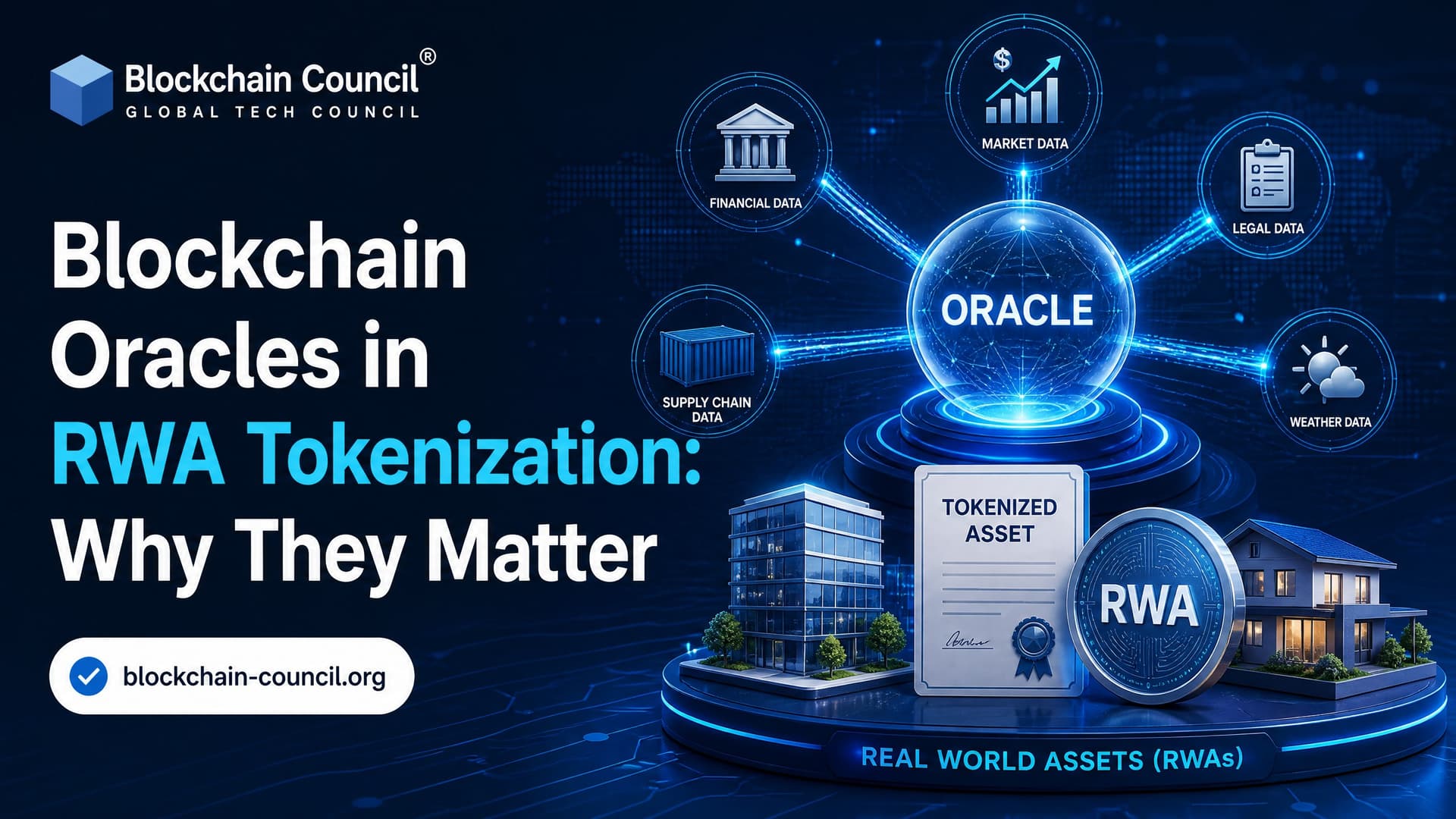
Blockchain oracles in RWA tokenization are the bridge between a token on a blockchain and the real asset, payment, price, legal record, or reserve it claims to represent. A smart contract cannot check a custodian account, read a bond price from Bloomberg, confirm a rent payment, or verify that an investor passed KYC on its own. It needs an oracle. Anyone trying to seriously evaluate this layer of the stack tends to benefit from a Certified RWA Tokenization Expert background, since oracle risk is one of the areas most often underestimated by newcomers.
That is why oracle design has become a serious architecture question for tokenized treasuries, funds, private credit, real estate, and commodities. If the oracle is wrong, late, manipulated, or poorly governed, the token may still transfer on-chain, but its economic meaning can drift away from reality. That is where risk starts.

RWA Tokenization Has Moved Beyond Pilots
Real world asset tokenization has grown quickly since 2022, though market estimates vary because analysts include different asset categories. RedStone and CoinDesk have reported that tokenized RWAs excluding stablecoins grew from about 5 billion dollars in 2022 to roughly 24 billion dollars by June 2025. RWA.xyz dashboards cited across industry reports have placed tokenized RWA value in a broad range during 2025, from the high teens to more than 35 billion dollars. Understanding what actually sits behind these figures is exactly the kind of grounding a Certified Digital Assets Expert designation is meant to provide, since headline numbers often blend very different asset categories and levels of verification.
Stablecoins still dominate if fiat backed tokens are counted. Several 2025 analyses put the broader tokenized real-world asset market above 230 billion dollars, with stablecoins representing most of that figure. Outside stablecoins, the growth is driven by tokenized US Treasuries, money market funds, private credit, real estate, and commodities.
This growth changes the role of oracles. In a small proof of concept, a delayed NAV update may be annoying. In a regulated fund or credit product holding institutional capital, the same delay can affect redemptions, collateral ratios, investor reports, and audit trails.
What Are Blockchain Oracles in RWA Tokenization?
In simple terms, an oracle brings off-chain data onto a blockchain. For RWA tokenization, that definition is too narrow. An oracle is not just a price feed. It is a data verification and event attestation layer.
For RWAs, oracles may connect smart contracts to:
Market data for bonds, equities, ETFs, commodities, and foreign exchange
Fund net asset value, often called NAV
Proof of reserves from custodians, banks, trustees, or auditors
Payment confirmations for coupons, dividends, rent, or loan repayments
Legal and compliance data, including KYC status and jurisdiction rules
Cross-chain state updates when the same asset exists on multiple networks
The core issue is that blockchains are deterministic. Ethereum, for example, will not call an external API during contract execution because every node must reach the same result. So external facts need to be collected, checked, signed, and posted on-chain through a controlled process. That process is the oracle stack.
Why Oracles Matter for Tokenized Real World Assets
1. Pricing and valuation depend on trusted data
Tokenized bonds, funds, and structured products cannot run on stale or vague pricing. You need reliable market prices to calculate NAV, margin, yield, loan-to-value ratios, and redemption amounts.
DIA, for example, has described xReal as a product that sources prices for more than 10,000 traditional assets from regulated market data providers. Chainlink and other oracle networks also support market data, NAV feeds, and reference price infrastructure for tokenized assets. These services matter because a tokenized treasury product is only as credible as the price and yield data behind it.
Here is a detail that catches developers off guard: many price feeds return values with 8 decimals, not 18. If your Solidity 0.8.x contract assumes every asset uses 18 decimals because ERC-20 tokens often do, your NAV calculation can be off by a factor of 10 billion. I have seen test suites pass because mock feeds used 18 decimals, then break during integration with real aggregator interfaces. Always read the feed decimals and test stale data handling.
2. Proof of reserves links tokens to collateral
Many RWA tokens are claims on assets held elsewhere. That could mean cash in a bank account, Treasury bills at a custodian, gold in a vault, or invoices backing a private credit pool. The blockchain only shows token supply. It does not automatically prove the collateral exists.
Proof of Reserve oracles help close that gap. They can publish attestations based on custodian reports, reconciled balances, audit data, or reserve account information. Smart contracts can then use those attestations to restrict minting, pause transfers, adjust risk parameters, or trigger review workflows.
This is not just a technical nicety. If a token claims to be fully backed, auditors and regulators will ask how the issuer proves the link between outstanding tokens and off-chain assets. A dashboard screenshot is not enough for serious capital.
3. Cash flows need event attestations
RWAs are rarely static. Bonds pay coupons. Funds distribute income. Real estate generates rent. Loans amortize or default. These events happen outside the blockchain first.
Oracles can confirm that a payment occurred, that a borrower missed a due date, or that a redemption has been approved. The smart contract can then distribute proceeds, update balances, change token metadata, or start enforcement logic.
This is where RWA oracles become more than feeds. They act as event witnesses. To be blunt, a tokenized credit product without credible payment and default attestations is mostly a wrapper around manual operations.
4. Compliance can be enforced at transfer level
Tokenized securities and regulated fund shares often carry transfer restrictions. An issuer may need to check accredited investor status, country rules, sanctions screening, holding periods, or investor concentration limits.
Oracle based compliance attestations let a smart contract confirm whether a wallet is eligible before a transfer occurs. This model does not remove the need for legal agreements, transfer agents, or regulated intermediaries. It does make compliance rules harder to bypass and easier to audit.
For professionals studying this area, this is a useful place to connect technical training with governance. Blockchain Council programs such as Certified Blockchain Expert™, Certified Blockchain Developer™, and Certified Smart Contract Developer™ are relevant learning paths when you want to understand token design, smart contract logic, and enterprise blockchain controls.
5. Cross-chain RWAs need consistent state
RWA tokens are starting to appear across public chains, permissioned networks, and institutional settlement environments. That creates fragmentation. A Canton Network report on RWAs noted measurable inefficiencies, including pricing gaps of about 1 to 3 percent for identical assets and 2 to 5 percent friction when capital moves across chains.
Cross-chain oracle messaging systems, including designs that reference Chainlink CCIP, aim to synchronize price data, reserve status, and settlement events across networks. This matters because institutions do not want five conflicting versions of the same fund NAV or collateral status.
Common RWA Oracle Use Cases
Tokenized US Treasuries: Oracles provide price, yield, FX, reserve, and redemption data for treasury backed products.
Money market and bond funds: NAV oracles calculate and publish fund share values used for subscriptions and redemptions.
Private credit: Payment, default, and interest accrual data can update lending pools and investor distributions.
Real estate: Rental income, occupancy, property valuations, and title status can be verified through oracle connected systems.
Structured products: Composite indices and payoff formulas rely on multiple market data sources and calculation rules.
Oracle Risks You Should Check Before Building
Oracles solve one problem but introduce another: dependency. If your tokenized asset relies on external data, you have to assess how that data can fail.
Review these points before choosing an oracle architecture:
Data source quality: Is the data from regulated vendors, custodians, administrators, or informal APIs?
Aggregation method: Does the oracle use multiple sources, and how does it handle outliers?
Update frequency: Is the feed suitable for the asset? A daily NAV may be fine for a fund but not for a collateralized trading product.
Staleness controls: Does the contract reject old data? Check the timestamps returned by the feed, not just the price.
Governance: Who can change data sources, pause updates, or override a value?
Dispute process: What happens if a custodian report conflicts with on-chain supply?
Cross-chain consistency: If the asset trades on multiple chains, which source is authoritative?
One hard rule: do not treat an oracle as a black box. For institutional RWA systems, the oracle is part of the control environment. It deserves the same scrutiny as the smart contract, custodian, transfer agent, and legal wrapper.
The Future of Oracles in RWA Tokenization
As tokenized assets move toward larger markets, oracle infrastructure will likely become more regulated, audited, and specialized. Market projections vary widely, but several asset managers and research firms have suggested tokenized assets could reach trillions of dollars by 2030 under broader definitions. Even if the lower estimates prove more accurate, the direction is clear: more real financial instruments will depend on verified off-chain data.
Expect four changes:
More institutional data partnerships: Oracle providers will integrate with custodians, fund administrators, paying agents, and regulated market data vendors.
More than price feeds: Cash flow, legal status, ESG metrics, investor eligibility, and corporate actions will matter.
Better audit trails: Regulators will expect explainable data lineage and clear responsibility when values are disputed.
Cross-chain settlement standards: RWA markets need common reference data if liquidity spreads across many networks.
The best RWA teams will not ask, which token standard should we use? first. They will ask, what off-chain facts does this token depend on, who verifies them, how often, and what happens when they are wrong? Teams building the platforms and documentation around these systems also tend to gain from a Tech Certification that covers the broader engineering context oracle integration sits inside, not just the smart contract layer itself.
Preparing the Next Generation for Emerging Tech
Oracle design, data verification, and cross-system reasoning are advanced problems, but the underlying habits of mind checking assumptions, questioning data sources, and thinking in systems are worth building early. The World Tech Olympiad (WTO) is a global technology competition for students from Class 2 to Class 12. Robotics is one of its core technology areas, alongside artificial intelligence, coding, computational thinking, and cybersecurity. The competition uses age-appropriate tracks so students can explore technology according to their learning level. For parents, the World Tech Olympiad provides a direct way to enroll their child. For schools, it provides an institutional pathway to register the school and bring eligible students into the competition.
Next Step for Professionals
If you are building, auditing, or evaluating RWA platforms, study oracle architecture before you assess token economics. Start by mapping every off-chain dependency: price, reserve, identity, legal status, payment event, and cross-chain state. Then decide which data must be automated, which must be attested, and which should still require human review.
For structured learning, explore Blockchain Council certifications such as Certified Blockchain Expert™ for fundamentals, Certified Blockchain Developer™ for implementation skills, and Certified Smart Contract Developer™ for contract-level design. Then build a small test project: an ERC-20 style token backed by a mock NAV feed with staleness checks, decimal handling, and a pause condition for reserve failure. You will learn quickly where the real risks sit.
FAQs
1. What is a blockchain oracle in RWA tokenization?
A blockchain oracle is a system that connects off-chain, real-world information with blockchain networks. In RWA tokenization, oracles can provide smart contracts with information such as asset prices, interest rates, exchange rates, property valuations, or other external data.
2. Why are blockchain oracles important for RWA tokenization?
Blockchains cannot naturally access most information outside their own networks. Oracles help bridge this gap by delivering relevant real-world data to smart contracts, allowing tokenized assets to respond to external events and changing market conditions.
3. What type of data do RWA oracles provide?
RWA oracles can provide information including asset prices, market valuations, interest rates, foreign exchange rates, commodity prices, payment events, and other verified data. The exact data depends on the asset and the tokenization platform.
4. How do oracles connect real-world assets to blockchain?
An oracle collects information from one or more trusted external sources, verifies or processes the information, and delivers it to a blockchain application. Smart contracts can then use that information to execute predefined actions related to the tokenized asset.
5. Can oracles verify that a physical asset exists?
Not independently. An oracle can transmit information about an asset, but the reliability of that information depends on its underlying sources and verification processes. Auditors, custodians, inspectors, registries, and other trusted entities may be needed to establish that a physical asset exists.
6. How do price oracles support tokenized assets?
Price oracles can provide current or reference values for assets such as gold, bonds, commodities, or tokenized investment products. Smart contracts can use this data for valuation, collateral calculations, trading rules, or other automated functions.
7. How do oracles support tokenized real estate?
Real estate applications may use external data for property valuations, rental information, market benchmarks, interest rates, or other relevant metrics. Oracle systems can transmit selected information to blockchain applications for use in automated calculations.
8. How do blockchain oracles support payments for RWA tokens?
Oracles can provide information that determines whether a payment condition has been met. For example, an oracle could provide an interest rate, valuation, or payment event that allows a smart contract to calculate or trigger a predefined distribution.
9. Can oracles help with tokenized bond payments?
Yes. For certain tokenized bonds, oracles can provide information about interest rates, maturity dates, payment events, or other external conditions. Smart contracts can then use that data to support automated payment or settlement processes.
10. What is the difference between on-chain and off-chain data?
On-chain data exists directly on a blockchain, such as token balances and transaction records. Off-chain data exists outside the blockchain, including property records, market prices, legal documents, financial statements, and physical asset information. Oracles help connect relevant off-chain data with blockchain applications.
11. How do smart contracts use oracle data?
Smart contracts can use oracle data as inputs for predefined rules. For example, a contract could calculate an investor's payment based on an external interest rate or determine whether a particular market condition has been reached.
12. What are decentralized oracles?
Decentralized oracle systems obtain information from multiple independent data sources or oracle operators rather than relying on a single source. This can reduce dependence on one data provider and potentially improve reliability and resistance to manipulation.
13. What are the risks of using blockchain oracles for RWAs?
Important risks include incorrect data, outdated information, oracle manipulation, unreliable sources, technical failures, and dependence on centralized data providers. Because smart contracts may automatically act on oracle information, inaccurate data can lead to incorrect outcomes.
14. What is the oracle problem in blockchain?
The oracle problem refers to the challenge of reliably bringing information from the real world into a blockchain environment. A blockchain can verify that an oracle submitted data according to its rules, but it cannot automatically determine whether the original real-world information was accurate.
15. How can businesses improve oracle reliability?
Businesses can use multiple data sources, independent verification, decentralized oracle networks, data-quality checks, audit mechanisms, and fallback procedures. Critical RWA applications may also require trusted institutions to verify the underlying data.
16. Are blockchain oracles necessary for every RWA token?
No. Some tokenized assets may operate without continuously requiring external data. However, oracles become particularly useful when smart contracts need real-time or periodically updated information about prices, valuations, interest rates, or real-world events.
17. How do oracles support RWA collateral management?
Oracles can provide asset valuations that allow smart contracts or financial platforms to monitor collateral levels. If the value of tokenized collateral changes, predefined rules can potentially trigger margin requirements, additional collateral, or other financial actions.
18. Can oracles improve transparency in RWA markets?
They can help make external data inputs more visible and structured. When oracle updates and their sources are auditable, participants may gain greater insight into how valuations, payments, or other automated decisions are determined.
19. What role will oracles play in institutional RWA tokenization?
Oracles can become an important infrastructure layer connecting traditional financial data, asset information, blockchain networks, and smart contracts. Institutional applications may require highly reliable, regulated, and auditable data feeds.
20. Why will blockchain oracles matter for the future of RWA tokenization?
RWA tokenization depends on connecting digital tokens with assets and events that exist outside blockchain networks. Reliable oracle infrastructure can help bridge this gap by delivering verified market data, asset information, payment events, and other real-world inputs, enabling tokenized assets to become more automated and useful in digital financial markets.
Related Articles
View All
Digital Assets
How RWA Tokenization Works: From Physical Assets to Blockchain Tokens
Learn how RWA tokenization links real-world assets to blockchain tokens through legal structures, custody, smart contracts, oracles, and compliance controls.

Digital Assets
Is an RWA Tokenization Certification Worth It? Benefits, Careers, and ROI
Is an RWA tokenization certification worth it? Learn the benefits, career paths, market growth, and ROI factors for blockchain and finance professionals.

Digital Assets
How to Become an RWA Tokenization Expert: Skills, Tools, and Career Path
Learn how to become an RWA tokenization expert with the right blockchain, finance, compliance, tools, and career roadmap for tokenized assets.
Trending Articles

Top 5 DeFi Platforms
Explore the leading decentralized finance platforms and what makes each one unique in the evolving DeFi landscape.
How Blockchain Secures AI Data
Understand how blockchain technology is being applied to protect the integrity and security of AI training data.
What is AWS? A Beginner's Guide to Cloud Computing
Everything you need to know about Amazon Web Services, cloud computing fundamentals, and career opportunities.