

How CBDC Infrastructure Works: A Step-by-Step Payment Journey
 Suyash Raizada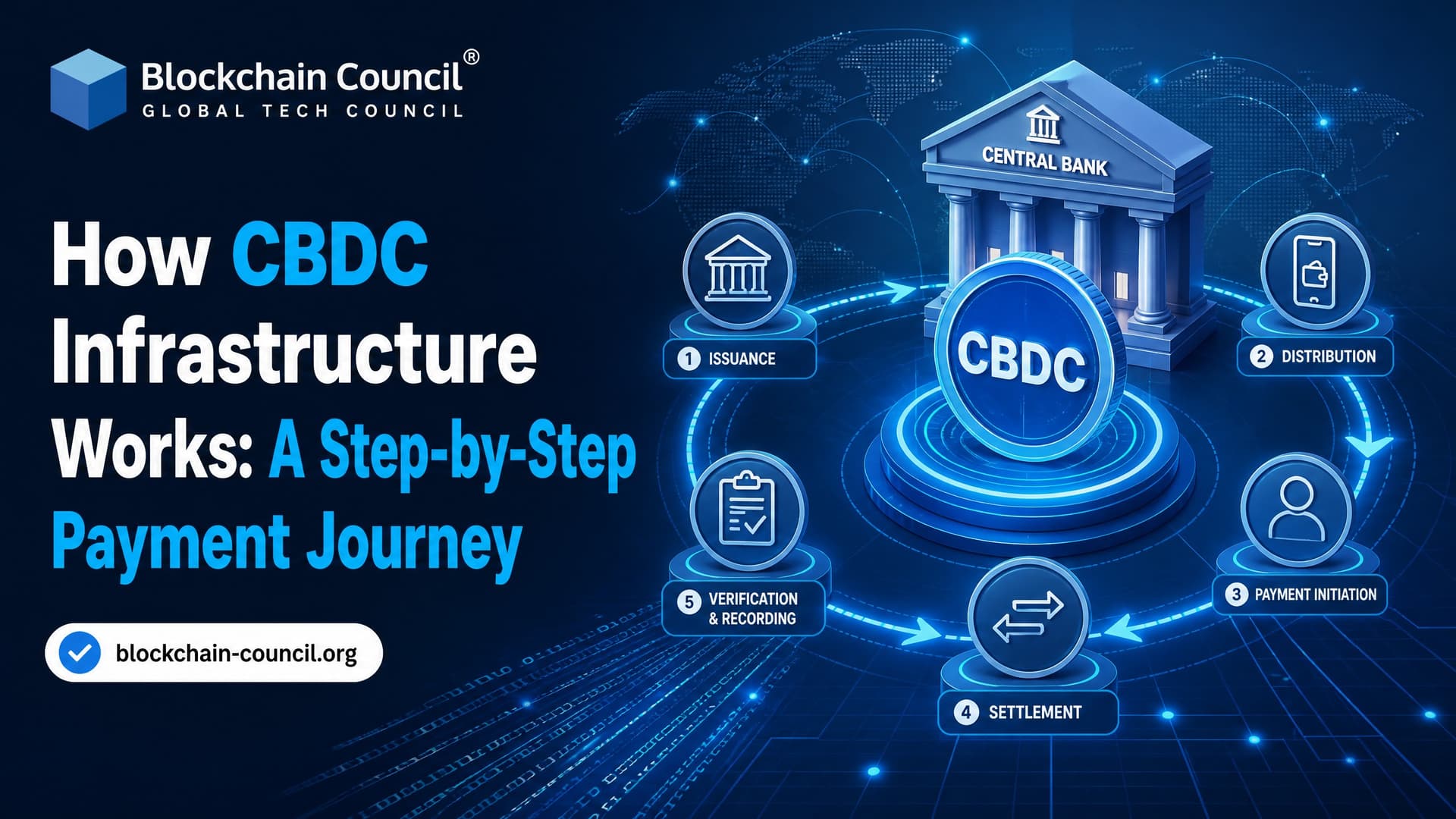
CBDC infrastructure is the technical stack that lets central bank money move through digital wallets, banks, payment service providers, compliance systems, and a core ledger controlled by the central bank. The simplest way to understand it is to follow one payment from a payer's phone to final settlement.
A central bank digital currency, or CBDC, is digital public money denominated in the national unit of account. Unlike a stablecoin or a bank deposit, a true CBDC is a direct liability of the central bank. The IMF, BIS, World Bank, and ITU Digital Currency Global Initiative all describe CBDC design as a layered system where the central bank protects monetary integrity while regulated intermediaries handle customer access, onboarding, and payment services. Anyone building expertise in this stack usually starts with a structured Certified Central Bank Digital Currency (CBDC) Expert foundation before working through the layer-by-layer detail below.

What CBDC Infrastructure Includes
Most CBDC infrastructure has two parts: the core CBDC system and the wider payment ecosystem. The core system contains the rulebook, the authoritative ledger, minting and burning controls, and security services. The wider ecosystem includes commercial banks, payment service providers, wallet apps, identity providers, fraud engines, and links to systems such as real time gross settlement, or RTGS.
The four main layers
Issuance layer: The central bank operates keys, nodes, or secure infrastructure used to create, destroy, and account for CBDC supply.
Distribution layer: Banks and regulated PSPs connect to the CBDC system, route transactions, manage user relationships, and support liquidity operations.
End-user layer: Wallets, merchant terminals, mobile apps, and web interfaces let people and firms send, receive, and view CBDC balances.
Compliance and integration layer: KYC, AML, sanctions screening, fraud monitoring, transaction limits, APIs, and RTGS connectivity sit here.
This layered design matters. If every citizen had a direct account on a central bank operated retail system, the central bank would need to run customer support, fraud disputes, password recovery, merchant onboarding, and compliance operations at national scale. That is one reason many current designs favor hybrid or intermediated CBDC models. Since the end-user and distribution layers increasingly connect to tokenized deposits and other digital assets, many professionals pair this CBDC foundation with a Certified Digital Assets Expert background to cover both sides of that connection.
Direct, Hybrid, and Intermediated CBDC Models
CBDC infrastructure can be built in different ways, and the design choice changes the payment journey.
Direct CBDC: The central bank provides wallets or accounts directly to users and maintains the full retail ledger.
Hybrid CBDC: Intermediaries handle customer-facing services, while the central bank keeps a central ledger and backup capability.
Intermediated or two tier CBDC: The central bank operates the core ledger. Licensed intermediaries manage onboarding, wallets, and customer checks.
Synthetic models: Private issuers create digital money backed by central bank reserves. Many policy papers now treat this as separate from a true CBDC.
To be blunt, the intermediated model is the practical default for most retail CBDC discussions. It preserves central bank control over the money while using institutions that already know how to serve customers, monitor risk, and connect to merchants.
Step-by-Step CBDC Payment Journey
Now follow a retail CBDC payment in an intermediated model. Alice pays Bob through her wallet provider, PSP A. Bob uses PSP B.
Step 1: Alice initiates the payment
Alice opens her CBDC wallet, enters Bob's identifier, scans a QR code, or taps at a point of sale terminal. PSP A authenticates her using the agreed method. That could be app credentials, device binding, biometric confirmation, a one time password, or a national eID scheme.
At the same time, PSP A checks basic risk controls. Is Alice onboarded? Is the wallet active? Is the payment within the allowed limit? Does the transaction look unusual compared with her normal activity?
Step 2: The payment message is created
After authentication, PSP A creates a structured payment instruction. A typical message includes:
Payer wallet or account reference
Payee wallet or account reference
Amount and currency
Transaction reference or idempotency key
Merchant or purpose metadata, where permitted
Timestamp and PSP identifier
That transaction reference is not a small detail. In real payment systems, mobile apps retry requests when the network drops. If the platform uses an at-least-once queue such as Amazon SQS, the same message can be delivered more than once. The CBDC gateway and ledger services must treat the reference as unique, otherwise a retry could become a second debit. This is the kind of operational issue that looks boring until it causes a production incident.
Step 3: PSP A signs and submits the instruction
PSP A digitally signs the payment message with its private key. The CBDC gateway verifies the signature against a registry of approved participants. It also checks whether PSP A is allowed to submit this type of transaction.
External participants usually do not write directly to the core CBDC ledger. They connect through APIs, gateways, and service layers. That separation gives the central bank better control over security, message validation, throttling, audit logs, and participant permissions.
Step 4: The transaction enters a workflow
Once the gateway accepts the message format, the transaction moves into the processing workflow. Technical reference architectures, including cloud based examples published by AWS, use queues and orchestration services to absorb traffic spikes and run each validation step in order.
In a national payment system, this design is not optional. Salary days, public benefit releases, shopping festivals, or an outage recovery window can create sudden volume. A queue protects downstream services from being overwhelmed, but it also forces engineers to design carefully for ordering, duplicate messages, timeout handling, and replay protection.
Step 5: Validation and risk checks run
The CBDC infrastructure now performs deeper checks. These may include:
Does Alice have enough CBDC balance?
Is Bob reachable through PSP B?
Are both parties onboarded and active?
Does the payment breach transaction or wallet limits?
Is the transaction flagged by AML, CTF, sanctions, or fraud systems?
Does it comply with the CBDC rulebook?
Some checks happen inside the CBDC platform. Others call external services such as identity registries, sanctions databases, analytics tools, or a bank's core system. The key point is that the authoritative CBDC balance sits on the core ledger, not inside a wallet screen.
If a check fails, the system rejects the transaction and returns a failure reason to PSP A. Good systems keep this reason clear enough for customer support but not so detailed that it helps attackers test the controls.
Step 6: The core ledger updates and settlement occurs
If the transaction passes validation, the CBDC core ledger debits Alice's CBDC store and credits Bob's CBDC store. The ITU DCGI reference architecture describes this as movement between digital stores, with the ledger processing a decrement on the sender side and an increment on the recipient side.
Settlement is final once the core ledger records the state change according to the CBDC rulebook. In many designs, that happens in real time or near real time. The ledger must prevent double spending, maintain transaction sequence integrity, and recover safely after component failure.
Some architectures also connect the CBDC ledger with RTGS. That matters when intermediaries need to convert between CBDC and central bank reserves, manage liquidity, or reconcile wholesale positions.
Step 7: PSPs receive confirmation
After settlement, the platform sends confirmation messages to PSP A and PSP B. Alice sees that the payment is complete. Bob's wallet updates, and he receives a notification by app message, SMS, or another approved channel.
From Bob's point of view, the money is available immediately. Behind the scenes, PSPs reconcile their internal records with the core ledger and, where relevant, RTGS or other payment rails. Reconciliation is not glamorous. It is essential.
Step 8: CBDC can be redeemed or converted
CBDC infrastructure must also support conversion. Users may move CBDC back into a bank deposit, withdraw cash through supported channels, or spend CBDC received from a government disbursement on merchant payments. When CBDC is redeemed out of circulation, the system updates supply records and may burn or destroy the corresponding CBDC units in the ledger.
Where CBDC Infrastructure Is Being Used Today
Retail CBDC is no longer only a whiteboard topic. The Bahamas' Sand Dollar, Nigeria's eNaira, and Jamaica's JAM-DEX are live examples often cited by the IMF and World Bank. Their models differ, but all use a controlled ecosystem where the central bank issues digital money and intermediaries support user access.
Common use cases include person to person transfers, merchant payments, government benefit payments, lower cost digital payment access, and cash alternatives in remote regions. Wholesale CBDC experiments focus more on securities settlement, interbank transfers, and cross border payment tests.
Key Design Trade-offs
CBDC infrastructure is full of hard choices. There is no perfect architecture.
Privacy vs compliance: A CBDC must support lawful monitoring, but a system that exposes every low value transaction to broad access will face public resistance.
Central control vs private innovation: The central bank should control monetary issuance and final settlement. Wallet design and merchant tools are usually better handled by regulated private providers.
Programmability vs safety: Conditional payments can be useful for benefit programs or automated settlement, but putting complex logic into the core ledger is risky.
Online speed vs offline resilience: Offline CBDC can help during network outages, but it introduces hard problems around double spending and device security.
My view: CBDC should not try to replace every payment rail. It works best as digital public money that coexists with cash, bank deposits, instant payments, cards, and tokenized asset platforms.
Skills Professionals Need to Understand CBDC Systems
If you work in banking, payments, compliance, blockchain architecture, or digital assets, CBDC infrastructure sits at the intersection of monetary policy and system design. You need to understand ledger models, cryptographic signing, identity controls, API governance, settlement finality, and operational resilience.
For structured learning, consider Blockchain Council programs such as Certified Blockchain Expert™, Certified Blockchain Developer™, and Certified Cryptocurrency Expert™. Developers who want to compare CBDC architecture with token standards and smart contract based payment flows can also explore smart contract focused training. Engineers working on the queueing, API, and reconciliation layers described above may also find it worth browsing the wider Tech Certification catalog, since that part of the stack is standard distributed-systems engineering applied to a regulated payments context.
What to Learn Next
Start by mapping a CBDC payment on paper: wallet, PSP, gateway, validation services, ledger, RTGS, notification, and reconciliation. Then compare that map with a card payment or instant payment flow. The differences will show you where CBDC infrastructure is genuinely new and where it simply adapts proven payment engineering to central bank money.
If your goal is implementation work, learn API security, digital signatures, distributed ledger fundamentals, and payment operations. If your goal is policy or strategy, focus on architecture models, privacy design, financial stability, and interoperability. CBDC is not just a blockchain topic. It is payment infrastructure, central banking, and digital identity in one stack. And if part of your role involves explaining that stack to leadership, regulators, or partners, a Marketing Certification can help you turn this technical map into a story that lands with a non-specialist audience.
FAQs
1. What is CBDC infrastructure?
Central bank digital currency (CBDC) infrastructure is the combination of technology, institutions, rules, and security mechanisms that allows digital central bank money to be issued, distributed, transferred, settled, and redeemed.
A typical retail CBDC ecosystem could involve:
Central Bank → Banks/PSPs → Wallets → Users & Merchants
Behind a seemingly simple payment may sit identity systems, ledgers, APIs, fraud controls, cryptography, settlement infrastructure, and compliance systems. Buying coffee apparently requires an architecture diagram now.
2. Who are the main participants in a CBDC payment?
Depending on the CBDC model, participants can include:
Central bank
Commercial banks
Payment service providers (PSPs)
Wallet providers
Consumers
Merchants
Government agencies
Identity providers
Payment processors
In a two-tier model, the central bank typically manages the monetary core while regulated intermediaries provide much of the customer-facing infrastructure.
3. How does CBDC enter circulation?
The process begins with CBDC issuance.
The central bank creates CBDC according to the rules of the monetary system. Authorized intermediaries may then obtain and distribute it to customers.
Conceptually:
Central Bank → Bank/PSP → Customer Wallet
The CBDC remains a liability of the central bank even when a private institution provides the wallet or interface.
4. How might a user obtain CBDC?
A user could potentially convert commercial bank deposits or other eligible money into CBDC.
For example:
Bank Deposit: −$100
CBDC Wallet: +100 CBDC units
Behind the interface, the banking and CBDC systems would perform the corresponding settlement and ledger operations.
The exact mechanism depends on the country's CBDC architecture.
5. What happens before the user can make payments?
The user may first need to be onboarded by a bank or PSP.
This can involve:
Identity verification → KYC checks → wallet registration → credential creation → authentication setup
Different access tiers could potentially have different identity or transaction requirements, depending on regulation and CBDC design.
6. Where is CBDC actually stored?
That depends on the architecture.
CBDC holdings might be represented through:
Central ledger balances
Intermediary-managed account records
Cryptographic tokens
Secure device-based value
Hybrid arrangements
A wallet therefore does not necessarily “contain coins” in the ordinary sense. Often it contains credentials that allow the user to access or control value recorded elsewhere.
7. How does a CBDC payment begin?
Suppose Alice wants to pay a merchant 25 CBDC units.
She might:
Scan QR code → enter or confirm amount → authenticate → approve payment
Her wallet then creates a payment instruction containing the information required by the CBDC system.
From Alice's perspective, this may take seconds. The infrastructure gets the privilege of handling everything complicated.
8. How is the payer authenticated?
The wallet or provider must verify that the person initiating the payment is authorized to use the funds.
Authentication could involve:
PIN
Password
Device credential
Biometrics
Cryptographic key
Multi-factor authentication
Secure hardware
Higher-value or higher-risk transactions might require stronger authentication.
9. What happens after authentication?
Once authenticated, the wallet sends the payment instruction to the relevant infrastructure.
In a two-tier system, the path might resemble:
Alice's Wallet → Alice's PSP → CBDC Core → Merchant's PSP → Merchant
The system then performs the checks necessary to determine whether the payment can be accepted.
10. What checks happen before payment authorization?
Depending on the architecture, checks could include:
Valid credentials
Sufficient CBDC balance
Transaction limits
Token validity
Duplicate transaction detection
Fraud indicators
Sanctions requirements
AML/CFT controls
Wallet status
Technical message integrity
Not every check necessarily occurs at the central bank. Responsibilities can be distributed among intermediaries and infrastructure operators.
11. How is double spending prevented?
Digital money must prevent the same value from being validly spent twice.
In an account-based architecture, the authoritative system can verify the available balance and update it when the transaction occurs.
In a token-oriented architecture, cryptographic or ledger mechanisms can verify that the digital value remains valid and has not already been spent.
Offline CBDC requires additional protections because the central system may temporarily be unavailable.
12. What happens on the CBDC ledger?
Once the payment is validated, the system updates the authoritative records.
For a balance-based example:
Alice before: 200
Payment: 25
Alice after: 175
Merchant before: 500
Merchant after: 525
The precise ledger implementation could use conventional databases, distributed ledgers, or a hybrid architecture.
13. When is a CBDC payment settled?
Settlement occurs when the transfer becomes final according to the system's legal and technical rules.
One potential advantage of CBDC is that payments can settle directly in central bank money, reducing or changing some settlement risks associated with claims on private intermediaries.
However, “instant” user confirmation and legal settlement finality are concepts that should be distinguished carefully.
14. Does the merchant receive CBDC immediately?
Potentially.
A well-designed retail CBDC system could provide near-real-time confirmation and settlement.
The merchant might then choose to:
Keep CBDC
Spend CBDC
Transfer it elsewhere
Convert it into a commercial bank deposit
The precise options would depend on system rules and financial services available.
15. What happens if the merchant converts CBDC into bank deposits?
Suppose the merchant converts 500 CBDC units into a bank deposit.
Conceptually:
CBDC balance: −500
Commercial bank deposit: +500
The CBDC and banking infrastructures would perform the necessary corresponding settlement operations.
This convertibility is important if CBDC is intended to coexist smoothly with existing forms of money.
16. What happens when two different wallet providers are involved?
Interoperability allows users of different banks or PSPs to transact.
For example:
Wallet A → PSP A → CBDC Infrastructure → Bank B → Wallet B
Common technical standards can define:
Payment messages
Authentication
APIs
Transaction identifiers
Error handling
Settlement instructions
Without interoperability, a national CBDC could deteriorate into several incompatible wallet ecosystems, which would be an impressively modern way to reinvent inconvenience.
17. How could an offline CBDC payment work?
An offline payment could allow devices to exchange limited amounts of CBDC without contacting the central infrastructure immediately.
A simplified flow might be:
Payer device → secure local verification → Recipient device → Later synchronization
The system would need safeguards such as:
Offline balance limits
Secure hardware
Double-spending controls
Transaction counters
Device authentication
Synchronization rules
Offline capability can improve resilience and inclusion but creates difficult security trade-offs.
18. What happens if part of the CBDC system fails?
A resilient architecture can include:
Redundant data centers
Replicated records
Backup communication networks
Automatic failover
Multiple PSPs
Disaster-recovery systems
Offline payment capability
Transaction reconciliation
Because CBDC could become critical national infrastructure, availability requirements would likely be demanding. “Try again tomorrow” is not an especially persuasive payment-system feature.
19. What does the complete CBDC payment journey look like?
A simplified end-to-end journey is:
1. Central bank issues CBDC
↓
2. Bank or PSP distributes CBDC
↓
3. User receives CBDC in a wallet
↓
4. Merchant sends payment request
↓
5. User confirms transaction
↓
6. Wallet authenticates user
↓
7. PSP validates relevant payment information
↓
8. Fraud/compliance checks occur where required
↓
9. CBDC infrastructure validates funds or tokens
↓
10. Authoritative records are updated
↓
11. Settlement becomes final
↓
12. Merchant receives confirmation
↓
13. Merchant keeps, spends, or converts the CBDC
A production system could perform many of these steps simultaneously rather than as a slow sequential chain.
20. What is the easiest way to understand CBDC infrastructure?
Think of CBDC infrastructure as several interconnected layers:
User Layer
Wallets → phones → cards → merchant terminals
↓
Access Layer
Banks → PSPs → wallet providers → identity services
↓
Payment Layer
Authentication → routing → fraud controls → transaction processing
↓
CBDC Core
Issuance → ledger/token validation → settlement → redemption
↓
Central Bank Layer
Monetary governance → system rules → oversight → resilience
The crucial point is that a CBDC payment is not simply “digital money moving from one phone to another.” It is a coordinated process that must establish who can spend, whether the value exists, whether the transaction is valid, how records change, when settlement becomes final, and what information each participant is permitted to see.
If all of that works properly, the user experiences the least impressive part: a payment confirmation appearing on a screen. That boring simplicity is rather the point.
Related Articles
View All
Digital Assets
How RWA Tokenization Works for Infrastructure Assets and Project Finance
Learn how RWA tokenization turns infrastructure equity, debt, and revenue rights into compliant digital tokens for project finance.

Digital Assets
CBDC vs UPI: Digital Currency Is Not an Instant Payment Rail
CBDC vs UPI explained: CBDC is central bank digital money, while UPI is an instant rail that moves bank deposits. Learn how they differ.

Digital Assets
How RWA Tokenization Works for Carbon Credits and Climate Assets
Learn how RWA tokenization converts carbon credits and climate assets into traceable blockchain tokens, including MRV, bridging, risks, and use cases.
Trending Articles
The Role of Blockchain in Ethical AI Development
How blockchain technology is being used to promote transparency and accountability in artificial intelligence systems.
What is AWS? A Beginner's Guide to Cloud Computing
Everything you need to know about Amazon Web Services, cloud computing fundamentals, and career opportunities.
Blockchain in Supply Chain Provenance Tracking
Supply chains are under pressure to prove not just efficiency, but also authenticity, sustainability, and fairness. Customers want to know if their coffee really is fair trade, if the diamonds are con