

CBDC vs UPI: Digital Currency Is Not an Instant Payment Rail
 Suyash Raizada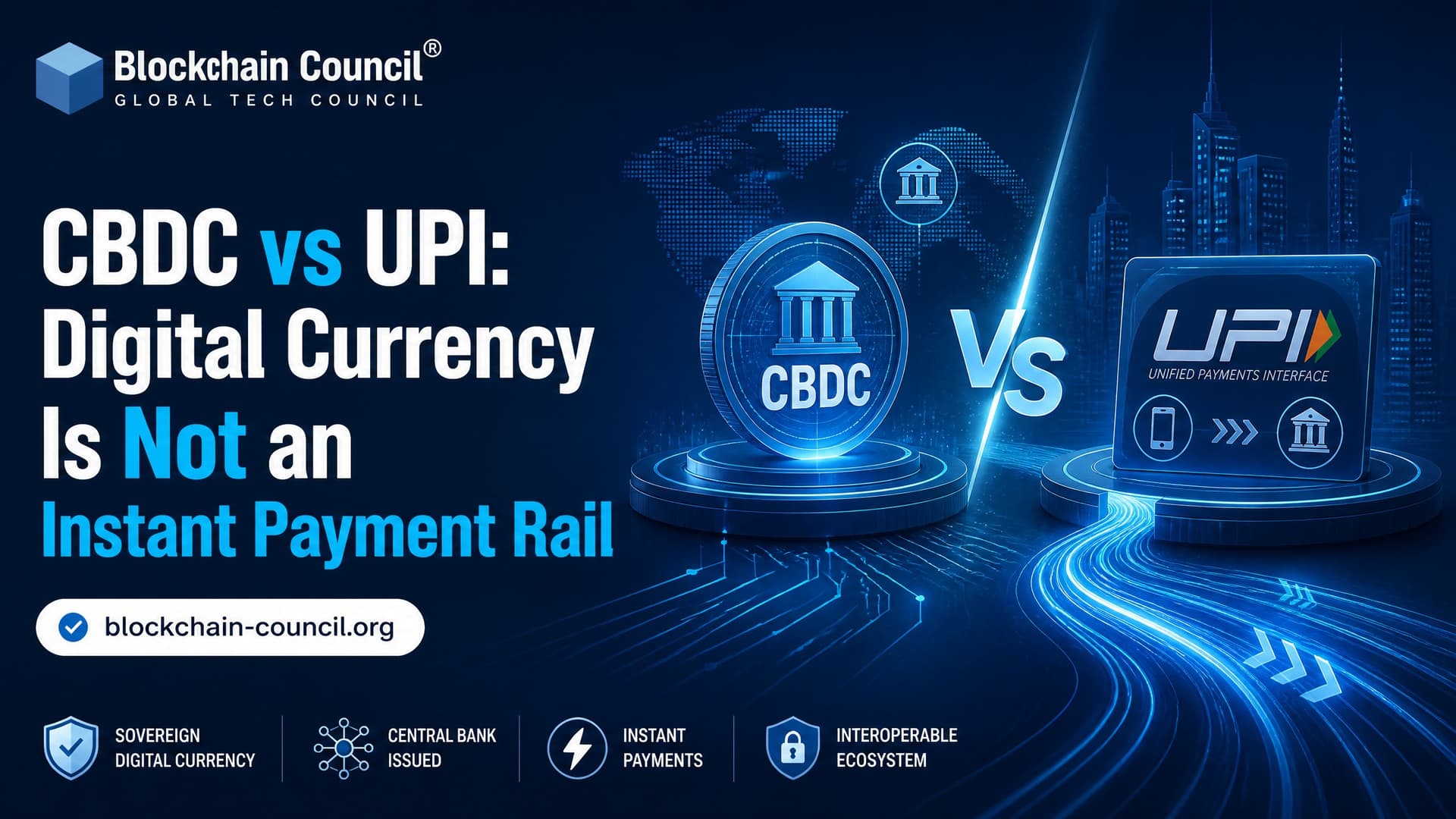
CBDC vs UPI is not a contest between two payment apps. It is the difference between money and the pipe that moves money. A central bank digital currency, such as India's e-rupee, is sovereign digital money issued by the Reserve Bank of India. UPI, built and operated by the National Payments Corporation of India, is an instant payment rail that moves existing bank deposits between accounts.
That distinction sounds academic until you design a wallet, reconcile merchant payments, or assess settlement risk. Then it matters a lot. UPI changes where bank money sits. CBDC changes what kind of money the user holds. Professionals working through this exact distinction often build their foundation with the Certified Central Bank Digital Currency (CBDC) Expert program, since the CBDC-versus-payment-rail question keeps resurfacing across wallet design, settlement, and compliance work.

CBDC vs UPI: The Core Difference
CBDC is digital legal tender
A CBDC is a digital form of a country's fiat currency issued by its central bank. In India, the e-rupee is issued by the RBI and represents a direct liability of the central bank, similar in legal character to physical cash but held and transferred digitally.
The RBI's concept note on central bank digital currency describes CBDC as a digital form of currency notes. That framing is useful. You are not just initiating a bank transfer. You are moving a tokenized form of sovereign money.
UPI is a payment rail
UPI is not money. It is infrastructure. It lets users send and receive funds instantly between bank accounts through mobile apps, QR codes, virtual payment addresses, and merchant payment flows.
When you pay a shop through UPI, your commercial bank deposit decreases and the merchant's bank deposit increases. UPI coordinates the instruction. The money stays bank money throughout the process.
In short:
CBDC: The asset itself, central bank-backed digital cash.
UPI: The rail, a system for moving bank deposits.
CBDC wallet transfer: Token movement between wallets.
UPI transfer: Account-to-account movement across banks.
As this asset-versus-rail distinction extends further into stablecoins and tokenized deposits sitting on the same payment stack, many professionals pair this grounding with a Certified Digital Assets Expert certification so CBDC is understood as one instrument among several rather than in isolation.
How UPI Works Behind the Screen
For users, UPI feels simple. Scan, enter PIN, done. Under the hood, it depends on banks, payment service providers, NPCI switching infrastructure, and settlement arrangements. UPI runs on the banking system and builds on India's real-time retail payment infrastructure, including IMPS.
This is why a UPI payment is not the same as handing over digital cash. Your bank must be part of the flow. The recipient's bank is part of the flow. The payment app and NPCI rails coordinate the message.
If you have ever worked on a merchant UPI integration, the unglamorous part is not the QR code. It is reconciliation. A payment callback can reach your system before final merchant settlement data is available, and your ledger has to decide whether to mark the order as paid, pending, or subject to manual review. That is ordinary payment engineering. CBDC changes that model because the value transfer itself can update wallet balances directly.
How CBDC Works Differently
India's retail CBDC is designed as a token-based digital currency. A user can convert bank deposits into e-rupee units held in a CBDC wallet. When a payment is made, tokens move from one wallet to another rather than triggering an interbank transfer instruction.
RBI officials have publicly explained that e-rupee transactions do not require bank routing in the same way UPI does. That is the key technical split. UPI asks banks to move balances. CBDC moves central bank digital tokens.
CBDC systems may use distributed ledger technology, blockchain-inspired designs, or centralized ledger architectures. Do not assume every CBDC is a public blockchain. Most central banks are cautious about permissioning, privacy, compliance, and monetary control. A CBDC is not an ERC-20 token on Ethereum mainnet, and you should not model it that way unless the issuing authority explicitly publishes such a design.
Settlement: Deferred Bank Settlement vs Direct Token Transfer
UPI payments look instant to users, but banking settlement can involve deferred net settlement between participating institutions. That is normal for retail payment systems. The user experience is instant. The institutional accounting layer follows its own cycle.
CBDC can reduce or remove the need for separate bank-to-bank settlement in a wallet-to-wallet transfer because the central bank ledger records the movement of value directly. This is why central banks study CBDC for wholesale use cases, including interbank and institutional settlement.
The practical result is simple:
UPI settlement risk: Depends on payment system rules, banks, and reconciliation processes.
CBDC settlement model: Can be closer to final movement of central bank money.
Enterprise impact: Treasury, reconciliation, refund handling, and ledger design may change.
Building and hardening the settlement infrastructure on either side of that split is real backend engineering work, and a broader Tech Certification from Global Tech Council is a practical way to build the cloud, database, and cybersecurity skills that support reconciliation systems at this scale.
Privacy and Data Differences
UPI transactions are linked to bank accounts and payment service providers. Banks and regulated intermediaries record transaction history. That is necessary for dispute handling, fraud controls, compliance, and account statements.
CBDC is often discussed as a digital equivalent of cash, especially for small-value payments. In India's CBDC discussions, wallet-to-wallet transfers are presented as reducing the banking transaction data trail because the payment does not travel through a bank account in the same way. Still, be careful with the word anonymous. Central banks have to balance privacy with anti-money laundering rules, counter-terror financing controls, and lawful access requirements.
My view: CBDC can offer better cash-like privacy than standard account-based payments for low-value use cases, but it will not be private like a bearer asset outside the regulated financial system. Anyone building products around CBDC should expect tiered limits, KYC controls, and audit obligations.
Costs for Users and Merchants
UPI is widely seen as free or low cost for consumers. For businesses, the picture depends on payment gateway arrangements, merchant collection setups, value-added services, and reconciliation tooling. Some merchants still face gateway or service charges even when the underlying payment rail is low cost.
CBDC is expected to reduce transaction costs because fewer intermediaries may be involved in wallet-to-wallet transfers. That matters for small merchants. A 1 percent or 2 percent fee may look minor in a boardroom, but it hurts a tea seller or a local grocery store processing hundreds of low-ticket transactions a day.
CBDC may also support offline payments in low-connectivity areas. This is not a small feature. UPI normally needs live connectivity to banking infrastructure. Offline CBDC, if implemented well, could help remote markets, disaster-response payments, and areas with unstable networks. The hard part is preventing double spending while allowing temporary offline value transfer. That is a design challenge, not a marketing line.
Financial Inclusion: Different Paths to the Same Goal
UPI has already expanded digital payments across India because it connects familiar bank accounts to mobile-first payment apps. Its success is visible at street vendors, metro stations, online stores, and household transfers.
CBDC targets a different gap. It can potentially serve people who need digital money without relying fully on a traditional bank account model. If wallet design, onboarding, and offline capability are handled well, CBDC can support underbanked users who are not fully served by account-based payments.
But do not overstate it. A poorly designed CBDC wallet with confusing recovery, weak agent networks, or strict smartphone dependence will not solve inclusion. UPI won because the front-end behavior was easy. CBDC has to be just as easy, or people will ignore it.
Will CBDC Replace UPI?
No. CBDC and UPI are expected to coexist.
UPI has scale, user trust, merchant acceptance, and deep bank integration. It is the right choice for most everyday account-based payments today. CBDC adds a new form of settlement asset: digital central bank money. That makes it useful for specific cases where direct settlement, lower intermediary costs, cash-like behavior, or offline support are valuable.
A future payment app may hide this choice from the user. You may scan the same QR code, but the app could ask whether you want to pay from your bank account through UPI or from your e-rupee wallet. Same gesture. Different monetary layer.
What Developers and Enterprises Should Prepare For
If you build payment systems, prepare for a multi-rail future. UPI will stay essential for reach. CBDC will introduce new wallet models, token lifecycle rules, compliance workflows, and settlement accounting.
Enterprises should assess:
Whether CBDC can reduce merchant payment costs.
How refunds work when payment value is held as digital tokens.
What ledger changes are needed for direct CBDC settlement.
Whether offline payments create new fraud and reconciliation risks.
How privacy obligations differ from bank-account payment data.
Developers should understand token-based architecture, payment APIs, identity layers, and secure wallet design. If you come from blockchain development, resist the habit of treating CBDC like a public chain asset. If you come from fintech, resist treating CBDC like another UPI handle. Both shortcuts produce bad architecture.
Learning Path for Blockchain and Digital Asset Professionals
For a solid foundation, start with monetary architecture before coding. Learn the difference between commercial bank money, central bank money, stablecoins, tokenized deposits, and CBDC. Then study payment settlement and wallet security.
Relevant Blockchain Council certifications include the Certified Blockchain Expert for blockchain fundamentals, the Certified Blockchain Developer for smart contract and distributed application skills, and the Certified Cryptocurrency Expert for digital asset market structure. If your work touches enterprise payment design, pair those with practical study of UPI, RBI CBDC publications, NPCI documentation, and cybersecurity controls for wallets. And because none of this adoption story works without users and merchants understanding why to switch, teams handling outreach and go-to-market strategy may also want to look at a Marketing Certification from Universal Business Council, since building trust in a new monetary layer is a communication challenge as much as a technical one.
Build one small project next: a mock checkout that supports two balances, one bank-deposit balance and one CBDC-wallet balance. Keep separate ledgers. Add refund states. Add failed network states. You will understand CBDC vs UPI faster by modeling the accounting than by reading another comparison table.
FAQs
1. What is the difference between CBDC and UPI?
A Central Bank Digital Currency, or CBDC, is digital money issued as a liability of a central bank. UPI, or Unified Payments Interface, is an instant payment system developed for transferring funds between participating accounts and payment applications in India. Put simply, CBDC concerns the form of money being transferred, while UPI primarily provides infrastructure for initiating and routing payments.
2. Is UPI a Central Bank Digital Currency?
No. UPI is not a CBDC and does not create a new form of sovereign digital currency. It is payment infrastructure that allows users to transfer money between participating bank accounts and supported services. India's retail CBDC, the digital rupee or e₹, represents central-bank money issued by the Reserve Bank of India, making it fundamentally different from UPI.
3. Is the digital rupee the same as UPI?
No. The digital rupee is India's Central Bank Digital Currency and represents a digital form of central-bank money. UPI is an instant payment rail used to initiate transfers involving existing financial accounts. Both can offer convenient digital payments and may support similar interfaces, but their underlying monetary and settlement structures are different.
4. Why is CBDC called money while UPI is called a payment rail?
CBDC represents the monetary asset itself. A retail CBDC balance or digital token represents a claim on the central bank according to the system's design. UPI provides the infrastructure that sends payment instructions between participating financial institutions. A useful comparison is that money is what is transferred, while the payment rail is part of the mechanism used to transfer it.
5. What type of money moves through UPI?
A conventional UPI transaction generally transfers commercial bank money between participating accounts. The balances consumers see in their bank accounts represent liabilities of their respective commercial banks. UPI provides the payment infrastructure connecting those accounts. Interbank settlement occurs through the regulated financial infrastructure supporting the system rather than turning the customer's bank deposit itself into CBDC.
6. What type of money is the digital rupee?
The digital rupee, or e₹, is a digital form of sovereign currency issued by the Reserve Bank of India. Unlike a commercial bank deposit, it represents a liability of the central bank. India's CBDC initiatives include retail and wholesale applications, with the retail digital rupee designed for use by consumers and businesses through participating institutions and approved infrastructure.
7. Why do CBDC and UPI payments look similar to users?
Both systems can use familiar digital interfaces such as mobile applications and QR codes. A user may scan a merchant QR code, enter or confirm an amount, authenticate the transaction, and receive confirmation. The front-end experience can therefore appear nearly identical even though the underlying money and settlement architecture are different. Interface similarity does not make the systems financially equivalent.
8. Can the digital rupee use UPI QR codes?
Interoperability initiatives have enabled participating digital-rupee wallets to work with existing UPI QR infrastructure in supported scenarios. This can help merchants accept CBDC payments without maintaining completely separate QR acceptance arrangements. The payment may therefore begin through a familiar QR experience while the underlying digital rupee remains CBDC rather than becoming a conventional UPI bank-account payment.
9. Does a CBDC payment require a bank account?
The answer depends on the CBDC design and access model. One potential advantage of retail CBDCs is that they can be designed to provide digital central-bank money without requiring every transaction to originate from a conventional bank deposit. In practice, onboarding, wallet funding, identity requirements, and participating intermediaries can still create connections with the banking system.
10. Does UPI require a bank account?
Traditional UPI usage has been closely connected to participating bank accounts, although the UPI ecosystem has expanded to support additional products and access models. Users typically connect eligible accounts or supported financial instruments to a UPI-enabled application. This differs from the conceptual model of CBDC, where the digital currency itself is the monetary asset held or transferred.
11. Is CBDC safer than UPI?
This is not a direct comparison because CBDC is money while UPI is payment infrastructure. CBDC reduces exposure to an individual commercial bank at the monetary-liability level because it is central-bank money. Both CBDC and UPI systems still require cybersecurity, fraud prevention, secure authentication, operational resilience, and consumer protection. Users can face scams or compromised devices regardless of the underlying payment architecture.
12. Is CBDC more private than UPI?
Not automatically. Privacy depends on how the CBDC is designed, what information participating intermediaries collect, and what legal access rules apply. UPI transactions operate through regulated financial institutions and generate transaction records. CBDC architectures can potentially incorporate data minimization and privacy-enhancing features, but the existence of central-bank digital money does not by itself guarantee cash-like anonymity.
13. Can the digital rupee work offline while UPI needs internet connectivity?
Offline functionality is one area being explored for CBDCs because digital cash could be useful where network connectivity is limited or temporarily unavailable. UPI has also developed mechanisms aimed at expanding payment access under constrained connectivity conditions. Offline CBDC presents distinctive technical challenges involving device security, double spending, transaction limits, and later synchronization with the wider system.
14. Is CBDC faster than UPI?
Not necessarily. UPI already provides extremely fast retail payments, so transaction speed alone is not the defining advantage of India's CBDC. A CBDC introduces a different form of digital money and potentially different settlement, offline, programmability, or resilience capabilities. Evaluating CBDC solely by whether it can beat an already-fast payment rail misses most of the monetary-policy and infrastructure questions involved.
15. Is CBDC cheaper than UPI?
Not necessarily. UPI already provides highly efficient digital payments in India. CBDC infrastructure can potentially improve certain settlement or payment use cases, but wallets, cybersecurity, compliance, technology infrastructure, and customer services still have operating costs. The economic case for CBDC therefore involves more than simply attempting to make an inexpensive retail payment system fractionally less expensive.
16. Can CBDC and UPI work together?
Yes. CBDC and UPI can be complementary because they operate at different layers. Interoperable QR codes and payment interfaces can allow consumers and merchants to use familiar experiences while supporting different underlying forms of money. Such interoperability can reduce merchant friction and help CBDC adoption without requiring India to discard its extensive existing digital-payment infrastructure.
17. Will the digital rupee replace UPI?
There is no inherent reason for the digital rupee to replace UPI. UPI has a deeply established role in India's retail payment ecosystem, while the digital rupee introduces central-bank digital money with different characteristics. The more plausible future is coexistence and interoperability, allowing users to access commercial bank money and CBDC through increasingly integrated payment experiences.
18. Will CBDC replace cash in India?
CBDC does not inherently require the elimination of physical cash. The digital rupee can provide an additional form of central-bank money alongside banknotes and coins. Cash continues to offer accessibility, familiarity, privacy characteristics, and resilience that matter to many users. The appropriate balance between physical and digital sovereign money will depend on consumer demand, policy, infrastructure, and inclusion.
19. Why does India need CBDC when UPI already works well?
This is one of the most important questions in India's CBDC debate. UPI solves the problem of making digital bank-account payments fast and convenient. CBDC addresses a different question: whether citizens and businesses should have access to a native digital form of central-bank money. Potential CBDC use cases include offline digital cash, programmable payments, settlement innovation, financial inclusion, and future digital financial infrastructure.
20. Which is better: CBDC or UPI?
CBDC and UPI should not be evaluated as if they are two competing payment applications.
They belong to different layers of India's monetary and payment architecture.
A useful way to understand the distinction is:
CBDC = Money
UPI = Payment Infrastructure
When a consumer makes a conventional UPI payment, UPI helps transfer value between participating financial accounts. The consumer's balance generally represents commercial bank money.
When a consumer pays using the digital rupee, the underlying asset is central-bank money issued by the Reserve Bank of India.
The user experience can nevertheless become almost identical.
Both may involve smartphones, QR codes, merchant applications, and instant confirmation. Interoperability can make those interfaces even more similar.
This is precisely why the distinction matters.
A QR code is not money. A payment application is not money either. These are interfaces and mechanisms for initiating transactions.
CBDC changes the underlying monetary asset.
UPI changes how efficiently users can move existing forms of money.
India's future payment ecosystem therefore does not necessarily require choosing one over the other.
UPI can continue providing highly efficient payment connectivity. Commercial banks can continue providing deposits, credit, and financial services. Cash can continue serving people who want or need physical currency.
The digital rupee can exist alongside them as another form of sovereign money.
Over time, consumers may even use applications that automatically handle different forms of money without requiring them to understand the settlement architecture underneath.
That is probably the sensible destination:
Cash for physical sovereign money.
CBDC for digital sovereign money.
Bank deposits for commercial bank money.
UPI and other payment systems for moving money efficiently.
The distinction may sound technical, but it prevents one of the most persistent misunderstandings in digital finance.
UPI digitized the payment experience. CBDC digitizes central-bank money itself.
Those are related innovations, but they are not the same thing.
Related Articles
View All
Digital Assets
CBDC for Remittances: How Digital Currency Could Lower Cross-Border Costs
CBDC for remittances could cut cross-border costs by reducing intermediaries, FX spreads, settlement delays, and cash handling, if systems interoperate.

Digital Assets
CBDC Career Roadmap: From Beginner to Digital Currency Specialist
A practical CBDC career roadmap covering skills, roles, certifications, and learning stages from blockchain basics to digital currency specialist work.

Digital Assets
CBDC Architect Roles and Responsibilities: Designing Secure Digital Currency Systems
Explore CBDC architect roles and responsibilities, from ledger design and cyber resilience to privacy, interoperability, governance, and skills for secure digital currency systems.
Trending Articles
The Role of Blockchain in Ethical AI Development
How blockchain technology is being used to promote transparency and accountability in artificial intelligence systems.
What is AWS? A Beginner's Guide to Cloud Computing
Everything you need to know about Amazon Web Services, cloud computing fundamentals, and career opportunities.
Claude AI Tools for Productivity
Discover Claude AI tools for productivity to streamline tasks, manage workflows, and improve efficiency.