

CBDC Infrastructure Explained: Wallets, Ledgers, APIs, and Settlement
 Suyash Raizada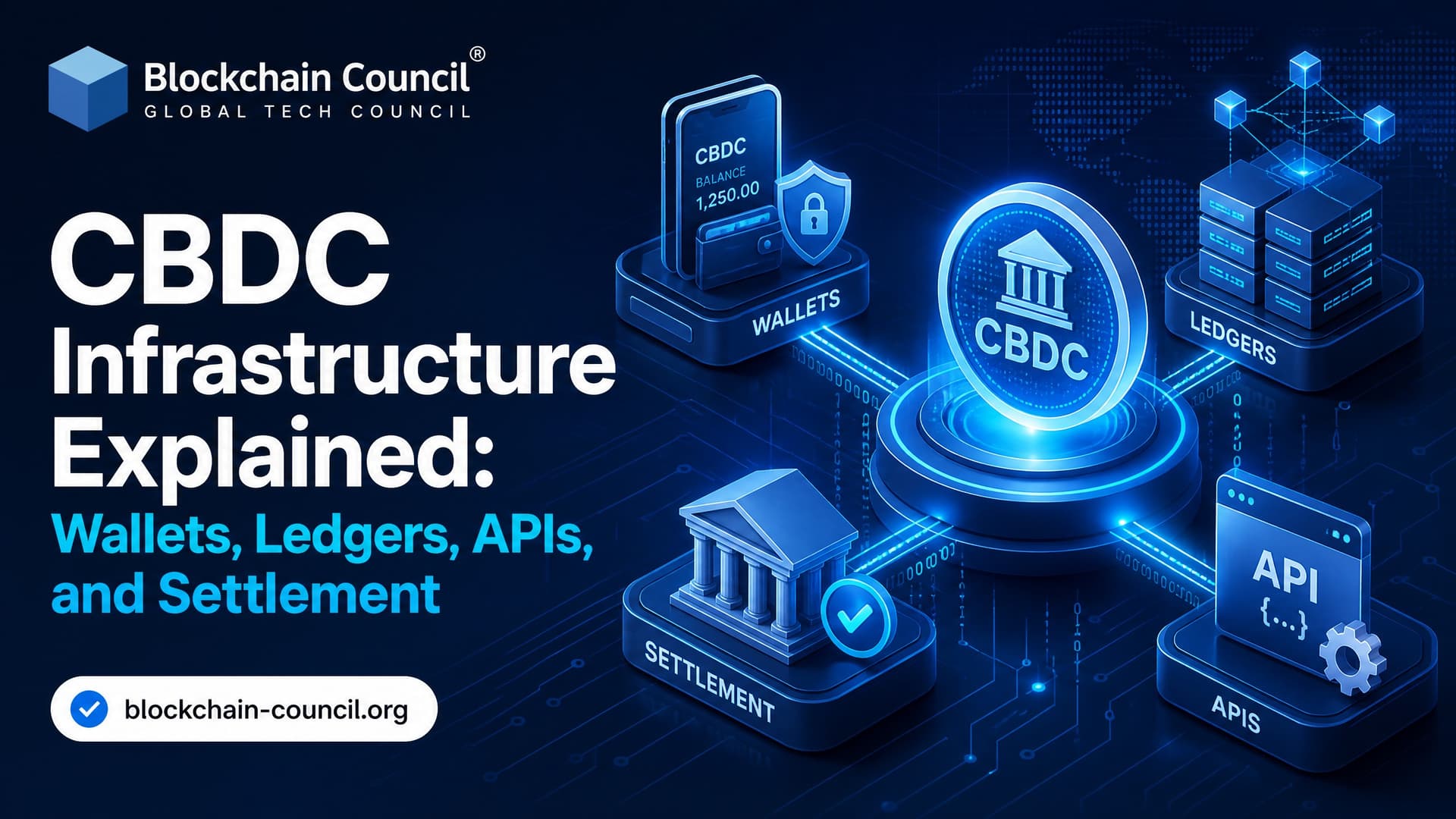
CBDC infrastructure is not just a digital wallet issued by a central bank. It is a controlled payment stack made of wallets, ledgers, APIs, identity controls, and settlement rules that must work with existing banking systems. Creating a token is the easy part. The hard part is moving central bank money safely, at national scale, with finality, privacy controls, and operational resilience.
Most current CBDC designs are converging around a platform model. A central bank runs the core ledger or settlement platform. Regulated intermediaries connect through APIs. Users access funds through wallets built by banks, payment providers, or approved public providers. The BIS, the Bank of England, the ITU Digital Currency Global Initiative, and several national central banks now describe CBDCs in this layered way. Anyone building real expertise in this stack usually starts with a structured Certified Central Bank Digital Currency (CBDC) Expert foundation before working through wallets, ledgers, and APIs in detail.

What Is CBDC Infrastructure?
A central bank digital currency is digital central bank money recorded on a controlled ledger. It may be designed for retail use, such as household and merchant payments, or wholesale use, such as interbank settlement and securities transactions.
In practical terms, CBDC infrastructure has three main layers:
Platform or settlement layer: The core ledger operated by the central bank. It handles issuance, redemption, balance updates, and final settlement.
Intermediation layer: Regulated banks, payment firms, and other approved entities that connect to the core ledger and manage customer-facing services.
User access layer: Wallets, mobile apps, merchant terminals, and institutional systems used to send and receive CBDC.
This layered design matters. It lets a central bank keep control over monetary issuance and settlement while private providers build user interfaces, compliance workflows, and specialized payment services. Because that intermediation layer increasingly touches tokenized deposits and other digital assets, many professionals pair this CBDC foundation with a Certified Digital Assets Expert background to cover both sides of the connection.
CBDC Wallets: The User Access Layer
CBDC wallets are where most users experience the system. A wallet may look like a normal banking app, but under the hood it has to handle identity, transaction authorization, credentials, and synchronization with the wider CBDC network.
Core wallet functions
User authentication: The wallet verifies that you are allowed to access the account or stored value. This may involve digital ID, biometrics, PINs, device binding, or multi-factor authentication.
Transaction authentication: The wallet confirms that a payment instruction is valid and authorized. Some designs use cryptographic signatures or secure hardware.
Balance and payment interface: The wallet shows balances, sends payment requests, receives funds, and stores transaction history.
Compliance support: Wallet providers often handle Know Your Customer checks, sanctions screening, fraud alerts, and risk scoring.
Offline capability is one of the hardest wallet requirements. If two phones exchange value without internet access, the system must later sync the transaction with the core ledger. That creates double-spend risk. Good designs cap offline balances, use secure elements, and apply deferred reconciliation once connectivity returns.
A small implementation detail that trips teams up: retry logic. If a wallet submits a payment API call and receives an HTTP 504 timeout, you cannot blindly send the same payment again. Production payment APIs usually need an idempotency key, such as x-idempotency-key, so the ledger or intermediary can detect a retry and avoid double posting. That boring header can save a CBDC pilot from a messy reconciliation incident.
CBDC Ledgers: The Authoritative Record
The ledger is the source of truth for CBDC holdings. It records issuance, redemption, transfers, and settlement events. It may be a centralized database, a permissioned distributed ledger, or a partitioned architecture built for scale.
Centralized ledger model
In a centralized model, the central bank or its appointed operator controls the ledger directly. Every settlement-relevant transaction is recorded in one authoritative system. This model is familiar to central banks because it resembles existing high-value payment and settlement systems.
The Bank of Japan's early CBDC experiments used application servers to process transaction requests and database servers to store ledger data. That is a useful reminder: CBDC does not require a public blockchain. In many cases, conventional database technology is faster to test, easier to govern, and simpler to audit.
Permissioned DLT model
In a permissioned distributed ledger model, only approved nodes can validate or update records. These nodes may include the central bank and selected intermediaries. The design can improve redundancy and create shared operational visibility, but it also adds governance and coordination overhead.
To be blunt, public permissionless blockchains are rarely a good fit for core CBDC settlement. Central banks need controlled access, legal finality, privacy management, and predictable governance. Permissioned DLT may be useful. A public mempool is usually not.
Partitioned and sub-ledger designs
Some research points toward micro-partitioned systems, including OpenCBDC-style designs studied by the Bank of Canada and the MIT Digital Currency Initiative. These systems split ledger activity across partitions or sub-ledgers to improve scalability and fault tolerance.
The trade-off is complexity. A two-leg payment may require both a core state update and a wallet-to-wallet transfer. That can scale better, but engineers must handle partial failures, ordering, reconciliation, and rollback rules very carefully.
CBDC APIs: How Systems Connect
APIs are the control gates of CBDC infrastructure. They let intermediaries, wallets, identity services, reporting tools, and external payment rails interact with the core platform under defined permissions.
The Bank of England's platform model describes Payment Interface Providers connecting to a central bank core ledger through APIs. AWS retail CBDC architecture guidance uses a similar pattern: a core ledger, distributor systems, and wallet applications connected through gateway services.
Typical CBDC API functions
Payment initiation: Submit transfer instructions from a wallet, bank, or payment provider.
Balance queries: Check ledger or distributor balances, depending on the architecture.
Issuance and redemption: Move value between CBDC and other forms of central bank money.
Identity checks: Connect to KYC, AML, consent, and authorization systems.
Reporting and reconciliation: Share transaction data with intermediaries, regulators, and settlement systems.
CBDC API design should also align with existing financial messaging standards where possible. ISO 20022 is already used across major payment modernization programs, and any serious CBDC project has to think about how messages map into current payment, treasury, and core banking workflows.
Security is not optional at the API layer. You need strong client authentication, strict rate limits, signed requests for high-risk actions, audit logs, and clear error semantics. A vague transaction failed response is not enough when an intermediary has to reconcile thousands of payments after a network interruption. Engineers focused on this gateway and API layer often round out their skills with a broader Tech Certification as well, since strong authentication, rate limiting, and audit logging are general secure-API practice applied to a regulated payments context.
CBDC Settlement: Finality, Atomicity, and Risk
Settlement is the point at which a payment obligation is finally discharged. In CBDC systems, that usually means the core ledger has updated balances and the transfer is legally final.
Real-time gross settlement
Wholesale CBDC often focuses on real-time gross settlement between banks or financial institutions. Each transfer settles individually and immediately on the CBDC ledger. This can reduce counterparty risk and make liquidity positions clearer.
Atomic settlement
Atomic settlement is one of the strongest arguments for CBDC in wholesale markets. It means two linked transfers either both happen or neither happens. For example, tokenized securities and wholesale CBDC can be exchanged in a delivery-versus-payment transaction, cutting the risk that one party delivers an asset while the other fails to pay.
The BIS has argued that unified ledgers or shared platforms could support tokenized deposits, CBDC, and other regulated assets in synchronized workflows. Project Jura, which involved euro and Swiss franc wholesale CBDCs on a DLT platform, showed how cross-border settlement and tokenized asset transfers can be tested under controlled conditions.
Deferred settlement for offline payments
Retail CBDC adds another wrinkle: offline payments. If the payor and payee are offline, settlement may be deferred until wallets reconnect. This is useful for resilience and inclusion, but it requires limits, fraud controls, and careful conflict resolution.
Retail CBDC vs Wholesale CBDC Infrastructure
Retail and wholesale CBDCs share building blocks, but the engineering priorities differ.
Retail CBDC: Prioritizes wallet usability, inclusion, privacy, low-value payments, offline capability, and integration with merchants.
Wholesale CBDC: Prioritizes settlement finality, liquidity management, cross-border interoperability, and integration with securities and interbank systems.
Retail systems may keep user-level records at intermediaries while the central bank ledger records aggregate distributor balances. Wholesale systems usually require direct settlement visibility among approved financial institutions.
Privacy, Identity, and Governance
CBDC infrastructure has to balance privacy with compliance. Every ledger update creates data. The question is who can see it, under what legal authority, and at what level of detail.
IMF research has highlighted this tension clearly. Too much visibility can damage public trust. Too little visibility can weaken AML controls and fraud detection. A workable design uses tiered identity, data minimization, strong access controls, and clear legal rules for disclosure.
Governance is just as important as code. Who can operate a node? Who can freeze funds? What happens if an intermediary fails? How are wallet providers certified? These choices define the real operating model of a CBDC.
What Professionals Should Learn Next
If you work in payments, banking technology, blockchain, or cybersecurity, CBDC infrastructure is a serious area to study. The useful skills are practical: API architecture, ledger design, digital identity, cryptography, settlement risk, and regulated system operations.
For structured learning, consider Blockchain Council's Certified Blockchain Expert™ if you need a broad foundation in blockchain and digital assets. Developers building payment or ledger systems may find the Certified Blockchain Developer™ and Certified Smart Contract Developer™ useful as internal learning paths. If your role touches digital money strategy, the Certified Cryptocurrency Expert™ can help connect CBDCs with the wider digital asset market.
Start small. Map a CBDC payment from wallet authentication to API submission, ledger update, and settlement finality. Then add one failure: a timeout, an offline wallet, or a failed intermediary reconciliation. That exercise will teach you more about CBDC infrastructure than any architecture diagram on its own. And if your role involves explaining that architecture to leadership, regulators, or partners, a Marketing Certification can help you turn the technical map into a case that lands with a non-specialist audience.
FAQs
1. What is CBDC infrastructure?
CBDC infrastructure is the combination of technical systems, institutions, standards, and security controls that allows a central bank digital currency to be issued, distributed, stored, transferred, settled, and redeemed.
A simplified architecture looks like:
Central Bank → Core Ledger → APIs/Payment Network → Banks & PSPs → Wallets → Users and Merchants
The precise architecture varies by CBDC design. There is no universal CBDC technology stack.
2. What are the main components of CBDC infrastructure?
A retail CBDC platform may include:
Core ledger or transaction system
Digital wallets
Bank and PSP infrastructure
APIs
Identity and authentication systems
Payment-routing services
Fraud and compliance systems
Settlement mechanisms
Cybersecurity infrastructure
Offline-payment components
Monitoring and recovery systems
The user's wallet is merely the visible end of a fairly substantial technological iceberg.
3. What is the CBDC core ledger?
The core ledger is the authoritative system that records CBDC balances, transactions, ownership or control states, depending on the architecture.
It may be operated directly by the central bank or through an authorized infrastructure arrangement.
Its responsibilities can include:
Issuance → transfer validation → balance updates → redemption → reconciliation
The ledger is essentially the monetary system's source of truth.
4. Does a CBDC ledger require blockchain?
No.
A CBDC ledger could use:
Conventional centralized databases
Distributed databases
Distributed ledger technology (DLT)
Permissioned blockchain
Hybrid architectures
Blockchain is an implementation option, not a defining requirement of CBDC.
Central banks generally begin with requirements such as resilience, throughput, privacy, security, and finality rather than asking how many blockchains can be inserted into the diagram.
5. What does a CBDC wallet do?
A CBDC wallet provides the interface through which users access and control their digital currency.
Depending on the system, a wallet could allow users to:
View balances
Receive CBDC
Send payments
Scan QR codes
Authenticate transactions
Review payment history
Manage credentials
Make offline payments
Recover access
Wallets could be offered by banks, PSPs, fintech companies, or potentially public institutions.
6. Does a wallet actually store the CBDC?
Not necessarily.
In an account-oriented system, the actual balance may exist on a ledger while the wallet stores credentials that authorize access.
In a token-oriented or offline system, some representation of value or spending authority may be stored locally on a secure device.
So:
Wallet ≠ necessarily the location of the money
It may instead be the mechanism for controlling it.
7. What types of CBDC wallets could exist?
Possible wallet formats include:
Smartphone applications
Bank applications
Web wallets
Payment cards
Smart cards
Hardware devices
Wearables
Feature-phone interfaces
Supporting several access methods could improve financial inclusion and resilience, particularly where smartphone or internet access is unreliable.
8. What role do banks and PSPs play?
In a two-tier or intermediated CBDC model, banks and payment service providers (PSPs) can provide the customer-facing layer.
They might handle:
Customer onboarding
Identity verification
KYC
Wallet services
Authentication
Payment initiation
Fraud monitoring
AML/CFT controls
Merchant services
Customer support
This allows the central bank to concentrate on core monetary infrastructure rather than becoming everyone's help desk.
9. What are CBDC APIs?
An API, or Application Programming Interface, allows different systems to communicate according to defined technical rules.
CBDC APIs could connect:
Banks ↔ CBDC core
PSPs ↔ CBDC core
Wallets ↔ PSPs
Merchants ↔ payment providers
Government systems ↔ CBDC services
APIs are therefore critical for interoperability.
10. What information could a CBDC payment API carry?
Depending on the design, a payment message might include:
Transaction identifier
Payer and payee identifiers
Amount
Currency
Timestamp
Authentication information
Payment status
Routing information
Compliance-related fields
Good API design should expose only the information required for each function rather than casually distributing sensitive financial data across every participant.
11. What is payment routing?
Payment routing determines how a transaction travels from the payer's provider to the recipient's provider and the CBDC infrastructure.
For example:
Alice's Wallet → PSP A → CBDC Core → Bank B → Merchant
The routing layer needs to identify participants, deliver messages securely, handle failures, and provide transaction status information.
12. How does settlement work?
Settlement is the final transfer of value under the system's legal and technical rules.
Suppose Alice pays a merchant 50 CBDC units.
The system may update authoritative records:
Alice: −50
Merchant: +50
Once the transaction reaches legally defined finality, the transfer is settled.
Because CBDC is central bank money, CBDC settlement can potentially provide settlement directly in a central bank liability.
13. What is the difference between payment and settlement?
A payment is the broader process through which value is transferred.
Settlement is the point at which the financial obligation is finally discharged according to the system's rules.
A user might receive a payment confirmation almost immediately, but technical confirmation and legal settlement finality should not automatically be treated as identical concepts.
This distinction becomes especially important in wholesale and cross-border systems.
14. How is identity handled?
Identity could be managed through banks, PSPs, digital identity providers, or other authorized systems.
A possible architecture separates:
Identity information → regulated intermediary
from:
Payment and settlement information → CBDC infrastructure
This separation can support data minimization and reduce unnecessary exposure of personal information.
15. How is CBDC infrastructure secured?
Security must operate across several layers.
Controls may include:
Encryption
Multi-factor authentication
Digital signatures
Hardware security modules
Secure elements
Key management
Network segmentation
API authentication
Fraud detection
Transaction monitoring
Penetration testing
Disaster recovery
CBDC would likely qualify as critical national financial infrastructure, making “we'll patch it next quarter” an unattractive security philosophy.
16. How could offline CBDC infrastructure work?
Offline CBDC could allow limited payments when neither party has immediate connectivity to the core infrastructure.
A simplified process is:
Payer device → secure local transfer → recipient device → later ledger synchronization
This requires controls for:
Double spending
Offline limits
Secure storage
Device compromise
Transaction counters
Lost devices
Reconciliation
Offline functionality can improve resilience and inclusion, but it is technically demanding.
17. How does interoperability work?
CBDC infrastructure may need to interact with:
Commercial bank accounts
Instant-payment systems
Card networks
Merchant terminals
ATMs
Government platforms
Foreign CBDCs
Other digital-asset infrastructures
Interoperability requires common standards for messaging, identity, APIs, settlement, security, and governance.
A national digital currency that works only inside one wallet would be less a payment revolution and more a particularly ambitious closed-loop gift card.
18. How is CBDC infrastructure made resilient?
Resilience measures can include:
Multiple data centers → replicated ledgers → redundant networks → automated failover → backup providers → disaster recovery → offline capability
The system must also be designed for:
Hardware failures
Network outages
Cyberattacks
Software defects
Provider failures
Sudden transaction spikes
Resilience is especially important because widespread CBDC adoption could make the platform systemically important.
19. What does the complete CBDC technology stack look like?
A simplified stack can be represented as:
User Layer
Mobile wallets → cards → hardware devices → merchant terminals
↓
Access Layer
Banks → PSPs → fintech providers → identity services
↓
API & Messaging Layer
Payment APIs → routing → authentication → interoperability standards
↓
Processing Layer
Transaction validation → fraud controls → compliance → reconciliation
↓
Ledger & Settlement Layer
Balances/tokens → transfers → finality → issuance → redemption
↓
Infrastructure Layer
Databases/DLT → cryptography → networks → data centers → cybersecurity → recovery
↓
Governance Layer
Central bank rules → regulation → privacy requirements → technical standards → operational oversight
Actual implementations may combine or rearrange these layers.
20. What is the easiest way to understand CBDC infrastructure?
Think of four essential components:
Wallets → give people access to CBDC
APIs → allow institutions and systems to communicate
Ledgers → establish the authoritative state of CBDC holdings and transactions
Settlement → makes transfers final
Around those components sit identity, cybersecurity, compliance, interoperability, offline functionality, and operational resilience.
A typical payment therefore becomes:
Wallet → Authentication → API → PSP/Bank → Validation → Ledger Update → Settlement → Confirmation
The central challenge is not merely creating a digital unit of currency. Digital numbers are, regrettably, something computers mastered some time ago. The difficult part is building infrastructure that can move central bank money securely, privately, reliably, interoperably, and at national scale while remaining simple enough that ordinary users never have to think about any of the machinery underneath it.
Related Articles
View All
Digital Assets
CBDC vs Mobile Payments: Understanding Wallets, Settlement, and Money Types
CBDC vs mobile payments explained through wallets, settlement, and money types, with real examples from India, China, Nigeria, and the Bahamas.

Digital Assets
CBDC Governance Explained: Standards, Oversight, and Stakeholder Roles
CBDC governance defines how digital central bank money is issued, supervised, secured, and operated across central banks, banks, PSPs, regulators, and users.

Digital Assets
CBDC Blockchain Developer Skills: DLT, Smart Contracts, APIs, and Security
CBDC blockchain developer skills now span permissioned DLT, smart contracts, financial APIs, security engineering, privacy, and compliance.
Trending Articles
AWS Career Roadmap
A step-by-step guide to building a successful career in Amazon Web Services cloud computing.
What is AWS? A Beginner's Guide to Cloud Computing
Everything you need to know about Amazon Web Services, cloud computing fundamentals, and career opportunities.
Claude AI Tools for Productivity
Discover Claude AI tools for productivity to streamline tasks, manage workflows, and improve efficiency.