

Centralized vs Distributed CBDC Architecture: Which Model Works Best?
 Suyash Raizada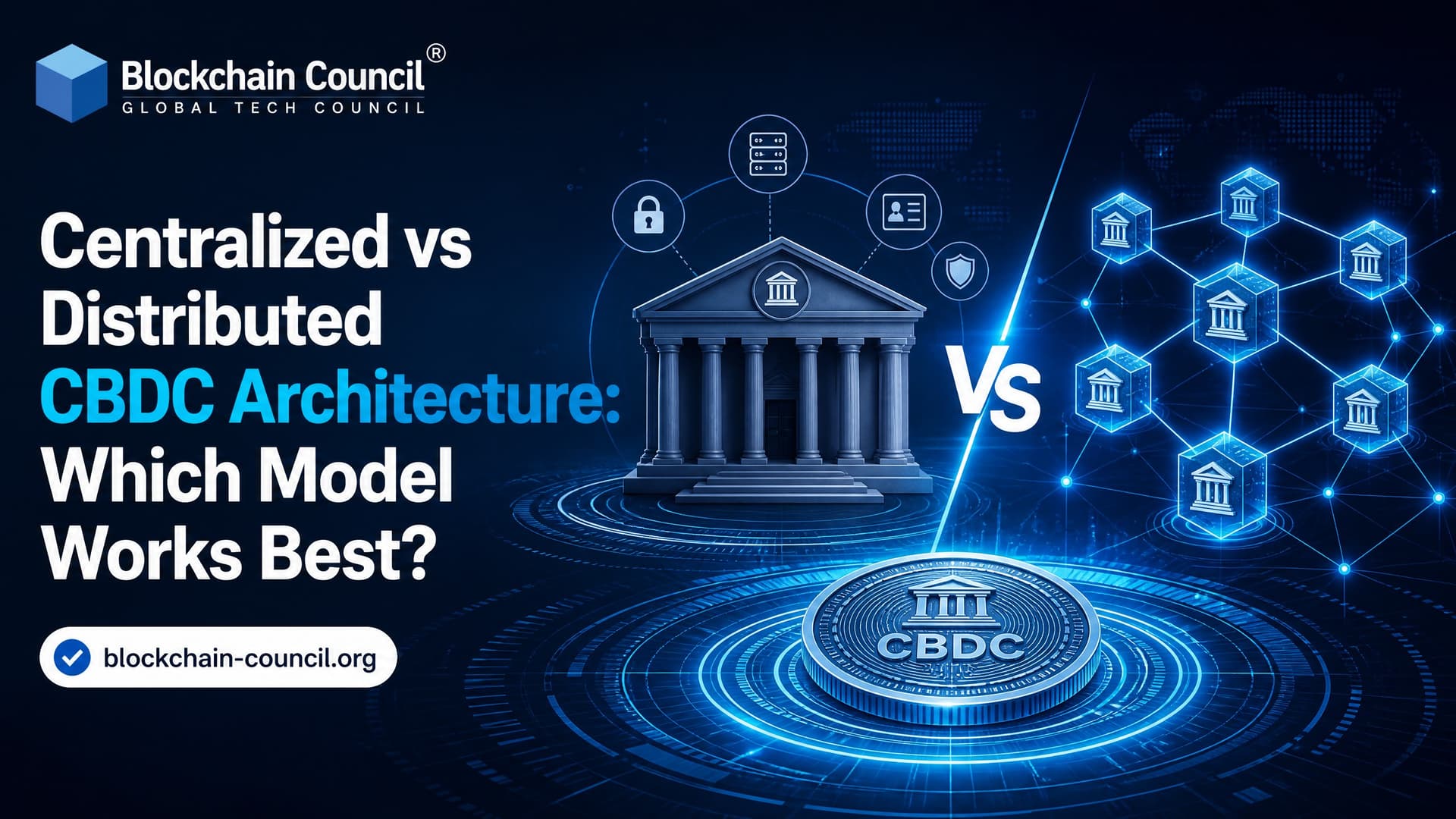
Centralized vs distributed CBDC architecture is not a winner-takes-all debate. The better model depends on what a central bank is trying to solve: retail payment scale, wholesale settlement, privacy, resilience, cross-border interoperability, or programmable money.
Evidence from the IMF, the Bank for International Settlements, the World Bank, and several central bank pilots points in one direction. Fully decentralized CBDCs are unlikely. Most serious designs use centralized ledgers, permissioned distributed ledgers, or hybrid hub-and-spoke systems where the central bank keeps control over issuance and governance. Anyone trying to reason through these trade-offs systematically usually benefits from a structured Certified Central Bank Digital Currency (CBDC) Expert foundation before comparing specific architecture models.

What CBDC Architecture Actually Means
CBDC architecture describes how the ledger is organized, who validates transactions, where data is stored, and which institutions can update the system. It sits beside other design choices such as retail versus wholesale CBDC, account-based versus token-based access, and direct versus indirect distribution.
The IMF treats the level of centralization as a core design axis because it affects legal responsibility, operational risk, monetary control, privacy, and settlement finality. In plain terms: architecture is not just an IT choice. It is policy in code. Because distributed CBDC models overlap heavily with tokenized asset design, many professionals pair this study with a Certified Digital Assets Expert background to understand both sides of the architecture spectrum.
Centralized CBDC Architecture
In a centralized CBDC architecture, one authority, usually the central bank or an appointed operator, maintains the main ledger. Transactions are validated and recorded in a central database under a strict governance framework.
This model looks familiar to anyone who has worked with national payment infrastructure. It resembles real-time gross settlement systems and high-volume payment switches more than public blockchains.
Key Strengths of Centralized CBDCs
High throughput: Centralized systems avoid consensus overhead and can be tuned for large retail payment volumes.
Clear accountability: The central bank controls the ledger, the rules, and settlement finality.
Simpler supervision: Fraud monitoring, reporting, and compliance checks are easier to coordinate in one core system.
Better fit with existing infrastructure: Integration with banks, anti-money laundering systems, and payment service providers is usually more direct.
For a mass retail CBDC, this matters. A national retail payment system may need to support millions of users and transaction spikes around salary dates, public benefit payments, or merchant peak hours. A well-designed central database can handle this without forcing every participant to synchronize ledger state.
Where Centralized CBDCs Struggle
The drawback is concentration. A central ledger can become a high-value cyber target. It can also raise privacy concerns if the central bank or government agencies can see granular user-level transaction data. Redundancy, disaster recovery, and data minimization help, but they do not remove the governance question.
To be blunt, a centralized CBDC is the wrong choice if the policy goal is shared validation among multiple institutions, or cross-border settlement where no single domestic operator should dominate the workflow.
Distributed CBDC Architecture
Distributed CBDC architecture spreads ledger data and validation across multiple authorized nodes. In practice, this usually means permissioned distributed ledger technology, not an open blockchain like Bitcoin or Ethereum mainnet.
Validators are known entities. They may include commercial banks, payment operators, central bank branches, or approved infrastructure providers. Governance still sits with the central bank, but transaction processing is shared across the network.
Key Strengths of Distributed CBDCs
Resilience: Multiple nodes can reduce dependence on one physical or logical site.
Shared infrastructure: Banks and intermediaries can participate directly in validation or settlement workflows.
Auditability: Permissioned ledgers can provide synchronized records across institutions.
Programmable settlement: Smart contract logic can support delivery-versus-payment, tokenized assets, and conditional transfers.
This is why distributed designs are common in wholesale CBDC pilots. Interbank settlement, securities settlement, and cross-border payment corridors involve multiple regulated institutions that need a shared view of state.
A developer detail that often gets missed: permissioned DLT is not magic under load. In Hyperledger Fabric v2.x test networks, for example, a poorly designed hot-account model can trigger an MVCC_READ_CONFLICT when several transactions try to update the same state key at once. That is not a theoretical issue. It changes how you model balances, batching, and endorsement policies.
Where Distributed CBDCs Struggle
Distributed systems add coordination cost. Nodes must run compatible software, follow upgrade rules, secure keys, and meet uptime requirements. Consensus protocols can introduce latency. Operational responsibility becomes harder to assign when something breaks.
Permissioned DLT also does not guarantee privacy. If every validator sees too much transaction data, the network may be more transparent than users or regulators want. Privacy depends on system design, legal rules, selective disclosure, data minimization, and sometimes cryptographic techniques such as zero-knowledge proofs.
Hybrid and Hub-and-Spoke CBDC Models
Hybrid CBDC architecture is where most real-world thinking is heading. The BIS has described hub-and-spoke models where the central bank controls the core monetary functions, while intermediaries store some data, process transactions, or manage customer-facing services.
In one common pattern, the central bank operates a master ledger for issuance and redemption. Banks and payment service providers handle wallets, identity checks, user support, and some transaction verification. Another pattern stores low-value balances on cards or smartphones for offline use, while the central ledger reconciles later.
This compromise works because CBDC systems need both control and distribution. Central banks need clear liability management. Users need reliable payment access. Intermediaries need enough room to innovate without turning the currency into a privately governed network.
CBDC Architecture by Use Case
Retail CBDC
For broad public use, centralized or hybrid models usually fit best. Retail CBDCs must handle high transaction volumes, consumer protection, fraud controls, accessibility, and integration with banks and merchants.
A fully distributed design can work technically, but it may be overbuilt for everyday payments. If the goal is to pay for groceries, receive government transfers, or transact through a mobile wallet, speed and reliability matter more than multi-party consensus.
Wholesale CBDC
Distributed or hybrid architecture makes more sense for wholesale CBDC. Banks, securities depositories, and payment operators already operate as a multi-party financial network. A permissioned ledger can support atomic settlement, tokenized securities, and cross-border experiments where several institutions need synchronized records.
This is where DLT earns its keep. Not for ideology. For shared state.
Cross-border CBDC
Cross-border use cases are harder. No central bank wants to give up monetary sovereignty, but no country wants a slow correspondent banking copy with a new label. Linked ledgers, shared platforms, and permissioned multi-CBDC networks are likely to grow here.
The architecture may be distributed across central banks, while each domestic CBDC remains centralized or hybrid at home.
Security, Privacy, and Regulation
Security is not automatically better in either model. Centralized CBDCs concentrate risk in one core platform. Distributed CBDCs spread risk across many nodes and vendors. Pick your failure mode.
Regulators must define who is liable for node failures, software bugs, cyber incidents, privacy breaches, and disputed transactions. In distributed systems, upgrade governance is especially sensitive. Who approves a protocol change? What happens if a bank node falls behind? Can the central bank override a transaction in a legal emergency?
Privacy is equally architectural. A direct centralized CBDC can give the central bank too much visibility unless strict controls are built in. An intermediated model may limit central bank access to personal transaction data while still allowing lawful compliance checks. European data protection analysis has repeatedly focused on proportionality, necessity, and privacy-by-design for CBDC systems.
Which CBDC Architecture Works Best?
The practical answer:
Centralized CBDC architecture works best for mass retail payments where speed, simplicity, regulatory control, and integration with existing systems are the top priorities.
Distributed CBDC architecture works best for wholesale settlement, tokenized asset markets, shared institutional infrastructure, and cross-border corridors.
Hybrid CBDC architecture is the strongest general-purpose option because it keeps central bank control over money while distributing operational roles across trusted intermediaries.
If you are designing policy, start with objectives before technology. If you are building prototypes, test both database and permissioned DLT approaches under realistic load. Do not compare a tuned PostgreSQL cluster with a toy blockchain demo. That tells you nothing.
Skills Professionals Need for CBDC Architecture Work
CBDC teams need more than blockchain knowledge. You should understand payment settlement, cybersecurity, cryptography, data protection, financial regulation, API design, and smart contract risk.
If you are building a learning path, Blockchain Council programs such as the Certified Blockchain Expert, the Certified Blockchain Developer, and the Certified Cryptocurrency Expert offer structured training in blockchain infrastructure, token systems, and digital asset design. Engineers focused on the database, consensus, and API layers above may also want to browse the broader Tech Certification catalog, since load testing, endorsement policies, and node governance draw as much on general distributed-systems engineering as on CBDC-specific training.
For technical teams, build a small prototype next: one centralized ledger API, one permissioned DLT settlement flow, and one hybrid wallet model. Measure latency, failure recovery, privacy exposure, and operational complexity. The best CBDC architecture is the one that survives that test under your jurisdiction's rules. And if you will be presenting that prototype's trade-offs to non-technical stakeholders or leadership, a Marketing Certification can help you frame the results in a way that lands with an audience that cares about outcomes, not consensus protocols.
FAQs
1. What is centralized versus distributed CBDC architecture?
A centralized CBDC architecture relies on a central system, typically operated or controlled by the central bank or an authorized operator, to maintain authoritative records and process or validate transactions.
A distributed CBDC architecture distributes some recordkeeping, validation, or processing functions across multiple authorized participants or nodes, potentially using distributed ledger technology (DLT).
The distinction concerns how infrastructure and trust are organized, not whether the currency itself is issued by the central bank.
2. Does a distributed CBDC mean the currency is decentralized?
No.
A CBDC remains a central bank liability regardless of whether its technical infrastructure is centralized or distributed.
A distributed architecture might involve banks and payment providers operating nodes, while the central bank still controls:
Currency issuance
Participation rules
Monetary characteristics
Governance
Access permissions
Final authority over the system
Distributed infrastructure is therefore not the same thing as decentralized monetary governance.
3. How does a centralized CBDC work?
A simplified centralized architecture looks like:
Users/Wallets → Banks & PSPs → Central CBDC Platform
The central platform maintains the authoritative ledger or database and processes or validates relevant transactions.
This resembles many existing high-performance payment and banking systems, although the exact CBDC implementation could differ considerably.
4. What are the advantages of centralized CBDC architecture?
Potential advantages include:
Simpler governance
Clear operational responsibility
High transaction throughput
Easier data consistency
Mature database technology
Straightforward system upgrades
Potentially lower infrastructure complexity
Easier monetary control
Centralized systems can be highly efficient because participants do not need to run elaborate consensus mechanisms merely to agree that someone bought coffee.
5. What are the disadvantages of centralized architecture?
Potential disadvantages include:
Concentration of operational risk
Attractive targets for cyberattacks
Dependence on central infrastructure
Potential bottlenecks
Greater consequences from major outages
Concerns about concentrated data access
These risks can be reduced through redundancy, geographically distributed infrastructure, backup systems, disaster recovery, and strong cybersecurity.
“Centralized” does not have to mean “one server sitting under someone's desk.”
6. What is distributed CBDC architecture?
A distributed architecture allows multiple authorized participants to maintain synchronized records or participate in transaction validation.
Participants might include:
Central banks
Commercial banks
Payment service providers
Other regulated institutions
A permissioned network could ensure that only approved entities participate.
7. Does distributed CBDC architecture require blockchain?
No.
Distributed architecture ≠ blockchain.
Distributed systems can use technologies other than blockchains, and blockchain itself is only one form of distributed ledger technology.
Likewise, some CBDC functions could use conventional databases while others use distributed components.
Technology should follow requirements, not whichever acronym currently has the better conference booth.
8. What is permissioned DLT?
A permissioned distributed ledger allows only authorized participants to operate nodes, validate transactions, or access specified information.
For a CBDC, the central bank could determine:
Which institutions can join
What each node can do
Which data each participant can access
How transactions are validated
How software is upgraded
How participants are removed
This differs substantially from permissionless cryptocurrency networks.
9. How would transactions work on a distributed CBDC?
A simplified transaction could follow:
User A → Bank A → Authorized Network → Bank B → User B
Authorized nodes validate and synchronize the transaction according to predefined rules.
Depending on the architecture, settlement finality might be determined through a consensus protocol, a central-bank-controlled mechanism, or a combination of distributed processing and centralized authority.
10. What is a consensus mechanism?
A consensus mechanism allows distributed participants to agree on the valid state of a ledger.
Public cryptocurrencies may use mechanisms such as proof of work or proof of stake.
A CBDC would more likely use controlled mechanisms suitable for known, regulated participants.
A central bank generally has little reason to make commercial banks burn electricity solving puzzles before allowing a supermarket payment to settle.
11. Which architecture is faster?
A well-designed centralized architecture can generally provide very high throughput and low latency because transaction processing does not require agreement among many independent nodes.
Distributed systems can also be fast, particularly permissioned systems, but synchronization and consensus can add overhead.
Actual performance depends on:
Architecture
Hardware
Network design
Transaction complexity
Security controls
Geographic distribution
Consensus mechanism
So “distributed is faster” or “centralized is faster” is too simplistic without specific system requirements.
12. Which architecture is more scalable?
Centralized architectures can scale extremely well using mature technologies such as:
Database replication
Partitioning
Load balancing
Distributed data centers
Cloud-style infrastructure
High-availability clusters
Distributed architectures can distribute workloads across participants, but adding nodes does not automatically increase transaction capacity because nodes may need to coordinate.
Scalability must therefore be measured rather than inferred from architecture labels.
13. Which architecture is more resilient?
Both can be highly resilient.
A centralized CBDC can use:
Multiple data centers → redundant networks → replicated databases → automated failover → disaster recovery
A distributed system can reduce dependence on a single operational location by maintaining synchronized infrastructure across several participants.
However, distributed systems introduce additional dependencies involving networking, synchronization, software consistency, and consensus.
Resilience is an engineering outcome, not a free gift included with the word “distributed.”
14. Which model is more secure?
Neither is inherently more secure.
Centralized architectures concentrate critical assets and therefore require exceptionally strong protection around central infrastructure.
Distributed architectures reduce some concentration risks but create more endpoints and communication channels that attackers may target.
Security depends on:
Authentication
Encryption
Key management
Access controls
Network segmentation
Software security
Hardware protection
Monitoring
Incident response
Governance
Architecture changes the threat model rather than eliminating it.
15. Which architecture provides better privacy?
Neither architecture automatically provides better privacy.
A centralized CBDC could implement:
Data minimization
Pseudonymous identifiers
Separation of identity and payment data
Encryption
Tiered access controls
A distributed architecture could restrict data visibility among nodes or use cryptographic privacy techniques.
Conversely, poorly designed versions of either architecture could expose excessive transaction information.
16. How does interoperability affect the choice?
A CBDC must potentially interact with:
Commercial banks
PSPs
Merchant systems
Instant-payment networks
Government payment platforms
ATMs
Foreign CBDCs
A centralized system can expose standardized APIs and messaging interfaces.
A distributed architecture can allow authorized institutions to participate more directly in shared infrastructure.
In either case, common standards and governance are more important than merely declaring the system “interoperable” in a policy document.
17. Could a CBDC use both centralized and distributed components?
Yes. A hybrid technical architecture may be practical.
For example:
Central bank issuance → centralized core ledger
combined with:
Distributed intermediary infrastructure → banks and PSPs
and perhaps:
Local secure devices → offline CBDC payments
Different architectural approaches can therefore be used for different system functions.
18. How do centralized and distributed architectures compare?
Area | Centralized | Distributed |
|---|---|---|
Authoritative records | Central platform | Shared/synchronized components possible |
Governance | Relatively straightforward | More coordination required |
Performance | Potentially very high | Depends on protocol |
Resilience | Requires strong redundancy | Can distribute some failure risks |
Complexity | Generally lower | Generally higher |
Cyber risk | Greater concentration | Larger distributed attack surface |
Data consistency | Relatively straightforward | Requires synchronization |
Upgrades | Easier to coordinate | Multiple participants may need coordination |
DLT required | No | Not necessarily |
Central bank control | High | Can remain high |
19. What should central banks consider when choosing an architecture?
Important criteria include:
Transaction throughput
Settlement latency
Availability targets
Cybersecurity
Privacy
Offline requirements
Financial inclusion
Interoperability
Operational resilience
Cost
Scalability
Auditability
Governance
Technology independence
Central banks should begin with these requirements and then select technology, rather than beginning with blockchain and working backward until a policy problem appears.
20. Which CBDC architecture works best?
There is no universally superior architecture.
A centralized architecture may be preferable when the priorities are high throughput, operational simplicity, mature technology, and clear governance.
A distributed architecture may be attractive when there is a genuine need for shared recordkeeping, institutional redundancy, or coordinated processing among multiple authorized participants.
A hybrid approach may combine the advantages of both.
The more useful decision framework is:
Need a single authoritative, high-performance core? → Centralized architecture may fit.
Need multiple institutions to maintain synchronized state or validation? → Distributed architecture may fit.
Need different properties for core settlement, intermediaries, and offline payments? → Hybrid architecture may fit best.
Ultimately, CBDC architecture should be judged by whether it delivers secure, resilient, private, scalable, interoperable, and efficient central bank money. “Centralized” and “distributed” are implementation choices, not ideological teams requiring matching jerseys.
Related Articles
View All
Digital Assets
CBDC vs Stablecoins: Which Digital Money Model Is Better for Payments?
CBDC vs Stablecoins for payments explained: compare speed, trust, regulation, Web3 use, cross border settlement, and where each model fits best.

Digital Assets
Best CBDC Course for Professionals: What to Look For Before Enrolling
Learn how to choose the best CBDC course by comparing global case studies, regulation, technical design, risks, and recognized certification options.

Digital Assets
CBDC and Blockchain: When Distributed Ledgers Make Sense
CBDC and Blockchain are not inseparable. Learn when distributed ledgers fit CBDC design, and when centralized ledgers are the smarter choice.
Trending Articles
The Role of Blockchain in Ethical AI Development
How blockchain technology is being used to promote transparency and accountability in artificial intelligence systems.

Top 5 DeFi Platforms
Explore the leading decentralized finance platforms and what makes each one unique in the evolving DeFi landscape.
How Blockchain Secures AI Data
Understand how blockchain technology is being applied to protect the integrity and security of AI training data.