

CBDC Payment Systems Explained: From Point-of-Sale to Real-Time Settlement
 Suyash Raizada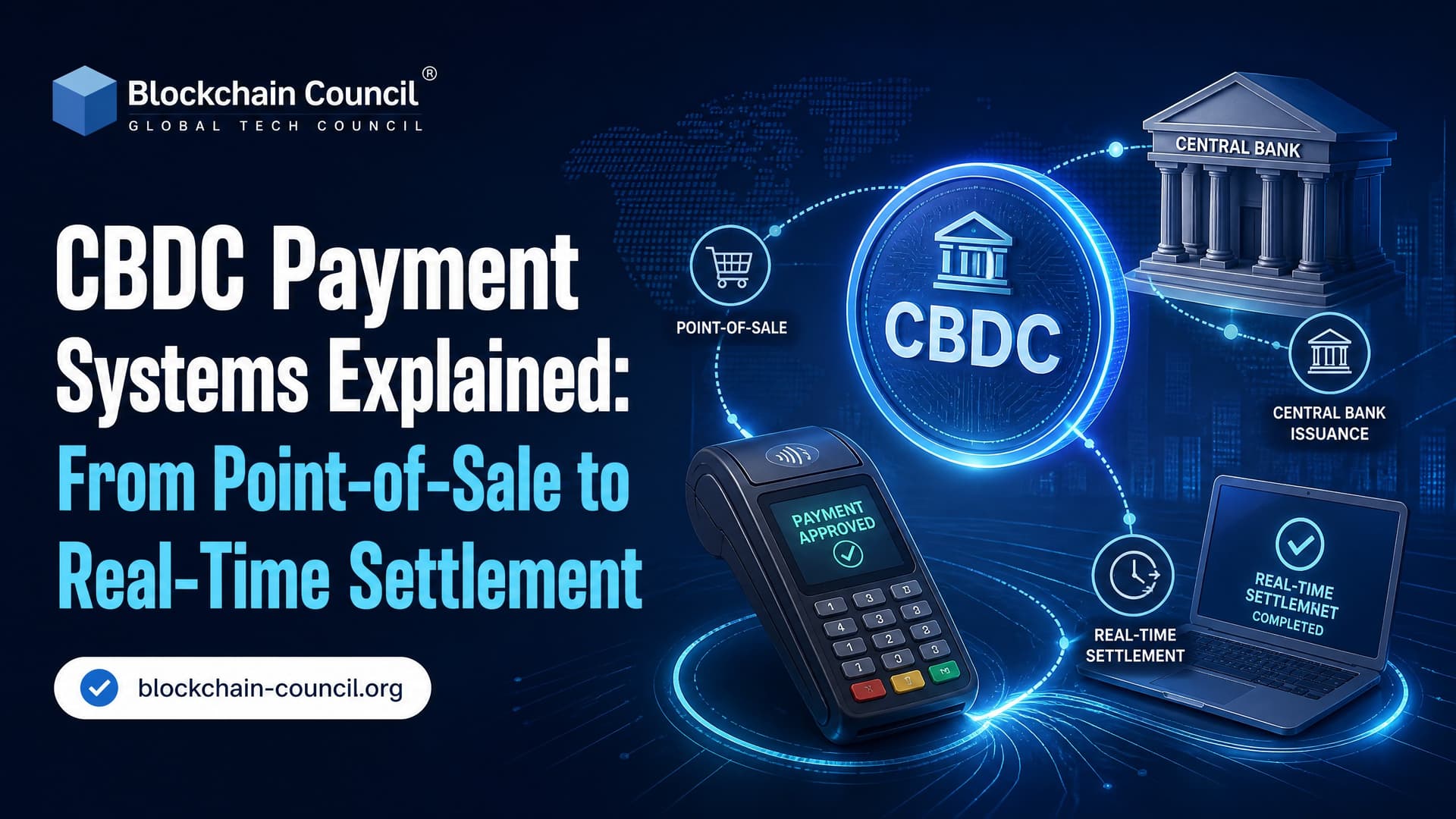
CBDC payment systems are moving from policy papers into working payment architecture. The hard part is not minting digital central bank money. The hard part is making it work at a shop counter, inside a bank treasury desk, across a securities ledger, and through real-time settlement without breaking the rails already in place. Professionals building expertise in this space are increasingly formalizing it through a program such as the Certified Central Bank Digital Currency (CBDC) Expert designation, which covers retail and wholesale payment architecture in one structured path.
As of 2026, more than 130 jurisdictions, representing about 98 percent of global GDP, are exploring central bank digital currencies. The International Monetary Fund points to the Bahamas, Jamaica, and Nigeria as nationwide retail CBDC launches, while the Eastern Caribbean DCash system and China's e-CNY pilot show how retail CBDC can operate at meaningful scale. Adoption is uneven, though. Nigeria's eNaira is a useful warning: sound infrastructure does not guarantee daily use.

What Are CBDC Payment Systems?
A CBDC payment system is the set of wallets, ledgers, payment service providers, compliance controls, and settlement processes that let central bank digital money move between parties. The design can serve consumers, merchants, banks, public agencies, or capital markets.
There are two broad categories:
Retail CBDC: Used by individuals and businesses for day-to-day payments, government transfers, and merchant purchases.
Wholesale CBDC: Used by regulated financial institutions for interbank settlement, securities settlement, FX, and liquidity operations.
The distinction matters. A retail CBDC wallet at a cafe and a wholesale CBDC transfer between banks solve different problems. They may share standards, identity checks, and ledger infrastructure, but the risk model is not the same.
How a CBDC Point-of-Sale Payment Works
At point-of-sale, a CBDC transaction looks simple to the customer. Scan a QR code, tap a phone, approve the amount. Behind that action, several systems coordinate quickly.
Typical POS flow
Payment initiation: The merchant terminal or app generates a payment request, often as a QR code or near-field communication message.
Customer authorization: The customer wallet verifies the merchant, amount, and currency, then signs or approves the payment.
PSP processing: A payment service provider may check limits, sanctions rules, wallet status, and transaction risk.
Ledger update: The CBDC ledger records the value transfer from the customer wallet to the merchant wallet or merchant account.
Merchant confirmation: The merchant receives confirmation that the payment is final or approved, depending on the design.
That last point is critical. In card payments, approval and settlement are not the same thing. With CBDC payment systems, some designs can give near-instant finality at the ledger layer. Others still separate the customer-facing approval from later settlement between providers.
Account-based vs token-based retail CBDC
Retail CBDC usually follows one of two models:
Account-based: Balances are recorded in accounts maintained by the central bank, a PSP, or a regulated intermediary.
Token-based: Digital tokens representing central bank money move between wallets, closer in concept to digital cash.
Most real designs are hybrids. Central banks rarely want to run every consumer interface themselves, so commercial banks and PSPs handle onboarding, user experience, fraud monitoring, and merchant integration. The central bank keeps control of issuance, redemption, and final settlement rules. Understanding how token-based value actually moves, gets custodied, and gets redeemed is close to the skill set covered in a Certified Digital Assets Expert program, which helps when a design decision comes down to account-based versus token-based tradeoffs.
From implementation experience, the boring mapping work causes the real pain. If a CBDC payment rail has to connect into bank back offices, ISO 20022 message types matter. A pacs.008 customer credit transfer is not the same as a pacs.009 financial institution transfer. Mix them up, and reconciliation teams will reject files even when the ledger transfer succeeded. This is where many pilots stop feeling like demos and start feeling like production systems.
Offline Payments: Useful, But Hard
Offline CBDC payments come up often as a way to preserve cash-like resilience. A customer could pay during a network outage, on an island with poor connectivity, or during disaster recovery, and the wallet would later synchronize with the central ledger.
The design problem is double spending. If a device can transfer value while disconnected, the system has to prevent the same value from being spent twice. Options include secure hardware, transaction limits, expiry windows, and delayed risk scoring. None are perfect.
For low-value payments, offline CBDC can make sense. For high-value retail or business payments, it is the wrong place to take settlement risk unless the controls are strict.
Wholesale CBDC and Real-Time Settlement
Wholesale CBDC is where the business case is often stronger. Banks, market infrastructures, and central banks already understand settlement finality. They also have clear pain points: counterparty exposure, fragmented ledgers, delayed reconciliation, and liquidity trapped across systems.
A wholesale CBDC can act as a central-bank-backed settlement asset for regulated institutions. Instead of settling through a chain of correspondent banks or deferred net positions, institutions can transfer wholesale CBDC in real time on a shared or connected ledger.
Interbank lending
Consider an overnight loan from Bank A to Bank B. In a wholesale CBDC setup, the loan agreement and repayment can be tied to a CBDC transfer that updates both institutions' settlement positions immediately. The Monetary Authority of Singapore has tested this direction through Singapore's wholesale CBDC work, with banks such as DBS, OCBC, and UOB taking part in tokenization and settlement trials under Project Guardian and related programmes.
Delivery-versus-payment for securities
Delivery-versus-payment, or DvP, is another strong use case. In a securities trade, the cash leg and the asset leg should settle together. If securities move but cash fails, one party carries risk. If cash moves but securities fail, the risk flips.
Projects such as Canada's Project Jasper and the Swiss National Bank's Project Helvetia have explored how tokenized cash and tokenized assets can settle atomically. In plain English: both legs happen, or neither happens. That is a practical improvement, not just a technical novelty. Building and testing this kind of atomic settlement logic is genuine software architecture work, and integration engineers on these projects often add a general Tech Certification to their skill set so they can work through ledger, messaging, and failure-state design alongside the payments and compliance teams.
How Retail and Wholesale Layers Connect
The most realistic CBDC payment systems are layered. Consumers may use wallets, bank apps, cards, or fast payment apps. PSPs aggregate activity. Banks and PSPs then settle obligations through wholesale CBDC or central bank accounts.
The World Bank has described this kind of model for fast payment systems: end users make instant payments, while PSPs settle net obligations at the central bank. CBDC can improve the settlement layer without forcing every consumer to change behavior.
This is why CBDC does not need to replace cards, bank deposits, or stablecoins. In many markets, it will sit beside them. The real question is which layer gets central bank money and which layer stays private money.
Global CBDC Payment System Examples
Bahamas Sand Dollar: A retail CBDC built partly around financial inclusion and access across islands.
Jamaica JAM-DEX: A nationwide retail CBDC intended for consumer and merchant use.
Nigeria eNaira: A live retail CBDC with limited adoption, showing that incentives and user experience matter as much as infrastructure.
Eastern Caribbean DCash: A regional CBDC for cross-island payments, with lessons around resilience and adoption.
China e-CNY: The largest retail CBDC pilot by transaction value, used in transport, retail, public services, and selected government salary payments.
Project mBridge: A multi-CBDC cross-border initiative exploring faster settlement between participating jurisdictions.
Singapore wholesale CBDC work: A testing environment for interbank lending, tokenized assets, and programmable settlement.
Policy Choices Are Splitting by Region
The CBDC map is not moving in one direction. In the United States, an executive order signed in January 2025 barred federal agencies from developing or issuing a retail CBDC, while research on private digital money and stablecoins continued through frameworks such as the GENIUS Act. The United Kingdom keeps design work going on a possible digital pound but is also prioritizing stablecoin regulation. The eurozone has moved through preparation for a digital euro and is expected to weigh next steps during its formal decision phase.
This split is rational. Large advanced economies already have card networks, instant payment systems, regulated bank deposits, and growing stablecoin markets. Retail CBDC has to prove it adds enough value to justify the privacy, bank funding, and operational risk debates that come with it. Wholesale CBDC has a cleaner case because settlement risk is expensive and measurable.
What Developers and Enterprises Should Learn
If you are preparing for CBDC integration, do not start with a wallet screen. Start with settlement architecture.
Understand RTGS, fast payment systems, and net versus gross settlement.
Study ISO 20022 payment messages and reconciliation flows.
Learn tokenized deposits, wholesale CBDC, and atomic settlement patterns.
Design for privacy thresholds, AML checks, and transaction limits from day one.
Test failure states: duplicate payment requests, expired QR codes, offline replay attempts, and ledger reconciliation mismatches.
For blockchain professionals, this is a strong reason to build skills beyond public-chain smart contracts. Blockchain Council's Certified Blockchain Expert™ and Certified Blockchain Developer™ credentials are useful learning paths if you want to understand distributed ledgers, tokenization, and enterprise-grade settlement design.
The Next Step for CBDC Payment Systems
Retail CBDCs will grow selectively, mostly where financial inclusion, cash digitization, or public payment efficiency are strong policy goals. Wholesale CBDC will likely move faster because banks and market infrastructures already have a clear reason to cut settlement risk. Neither will succeed on architecture alone; central banks and PSPs will still need to explain these systems clearly and build public and institutional trust, which is why some teams are pairing their technical roadmap with a general Marketing Certification focused on communication and adoption strategy.
If you work in payments, banking technology, or digital assets, build a small reference architecture next: one retail wallet flow, one PSP settlement account, and one wholesale CBDC settlement ledger. Then map the ISO 20022 messages and failure cases. That exercise will teach you more than another abstract CBDC debate.
FAQs
1. What are CBDC payment systems?
CBDC payment systems are the infrastructure, technologies, and processes that allow users to store, transfer, and spend Central Bank Digital Currency. These systems connect central banks, commercial banks, digital wallets, merchants, payment providers, and settlement networks. A CBDC payment system can support everyday purchases, person-to-person transfers, government payments, and institutional transactions depending on its design.
2. How does a CBDC payment system work?
A CBDC payment system typically involves a user wallet, an authorized intermediary, transaction verification processes, and a settlement mechanism operated or overseen by the central bank. When a user makes a payment, the system verifies identity, checks available funds, approves the transaction, and updates ownership records. The exact process depends on whether the CBDC uses centralized infrastructure, distributed ledger technology, or a hybrid model.
3. How do CBDCs work at the point of sale?
At a point-of-sale location, a customer could pay using a CBDC wallet through methods such as QR codes, near-field communication (NFC), mobile applications, or digital payment terminals. The payment request is authenticated, funds are transferred, and the merchant receives confirmation. Depending on the system design, settlement could occur instantly or shortly afterward. The goal is to make CBDC payments as simple as existing digital payments while using central bank money.
4. Can CBDCs replace card payments at stores?
CBDCs could become an alternative payment option for merchants and consumers, but they are unlikely to immediately replace cards. Adoption depends on transaction costs, merchant acceptance, user convenience, privacy features, and integration with existing payment systems. Many CBDC designs aim for coexistence rather than replacement. The financial world rarely throws away a working payment method; it usually adds another layer and then spends years explaining the difference.
5. How do consumers use CBDC wallets for payments?
Consumers can use CBDC wallets to hold digital currency, send payments, receive funds, and make purchases. Wallets may be offered by banks, fintech companies, or authorized providers. Users may authenticate payments through PINs, biometrics, devices, or other security methods. A successful CBDC wallet needs to balance security with simplicity because a payment tool requiring technical expertise will struggle to become everyday money.
6. How are CBDC transactions processed in real time?
Real-time CBDC transactions involve immediate verification and settlement of payment instructions. The system confirms that the sender has sufficient funds, validates authorization, updates records, and provides confirmation to both parties. Real-time settlement can reduce delays and improve cash-flow management. However, achieving true instant payments requires reliable infrastructure, strong cybersecurity, transaction monitoring, and operational resilience.
7. What is real-time settlement in CBDC systems?
Real-time settlement means that a payment is finalized almost immediately after approval rather than waiting for batch processing or intermediary reconciliation. CBDCs could enable real-time settlement because they represent direct claims on central bank money. This can reduce counterparty risk and improve payment efficiency. Wholesale CBDCs may be particularly valuable for real-time settlement in financial markets and institutional transactions.
8. How do CBDCs differ from traditional digital payments?
Traditional digital payments usually involve commercial bank money moving through card networks, payment processors, or banking systems. CBDCs represent digital central bank money issued directly by the monetary authority. The difference is not simply that both appear on screens. The legal status, settlement process, infrastructure, and role of intermediaries can differ significantly. A digital payment is not automatically a CBDC, despite technology marketing's enthusiasm for making everything sound similar.
9. How do merchants receive CBDC payments?
Merchants can receive CBDC payments through approved wallets, payment terminals, QR-code systems, or integrated payment platforms. After a customer authorizes payment, the merchant receives confirmation that funds have been transferred. Businesses may then integrate CBDC transactions with accounting, inventory, and financial-management systems. Merchant adoption depends on ease of use, costs, customer demand, and compatibility with existing payment technology.
10. Can CBDCs support contactless payments?
Yes. CBDCs can potentially support contactless payments through NFC technology, QR codes, mobile wallets, smart cards, and other digital payment methods. Contactless functionality could make CBDCs convenient for everyday purchases such as retail transactions and transportation payments. The challenge is ensuring security, accessibility, and compatibility across different devices and payment environments.
11. How do CBDC payment systems handle security?
CBDC payment systems use security measures such as encryption, authentication, cryptographic verification, fraud monitoring, access controls, and transaction limits. Wallet providers and infrastructure operators must protect against cyberattacks, account takeover, malware, and unauthorized transactions. Security must cover the entire ecosystem, including users, banks, merchants, APIs, and central infrastructure. Protecting the central ledger while ignoring the user's phone would be a rather optimistic security strategy.
12. How do CBDCs support person-to-person payments?
CBDCs can support direct transfers between individuals through digital wallets. Users may send money using wallet addresses, phone numbers, QR codes, or other identifiers. These payments could settle quickly without relying on multiple banking intermediaries. Person-to-person CBDC payments could be useful for everyday transfers, family support, small transactions, and informal payments.
13. How can businesses use CBDC payment systems?
Businesses can use CBDCs for customer payments, supplier settlements, payroll, treasury operations, and automated transactions. Faster settlement may improve liquidity management, while integration with business software could reduce reconciliation work. Large enterprises may also benefit from programmable payment features and connections with tokenized assets. Smaller businesses may benefit most if CBDC acceptance is simple and affordable.
14. How do CBDCs improve payment settlement between banks?
Wholesale CBDCs can improve interbank settlement by allowing financial institutions to exchange digital central bank money directly. This can reduce settlement risk, improve liquidity management, and support faster clearing processes. CBDCs may also enhance settlement for securities, foreign exchange, and other financial-market transactions. The benefits are especially relevant where current settlement processes involve multiple intermediaries and time delays.
15. Can CBDC payment systems work offline?
Some CBDC designs may support offline payments, allowing users to transact without continuous internet connectivity. Offline systems may use secure devices, cryptographic controls, transaction limits, and later synchronization with the main network. This can improve resilience and accessibility in areas with unreliable connectivity. However, preventing fraud and double spending becomes more challenging when transactions occur outside real-time verification.
16. How do CBDCs support cross-border payments?
CBDCs can support cross-border payments by connecting different national digital currency systems through interoperability frameworks. This could reduce payment delays, lower costs, and improve settlement transparency. Multi-CBDC platforms may allow direct exchange between currencies. However, international CBDC payments require cooperation on regulations, identity verification, privacy, foreign exchange, and compliance.
17. What role do banks play in CBDC payment systems?
Banks may provide CBDC wallets, customer onboarding, compliance checks, transaction services, and support. In many proposed models, central banks issue the CBDC while commercial banks and payment providers manage customer-facing services. This approach allows CBDCs to use existing financial expertise while maintaining central bank control over money issuance.
18. What are the challenges of implementing CBDC payment systems?
Challenges include cybersecurity, privacy protection, interoperability, infrastructure costs, regulatory compliance, user adoption, merchant acceptance, and integration with existing financial systems. Central banks must also consider effects on commercial banks and financial stability. A technically successful payment system can still struggle if users do not trust it, merchants do not accept it, or regulators cannot agree on the rules.
19. Will CBDCs create a faster global payment network?
CBDCs could contribute to faster global payments if countries develop interoperable systems. They may improve international settlement by reducing delays and simplifying payment processes. However, achieving a global network requires international cooperation, common standards, and agreement on legal and regulatory frameworks. Technology can connect systems, but it cannot force countries to share identical financial priorities.
20. What is the future of CBDC payment systems?
The future of CBDC payment systems may include instant retail payments, programmable business transactions, digital wallets, tokenized asset settlement, offline payments, and improved cross-border transfers. The most successful CBDC systems will likely combine speed, security, privacy, accessibility, and interoperability. CBDCs are not simply another payment app. They represent a possible redesign of how digital money moves through economies, which is why every central bank, regulator, and financial institution is examining the details with unusually serious spreadsheets.
Related Articles
View All
Digital Assets
CBDC Governance Explained: Standards, Oversight, and Stakeholder Roles
CBDC governance defines how digital central bank money is issued, supervised, secured, and operated across central banks, banks, PSPs, regulators, and users.

Digital Assets
CBDC vs Mobile Payments: Understanding Wallets, Settlement, and Money Types
CBDC vs mobile payments explained through wallets, settlement, and money types, with real examples from India, China, Nigeria, and the Bahamas.

Digital Assets
CBDC vs UPI: Digital Currency Is Not an Instant Payment Rail
CBDC vs UPI explained: CBDC is central bank digital money, while UPI is an instant rail that moves bank deposits. Learn how they differ.
Trending Articles
AWS Career Roadmap
A step-by-step guide to building a successful career in Amazon Web Services cloud computing.

Top 5 DeFi Platforms
Explore the leading decentralized finance platforms and what makes each one unique in the evolving DeFi landscape.
How Blockchain Secures AI Data
Understand how blockchain technology is being applied to protect the integrity and security of AI training data.