

Enterprise Digital Asset Strategy: How Companies Can Plan Adoption

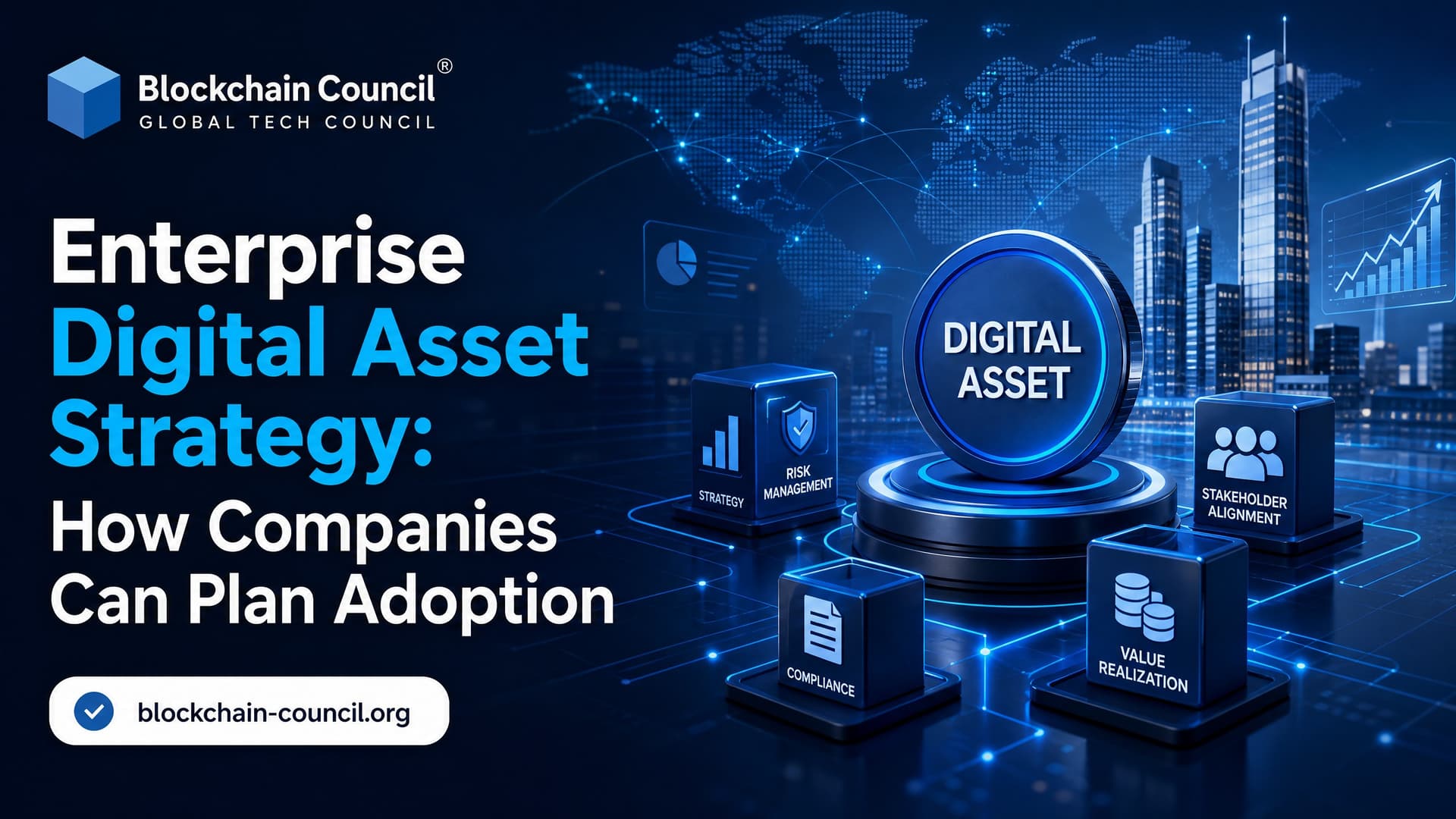
Enterprise digital asset strategy has moved from boardroom theory to operating plans. Banks, asset managers, manufacturers, media firms, and technology companies are now asking a harder question: which digital assets should we use, who owns the risk, and how do we connect them to real systems without creating another isolated pilot?
The answer is not to buy crypto first and write a policy later. That is backwards. A serious enterprise digital asset strategy starts with taxonomy, governance, compliance, architecture, and measurable use cases. Only then do you decide whether crypto exposure, stablecoins, tokenization, digital asset management platforms, or AI-linked asset tracking deserve investment.

Why Enterprises Are Taking Digital Assets Seriously
Digital assets are now part of mainstream institutional planning. Morgan Stanley has described the sector as a multi-trillion dollar business moving toward the center of global capital markets. Its analysis noted that global digital asset market capitalization briefly exceeded 4 trillion dollars, which puts the market well beyond the experimental stage.
Institutional surveys point the same way. Alpha FMC's 2025 synthesis of major research found that 86 percent of institutional investors already have exposure to digital assets or plan to allocate in 2025. It also reported that 83 percent are confident in the long term viability of blockchain technology and digital assets. That does not mean every firm should hold Bitcoin on its balance sheet. It means digital assets now deserve a formal strategy, not a side conversation.
Goldman Sachs has observed that the market conversation has shifted from why digital assets to how to integrate them. Digital asset mergers and acquisitions reached 15.8 billion dollars in 2024, up from 1 billion dollars in 2019, which shows that larger firms are buying capabilities, not just watching from the sidelines.
Define What Digital Assets Mean Inside Your Company
Start here. Many enterprise discussions fail because finance, IT, legal, and marketing use the same term for different things.
Financial digital assets
- Cryptocurrencies such as Bitcoin and Ether
- Stablecoins and tokenized deposits
- Tokenized securities, including equity, debt, funds, and structured products
- Exchange traded products that provide digital asset exposure
Operational digital assets
- Brand assets, images, video, product files, and documents managed through digital asset management systems
- Tokenized media rights, licensing records, or royalty claims
- AI-generated content with provenance and usage controls
- Digital twins and data products connected to enterprise asset management systems
This distinction matters. A tokenized bond creates securities law, custody, settlement, and investor disclosure questions. A DAM platform for marketing content creates different issues: metadata quality, permissions, copyright, workflow, and AI usage rights. Some enterprises will need both.
Build the Business Case Around Use Cases, Not Hype
A good enterprise digital asset strategy ties each use case to a business metric. If you cannot measure the gain, pause the project.
Treasury and payments
Stablecoins and digital currencies can support faster cross-border payments, 24/7 treasury movement, and conditional transfers. This is useful when payment delays create working capital pressure or supplier friction. It is less useful if your payment flows are domestic, low cost, and already well automated.
Use metrics such as settlement time, FX cost, reconciliation breaks, and treasury liquidity buffers. Do not start with a public mainnet payment flow if your compliance team has no wallet screening, sanctions monitoring, or key management process in place.
Tokenized funds and private markets
State Street's 2025 digital asset study found that respondents expect private equity and private fixed income to be among the first asset classes to undergo tokenization, at 63 percent and 53 percent respectively. That makes sense. Private markets still suffer from slow transfers, manual documentation, and limited transparency.
Tokenization can help with fractional ownership, faster transfer workflows, and cleaner lifecycle records. But it does not magically create liquidity. To be blunt, a tokenized illiquid asset is still illiquid unless there are buyers, transfer rules, market infrastructure, and legal recognition.
Institutional access through ETPs
For many corporates and financial institutions, exchange traded products are the cleanest first step. Industry analysis citing EY data found that 55 percent of current crypto holders use an ETP, while 69 percent of those planning 2025 investments intend to use one. That route can reduce custody burden and simplify operational onboarding, though firms still need risk limits and accounting treatment.
Digital content, AI, and provenance
The digital asset management software market was valued at 6.59 billion dollars in 2025 and is projected by market researchers to reach about 14 billion dollars by 2031. This growth is not only about storing files. Enterprises are adding AI search, rights management, workflow controls, and content reuse analytics.
Blockchain can add value when content ownership, licensing, royalty distribution, or audit history must be independently verifiable. It is the wrong tool for every file approval. Use it where shared trust is the problem.
Create a Governance Model Before Scaling
Alpha FMC reported that 62 percent of institutions have or are building a dedicated digital assets function. That is the right direction. Digital assets touch too many control points to be owned by one team alone.
Your governance model should include:
- Executive ownership: A steering committee that includes finance, risk, legal, compliance, security, and technology.
- Risk appetite: Clear limits for asset exposure, counterparty risk, smart contract risk, liquidity, and volatility.
- Custody rules: Decisions on third party custody, self-custody, multi-signature workflows, and key recovery.
- Compliance controls: AML, KYC, sanctions screening, market conduct, tax, consumer protection, and data privacy.
- Incident response: Playbooks for compromised keys, failed transactions, smart contract bugs, and exchange or custodian outages.
One practical detail from implementation work: chain configuration errors are common and costly. Ethereum mainnet uses chain ID 1, while Hardhat's local development network commonly uses 31337. If a signing flow, wallet policy, or EIP-712 typed data domain uses the wrong chain ID, transactions can fail validation or get rejected by wallets. It sounds minor until a deployment window is blocked by an avoidable environment mismatch.
Plan the Technology Architecture
Your architecture should connect digital assets with existing enterprise systems. Otherwise, you create a shiny silo.
Core components
- Custody and wallet infrastructure: Hardware security modules, multi-party computation, multi-signature approval, and privileged access controls.
- Tokenization platform: Issuance, transfer restrictions, cap table or investor registry integration, lifecycle events, and redemption.
- Blockchain connectivity: Public chains, permissioned networks, node providers, transaction monitoring, and audit logging.
- Enterprise integration: ERP, treasury management systems, CRM, DAM, EAM, data warehouses, and reporting tools.
- Analytics and AI: Risk scoring, anomaly detection, portfolio analytics, document review, and compliance monitoring.
State Street's 2025 study also found that 57 percent of respondents believe generative AI will be more impactful than tokenization, with expected early impact in securities selection and risk management. Treat that as a planning signal. Your digital asset roadmap should sit beside your AI and data strategy, not compete with it.
Manage Risk With Realistic Assumptions
Digital assets can offer new return sources and operating efficiencies, but volatility is real. Morgan Stanley's Global Investment Committee has projected crypto returns of around 6 percent over a seven year horizon, while highlighting annualized volatility near 55 percent, about four times that of the S&P 500 Index.
That risk profile demands discipline:
- Set allocation limits by asset class and legal entity.
- Stress test drawdowns, liquidity freezes, and counterparty failures.
- Separate client assets from corporate assets.
- Use independent price sources and valuation controls.
- Review smart contract audits, admin keys, upgrade rights, and oracle dependencies.
Regulation is another moving target. EY has identified regulatory clarity as the top catalyst for further institutional growth. The approval of spot Bitcoin and Ethereum ETFs in the United States in 2024 helped institutional access, but rules for custody, stablecoins, tokenized securities, accounting, and disclosures continue to vary by jurisdiction. Build a roadmap that can slow down without collapsing.
A Practical Adoption Roadmap
Use a staged model. It keeps ambition high and risk contained.
- Assess: Inventory current digital assets, payment flows, investment exposure, content systems, data assets, and regulatory obligations.
- Prioritize: Pick two or three use cases with measurable value. Good first candidates include ETP exposure, internal tokenization pilots, DAM modernization, or controlled stablecoin settlement tests.
- Design controls: Define custody, wallet permissions, approval workflows, risk limits, reporting, and incident response.
- Pilot: Run in a limited environment with real users, real compliance checks, and clear success criteria.
- Integrate: Connect the pilot to ERP, treasury, DAM, analytics, or customer systems before expanding.
- Scale: Move successful use cases into production governance, vendor management, audit, and staff training.
Timelines should be flexible. State Street's research suggests many institutions expect tokenization to become mainstream within 3 to 9 years, while its earlier regional study found that about 60 percent of respondents expected digital assets to take at least a decade to become fully mainstream. Plan for both scenarios.
Build the Skills Base
Technology alone will not carry the program. You need people who understand blockchain mechanics, smart contracts, compliance, cyber risk, and financial products.
For internal capability building, consider linking your learning path to Blockchain Council programs such as Certified Blockchain Expert™, Certified Blockchain Developer™, Certified Smart Contract Developer™, Certified Cryptocurrency Expert™, and Certified DeFi Expert™. Teams working on AI-driven asset analytics may also benefit from Certified AI Expert™, while security and custody teams should add cyber training to the plan.
What You Should Do Next
Create a one-page digital asset taxonomy for your company this week. List financial assets, operational content assets, data assets, and AI-generated assets. Then choose one low-risk pilot with a named owner, budget, compliance reviewer, and success metric.
If you are building the capability internally, start with Certified Blockchain Expert™ for strategy leaders and Certified Blockchain Developer™ or Certified Smart Contract Developer™ for technical teams. That split works well: executives learn the operating model, while builders learn how the infrastructure actually behaves when real transactions, gas fees, wallets, and contracts are involved.
Related Articles
View All
Digital Assets
Institutional Digital Asset Adoption: Drivers, Barriers, and Market Outlook
Institutional digital asset adoption is moving from pilots to strategic allocations, driven by regulation, ETFs, tokenization, and stablecoin settlement.

Digital Assets
Digital Asset Management: Enterprise Tools, Workflows, and Best Practices
A practical guide to enterprise digital asset management tools, workflows, metadata, governance, AI-powered DAM, compliance, and platform selection.

Digital Assets
How to Become a Digital Asset Expert: Step-by-Step Roadmap for 2026
A practical 2026 roadmap to become a digital asset expert, covering blockchain, finance, compliance, AI skills, certifications, and portfolio projects.
Trending Articles
The Role of Blockchain in Ethical AI Development
How blockchain technology is being used to promote transparency and accountability in artificial intelligence systems.
AWS Career Roadmap
A step-by-step guide to building a successful career in Amazon Web Services cloud computing.
Claude AI Tools for Productivity
Discover Claude AI tools for productivity to streamline tasks, manage workflows, and improve efficiency.