

Digital Assets vs Physical Assets: Key Differences, Benefits, and Risks

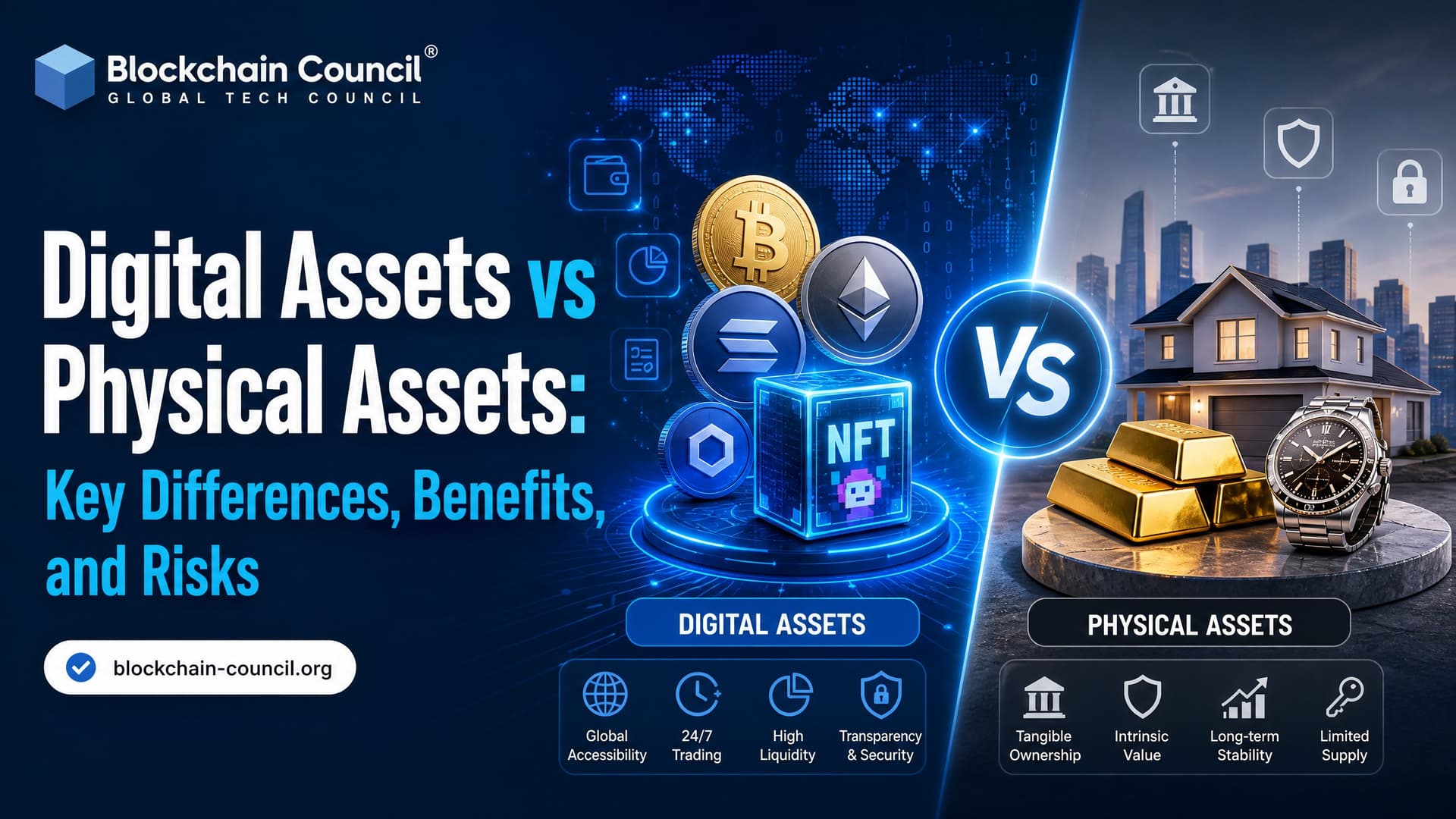
Digital assets vs physical assets is not just a finance debate. It affects how you store value, prove ownership, move money, insure property, manage business records, and control risk. Digital assets are intangible, data-based items with value, such as cryptocurrencies, stablecoins, NFTs, tokenized securities, customer data, software, images, and digital records. Physical assets are tangible items with value, such as real estate, machinery, vehicles, gold, buildings, and equipment.
The short version: digital assets usually win on speed, divisibility, and market access. Physical assets usually win on tangibility, legal maturity, and psychological comfort. Neither category is automatically safer. The risk sits in the details.

What Are Digital Assets?
A digital asset is something that exists in electronic form, can be identified, and can be owned or controlled for economic, operational, or personal value. In blockchain markets, this includes Bitcoin, Ether, stablecoins, tokenized bonds, tokenized real estate, NFTs, and central bank digital currencies. In enterprises, it also covers customer databases, product images, design files, videos, software repositories, and internal documents.
The common traits show up again and again: intangibility, cryptographic ownership, faster cross-border movement, and easier fractional distribution. That frame works well for blockchain-based assets in particular.
One practical detail matters here. Control is not always the same as legal ownership. If you hold Bitcoin in a self-custody wallet, the private key controls the asset. If you hold a token on a centralized exchange, your access depends on the exchange account, its policies, and its solvency. Those are very different risk profiles.
What Are Physical Assets?
Physical assets are material objects that carry value. They exist independently of a database or blockchain network. Common examples include:
- Residential and commercial real estate
- Factories, vehicles, machines, and logistics equipment
- Gold, silver, and other physical commodities
- Artwork, collectibles, and luxury goods
- Buildings, land, infrastructure, and inventory
Ownership is usually evidenced through possession, invoices, deeds, titles, land registries, warehouse receipts, or other legal records. You can digitize the paperwork, but the underlying asset stays physical.
Digital Assets vs Physical Assets: Core Differences
1. Tangibility
Digital assets are intangible. You reach them through software, accounts, wallets, platforms, keys, and networks. Physical assets can be seen, touched, stored, repaired, and inspected in person.
This difference sounds basic, but it changes everything. If your cold wallet seed phrase is gone, there may be no recovery path. If your property deed is lost, legal systems usually provide a process to reconstruct ownership records.
2. Ownership Proof
Digital asset ownership may be proven through cryptographic keys, platform records, or blockchain ledger entries. On Ethereum mainnet, for example, the chain ID is 1, and transfers are recorded on a public ledger. That transparency is useful, but it is unforgiving. Send an ERC-20 token to the wrong address and the network will not ask if you are sure.
Physical asset ownership relies on mature legal documentation. Land registries, vehicle titles, notarized agreements, insurance contracts, and courts all play a role. The process is slower, but legal recourse is usually clearer.
3. Transfer Speed
Blockchain-based digital assets can move across borders in minutes, sometimes seconds, depending on the network. Traditional digital securities can also settle faster than physical transactions when handled through electronic systems.
Physical assets move slowly. Selling a house may take weeks or months. Transferring machinery may involve inspection, transport, insurance, tax paperwork, and financing approvals.
4. Divisibility
Digital assets are easy to split. You can buy a small fraction of Bitcoin, a fractional token representing real estate exposure, or a small unit in a tokenized fund. Fractional ownership lowers the entry barrier.
Physical assets are harder to divide. You cannot sell 0.03 percent of a warehouse without a legal structure around it. Tokenization tries to solve this, but the physical asset still needs custody, valuation, governance, and legal enforcement.
5. Liquidity
Many digital assets trade around the clock. Liquidity can be deep for major assets such as Bitcoin and Ether, but thin or faked for small tokens and NFT collections. Be blunt about this: a token listed on an exchange is not automatically liquid.
Physical assets often carry lower liquidity. Real estate, rare art, industrial equipment, and private inventory need buyers, inspections, negotiations, and paperwork. The sale price may also depend heavily on timing and location.
Benefits of Digital Assets
Lower Transaction Costs
Digital transfers can reduce brokerage, administrative, storage, and settlement costs. A stablecoin payment may avoid some banking delays. A tokenized asset may cut manual paperwork. Still, network fees, custody fees, compliance costs, and exchange spreads do not disappear. They just move to different places.
Faster Settlement and Global Access
Digital assets can move across jurisdictions without the same physical logistics. This is why stablecoins are gaining attention in cross-border payments. For businesses, programmable transfers can also support escrow, conditional payments, and automated settlement through smart contracts.
Fractional Ownership
Tokenization can open access to markets that were once too expensive or too illiquid, such as commercial real estate, private credit, infrastructure, or high-value collectibles. This is one of the strongest arguments for digital assets, but only if the legal structure is sound.
New Business Models
Digital assets are not only investment products. Enterprises use digital asset management systems to organize media files, customer data, campaign material, and product content. Industry estimates place the digital asset management market at about 5.3 billion USD in 2024, with projections near 10.3 billion USD by 2029 at roughly a 14 percent CAGR. That growth reflects a simple reality: companies now treat data and content as assets, not by-products.
Benefits of Physical Assets
Tangibility and Durability
Physical assets offer practical utility. A building can generate rent. A machine can produce goods. Gold can be stored outside a platform account. Physical presence gives many owners confidence, especially when digital systems fail or markets panic.
Established Legal Protection
Property law, insurance, secured lending, collateral rules, and bankruptcy procedures are well developed for most physical assets. That maturity matters for lenders, enterprises, and conservative investors.
Lower Exposure to Technical Failure
A building is not exposed to a wallet exploit. A truck does not depend on a smart contract audit. Physical assets carry their own risks, but they do not vanish because someone lost a private key or clicked a phishing link.
Risks of Digital Assets
Volatility
Cryptocurrencies and NFTs can move sharply on sentiment, liquidity, social media cycles, macro news, and regulatory signals. The total digital asset market has crossed 3 trillion USD by several market estimates, but scale does not remove volatility.
Cybersecurity and Key Management
This is where beginners get hurt. A seed phrase stored in a cloud note, a fake MetaMask popup, or a wallet approval signed without reading the spender address can drain funds. In smart contract testing, developers often see errors like execution reverted: ERC20: transfer amount exceeds balance. In production, mistakes are far more expensive. There is no help desk at the protocol layer.
Platform and Counterparty Risk
If you use centralized exchanges, custodians, tokenization platforms, or digital gold providers, you depend on their controls and their balance sheet. Digital convenience can hide old-fashioned counterparty risk.
Regulatory Uncertainty
Digital asset classification still varies by jurisdiction. A token may be treated as a security, a commodity, a payment instrument, a collectible, or something else. That affects tax, reporting, custody, marketing, and investor protection duties.
Risks of Physical Assets
Storage, Insurance, and Maintenance
Physical assets cost money to protect. Real estate needs repairs, tax payments, insurance, and compliance. Gold needs secure storage. Machinery needs maintenance and may become obsolete.
Slow Sales and High Friction
Physical transfers often involve agents, lawyers, inspectors, logistics providers, banks, and government registries. Stamp duties, closing costs, transport costs, and commissions can eat into returns.
Damage, Theft, and Location Risk
Fire, flood, theft, political instability, zoning changes, and local market weakness can all reduce value. Insurance helps, but exclusions and claim delays are real.
Hybrid Assets: Where Digital and Physical Meet
The most interesting growth area is not digital replacing physical. It is the connection between them. Tokenized real-world assets create digital claims linked to physical or traditional financial assets such as property, commodities, Treasury products, private credit, or precious metals.
Digital gold is a good example. You may hold a digital claim while the metal sits in a vault. That gives you easier trading and smaller purchase sizes, but you must assess the issuer, audit reports, redemption rights, fees, and custody structure. The token is only as credible as the legal and operational system behind it.
Which Asset Type Fits Your Goal?
- Choose digital assets when you need fast transfer, fractional access, programmable settlement, global reach, or exposure to crypto-native markets.
- Choose physical assets when you need long-term utility, collateral stability, legal clarity, or an asset you can inspect and insure through established channels.
- Use hybrid models when you want digital efficiency tied to real-world value, but only after reviewing custody, audits, redemption terms, and regulation.
For professionals building expertise here, Blockchain Council certifications such as Certified Blockchain Expert™, Certified Blockchain Developer™, Certified Cryptocurrency Expert™, and Certified Smart Contract Developer™ map well to these topics. If your work is enterprise-focused, pair blockchain knowledge with data governance, cybersecurity, and digital asset management practices.
Final Takeaway
Digital assets vs physical assets is not a winner-takes-all comparison. Digital assets bring speed, fractional ownership, lower entry barriers, and programmable value. Physical assets bring tangibility, mature legal systems, and proven use in collateral and long-term wealth storage.
Your next step is simple: map the asset to the risk. If you are investing, check liquidity, custody, legal rights, and exit options before you look at returns. If you are building products around tokenization, learn the technical layer and the asset law behind it. Start with a small project, such as tracking an ERC-20 token transfer on Ethereum, then study how custody, compliance, and smart contract security change the real business outcome.
Related Articles
View All
Digital Assets
Real-World Assets vs Digital Assets: Key Differences Investors Should Know
Understand Real-World Assets vs Digital Assets, including value, legal rights, regulation, liquidity, yield, and investor due diligence.

Digital Assets
RWA Tokenization and Digital Securities: Similarities, Differences, and Regulations
RWA tokenization and digital securities overlap, but differ in asset scope, regulation, trading venues, liquidity, and DeFi integration.

Digital Assets
RWA Tokenization and Stablecoins: Connecting Real Assets to Digital Money
RWA tokenization and stablecoins are converging as tokenized Treasuries, real estate, and funds settle through blockchain-based digital money.
Trending Articles
How Blockchain Secures AI Data
Understand how blockchain technology is being applied to protect the integrity and security of AI training data.

Can DeFi 2.0 Bridge the Gap Between Traditional and Decentralized Finance?
The next generation of DeFi protocols aims to connect traditional banking with decentralized finance ecosystems.
Claude AI Tools for Productivity
Discover Claude AI tools for productivity to streamline tasks, manage workflows, and improve efficiency.