

CBDC vs Bitcoin: Key Differences in Purpose, Control, and Monetary Design
 Suyash Raizada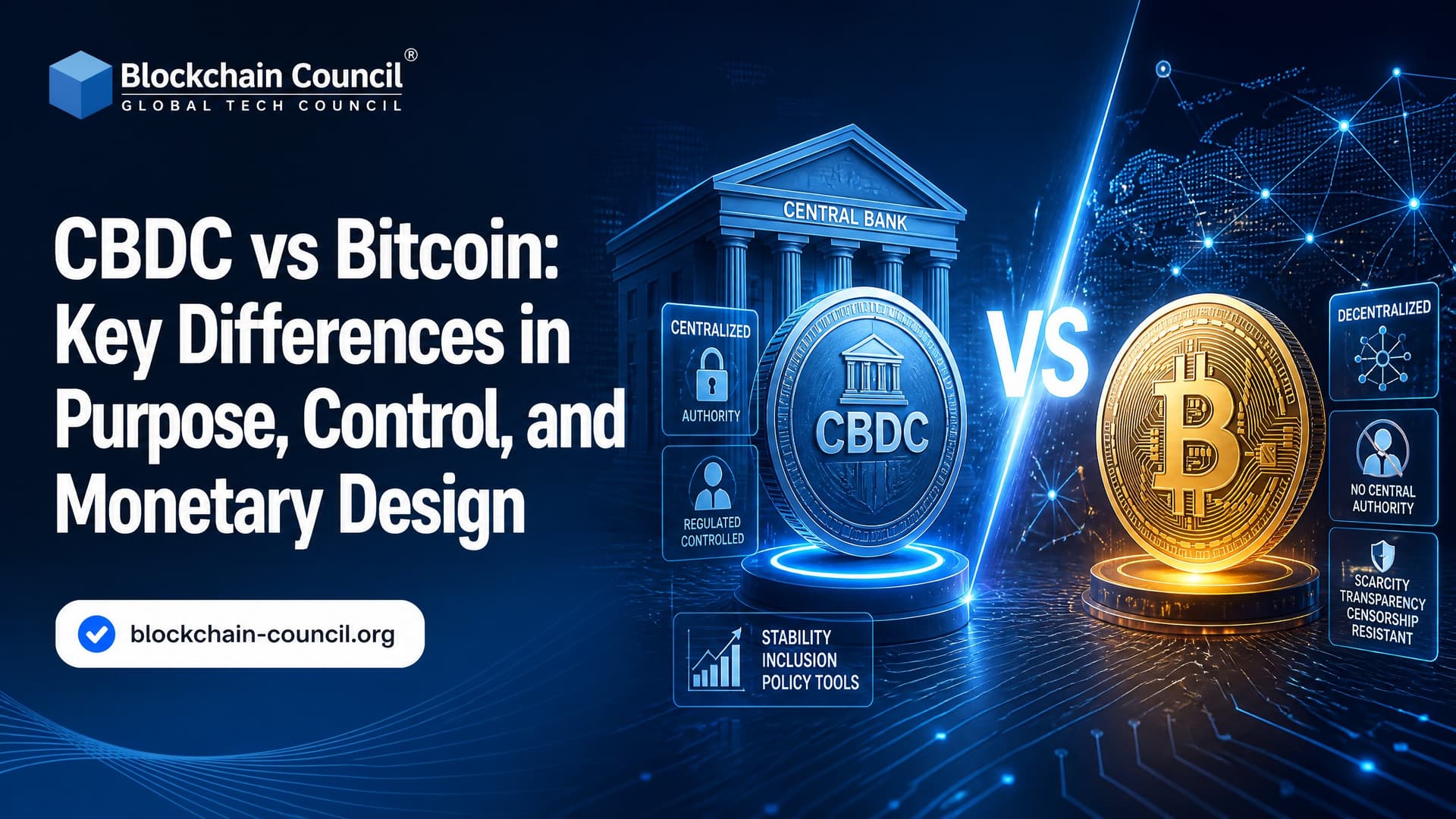
CBDC vs Bitcoin is not a debate about two versions of the same digital money. A central bank digital currency extends a country's fiat system in digital form. Bitcoin is a decentralized monetary network with a fixed supply and no central issuer. That difference shapes everything: privacy, regulation, programmability, user control, and long-term monetary behavior.
If you work in payments, crypto compliance, treasury, or digital asset product design, do not treat these systems as interchangeable. They solve different problems. Sometimes they are even designed to oppose each other. Anyone building a working knowledge of sovereign digital money before comparing it to Bitcoin will find the Certified Central Bank Digital Currency (CBDC) Expert credential a useful starting point, since it covers exactly the policy and design questions this comparison depends on.

CBDC vs Bitcoin at a Glance
Issuer: A CBDC is issued by a central bank. Bitcoin is issued by protocol rules through mining rewards.
Monetary unit: A CBDC represents fiat currency, such as a digital euro or digital rupee. Bitcoin is its own asset, BTC.
Supply design: CBDC supply follows central bank policy. Bitcoin has a hard cap of 21 million coins.
Network access: CBDCs usually run on permissioned systems. Bitcoin runs on a public, permissionless blockchain.
Control: CBDCs can include identity checks, transaction limits, freezes, and legal reversals. Bitcoin has no built-in account freeze function at protocol level.
Privacy model: CBDCs are typically tied to regulated identity systems. Bitcoin is pseudonymous, but every transaction is public.
What Is a CBDC?
A central bank digital currency is digital fiat money issued or backed by a central bank. It is meant to be a direct claim on sovereign money, usually one to one with the national currency. A digital pound, for example, would not be a new private token. It would be a digital form of sterling under the Bank of England's monetary framework.
CBDC research has grown quickly. The Atlantic Council's CBDC Tracker reports that around 130 to 134 countries, representing about 98 percent of global GDP, are exploring, developing, piloting, or using CBDCs. The Bank for International Settlements has also reported high central bank engagement, with most surveyed central banks researching retail CBDCs, wholesale CBDCs, or both.
Only a few retail CBDCs are live at national scale. The Bahamas has the Sand Dollar, Jamaica has JAM-DEX, and Nigeria has the eNaira. Adoption has been modest so far. That matters. Good policy design does not automatically produce daily usage, especially where mobile money, cards, and real-time payment systems already work well.
What Is Bitcoin?
Bitcoin launched in 2009 as a peer-to-peer electronic cash system. Its design removes the need for a central issuer, clearinghouse, or trusted payment intermediary. The network is maintained by nodes that verify rules and miners that secure blocks through Proof of Work. Professionals who want to go deeper than a surface-level summary usually work toward the Certified Bitcoin Expert credential, which covers the protocol, wallet, and mining fundamentals this section only introduces.
Bitcoin's monetary policy is simple and strict: new BTC enters circulation through block rewards, the reward halves roughly every 210,000 blocks, and total supply cannot exceed 21 million BTC under current consensus rules. Changing that limit would require broad network agreement. To be blunt, that is the point. Many Bitcoin users value the system precisely because no central bank committee can vote to expand supply.
In practice, Bitcoin is not used mainly for coffee payments. It is more often held as a speculative asset, treated as a long-term store-of-value thesis, used for cross-border settlement, or used to hold money outside domestic banking systems. It is volatile. It can be slow during fee spikes. But it is open and globally accessible.
Purpose: Public Digital Fiat vs Non-Sovereign Money
CBDCs aim to improve official money
Central banks frame CBDCs as public payment infrastructure. Common goals include lower cash handling costs, faster domestic payments, financial inclusion, programmable government disbursements, and resilience if private payment platforms fail. Wholesale CBDCs also target tokenized bond settlement, interbank transfers, and cross-border payment experiments.
The European Central Bank's digital euro work, for example, focuses on giving citizens access to public money in a digital economy while managing privacy and bank deposit risks. India has expanded digital rupee pilots across banks and regions, building around a payment ecosystem that already includes UPI. China has tested the e-CNY across retail, transit, benefits, and app-based payment scenarios.
Bitcoin aims to reduce dependence on official money
Bitcoin's purpose is almost the opposite. It does not improve fiat money. It creates a separate asset with rules enforced by software and network consensus. That makes Bitcoin attractive to users who distrust inflationary policy, capital controls, censorship, or weak local currencies.
This is the first exam trap I see when teaching digital asset candidates: they describe CBDCs and Bitcoin as two forms of blockchain money. Not quite. Many CBDCs do not need a public blockchain at all. Bitcoin absolutely does. If you can run bitcoin-cli gettxout and verify UTXO data yourself, you are interacting with a radically different trust model than a permissioned CBDC wallet that can reject a transfer because identity checks failed. This is also where the picture gets bigger than any single asset. Anyone who wants to see how Bitcoin fits alongside tokenized securities, stablecoins, and other on-chain instruments benefits from the Certified Digital Assets Expert program, which frames these instruments side by side instead of in isolation.
Control and Governance
CBDCs are centrally governed
CBDCs sit inside existing legal and monetary systems. The central bank controls issuance and redemption. Commercial banks, payment firms, or wallet providers may handle user interfaces, but the ultimate rule-set is public policy.
Most CBDC designs include:
Know-your-customer checks at wallet issuance or usage tiers
Transaction monitoring for anti-money-laundering and sanctions compliance
Holding limits to reduce bank deposit outflows
Possible offline payment features for resilience
Legal authority to freeze, block, or reverse balances in specific cases
These tools help regulators. They also create privacy concerns. Civil liberties groups worry that a retail CBDC could give the state fine-grained visibility into everyday spending unless strict legal and technical safeguards exist.
Bitcoin is governed by consensus, not decree
Bitcoin has no central operator. Developers propose changes, but they cannot force users to run new software. Miners produce blocks, but full nodes decide whether blocks follow consensus rules. Exchanges and custodians can be regulated, but the base protocol has no compliance department.
That distinction is practical, not philosophical. A bank can freeze a CBDC wallet if law requires it. A Bitcoin address cannot be frozen by the Bitcoin protocol. A regulated exchange account holding Bitcoin can be frozen, of course. Self-custody changes the control model.
Monetary Design: Flexible Supply vs Fixed Scarcity
CBDCs inherit fiat monetary policy. If a central bank raises rates, expands liquidity, or changes reserve conditions, the CBDC remains part of that same policy environment. Some CBDC proposals discuss tiered interest, balance caps, and programmable conditions. That flexibility is useful for policymakers, but users must trust the institution setting the rules.
Bitcoin rejects discretionary monetary policy. Its issuance schedule is public and predictable. The trade-off is clear. Bitcoin cannot respond to recessions, banking crises, or national employment goals. CBDCs can. But CBDCs can also be expanded, restricted, or redesigned by policy choice.
For enterprises, this affects treasury thinking. A CBDC is a settlement instrument denominated in fiat. Bitcoin is a balance sheet asset with price risk. Treating BTC like cash is poor risk management unless you have explicit policy, custody controls, and accounting procedures.
Regulation: Different Buckets, Different Rules
Regulators usually classify CBDCs as sovereign money infrastructure. Laws must define legal tender status, data rights, operational responsibilities, cybersecurity standards, and the role of banks or payment firms.
Bitcoin falls under cryptoasset regulation. The European Union's Markets in Crypto-Assets Regulation covers service providers and market conduct for cryptoassets, while Bitcoin itself has no issuer to license. The United Kingdom and several Asian markets are moving toward exchange licensing, custody requirements, disclosure rules, and stricter anti-money-laundering supervision. The United States has taken a more skeptical stance toward a retail CBDC, with recent federal policy blocking a direct-to-consumer Federal Reserve CBDC while leaving room for research and wholesale settlement discussions.
Use Cases: Where Each Makes Sense
CBDC use cases
Retail payments backed by central bank money
Government benefits and tax refunds
Offline payments during network outages
Wholesale settlement of tokenized securities
Cross-border settlement between central banks
Bitcoin use cases
Long-term holding as a scarce digital asset
Cross-border value transfer without bank settlement rails
Self-custody outside traditional financial intermediaries
Institutional exposure through regulated custody or exchange-traded products
Payments in niche markets where censorship resistance matters more than price stability
Neither system wins every use case. A CBDC is better for a tax refund to millions of verified citizens. Bitcoin is better for open, permissionless settlement where no central issuer should control access. Teams building or auditing the infrastructure behind either model, from permissioned CBDC rails to Bitcoin custody systems, often pair this domain knowledge with a broader Tech Certification that covers the underlying engineering practices at play.
What Professionals Should Learn Next
If your work touches payments, compliance, tokenization, or treasury, build separate mental models for CBDCs, Bitcoin, and stablecoins. Mixing them leads to bad architecture and worse policy advice.
For structured learning, consider Blockchain Council's Certified Bitcoin Expert™ if you want a stronger grasp of Bitcoin's protocol, wallets, mining, and monetary design. If your role spans broader digital assets and regulation, Certified Cryptocurrency Expert™ is a useful next step. Developers who want to compare public and permissioned systems should also look at Certified Blockchain Developer™ and Certified Smart Contract Developer™. And if your responsibilities lean toward explaining these systems to customers, regulators, or investors rather than building them, a Marketing Certification can help you turn this technical grounding into messaging that lands with a non-technical audience.
Your next step is simple: map one payment flow twice. First, design it with a permissioned CBDC wallet and KYC controls. Then design it with Bitcoin self-custody and public blockchain settlement. The differences you document will teach you more than another abstract CBDC vs Bitcoin argument.
FAQs
1. What is the difference between CBDC and Bitcoin?
A Central Bank Digital Currency, or CBDC, is digital sovereign money issued as a liability of a central bank. Bitcoin is a decentralized digital asset operating on a public blockchain without a central issuer. CBDCs are designed to represent national currencies within existing monetary systems, while Bitcoin operates according to protocol rules maintained by a distributed network.
2. Is Bitcoin a CBDC?
No. Bitcoin is not a Central Bank Digital Currency. It was designed as a peer-to-peer electronic cash system that does not require a central bank to issue or control the asset. A CBDC, by contrast, exists specifically because a central bank issues digital sovereign money under a country's monetary and legal framework.
3. Is a CBDC a cryptocurrency like Bitcoin?
Not in the conventional sense. CBDCs and Bitcoin are both digital, and CBDCs may use cryptographic technologies, but their monetary structures are fundamentally different. Bitcoin is a decentralized crypto asset native to its blockchain. A CBDC is a digital representation of sovereign fiat currency and may operate on centralized, distributed, or hybrid infrastructure without using a public blockchain.
4. Who controls Bitcoin and CBDCs?
A CBDC is issued and governed within a country's central-banking and legal framework. Central banks can determine monetary characteristics and operational rules subject to applicable law and institutional mandates. Bitcoin has no central issuing authority. Its network operates through open-source software, miners, nodes, users, and market participants coordinating around agreed protocol rules.
5. Who issues Bitcoin?
Bitcoin does not have an issuer comparable to a central bank or private company. New bitcoin enters circulation according to protocol-defined mining rules as miners successfully produce valid blocks. The issuance schedule declines over time through Bitcoin's halving mechanism. This differs fundamentally from fiat currencies, whose monetary supply is managed within central-bank monetary-policy frameworks.
6. Is Bitcoin's supply limited while CBDC supply is unlimited?
Bitcoin's protocol limits total issuance to approximately 21 million BTC, with new supply released according to its programmed schedule. A CBDC would not normally have an independent fixed supply because it represents an existing sovereign currency. Its quantity would operate within the issuing central bank's broader monetary framework rather than through a Bitcoin-style hard cap.
7. How does CBDC monetary policy differ from Bitcoin?
CBDCs remain part of conventional monetary systems. Central banks can use established monetary-policy tools to pursue objectives defined by their mandates, while the CBDC represents another form of that sovereign currency. Bitcoin's monetary issuance follows predetermined protocol rules and is not adjusted by a central authority in response to inflation, unemployment, recessions, or other economic conditions.
8. Is Bitcoin more decentralized than a CBDC?
Yes, structurally. Bitcoin is designed to operate without a central monetary authority, with independent nodes verifying transactions and miners participating in block production. A CBDC remains a central-bank liability even if its technical infrastructure uses distributed systems or private intermediaries. A distributed database does not transform centrally issued sovereign money into a decentralized monetary system.
9. Which is more private: Bitcoin or CBDC?
Neither should automatically be considered anonymous. Bitcoin transactions are recorded on a public blockchain, allowing addresses and transaction flows to be analyzed even though addresses do not inherently display real-world names. CBDC privacy depends on its architecture, intermediaries, regulations, and data-access rules. A well-designed CBDC could incorporate privacy protections, while a poorly designed one could enable extensive transaction visibility.
10. Can governments track Bitcoin transactions?
Bitcoin's public blockchain allows anyone to inspect transaction histories and address activity. Blockchain analytics can sometimes connect addresses with real-world identities using exchange records and other information. Governments do not need to control Bitcoin to analyze its public ledger. Privacy-enhancing practices can make attribution more difficult, but Bitcoin should generally be considered pseudonymous rather than inherently anonymous.
11. Can governments track CBDC transactions?
The degree of visibility depends on the CBDC's technical and legal design. A CBDC could use intermediaries, data minimization, tiered privacy, or privacy-enhancing technologies to limit what central authorities can see. Alternatively, architectures could provide greater centralized visibility. Users should therefore examine specific privacy rules rather than assuming every CBDC enables either complete anonymity or complete surveillance.
12. Is Bitcoin legal tender?
Bitcoin's legal status differs across jurisdictions. Some countries have adopted special legal frameworks for Bitcoin, while others regulate or restrict its use differently. CBDCs, by contrast, are issued within national monetary frameworks and may receive legal-tender status depending on local legislation. Legal tender is therefore a jurisdiction-specific legal question rather than an inherent technological property.
13. Is a CBDC more stable than Bitcoin?
In nominal terms, a CBDC is designed to represent the issuing country's currency, so one digital unit should correspond to one unit of that currency. Bitcoin's market price can fluctuate substantially against fiat currencies because it is independently traded. CBDCs therefore avoid BTC-style exchange-rate volatility relative to their own national unit of account, although they remain exposed to that currency's purchasing-power changes.
14. Can Bitcoin or CBDCs be used for everyday payments?
Both can technically support payments, but their practical characteristics differ. CBDCs can be designed specifically for domestic retail payments with stable denomination and integration into national payment infrastructure. Bitcoin can be transferred globally, while scaling technologies such as the Lightning Network can support faster, lower-cost payments. Adoption, fees, regulation, merchant acceptance, and user preferences determine practical usage.
15. How do Bitcoin and CBDCs differ in cross-border payments?
Bitcoin can be transferred across its global network without requiring separate national Bitcoin systems, although exchanges, regulation, fees, volatility, and conversion into local currency remain considerations. Cross-border CBDC payments require interoperability between national systems, foreign-exchange mechanisms, compliance frameworks, and central-bank cooperation. CBDCs preserve national monetary sovereignty while Bitcoin operates as a borderless network asset.
16. Can CBDC transactions be reversed while Bitcoin transactions cannot?
Confirmed Bitcoin transactions do not contain a built-in chargeback mechanism controlled by a central administrator. CBDC systems could potentially include recovery, dispute-resolution, or reversal mechanisms depending on their legal and technical design. This could improve consumer protection but introduces institutional control absent from Bitcoin's base protocol. The exact capabilities would vary considerably between CBDC implementations.
17. What happens if I lose my Bitcoin or CBDC wallet?
With self-custodied Bitcoin, permanently losing private keys or recovery credentials can result in permanent loss of access to the BTC. CBDC systems may provide identity-based or intermediary-assisted wallet recovery, depending on their architecture. Such recovery can improve usability and consumer protection, although it introduces different trust, identity, and privacy considerations compared with bearer-like self-custody.
18. Can CBDCs replace Bitcoin?
CBDCs are unlikely to replace Bitcoin because they address different objectives. A CBDC provides digital access to sovereign fiat currency, while Bitcoin offers a decentralized digital asset with a fixed issuance framework and no central issuer. People may use CBDCs for payments while holding or transferring Bitcoin for entirely different reasons. Their overlapping digital characteristics do not make them interchangeable.
19. Will Bitcoin replace CBDCs or traditional currencies?
Bitcoin has created an alternative digital monetary network, but replacing sovereign currencies would require much more than technical adoption. Governments collect taxes, conduct monetary policy, denominate public obligations, and operate economies using national currencies. Bitcoin can coexist with fiat currencies, stablecoins, CBDCs, and bank deposits without necessarily replacing them. The eventual balance depends on regulation, adoption, technology, and economic preferences.
20. Which is better: CBDC or Bitcoin?
There is no universal winner because CBDCs and Bitcoin were designed around fundamentally different ideas about digital money.
A CBDC asks:
How can sovereign fiat currency operate in a digitally native environment?
Bitcoin asks something closer to:
Can digital value operate without a central monetary issuer?
That difference shapes nearly everything else.
A CBDC is issued within a national monetary framework. Its value is denominated in the country's existing currency, and its supply remains connected to central-bank monetary policy.
Bitcoin has no central issuer. Its monetary issuance follows protocol rules, with total issuance capped at approximately 21 million BTC.
Their governance models are equally different.
CBDCs rely on central banks, legislation, regulated intermediaries, and institutional oversight.
Bitcoin relies on software rules, cryptography, economic incentives, miners, nodes, developers, and users participating in a decentralized network.
Privacy is more complicated than the usual slogans suggest.
Bitcoin is decentralized but its blockchain is public. CBDCs are centralized in monetary issuance but could potentially incorporate strong privacy protections. Practical privacy therefore depends on transaction architecture, identity requirements, custody, and data-access rules.
The risk profiles are also different.
Bitcoin exposes holders to substantial market-price volatility and self-custody risks. A CBDC avoids Bitcoin-style price volatility against its own unit of account but introduces questions involving cybersecurity, privacy, operational resilience, and institutional control.
The clearest comparison is therefore:
CBDC = Digital sovereign fiat money
Bitcoin = Decentralized, protocol-native digital asset
CBDCs prioritize monetary stability, institutional accountability, legal integration, and payment infrastructure.
Bitcoin prioritizes decentralization, predictable issuance, censorship resistance, and the ability to transfer value without a central monetary operator.
The future could contain both.
People may use CBDCs, bank deposits, or stablecoins for routine payments while using Bitcoin for other financial purposes. Different jurisdictions will make different regulatory and monetary choices.
So the useful question is not simply, “Which one wins?”
It is “Which monetary properties does a particular user or use case actually require?”
Digital money stopped being a single category some time ago. The vocabulary, rather inconveniently, is still catching up.
Related Articles
View All
Digital Assets
Real-World Assets vs Digital Assets: Key Differences Investors Should Know
Understand Real-World Assets vs Digital Assets, including value, legal rights, regulation, liquidity, yield, and investor due diligence.

Digital Assets
CBDC Implementation Roadmap: From Pilot Design to National Rollout
A practical CBDC implementation roadmap covering policy design, pilots, legal readiness, infrastructure scaling, adoption metrics, and national rollout.

Digital Assets
Token-Based CBDC vs Account-Based CBDC: Which Design Protects Privacy Better?
Token-based CBDC usually protects privacy better than account-based CBDC, but real protection depends on identity linkage, data rules, and governance.
Trending Articles
The Role of Blockchain in Ethical AI Development
How blockchain technology is being used to promote transparency and accountability in artificial intelligence systems.
AWS Career Roadmap
A step-by-step guide to building a successful career in Amazon Web Services cloud computing.
Claude AI Tools for Productivity
Discover Claude AI tools for productivity to streamline tasks, manage workflows, and improve efficiency.