

Digital Asset Career Guide: Roles, Skills, Salaries, and Learning Paths
 Suyash Raizada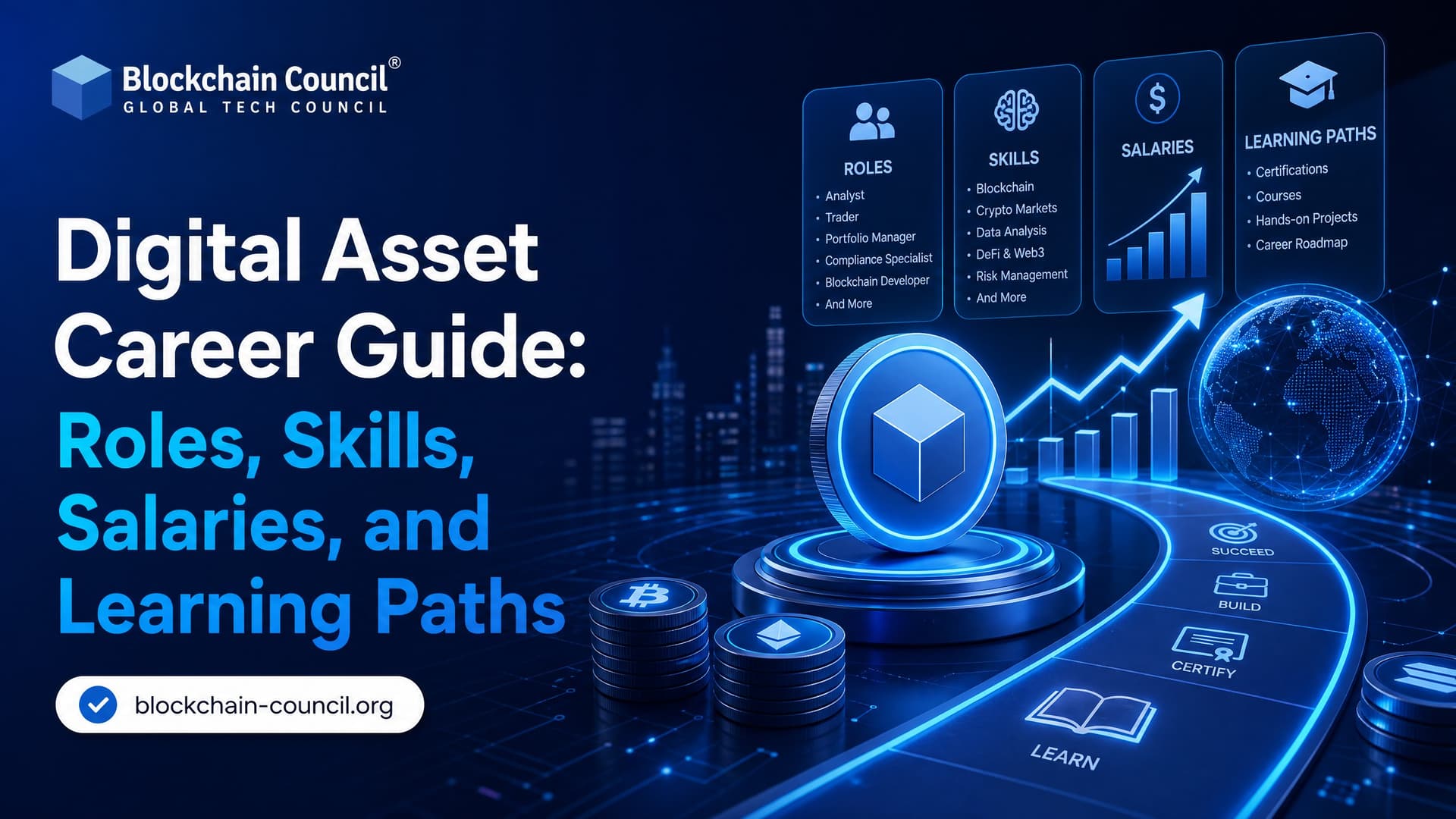
Digital asset career searches have shifted for a reason: the market is no longer just hiring Solidity developers for speculative token launches. In 2025, digital asset careers span engineering, compliance, risk, custody, product, tokenization, analytics, and institutional finance. Hiring reports estimate roughly 1.6 million professionals working in crypto and blockchain roles globally, with about 66,000 new Web3 roles added in 2025 after a rough 2024.
The useful question is not, Should I work in crypto? It is sharper: Which digital asset role fits your current skill base, and what should you learn next?

As digital asset careers continue to expand across finance, technology, and enterprise operations, professionals benefit from developing expertise that goes beyond cryptocurrencies alone. A Certified Digital Assets Expert credential provides a structured understanding of digital asset ecosystems, governance, compliance, tokenization, and real-world business applications, helping candidates prepare for a wide range of evolving roles.
Current State of Digital Asset Careers
The digital asset job market has matured. Engineering still matters, but banks, exchanges, asset managers, fintech firms, and infrastructure companies now hire for custody, tokenized funds, compliance monitoring, stablecoin risk, and institutional trading systems.
Industry hiring reports show remote roles remain common, with about 40 percent of new Web3 jobs in 2025 listed as remote. Larger financial institutions often prefer hybrid teams for security, compliance, and trading operations. That is not surprising. If you are designing custody workflows or reviewing transaction approval controls, Slack alone is rarely enough.
Hiring has also moved away from generalist Web3 enthusiasm. Employers want people who can ship secure code, interpret regulation, build controls, or manage tokenized financial products. To be blunt, a basic NFT marketplace tutorial will not carry much weight in a senior interview anymore.
Major Digital Asset Career Tracks
1. Blockchain and Web3 Developer
Blockchain developers build smart contracts, decentralized applications, wallet integrations, protocol tools, and on-chain infrastructure. Common skills include Solidity, JavaScript or TypeScript, Python, Rust, smart contract testing, RPC APIs, wallet connections, and security fundamentals.
A practical detail: beginners often deploy to Hardhat's local network with chain ID 31337, then wonder why their MetaMask setup or signature validation fails when they later test against Ethereum mainnet assumptions. Ethereum mainnet uses chain ID 1. Small mismatch. Big debugging session.
Typical salary ranges:
North America: 120,000 to 250,000 dollars per year for many Web3 developer roles
Europe: 80,000 to 180,000 euros for experienced developers
Global remote roles: often 100,000 to 200,000 dollars, with higher bands for senior engineers
If this is your path, build with Solidity 0.8.x, understand ERC-20 and ERC-721, and learn why arithmetic still matters even though Solidity 0.8 introduced default overflow checks that revert with Panic(0x11).
Relevant learning paths include the Certified Blockchain Developer™, Certified Smart Contract Developer™, and Certified Web3 Expert™ from Blockchain Council.
2. Smart Contract Auditor and Security Engineer
Smart contract auditors review code before real funds touch it. This is one of the highest paying digital asset careers because mistakes are public, permanent, and expensive. You need to understand reentrancy, access control, oracle manipulation, signature replay, unsafe upgrade patterns, MEV exposure, and protocol-level risk.
Senior smart contract auditors and security engineers often earn 150,000 to 300,000 dollars per year. Top freelance auditors can earn more through contests and bug bounties, but that route is volatile. It rewards skill, patience, and a thick skin.
Good preparation includes reading audit reports from firms such as OpenZeppelin, Trail of Bits, and ConsenSys Diligence, then reproducing the bugs locally. Do not just read. Break things.
Blockchain Council's Certified Smart Contract Auditor™ fits professionals moving from development into security review.
3. Digital Asset Compliance and AML
Digital asset compliance roles are growing quickly as regulation catches up with institutional adoption. These jobs cover anti-money laundering controls, transaction monitoring, sanctions screening, surveillance, licensing, policy drafting, and regulator engagement.
Common employers include exchanges, brokerages, banks, fintech platforms, custodians, and tokenization firms. Job descriptions for senior compliance roles often ask for 7 or more years in compliance, legal, financial crime, or regulatory advisory work.
Salary examples from recent US postings:
Senior compliance program manager: about 129,000 to 161,000 dollars
Director of digital assets compliance: about 160,000 to 240,000 dollars
Crypto compliance architect: about 165,000 to 220,000 dollars, sometimes with equity
You should know the roles of the SEC, CFTC, FinCEN, NYDFS, OCC, Federal Reserve, and FDIC in the United States. In Europe, MiCA is now a key framework for crypto asset service providers and stablecoin issuers.
For this track, consider the Certified Blockchain and Law Professional™ or Certified Cryptocurrency Expert™, depending on your current background.
4. Digital Asset Risk, Custody, and Operations
Risk and custody roles sit close to institutional money. You may work on private key governance, transaction approval workflows, segregation of duties, settlement risk, stablecoin exposure, incident response, vendor risk, or operational controls.
This is not glamorous work, but it is where serious institutions spend money. A custody mistake can mean lost assets. A weak approval policy can create fraud exposure. A poor key rotation process can stop operations at the worst possible time.
Digital asset custody professionals usually need a mix of finance, cybersecurity, and blockchain knowledge. Risk managers often come from banking, payments, brokerage, or enterprise risk management.
5. RWA Tokenization and Product Strategy
Real world asset tokenization, often called RWA tokenization, is one of the strongest career themes in digital assets. It covers tokenized treasury bills, private credit, real estate, commodities, fund interests, and other financial assets represented on blockchain networks.
Roles include tokenization lead, product manager, investment operations associate, enterprise account manager, and blockchain engineer for tokenized assets. Product managers at major exchanges and market infrastructure firms can earn roughly 134,000 to 248,000 dollars, with senior tokenization product roles sometimes above 200,000 dollars.
This track favors people who understand both capital markets and blockchain standards such as ERC-20, ERC-721, and ERC-1400. If you only know DeFi slang but cannot explain transfer restrictions, investor eligibility, custody, or yield distribution, you are not ready for institutional tokenization work.
Regardless of the career path professionals choose, a solid grasp of blockchain architecture, consensus mechanisms, smart contracts, and enterprise blockchain adoption remains a valuable advantage. A Certified Blockchain Expert credential helps strengthen these core technical concepts while supporting career growth across development, operations, compliance, and digital asset strategy.
Core Skills You Need Across Digital Asset Jobs
Different roles need different depth, but most digital asset careers draw from the same skill groups:
Blockchain fundamentals: consensus, wallets, transactions, cryptographic hashes, public and private keys, and network types.
Smart contracts: Solidity, Rust, testing frameworks such as Hardhat and Foundry, deployment, and upgrade patterns.
Security: threat modeling, key management, audits, incident response, and on-chain monitoring.
Finance: trading, custody, settlement, tokenomics, asset structuring, and market operations.
Regulation: AML, securities law, commodities rules, licensing, stablecoin policy, and MiCA.
Data and AI: on-chain analytics with tools such as Dune and Flipside, risk scoring, anomaly detection, and reporting.
Communication: writing clear policies, explaining technical risk to executives, and working across legal, engineering, product, and operations teams.
Digital Asset Salary Benchmarks
Compensation varies by country, seniority, company stage, and risk level. Still, the pattern is clear: specialist digital asset skills command strong pay.
Blockchain developer: average estimates cluster near 150,000 dollars annually, with broad ranges from about 78,000 to more than 260,000 dollars.
Senior smart contract developer: commonly 180,000 to 250,000 dollars.
Protocol engineer: often 200,000 to 350,000 dollars at L1 and L2 infrastructure teams.
Smart contract auditor: often 150,000 to 300,000 dollars.
Digital asset compliance director: often 160,000 to 240,000 dollars in US postings.
Tokenization product manager: commonly 134,000 to 248,000 dollars in major institutional roles.
Entry-level support and operations roles can be far lower, especially in asset tokenization administration. Do not assume every digital asset job pays Silicon Valley engineering rates. The premium goes to scarce, accountable skills.
Best Learning Paths by Background
If You Are a Developer
Strengthen JavaScript or TypeScript, Python, and basic security.
Learn blockchain fundamentals and Ethereum transaction mechanics, including EIP-1559 gas pricing.
Build smart contracts in Solidity 0.8.x.
Use Foundry or Hardhat for tests, fuzzing, and local deployment.
Build one serious portfolio project, such as a token vault, staking contract, or RWA-style restricted token demo.
Study smart contract exploits and complete a certification such as the Certified Blockchain Developer™.
If You Come From Finance or Compliance
Learn wallets, exchanges, custody models, stablecoins, and DeFi basics.
Study AML and transaction monitoring for crypto businesses.
Map regulations by jurisdiction, especially SEC, CFTC, FinCEN, NYDFS, and MiCA.
Practice writing a digital asset risk assessment or compliance policy.
Move toward tokenization, custody, or digital asset compliance roles.
If You Are a Product Manager
Understand user problems in custody, onboarding, trading, reporting, and tokenized assets.
Learn enough smart contract architecture to ask engineers good questions.
Study capital markets workflows if you want RWA tokenization.
Build product judgment around regulation. In this field, shipping fast without controls is often the wrong move.
Many digital asset roles also require expertise beyond blockchain itself, including cybersecurity, cloud computing, APIs, automation, enterprise integration, analytics, and AI-driven technologies. A Tech Certification helps professionals develop these complementary technical capabilities, making them better equipped to work across modern digital asset and Web3 ecosystems.
Where the Market Is Heading
The strongest signals point toward institutional infrastructure, not short-term speculation. Custody architecture, tokenized funds, compliance tooling, on-chain analytics, stablecoin risk, and smart contract security should remain durable hiring areas.
AI plus Web3 is also becoming more relevant, particularly for on-chain intelligence, fraud detection, trading analytics, and automated risk scoring. Be careful, though. AI is useful when it improves investigation quality or decision speed. It is not a substitute for understanding blockchain data, regulatory duties, or adversarial behavior.
Geographically, the United States remains a major hiring center, with Singapore, Dubai, Portugal, parts of Europe, Latin America, and Taiwan showing strong activity. Local regulation matters. A crypto-friendly hub can create jobs quickly, while unclear licensing can slow them just as fast.
How to Choose Your Digital Asset Career Path
Pick based on your existing advantage:
You code well: choose blockchain development, protocol engineering, or smart contract security.
You know banking or brokerage: choose compliance, risk, custody, or tokenized products.
You understand capital markets: focus on RWA tokenization and digital asset product strategy.
You like investigation: explore on-chain analytics, financial crime, and blockchain forensics.
You work with data or AI: move toward on-chain intelligence, risk models, and institutional analytics.
The next step is simple: choose one track, build one credible project or work sample, and fill the gaps with structured training. For technical roles, start with the Certified Blockchain Developer™ or Certified Smart Contract Auditor™. For business, risk, or policy roles, review the Certified Cryptocurrency Expert™, Certified Blockchain Expert™, or Certified Blockchain and Law Professional™. Then apply what you learn to a real use case, because digital asset employers still trust proof of work more than a polished resume.
Building a successful career in digital assets also involves communicating complex ideas to business leaders, clients, investors, and cross-functional teams. A Marketing Certification helps professionals strengthen strategic communication, brand positioning, and stakeholder engagement skills, complementing technical expertise while supporting long-term career development.
FAQs
1. What is a digital asset career?
A digital asset career involves working with blockchain technology, cryptocurrencies, tokenized real-world assets (RWAs), decentralized finance (DeFi), digital identity, or enterprise blockchain solutions. Professionals in this field contribute to technology development, product management, cybersecurity, compliance, finance, operations, consulting, and business strategy.
2. What are the most common digital asset career roles?
Popular roles include Blockchain Developer, Smart Contract Developer, Blockchain Architect, Digital Asset Product Manager, Blockchain Business Analyst, Web3 Developer, Digital Asset Compliance Officer, Blockchain Security Engineer, Digital Asset Risk Analyst, Blockchain Consultant, Crypto Research Analyst, Digital Asset Operations Specialist, and Enterprise Blockchain Solutions Architect.
3. What skills are required for a digital asset career?
Important skills include blockchain fundamentals, distributed ledger technology (DLT), cryptography, smart contracts, tokenization, cybersecurity, cloud computing, programming languages, data analysis, governance, compliance, communication, and problem-solving. The required skill set varies depending on technical, business, or regulatory responsibilities.
4. Which programming languages are valuable in blockchain careers?
Common programming languages include Solidity, Rust, Go, JavaScript, TypeScript, Python, Java, C++, and SQL. The preferred language depends on the blockchain ecosystem, development framework, and specific role.
5. What certifications are useful for digital asset professionals?
Professionals often pursue certifications covering blockchain fundamentals, digital assets, cloud computing, cybersecurity, project management, compliance, AI, and enterprise architecture. While certifications can strengthen a resume, employers typically value practical experience and demonstrable skills alongside formal credentials.
6. What industries hire digital asset professionals?
Organizations hiring digital asset talent include financial institutions, fintech companies, blockchain startups, consulting firms, technology vendors, cybersecurity companies, healthcare organizations, supply chain providers, government agencies, insurance companies, gaming studios, and enterprise software firms.
7. What does a Blockchain Developer do?
Blockchain Developers design, build, test, and maintain blockchain applications, smart contracts, decentralized applications (dApps), APIs, and supporting infrastructure. They also focus on performance, security, scalability, and integration with existing enterprise systems.
8. What does a Digital Asset Product Manager do?
A Digital Asset Product Manager defines product strategy, gathers requirements, prioritizes roadmaps, collaborates with engineering and compliance teams, and ensures blockchain products deliver measurable business value while meeting regulatory and customer requirements.
9. What does a Digital Asset Compliance Officer do?
Compliance professionals help organizations manage regulatory obligations related to digital assets. Their responsibilities may include anti-money laundering (AML), know-your-customer (KYC), sanctions screening, risk assessments, regulatory reporting, policy development, and internal compliance monitoring.
10. What are the salary expectations for digital asset careers?
Compensation varies significantly based on role, experience, location, industry, employer, and market conditions. Specialized positions in blockchain engineering, cybersecurity, enterprise architecture, and senior product leadership often command higher salaries than entry-level or generalist roles, but there is no universal salary range applicable across all markets.
11. What soft skills are important in digital asset careers?
Strong communication, collaboration, analytical thinking, adaptability, stakeholder management, leadership, project management, critical thinking, continuous learning, and ethical decision-making are valuable across both technical and business-focused blockchain roles.
12. How can beginners start a digital asset career?
Beginners should learn blockchain fundamentals, understand cryptocurrencies and tokenization, build practical projects, complete reputable training programs, contribute to open-source initiatives, develop a professional portfolio, and stay informed about industry developments through trusted educational resources.
13. How important is cybersecurity knowledge?
Cybersecurity is a critical skill because digital assets rely on secure key management, cryptography, smart contract security, secure infrastructure, and effective operational controls. Even non-technical professionals benefit from understanding common security risks and mitigation strategies.
14. How does AI influence digital asset careers?
AI is increasingly used for blockchain analytics, fraud detection, compliance monitoring, cybersecurity, customer support, operational automation, predictive risk analysis, and portfolio management. Professionals who understand both AI and blockchain technologies may find broader career opportunities as these fields continue to converge.
15. What career paths are available beyond software development?
Career options include product management, digital asset operations, compliance, legal advisory, consulting, business analysis, enterprise architecture, investment research, marketing, sales engineering, education, technical writing, customer success, and governance.
16. What challenges do professionals face in digital asset careers?
Common challenges include rapidly changing technology, evolving regulations, cybersecurity threats, interoperability issues, market volatility, continuous learning requirements, and balancing innovation with compliance and risk management.
17. What mistakes should job seekers avoid?
Avoid focusing exclusively on cryptocurrency prices instead of underlying technology, neglecting cybersecurity knowledge, ignoring regulatory developments, overstating technical expertise, failing to build practical projects, or relying solely on certifications without demonstrating real-world skills.
18. What trends are shaping digital asset careers in 2026?
Major trends include institutional adoption of tokenized real-world assets (RWAs), enterprise blockchain implementation, AI-assisted blockchain operations, decentralized identity, blockchain interoperability, stablecoin infrastructure, digital asset governance, privacy-enhancing technologies, and expanding regulatory compliance roles.
19. What learning path should aspiring digital asset professionals follow?
A practical learning path includes mastering blockchain fundamentals, studying cryptography and distributed systems, learning smart contracts and tokenization, developing programming or business expertise, building real-world projects, earning relevant certifications, participating in blockchain communities, and continuously updating knowledge as the industry evolves.
20. What is the future of digital asset careers?
Digital asset careers are expected to expand as blockchain technology becomes more integrated into finance, healthcare, supply chains, government services, and enterprise software. Professionals who combine technical expertise with business understanding, security awareness, governance knowledge, and regulatory literacy are likely to remain competitive in a rapidly evolving job market. The technology changes quickly, but employers still appreciate timeless skills like solving problems, communicating clearly, and showing up to meetings with your microphone unmuted.
Related Articles
View All
Digital Assets
How to Become an RWA Tokenization Expert: Skills, Tools, and Career Path
Learn how to become an RWA tokenization expert with the right blockchain, finance, compliance, tools, and career roadmap for tokenized assets.

Digital Assets
How to Tokenize a Real-World Asset: Step-by-Step Guide
Learn how to tokenize a real-world asset through legal structuring, valuation, token design, smart contracts, compliance, custody, issuance, and servicing.

Digital Assets
How Asset Tokenization Creates Verifiable Digital Ownership
Asset tokenization turns rights to real world and financial assets into blockchain tokens, giving authorized parties a verifiable record of ownership, provenance, and compliance.
Trending Articles
The Role of Blockchain in Ethical AI Development
How blockchain technology is being used to promote transparency and accountability in artificial intelligence systems.

Top 5 DeFi Platforms
Explore the leading decentralized finance platforms and what makes each one unique in the evolving DeFi landscape.
How to Create Claude Skills?
Claude Skills are one of the most important features Anthropic has introduced for users who want automation that is structured, consistent and reusable. Instead of giving Claude long instructions ever