

CBDC vs Cryptocurrency: Key Differences Every Investor Should Know
 Suyash Raizada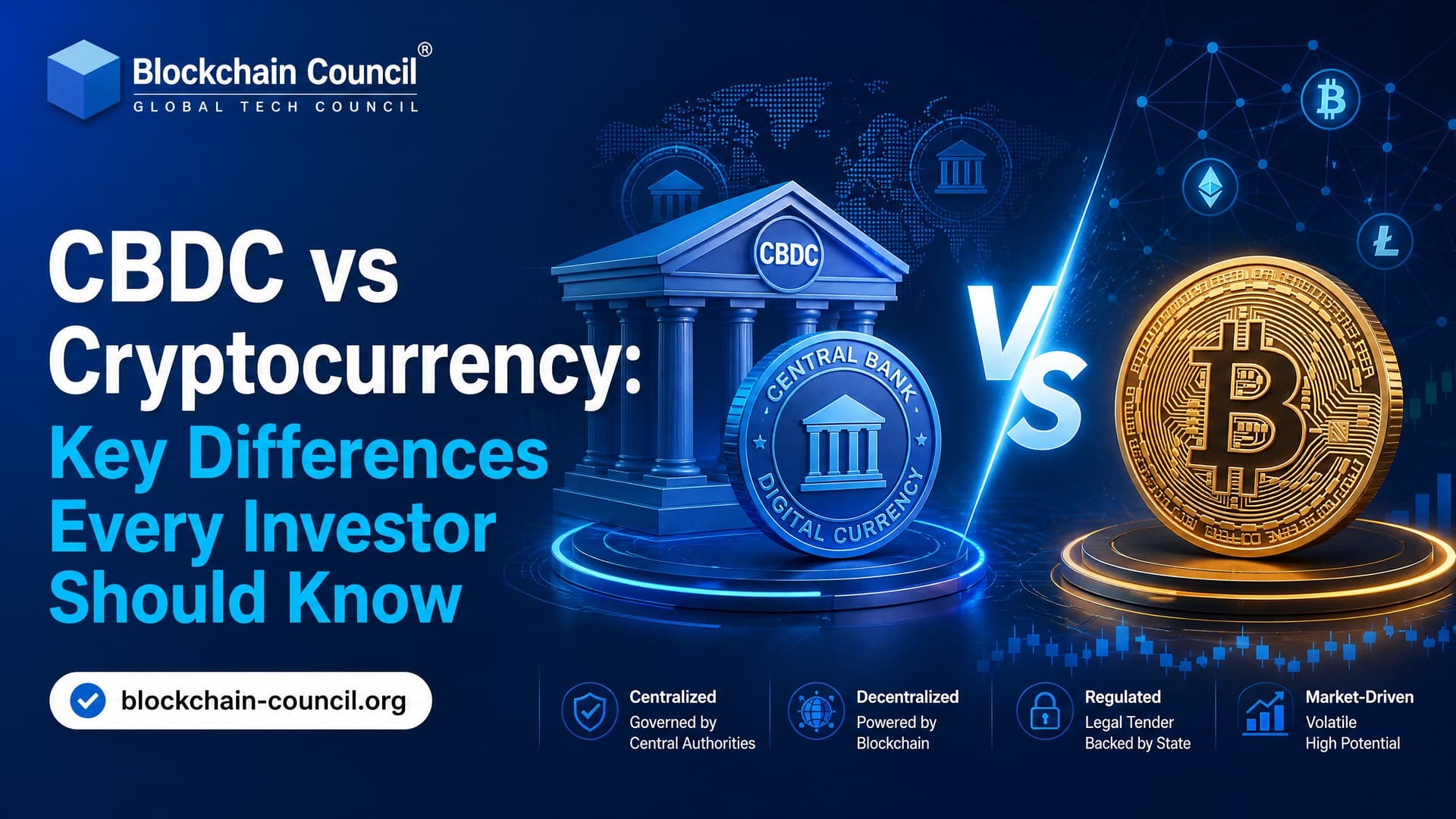
CBDC vs Cryptocurrency is not just a technical debate. It is a question about what you actually hold, who controls it, what legal rights come with it, and whether it belongs in an investment portfolio at all. A central bank digital currency is state-issued digital cash. A cryptocurrency is a market-priced digital asset secured by a blockchain network or protocol. For professionals who want to build a deeper understanding of CBDCs and their role in modern financial systems, a Certified Central Bank Digital Currency (CBDC) Expert pathway can provide focused knowledge of CBDC concepts and applications.
That difference changes everything for investors. CBDCs are built for payments, settlement, and monetary policy. Cryptocurrencies are built for open networks, programmable finance, and speculative ownership. Treating them as the same category is a mistake.

What Is a CBDC?
A central bank digital currency, or CBDC, is a digital version of a country's fiat currency. It is issued by the central bank and usually designed to hold a 1:1 value with the national currency. If a retail e-rupee equals one rupee, its job is not to rise against the rupee. Its job is to work like rupee cash in digital form.
For readers comparing CBDCs with cryptocurrencies and other digital assets, a Certified Cryptocurrency Expert pathway can provide a useful foundation for understanding cryptocurrency concepts, market behavior, and the broader digital asset environment.
CBDCs are normally direct liabilities of the central bank, similar in credit quality to physical cash. They may run on centralized databases or permissioned distributed ledger systems where approved institutions validate activity. The public does not usually get the same open access it gets on Bitcoin or Ethereum.
India's e-rupee is a useful example. It runs alongside physical rupees, is issued and regulated by the Reserve Bank of India, and is meant for everyday payments through approved wallets and banks. Other countries are testing retail CBDCs for consumers and wholesale CBDCs for interbank settlement.
What Is a Cryptocurrency?
A cryptocurrency is a digital asset issued by a protocol, project, or decentralized network rather than a central bank. Bitcoin is maintained by a public Proof of Work network. Ethereum, after The Merge in 2022, runs on Proof of Stake. Tokens on Ethereum often follow standards such as ERC-20 for fungible assets and ERC-721 for NFTs.
Most cryptocurrencies are not legal tender. Their value depends on supply, demand, liquidity, adoption, security, and market psychology. That creates upside. It also creates brutal drawdowns.
If you have ever tried to move an ERC-20 token from a self-custody wallet, you have seen the one small detail that catches beginners: you need the chain's native asset for gas. MetaMask may show the familiar error, insufficient funds for gas * price + value, even when your token balance looks healthy. That kind of operational detail does not exist with a typical CBDC wallet, where the system is controlled by approved payment providers.
CBDC vs Cryptocurrency: The Core Differences
Issuer and Liability
A CBDC is issued by a central bank. It is sovereign money and typically carries the credit backing of the state. A cryptocurrency is issued by code, miners, validators, a foundation, or market participants, depending on the network design.
For investors, this matters. A CBDC is closer to cash. It is not designed to produce capital gains. A cryptocurrency is closer to a high risk digital asset. No central bank stands behind Bitcoin, Ether, or governance tokens if the market collapses.
Legal Status
CBDCs are generally designed to inherit the legal status of fiat money. Where launched, they can be used for payments and may be accepted for settling obligations under local rules.
Cryptocurrencies sit in a more uneven legal environment. Some jurisdictions allow trading and tax crypto gains. Some restrict specific activities. China has taken a hard line against crypto trading and mining, while Hong Kong has built a licensing framework for virtual asset platforms. India taxes crypto transactions and gains, but crypto is not treated as legal tender there.
Before you buy, check local law. Seriously. The asset is global, but enforcement is local.
Governance and Control
CBDCs are centrally governed. The central bank and approved intermediaries can set access rules, transaction limits, compliance checks, and policy features.
Cryptocurrencies use network governance. Bitcoin changes slowly because its community resists protocol changes that weaken neutrality. Ethereum moves faster, but upgrades still require coordination across core developers, validators, clients, applications, and users.
The trade-off is clear. CBDCs provide state oversight and payment certainty. Cryptocurrencies provide censorship resistance and open participation, but governance disputes can lead to forks, stalled upgrades, or protocol risk.
Value Behavior and Volatility
CBDCs are designed to hold value against the national currency. If inflation erodes the fiat currency's purchasing power, the CBDC follows that same path. It does not solve inflation by itself.
Cryptocurrencies can move violently. Bitcoin has crossed price peaks above 100,000 dollars, after earlier cycles that included drawdowns of more than 50 percent. This volatility is why crypto attracts investors. It is also why position sizing matters more than enthusiasm.
To be blunt, a CBDC is not an investment thesis. Crypto can be one, but only with risk controls.
Technology Architecture
CBDCs usually prioritize compliance, throughput, and operational control. Many designs use permissioned systems rather than fully public blockchains. Central banks need transaction finality, regulatory reporting, recovery processes, and integration with banks.
Cryptocurrencies prioritize open verification. Anyone can inspect Bitcoin transactions. Anyone can read Ethereum smart contracts, though reading them well takes skill. Public ledgers also create new risks: smart contract bugs, oracle failures, bridge hacks, MEV, phishing, and unsafe custody.
For developers and analysts who want to understand these systems in depth, Blockchain Council's Certified Blockchain Expert™, Certified Blockchain Developer™, and Certified Cryptocurrency Expert™ are useful learning paths for comparing monetary design, token standards, wallets, and network security.
Privacy and Surveillance
CBDCs raise serious privacy questions. A central bank system can be built with privacy protections, but it can also give governments more direct visibility into payment flows. Some policy researchers, including analysts at the Cato Institute, have warned that CBDCs may expand state control over payments.
Crypto is not automatically private. Bitcoin and Ethereum are pseudonymous, not anonymous. Every transaction is visible on public block explorers. Analytics firms can often connect addresses to exchanges, wallets, and known entities.
So the real comparison is not private versus public. It is state controlled data versus open but traceable ledgers.
Investor Implications: Which One Belongs in a Portfolio?
CBDCs and cryptocurrencies serve different roles. Investors should not force them into the same bucket.
CBDCs: Best understood as payment infrastructure, digital cash, or settlement rails. They may help with liquidity movement, government transfers, and retail payments.
Cryptocurrencies: High volatility assets linked to network adoption, token economics, protocol security, and market cycles.
Stablecoins: A separate category. They are privately issued tokens designed to track fiat value, often used in crypto markets, but they are not CBDCs.
For an institutional investor, a CBDC may reduce settlement friction but will not create portfolio alpha. Crypto exposure, by contrast, can sit in an alternative assets sleeve, but only after custody, tax, accounting, liquidity, and regulatory questions are settled.
CBDC and Crypto Use Cases
Common CBDC Use Cases
Retail payments through regulated wallets
Government benefit transfers
Wholesale interbank settlement
Cross border settlement pilots between financial institutions
Financial inclusion programs linked to mobile wallets and digital identity
Common Cryptocurrency Use Cases
Long term holding of assets such as Bitcoin or Ether
Decentralized finance, including lending, borrowing, and liquidity pools
Cross border transfers where banking access is limited
DAO governance and token based voting
NFTs, gaming assets, and tokenized community access
The stronger investment case usually sits on the crypto side. The stronger payment certainty usually sits on the CBDC side. That is the split.
For professionals looking to broaden their technical understanding of the infrastructure behind digital finance, a Tech Certification pathway can complement knowledge of CBDCs, cryptocurrencies, blockchain networks, and related technologies.
Key Risks Every Investor Should Watch
Regulatory risk: Crypto rules can change quickly. CBDCs will sit inside government rules from day one.
Custody risk: Losing a private key can mean losing crypto permanently. CBDC systems may allow recovery, but at the cost of centralized control.
Technology risk: Crypto protocols can suffer exploits. CBDCs can become targets for cyber attacks because they are national payment infrastructure.
Policy risk: CBDC design could include limits, monitoring, or capital controls. Crypto can face exchange bans, sanctions screening, or tax changes.
Market risk: CBDCs track fiat value. Cryptocurrencies can rise sharply, then fall just as fast.
How to Think About the Future
The most likely future is coexistence. CBDCs will support state backed payments and settlement. Cryptocurrencies will keep supporting open finance, tokenization, and alternative stores of value. Stablecoins may act as a bridge between the two, especially in trading and DeFi.
Industry estimates put the number of global crypto users in the hundreds of millions, with one 2024 estimate near 560 million. CBDCs, meanwhile, are moving through pilots and advanced development in dozens of countries. Adoption is not happening at the same speed, and it is not happening for the same reason.
If your goal is operational efficiency, study CBDC design and payment rails. If your goal is investment exposure, study crypto market structure, custody, token economics, and regulation. If you want a structured path, start with Blockchain Council's Certified Cryptocurrency Expert™ for asset analysis or Certified Blockchain Expert™ for the broader technology foundation.
Next step: map your digital asset exposure into three columns: cash-like instruments, speculative crypto assets, and infrastructure opportunities. CBDCs belong mostly in the first column. Cryptocurrencies belong in the second, unless you understand the protocol deeply enough to underwrite the risk.
As digital finance continues to develop, understanding how these technologies are communicated and positioned is also useful for professionals and businesses. A Marketing Certification pathway can complement technical and financial knowledge with broader marketing skills relevant to emerging digital asset and financial technology markets.
Building Technology Skills Through Competitions
Technology learning can also begin at an early stage through structured academic competitions. The World Tech Olympiad (WTO) is a global technology competition for students from Class 2 to Class 12, offering age-appropriate tracks in areas such as Robotics, Artificial Intelligence, Coding, Computational Thinking, and Cybersecurity.
The Robotics track gives students an opportunity to explore how machines work, how programmed instructions control robotic systems, and how technology can be used to solve real-world problems. Through structured learning and competition, students can develop practical technology awareness along with problem-solving, logical-thinking, and computational skills.
The World Tech Olympiad provides both individual and institutional participation pathways. Parents can directly enroll their children, while schools can register their institution and bring eligible students into the competition. This makes the Robotics Olympiad a practical way for schools and families to introduce students to emerging technologies and encourage early interest in technology-driven learning.
FAQs
1. What is the main difference between CBDC and cryptocurrency?
A Central Bank Digital Currency (CBDC) is digital sovereign money issued by a central bank, while cryptocurrency is a broader category of digital assets generally created and operated through blockchain or similar decentralized networks.
The simplest distinction is:
CBDC → central-bank-issued digital money
Cryptocurrency → digitally native asset governed by a network, protocol, or private ecosystem
For investors, this distinction matters because CBDCs and cryptocurrencies have fundamentally different purposes, risk profiles, governance structures, and potential for investment returns.
2. Is CBDC a cryptocurrency?
Generally, no. A CBDC can use cryptography and may even use blockchain or Distributed Ledger Technology (DLT), but that does not make it a cryptocurrency in the conventional sense.
CBDC represents an official national currency and is issued under central-bank authority. Cryptocurrencies such as Bitcoin and Ether operate according to network protocols rather than central-bank monetary policy.
In other words, cryptography is a technology. Cryptocurrency is a category of digital asset. The naming could have been kinder to beginners, but apparently that opportunity was declined.
3. Who controls CBDCs and cryptocurrencies?
CBDCs are governed by central banks and applicable public institutions. The issuing authority determines monetary characteristics and may establish rules for distribution, participation, privacy, and settlement.
Cryptocurrency governance varies significantly. Bitcoin relies on a decentralized ecosystem of miners, nodes, developers, and users, while other crypto networks may involve validators, foundations, companies, token holders, or decentralized autonomous organizations.
Investors should therefore evaluate each cryptocurrency's actual governance rather than assuming that “crypto” automatically means fully decentralized.
4. How is the supply of CBDC different from cryptocurrency supply?
CBDC supply would be managed within the central bank's broader monetary framework. There is generally no permanently fixed maximum supply simply because the currency becomes digital.
Cryptocurrency supply depends on protocol rules. For example, Bitcoin has a maximum supply approaching 21 million BTC, while other cryptocurrencies can have inflationary, deflationary, capped, or dynamically managed supply models.
Supply mechanics can materially affect a crypto asset's investment thesis.
5. Is CBDC backed by the government?
A CBDC is a liability of the issuing central bank and is denominated in the sovereign currency. Its monetary status therefore comes from the official central-bank and legal framework.
Cryptocurrencies generally are not liabilities of governments, central banks, or commercial banks. Their value instead depends on factors such as market demand, scarcity, network utility, adoption, liquidity, and investor expectations.
This creates fundamentally different forms of risk.
6. Can investors make money by investing in CBDCs?
CBDCs are generally intended to function as money, not speculative investments.
If one unit of CBDC represents one unit of national currency, holding it does not normally produce a capital gain against that same currency:
1 digital dollar = $1
Some CBDC designs could theoretically pay interest, but that would still be very different from buying a cryptocurrency in anticipation of price appreciation.
CBDC should therefore not be confused with a government-issued crypto investment.
7. Why are cryptocurrencies more volatile than CBDCs?
Cryptocurrency prices are determined by markets and can respond dramatically to:
Supply and demand
Investor sentiment
Regulation
Technology developments
Network adoption
Macroeconomic conditions
Leverage and liquidations
Speculation
A domestic CBDC, by contrast, is denominated directly in the national currency. Its nominal value does not fluctuate against that same unit of account.
Its purchasing power can still change through inflation, naturally. Digital money has not yet negotiated an exemption from economics.
8. Is CBDC safer than cryptocurrency?
From an issuer and nominal-value perspective, CBDC would generally carry substantially less risk because it represents central bank money.
Cryptocurrency investors can face:
Market volatility
Exchange failures
Private-key loss
Smart-contract exploits
Protocol vulnerabilities
Fraud and scams
Liquidity risk
Regulatory changes
CBDCs still introduce cybersecurity, operational, privacy, and wallet-access risks. “Safer” therefore depends on the particular risk being measured.
9. Do CBDCs and cryptocurrencies both use blockchain?
Not necessarily.
Cryptocurrencies commonly use blockchain or related distributed-ledger technologies. A CBDC could instead operate using:
Centralized databases
Distributed databases
Permissioned DLT
Blockchain
Hybrid infrastructure
A central bank can therefore issue digital currency without putting the national monetary system on a public blockchain.
10. How does CBDC privacy compare with cryptocurrency privacy?
CBDC privacy depends on its technical architecture and legal rules. A CBDC could use identity verification, data minimization, pseudonymous identifiers, tiered wallets, or privacy-enhancing technologies.
Cryptocurrency privacy varies enormously. Bitcoin and Ethereum transactions are generally recorded on public blockchains, although addresses are pseudonymous rather than inherently tied to legal identities.
Investors should not confuse pseudonymity with anonymity. Public blockchains can provide extraordinarily detailed transaction histories once an address is linked to a person or organization.
11. Can CBDC transactions be frozen or reversed?
Potentially, depending on applicable law and system design.
CBDC infrastructure could include mechanisms supporting:
Court orders
Sanctions
Fraud investigations
Legally authorized freezes
Recovery procedures
Decentralized cryptocurrencies generally lack a central authority capable of reversing ordinary protocol-level transactions. However, centralized exchanges, custodians, stablecoin issuers, and some smart contracts may have their own control mechanisms.
12. What is the difference between CBDC and Bitcoin?
Bitcoin is a decentralized digital asset with protocol-based issuance and a maximum supply approaching 21 million BTC.
A CBDC is centrally issued sovereign money whose supply is managed within monetary policy.
The contrast is:
CBDC → central authority + sovereign currency + policy-managed supply
Bitcoin → decentralized network + BTC + protocol-defined supply
Bitcoin can therefore be treated as an investment or speculative asset, whereas CBDC is primarily designed as money and payment infrastructure.
13. What is the difference between CBDC and Ethereum?
CBDC is a monetary instrument, while Ethereum is a programmable blockchain platform.
Ethereum allows developers to build:
Smart contracts
Decentralized applications
Tokens
DeFi protocols
Digital markets
Ether (ETH) is Ethereum's native crypto asset.
A CBDC could support programmable payments, but it is not inherently a general-purpose application platform like Ethereum.
14. What is the difference between CBDC and stablecoin?
A CBDC is issued by a central bank. A stablecoin is generally issued through a private arrangement and attempts to maintain a stable value relative to a reference asset, often a national currency.
For example:
CBDC → direct central-bank liability
Reserve-backed stablecoin → private token supported by reserves and redemption arrangements
Stablecoins therefore introduce risks involving reserve quality, custody, issuer governance, liquidity, and redemption that are structurally different from CBDC risks.
15. Could CBDCs reduce demand for cryptocurrencies?
CBDCs could compete with cryptocurrencies and stablecoins in some payment-oriented use cases, particularly where users want fast digital transfers denominated in sovereign currency.
However, CBDCs do not reproduce every cryptocurrency characteristic. They generally do not offer Bitcoin's fixed supply model or the open programmability and permissionless application ecosystem associated with networks such as Ethereum.
CBDCs could therefore coexist with crypto rather than simply eliminating it.
16. How could CBDCs affect Bitcoin and crypto investors?
CBDCs could influence the crypto market indirectly by changing:
Digital payment infrastructure
Stablecoin demand
Fiat-to-crypto access
Regulatory frameworks
Settlement systems
Investor perceptions of digital money
Greater familiarity with digital sovereign currency could normalize digital wallets and tokenized finance, but stronger CBDC infrastructure could also reduce demand for cryptocurrencies whose primary value proposition is basic payments.
The effect will differ considerably by crypto asset.
17. Are cryptocurrencies a hedge against CBDCs or government-controlled money?
Some investors view decentralized cryptocurrencies, particularly Bitcoin, as alternatives to centrally managed monetary systems because their supply and transaction rules are not directly controlled by a central bank.
That does not make cryptocurrency a guaranteed hedge against inflation, monetary policy, or CBDC adoption. Crypto prices can fall sharply during periods of financial stress and remain highly sensitive to liquidity and investor sentiment.
“Hedge” is an investment hypothesis, not a magical property acquired by calling something decentralized.
18. What risks should investors compare before choosing crypto assets?
Investors evaluating cryptocurrencies should consider several dimensions of risk:
Market risk: How volatile is the asset?
Liquidity risk: Can positions be exited efficiently?
Custody risk: Who controls the private keys?
Protocol risk: Could the network fail or change materially?
Smart-contract risk: Could application code be exploited?
Regulatory risk: Could laws affect trading, custody, taxation, or use?
Tokenomics: How are new tokens created and distributed?
CBDC analysis focuses far more on monetary architecture, privacy, cybersecurity, access, and financial-system effects than speculative investment returns.
19. How do CBDCs and cryptocurrencies compare for investors?
Feature | CBDC | Cryptocurrency |
|---|---|---|
Issuer | Central bank | Network/protocol/project-dependent |
Primary purpose | Money and payments | Varies by asset |
Investment asset | Generally no | Commonly |
Price | National currency denomination | Market determined |
Volatility | Low against its own unit | Often high |
Supply | Monetary-policy framework | Protocol/tokenomics |
Blockchain required | No | Usually |
Governance | Central bank/public framework | Network/project-dependent |
Credit structure | Central-bank liability | Usually no issuer claim |
Capital appreciation | Not primary purpose | Possible, never guaranteed |
Privacy | CBDC-design-dependent | Network-dependent |
Regulation | Sovereign monetary framework | Jurisdiction-dependent |
Smart contracts | Optional | Common on some networks |
Main investor concern | Monetary/system implications | Risk versus expected return |
The table exposes the central problem with treating CBDC as another cryptocurrency: economically, they belong in rather different drawers.
20. What should every investor understand about CBDC vs cryptocurrency?
The most important lesson is that CBDC and cryptocurrency are not simply two competing versions of the same asset.
Think of the distinction as:
CBDC
Central Bank → Sovereign Digital Currency → Payments and Settlement
versus:
Cryptocurrency
Blockchain/Protocol → Digital Asset → Network Utility, Payments, Applications or Investment
CBDCs are primarily designed to modernize money and payment infrastructure. Cryptocurrencies can serve very different purposes, ranging from decentralized monetary assets such as Bitcoin to programmable network assets such as ETH and thousands of more speculative tokens.
For investors, CBDCs matter less as something to “buy before the price goes up” and more as a structural development that could affect stablecoins, crypto payments, exchanges, tokenized assets, banking, settlement, and financial regulation.
The sensible investment question is therefore not “Should I invest in CBDC or cryptocurrency?” A CBDC generally is not that kind of investment.
The more useful question is how the expansion of sovereign digital money could change the risks, utility, adoption, and long-term investment case for different cryptocurrency sectors. That distinction saves investors from comparing a monetary infrastructure project with a speculative asset and wondering why the spreadsheet has begun protesting.
Related Articles
View All
Digital Assets
Real-World Assets vs Digital Assets: Key Differences Investors Should Know
Understand Real-World Assets vs Digital Assets, including value, legal rights, regulation, liquidity, yield, and investor due diligence.

Digital Assets
CBDC vs Bitcoin: Key Differences in Purpose, Control, and Monetary Design
CBDCs are state-issued digital fiat. Bitcoin is decentralized scarce money. This guide compares CBDC vs Bitcoin by purpose, control, policy, and design.

Digital Assets
CBDC Skills Every Professional Needs: Blockchain, Payments, Compliance, and Risk
CBDC skills now require blockchain architecture, payment systems knowledge, AML/CFT compliance, privacy design, cybersecurity, and risk management expertise.
Trending Articles
How Blockchain Secures AI Data
Understand how blockchain technology is being applied to protect the integrity and security of AI training data.
What is AWS? A Beginner's Guide to Cloud Computing
Everything you need to know about Amazon Web Services, cloud computing fundamentals, and career opportunities.

Can DeFi 2.0 Bridge the Gap Between Traditional and Decentralized Finance?
The next generation of DeFi protocols aims to connect traditional banking with decentralized finance ecosystems.