

CBDC Privacy vs Cryptocurrency Privacy: Transparency, Anonymity, and Compliance
 Suyash Raizada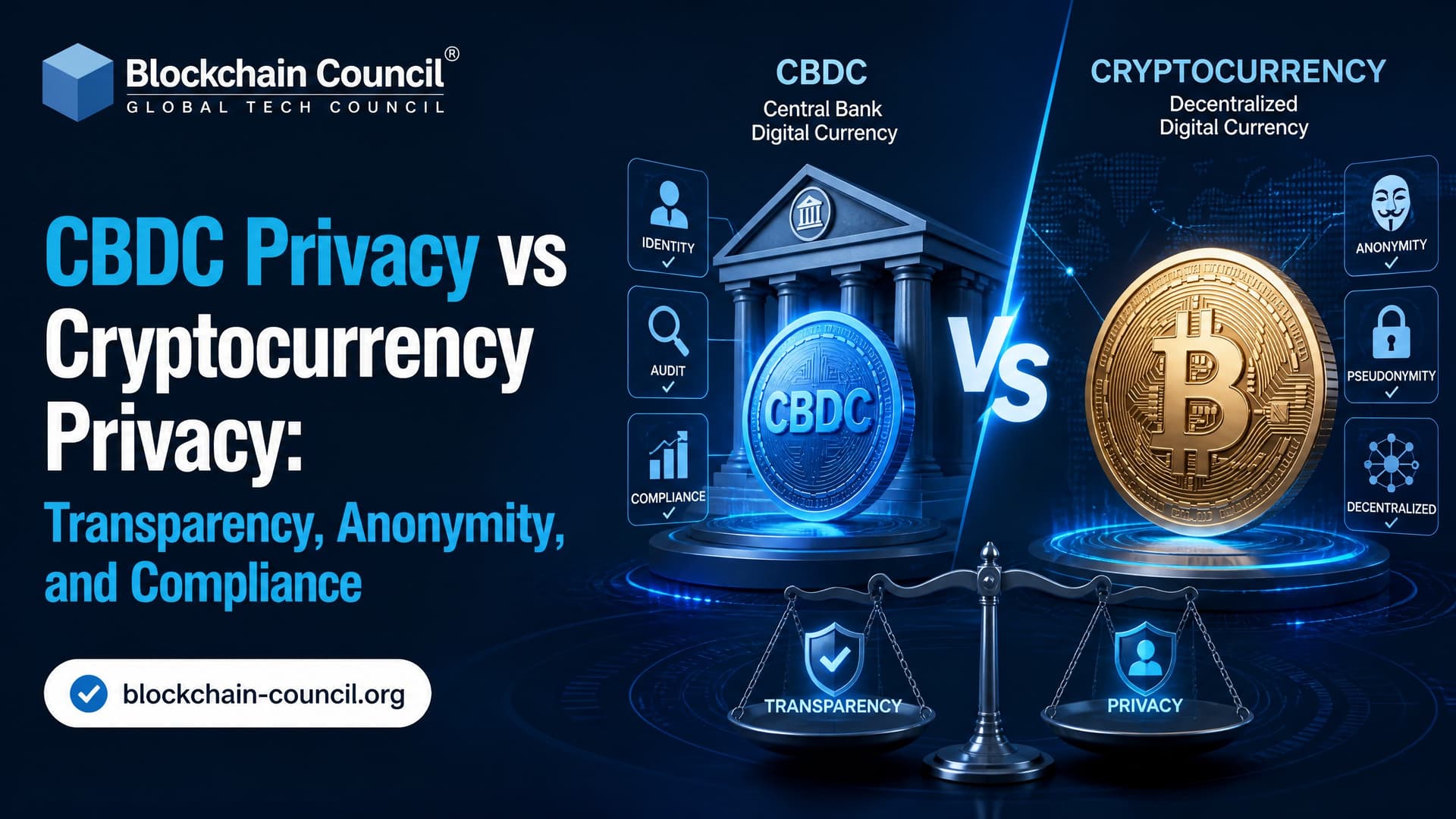
CBDC privacy vs cryptocurrency privacy comes down to control. A central bank digital currency is usually designed with conditional anonymity and built-in compliance. A cryptocurrency gets its privacy from protocol design, wallet behavior, and regulation at the exchange level. That difference matters if you build products, advise clients, or handle digital asset risk. Anyone comparing the two seriously benefits from a grounded understanding of sovereign digital money first, which is exactly what the Certified Central Bank Digital Currency (CBDC) Expert credential is designed to provide.
Here is the short version. CBDCs are moving toward privacy-by-design, but regulators stay inside the system. Most cryptocurrencies are transparent by default, pseudonymous in practice, and only private when the protocol or the user workflow makes them private. Not the same thing at all.

What Privacy Means in Digital Money
Privacy in digital money is not one feature. It has at least three layers:
Transparency: who can see transactions, balances, and wallet relationships.
Anonymity: whether a person can transact without being identified.
Compliance: how AML/CFT, sanctions, tax, and fraud controls get applied.
Cash scores well on everyday anonymity. Bank accounts score well on compliance. Public blockchains score high on ledger transparency but low on practical anonymity once addresses touch KYC platforms. CBDCs are being designed to sit somewhere in the middle, with privacy for low-risk payments and traceability for higher-risk activity. Understanding that middle ground on the crypto side is just as important, which is why many professionals pair CBDC study with the Certified Cryptocurrency Expert credential, since it covers the market structure and compliance fundamentals that shape how public blockchain privacy actually plays out.
How CBDC Privacy Works
A CBDC is issued by a central bank, so privacy is not only a technical question. It is a legal and policy choice. The Bank for International Settlements, the IMF, the World Bank, and the European Central Bank have all flagged the same tension: citizens expect cash-like privacy, while governments need financial integrity controls.
Direct, Hybrid, and Intermediated CBDCs
CBDC architectures usually fall into three models:
Direct CBDC: the central bank operates the retail ledger or user accounts. This gives the central bank broad visibility into balances and transfers.
Hybrid CBDC: private intermediaries manage customer interfaces, while the central bank maintains a backup ledger. Data is less concentrated than in a direct model, but sensitive information still exists in multiple places.
Intermediated CBDC: banks or payment firms manage wallets and customer relationships, while the central bank issues the money. This distributes data storage, but it also increases the number of entities handling personal financial data.
The privacy risk is obvious. If a CBDC records retail payments at scale, it can create a detailed map of daily life: rent, medication, donations, travel, subscriptions, political spending. Legal scholars have warned that this aggregation could become a surveillance tool if access rules are weak or if agencies can request data too easily.
Conditional Anonymity Is the Dominant CBDC Model
Most serious CBDC proposals do not promise full anonymity. They aim for conditional anonymity. In plain English, you may get stronger privacy for small payments, but larger or suspicious transactions trigger identity checks.
The European Central Bank's digital euro proof of concept tested a practical version of this idea using anonymity vouchers. Users could make limited private transfers over a defined period, while higher-value transactions still met AML/CFT requirements. The design tries to protect low-risk payments without creating a digital cash system that is invisible to law enforcement.
That is a reasonable compromise, but only if the limits, oversight, and redress mechanisms are written into law. A privacy promise in a white paper is not enough.
Privacy-Enhancing Technologies in CBDCs
CBDC teams are now exploring privacy-enhancing technologies, often called PETs. These include:
Tokenized or pseudonymous identifiers that separate identity from transaction data.
Zero-knowledge proofs to verify a rule without exposing the underlying information.
Secure enclaves and strict access controls for sensitive records.
Tiered wallets with different KYC thresholds.
Offline payment designs for small transactions.
Research designs such as ARC-CBDC go further, using advanced signature schemes like BBS+ to shield user identity from commercial banks while preserving controlled traceability. That sounds abstract, but the core idea is simple: hide the person by default, reveal only under defined legal conditions.
How Cryptocurrency Privacy Works
Cryptocurrency privacy starts from a different place. Bitcoin, Ethereum, and many other public blockchains are open ledgers. Anyone can inspect transactions. You do not need a subpoena to look up an address on a block explorer.
This is where many beginners get privacy wrong. If you withdraw ETH from a KYC exchange to a fresh MetaMask wallet, that wallet is not anonymous. The exchange knows where the funds went, and chain analytics can follow later movements. A small operational habit, such as reusing the same address for DeFi, NFTs, and payroll, can link your entire activity graph.
I have watched teams discover this late, during compliance reviews. One founder thought separate wallets meant separate identities. Then an analyst connected them through a shared funding transaction and near-identical gas-fee patterns. Public ledgers are unforgiving. Teams building or auditing the infrastructure behind this kind of chain analysis, on either the CBDC or crypto side, often support that technical depth with a general Tech Certification, since clustering heuristics, secure APIs, and data pipelines draw on broader engineering skills than blockchain knowledge alone.
Public Blockchains Are Transparent, Not Anonymous
Bitcoin and Ethereum are best described as pseudonymous. Your legal name is not written on-chain, but your address, balances, token transfers, NFT activity, and smart contract interactions are all visible. Once one address is tied to you, the privacy loss can spread fast.
Chain-analysis firms use clustering heuristics, exchange KYC data, transaction timing, wallet reuse, and known service addresses. They do not need perfect certainty for every case. For regulated compliance work, a risk score is often enough to trigger enhanced due diligence.
Privacy Coins and Stronger Anonymity
Some cryptocurrencies are built for stronger privacy. Monero uses ring signatures, stealth addresses, and confidential transactions to hide sender, receiver, and amount. Zcash uses zero-knowledge proofs through shielded transactions, though usage patterns matter here because not every Zcash transaction is shielded.
These systems offer far stronger privacy than Bitcoin or Ethereum. They also attract heavier regulatory scrutiny. That is the trade-off. If a protocol hides transaction graphs from everyone, it also makes sanctions screening and AML investigations harder.
CBDC Privacy vs Cryptocurrency Privacy: Key Differences
The main difference is governance. CBDC privacy is set by central bank design, legislation, and the operating model. Cryptocurrency privacy is set by code, user behavior, market infrastructure, and external regulation.
Who Can See What?
CBDCs: central banks, intermediaries, and approved authorities may have access depending on the architecture. Good designs minimize this access and require oversight.
Public cryptocurrencies: everyone can see the ledger, but identities stay hidden until linked through KYC, investigations, or user mistakes.
Privacy cryptocurrencies: transaction details may be hidden from public view, and sometimes even from most network participants.
Where Compliance Happens
CBDCs can embed compliance into the payment system itself. Limits, identity tiers, transaction monitoring, and reporting can be part of the design from day one.
Cryptocurrency compliance is mostly external. Exchanges, custodians, brokers, and payment processors perform KYC and monitoring. The protocol itself usually does not know whether a wallet belongs to a sanctioned entity, a retail user, or a smart contract.
This is why regulators treat centralized crypto platforms differently from non-custodial wallets. A licensed exchange has customers and records. A self-custody wallet is software.
Compliance Does Not Automatically Mean Surveillance
To be blunt, CBDCs can become surveillance infrastructure if governed badly. But that outcome is not technically inevitable. The IMF and the World Economic Forum have both argued for privacy-by-design, data minimization, clear purpose limits, and accountable access rules.
A credible CBDC privacy framework should include:
Clear laws defining which authority can access data and why.
Judicial or independent oversight for sensitive access requests.
Data minimization, not blanket retention.
User rights for access, correction, portability, and complaint handling.
Technical separation between identity data and transaction data.
Public audits of privacy controls.
Without those safeguards, conditional anonymity can become conditional privacy, which means privacy only until the state decides otherwise.
What This Means for Professionals and Enterprises
If you work in payments, compliance, fintech, public policy, or digital asset product design, do not treat CBDCs and cryptocurrencies as interchangeable. They solve different problems and create different risks.
For enterprises, CBDCs may reduce settlement friction and improve regulated payment workflows, but they raise data governance questions. Who stores customer transaction data? How long is it kept? Can it be combined with loyalty, credit, or tax data?
For crypto teams, the challenge is different. You need to understand how visible your protocol is, where KYC touchpoints occur, and how privacy tools affect regulatory risk. A DeFi app that accepts funds from any address has a different exposure profile than a custodial exchange with screening obligations.
If you want a structured learning path, consider Blockchain Council's Certified Blockchain Expert for core blockchain architecture, Certified Cryptocurrency Expert for crypto market and compliance fundamentals, and Certified Smart Contract Developer if you build on-chain systems. Each one covers formal training that goes beyond theory.
Future Outlook: Tiered Privacy Will Win
The likely future is not full anonymity for CBDCs or total transparency for all crypto. The market is moving toward tiered privacy.
CBDCs will likely provide stronger privacy for small retail payments and stricter checks for high-value transfers.
Central banks will test more PETs, including zero-knowledge proofs and secure computation.
Privacy coins and mixers will face more pressure when they interact with regulated institutions.
Enterprises will need privacy impact assessments before integrating CBDC or crypto payment rails.
Legal design will matter as much as cryptographic design.
Here is the practical takeaway. CBDC privacy vs cryptocurrency privacy is not a simple contest between surveillance and freedom. CBDCs make privacy a policy-controlled feature. Cryptocurrencies make privacy an outcome of protocol design and user discipline. If you are building, regulating, or investing in digital assets, study both models. Then test your assumptions on a real wallet, a block explorer, and a compliance workflow before you make design decisions. If part of your role also involves explaining these privacy trade-offs to customers, regulators, or the public, a Marketing Certification can help you turn this dense comparison into messaging a non-technical audience will actually understand.
FAQs
1. What is the difference between CBDC privacy and cryptocurrency privacy?
CBDC privacy depends on how a central bank and participating intermediaries design the digital currency, including identity requirements, transaction-data access, and regulatory controls. Cryptocurrency privacy varies widely by network. Public blockchains may expose transaction histories under pseudonymous addresses, while privacy-focused cryptocurrencies can use cryptographic techniques to conceal transaction details. Neither CBDCs nor cryptocurrencies should automatically be described as completely anonymous. Humans have, predictably, made digital money considerably more nuanced than that.
2. Are CBDCs more private than cryptocurrencies?
Not necessarily. Privacy depends on the specific CBDC and cryptocurrency being compared. A privacy-oriented CBDC could minimize transaction data and restrict access through legal and technical safeguards. A public blockchain may permanently expose transaction relationships, although addresses may initially be pseudonymous. Conversely, privacy-focused cryptocurrencies can conceal substantially more information. Comparing CBDCs with “cryptocurrency” as a single category therefore produces a misleadingly simple answer.
3. Are CBDC transactions anonymous?
CBDC transactions are unlikely to guarantee complete anonymity in many proposed systems because central banks and regulated intermediaries may need to meet AML, KYC, sanctions, and other legal requirements. Some CBDC designs could provide greater privacy for low-value transactions or offline payments. Tiered identity models and privacy-enhancing technologies may also reduce unnecessary disclosure. The important distinction is between anonymity, where identity cannot readily be established, and privacy, where information exists but access and use are appropriately restricted.
4. Are cryptocurrency transactions anonymous?
Many cryptocurrencies are better described as pseudonymous rather than anonymous. On public blockchains such as Bitcoin, transactions can be visible to anyone, while users interact through blockchain addresses rather than names. If an address becomes connected to a person's identity, blockchain analytics may reveal substantial transaction history. Privacy-focused cryptocurrencies can use technologies designed to conceal transaction information, although their privacy characteristics, regulatory treatment, and practical effectiveness vary.
5. What is the difference between anonymity and pseudonymity in digital currency?
Anonymity means a transaction cannot readily be connected to a person's identity, while pseudonymity means activity occurs under an identifier such as a wallet address rather than a real name. Public cryptocurrencies commonly provide pseudonymity, but transaction analysis and information from exchanges can sometimes connect addresses to real identities. CBDCs may use verified identities internally while limiting what counterparties see. Consequently, an apparently anonymous-looking wallet address does not necessarily mean the person behind it cannot be identified.
6. Can governments track CBDC transactions?
The degree of government visibility depends on the CBDC architecture, laws, and governance model. Some designs may allow regulated intermediaries to retain customer information while limiting the central bank's access to identifiable transaction data. Authorities may obtain information under legally defined circumstances for purposes such as financial-crime investigations. Privacy-focused CBDCs can use data minimization, institutional separation, access controls, and cryptography to prevent unnecessary centralized visibility into everyday payments.
7. Can governments track cryptocurrency transactions?
Transactions on public blockchains can often be observed and analyzed because ledger data is publicly available. Blockchain analytics can identify transaction patterns and sometimes connect addresses with known individuals, exchanges, services, or organizations. Regulated cryptocurrency exchanges may also collect customer identity information. Privacy-enhancing cryptocurrencies and techniques can make analysis more difficult, but it is inaccurate to assume that using cryptocurrency automatically makes financial activity invisible to governments or investigators.
8. How does KYC affect CBDC privacy?
Know Your Customer requirements can connect a CBDC wallet with a verified individual or business. However, completing KYC does not necessarily mean a user's identity must be exposed during every transaction. Systems can separate identity verification from payment data and use intermediaries, pseudonymous identifiers, or selective disclosure. Tiered KYC could also apply simplified requirements to lower-value wallets. Privacy therefore depends on how identity information is stored, accessed, and linked with transaction records.
9. How does KYC affect cryptocurrency privacy?
Cryptocurrency users interacting with regulated exchanges or custodians may need to complete KYC verification. This can create a link between a real-world identity and cryptocurrency addresses, particularly when users deposit or withdraw assets. Transactions occurring subsequently on public blockchains may then become easier to analyze. Self-custody can change the information available to intermediaries, but it does not automatically make public blockchain transactions private. Network architecture and user behavior remain significant factors.
10. Are CBDCs more transparent than cryptocurrencies?
CBDCs and cryptocurrencies provide different forms of transparency. Public blockchains can offer extremely high ledger transparency because transaction records are broadly visible, even though participants may be pseudonymous. CBDCs may use permissioned or centralized infrastructure where transaction information is visible only to authorized participants. CBDC transparency therefore tends to concern regulated access and accountability, while public blockchain transparency can involve open inspection of ledger activity. More visible does not necessarily mean more identifiable, which is where the comparison becomes interesting.
11. How does Bitcoin privacy compare with CBDC privacy?
Bitcoin transactions are recorded on a public blockchain, allowing anyone to inspect transfers between addresses. Addresses are pseudonymous, but blockchain analytics and exchange records can sometimes associate them with real identities. A CBDC could operate very differently, potentially keeping transaction records away from public view while allowing regulated entities limited access. Bitcoin can therefore provide public ledger transparency with pseudonymous identities, while a CBDC may provide private ledger access combined with stronger formal identity requirements.
12. Can CBDCs offer cash-like privacy?
CBDCs could potentially provide some cash-like privacy, particularly for small-value or offline payments, but reproducing physical cash anonymity digitally is difficult. Digital systems need mechanisms to prevent double spending, fraud, and unauthorized creation of value. Regulatory requirements may also require identification or recordkeeping for certain transactions. Tiered privacy, offline functionality, and privacy-enhancing cryptography could provide stronger confidentiality for ordinary payments while maintaining appropriate controls for higher-risk activity.
13. Are privacy coins more anonymous than CBDCs?
Privacy-focused cryptocurrencies can use cryptographic techniques designed to obscure transaction amounts, addresses, or relationships between participants. Depending on implementation, they may provide stronger transactional anonymity than identity-linked CBDCs. However, privacy is not absolute and can be influenced by software vulnerabilities, exchange records, user behavior, network analysis, and regulatory controls. CBDCs generally pursue a different objective: providing regulated digital sovereign money while balancing user privacy with financial-crime and compliance obligations.
14. How do CBDCs and cryptocurrencies handle AML compliance differently?
CBDCs can be designed directly around regulated financial infrastructure, allowing banks or authorized payment providers to perform KYC, sanctions screening, transaction monitoring, and suspicious activity reporting. Cryptocurrency compliance often occurs through regulated intermediaries such as exchanges, custodians, and other service providers rather than through the decentralized protocol itself. This distinction matters because a blockchain network may operate globally without a single compliance administrator, while a CBDC typically exists within a defined national regulatory framework.
15. Can privacy-enhancing technology make CBDCs more private?
Yes. CBDCs could potentially use zero-knowledge proofs, selective disclosure, pseudonymous credentials, secure computation, and other privacy-enhancing technologies to reduce unnecessary exposure of personal information. Such technologies may allow a user to prove that certain compliance conditions are satisfied without revealing every underlying identity attribute. Their practical usefulness depends on scalability, security, regulatory acceptance, and implementation. Cryptography can reduce unnecessary disclosure, although it cannot resolve every legal and governance question by itself.
16. Which is better for financial privacy: CBDCs or cryptocurrencies?
There is no universal winner because privacy depends on architecture and usage. A CBDC with strong data minimization and legal protections could provide substantial privacy from merchants and the general public while remaining compliant with regulation. A public cryptocurrency may expose transaction histories but provide pseudonymous participation. Privacy-focused cryptocurrencies may conceal substantially more transaction information. Users should therefore compare specific systems based on data visibility, identity requirements, custody, governance, and legal protections.
17. What are the privacy risks of CBDCs compared with cryptocurrencies?
CBDC privacy risks can include centralized collection of transaction data, government access, intermediary breaches, identity theft, and misuse of personal financial information. Cryptocurrency risks differ: public blockchain records can remain visible indefinitely, addresses can become linked to identities, and centralized exchanges may suffer data breaches. Privacy-focused cryptocurrencies introduce other trade-offs involving compliance and accessibility. Both models therefore create privacy risks, but the location and nature of those risks can be fundamentally different.
18. Can CBDCs provide better data protection than public blockchains?
Potentially. A CBDC can be designed so transaction information is accessible only to authorized participants and protected by privacy and data-protection laws. Public blockchains, by contrast, can make transaction data permanently visible to anyone. However, centralized or permissioned CBDC systems create concentration risks if sensitive databases are compromised or improperly accessed. Strong CBDC data protection therefore requires encryption, access controls, data minimization, retention limits, oversight, and enforceable restrictions on data use.
19. Will CBDCs replace privacy-focused cryptocurrencies?
CBDCs are unlikely to replace every cryptocurrency because they serve different purposes and operate under different governance models. CBDCs are sovereign monetary instruments designed around central-bank objectives, while cryptocurrencies may prioritize decentralization, programmability, censorship resistance, investment, or transactional privacy. Regulation may influence how easily privacy-focused cryptocurrencies can interact with mainstream financial systems. CBDCs could provide greater privacy than some conventional digital payments without offering the same anonymity characteristics sought by certain cryptocurrency users.
20. What is the future of privacy for CBDCs and cryptocurrencies?
The future will likely involve increasingly sophisticated attempts to balance privacy, transparency, security, and financial-crime compliance. CBDCs may adopt tiered privacy, selective disclosure, stronger data minimization, and advanced cryptography. Cryptocurrency ecosystems may continue developing privacy technologies while facing evolving regulatory requirements. The central debate will not simply be whether digital money is “private.” It will be about who can see transaction information, under what circumstances, for how long, and with what legal safeguards.
Related Articles
View All
Digital Assets
CBDC Compliance Professional Guide: KYC, AML, Privacy, and Regulation
A practical CBDC compliance guide covering KYC tiers, AML/CFT monitoring, privacy controls, FATF guidance, offline CBDCs, and regulatory trends.

Digital Assets
Token-Based CBDC vs Account-Based CBDC: Which Design Protects Privacy Better?
Token-based CBDC usually protects privacy better than account-based CBDC, but real protection depends on identity linkage, data rules, and governance.

Digital Assets
CBDC Skills Every Professional Needs: Blockchain, Payments, Compliance, and Risk
CBDC skills now require blockchain architecture, payment systems knowledge, AML/CFT compliance, privacy design, cybersecurity, and risk management expertise.
Trending Articles
AWS Career Roadmap
A step-by-step guide to building a successful career in Amazon Web Services cloud computing.

Top 5 DeFi Platforms
Explore the leading decentralized finance platforms and what makes each one unique in the evolving DeFi landscape.

Can DeFi 2.0 Bridge the Gap Between Traditional and Decentralized Finance?
The next generation of DeFi protocols aims to connect traditional banking with decentralized finance ecosystems.