

CBDC Implementation Roadmap: From Pilot Design to National Rollout
 Suyash Raizada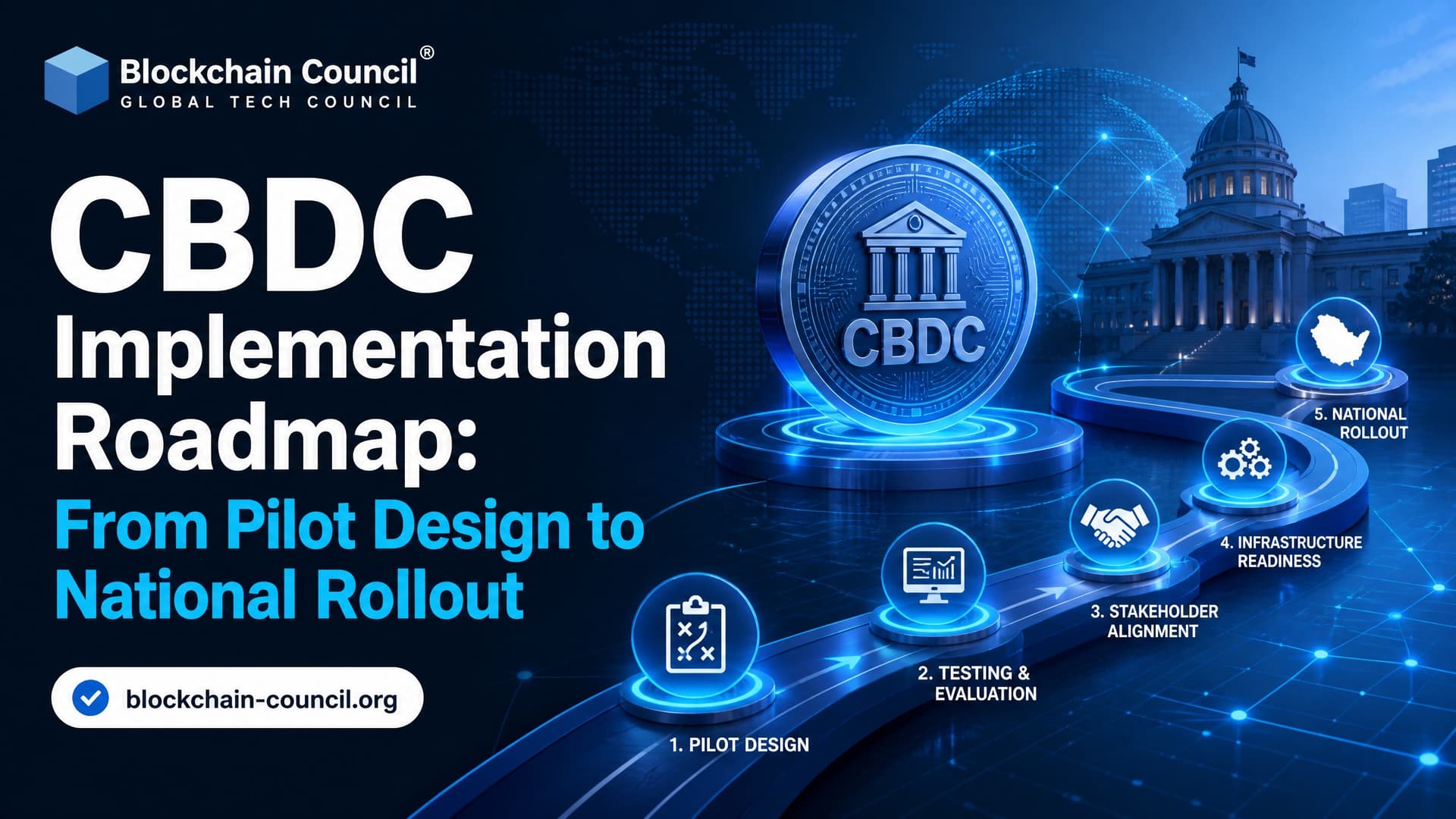
CBDC implementation roadmap work has shifted from white papers to live pilots, legal drafting, vendor selection, and user adoption testing. The hard part is no longer asking whether a central bank digital currency can be built. It can. The harder question is whether it should be issued nationally, under what rules, and with enough public trust to be used outside a controlled pilot. Professionals building a career around this kind of work often start with a structured credential like the Certified Central Bank Digital Currency (CBDC) Expert program, since the roadmap only makes sense once you understand the design trade-offs behind each phase.
The latest global data shows why the roadmap matters. A 2024 survey by the Bank for International Settlements found that 94 percent of 86 central banks were exploring a retail CBDC, wholesale CBDC, or both. Global trackers now place roughly 134 countries, representing about 98 percent of world GDP, in some stage of CBDC research or development. Yet only a small group has launched, and several live systems have struggled with adoption. That gap between experimentation and daily use is where implementation planning becomes decisive.

What a CBDC Implementation Roadmap Must Solve
A CBDC is not just a payment app run by a central bank. It touches monetary law, commercial bank balance sheets, wallet providers, data governance, merchant acceptance, cyber resilience, and public communication. Treat it like a technology rollout only, and the project will fail in the field. Because CBDC work increasingly sits next to stablecoins, tokenized deposits, and other digital assets on the same balance sheet and under the same regulatory eye, many teams pair this roadmap knowledge with a Certified Digital Assets Expert certification so that CBDC decisions are made with the wider digital asset landscape in view, not in isolation.
The International Monetary Fund frames CBDC work through five stages: preparation, proof of concept, prototype, pilot, and production. The World Bank adds a payments-system lens, asking whether CBDC improves competition, inclusion, cost, resilience, or cross-border payment performance. BIS research adds design guidance on privacy, offline payments, two-tier architecture, cyber risk, and interoperability.
In practical terms, a useful roadmap answers five questions:
Why issue it? Financial inclusion, settlement efficiency, cash resilience, cross-border payments, or competition.
Who uses it first? Banks, public-sector workers, welfare recipients, merchants, tourists, or securities market participants.
Who operates customer-facing services? The central bank, commercial banks, fintechs, or a regulated mix.
What data is visible? To whom, under what law, and with what audit trail.
When is national rollout justified? Only after legal, technical, and adoption evidence supports it.
Phase 0 - Strategic Preparation
Define the policy objective before choosing technology
Start with the problem. If the country already has a high-performing instant payment system, a retail CBDC must offer something distinct. India is the clearest warning here. Its digital rupee pilot has reached more than 5 million users across 16 banks, yet retail CBDC activity in mid 2024 was reported near 100,000 to 120,000 daily transactions. UPI, by comparison, processes hundreds of millions of transactions per day. A CBDC that merely copies a popular payment rail will not win on novelty.
Wholesale CBDC is different. BIS survey results suggest wholesale projects are generally more advanced because the use case is narrower: interbank settlement, securities delivery versus payment, tokenized deposits, and cross-currency settlement. For many economies, wholesale CBDC is the better first production candidate.
Build legal and governance readiness
Preparation also means checking whether the central bank has authority to issue digital legal tender. Some jurisdictions must amend monetary law. China, for example, has explored central bank law changes to recognize the e-CNY as an alternative form of legal tender, showing how legal work can run alongside pilots for years.
Governance should cover:
Legal tender status and finality of settlement
AML/CFT rules and tiered wallet limits
Data protection and lawful access standards
Intermediary licensing and supervision
Consumer recourse, fraud handling, and outage procedures
Phase 1 - Concept and Design Specification
Choose the CBDC model
Most retail CBDC designs now lean toward a two-tier model. The central bank issues and redeems the CBDC, while commercial banks or licensed payment providers manage wallets, onboarding, and customer support. The BIS Innovation Hub's Aurum project is a useful reference because it tested a two-tier retail CBDC design with privacy controls, redemption flows, and counterfeit detection.
The core design choices include:
Retail or wholesale: Public consumer use versus institutional settlement.
Account-based or token-based: Identity-led ledger access versus bearer-like transfer logic.
Direct or intermediated: Central bank wallets versus private-sector wallet providers.
Online and offline: Network-dependent transfers versus limited offline payments.
Programmability: Conditional payments, expiry rules, or smart contract-like controls.
To be blunt, programmability is often oversold. It is useful for targeted subsidies, escrow, and government disbursements. It is the wrong place to start if the country has not settled basic questions of consumer consent, dispute resolution, and liability when a condition executes incorrectly.
Design for privacy from day one
Privacy cannot be bolted on after a pilot. CBDC systems need tiered identity, data minimization, encryption, audit logging, and clear rules for who can access transaction data. Public trust depends on this. A technically sound CBDC that citizens see as a surveillance tool will face resistance, especially in democracies with strong privacy expectations.
Phase 2 - Proof of Concept and Prototype
A proof of concept should test the riskiest assumptions in a controlled setting. Can the ledger handle peak loads? Can wallets recover keys? Can offline payments prevent double spending? Can intermediaries reconcile balances with the central bank ledger at the end of day?
Prototype work should also test interoperability with existing systems. In payment projects, a small mapping mistake can cause real operational pain. One detail that often trips teams up is retry handling across ISO 20022 messages. If the same payment is resent after a timeout and the end-to-end identifier is not preserved, merchants may see duplicate pending payments even though final settlement happens once. That is not glamorous CBDC research. It is exactly the kind of plumbing that makes or breaks trust at the checkout counter. Engineers doing this kind of integration work usually end up leaning on skills that sit outside blockchain proper, which is where a broader Tech Certification from Global Tech Council can round things out, covering areas like cloud infrastructure, cybersecurity, and data engineering that CBDC prototypes depend on just as much as ledger design.
At this stage, teams should select partners carefully: banks, payment processors, wallet vendors, cloud or data-center operators, cybersecurity firms, and merchant acquirers. Service-level commitments need to be written before a live pilot, not negotiated during an outage.
Phase 3 - Pilot Design and Live Experimentation
Start narrow, then widen
A CBDC pilot should be limited enough to control risk, but real enough to produce evidence. Good pilots use actual users, real merchants, and measurable transaction flows. Common starting points include government transfers, transit payments, public-sector salary disbursement, selected retail districts, or cross-border corridors.
China's e-CNY shows the value of staged expansion. The pilot expanded from a handful of cities to 26 localities across 17 provincial-level regions, with use cases including transit, e-commerce, government procurement, public salaries, and cross-border retail testing in Hong Kong. Reported figures include hundreds of millions of personal wallets and cumulative transaction value in the trillions of yuan, while the project is still formally described as a pilot.
India's e₹ pilot followed a phased bank-and-city model. It began with wholesale and retail pilots in late 2022, later expanding to more banks, more locations, offline payment trials, and programmability tests. The Reserve Bank of India has made the right call by avoiding a rushed national launch deadline.
Measure adoption, not just wallet downloads
Wallet count is a vanity metric unless balances and repeat transactions follow. The Bahamas Sand Dollar has been reported with meaningful wallet penetration in some official settings, yet independent analysis found the CBDC's share of currency in circulation was very small. Nigeria's eNaira has processed billions of naira in transactions, but adoption remains low relative to population and other payment options. Jamaica's JAM-DEX tells a similar story: launch is not the same as usage.
Track these pilot metrics instead:
Monthly active users, not only registered wallets
Transactions per active wallet
Merchant acceptance and failed payment rates
Average and peak transaction latency
Fraud claims, disputes, and support tickets
Cash-out and redemption behavior
Cost per transaction compared with existing rails
Phase 4 - Transition to National Rollout
Use a go, revise, pause, or stop decision
After the pilot, central banks should resist political pressure to declare victory. The honest decision may be to revise the design, restrict CBDC to wholesale settlement, focus on government payments, or pause issuance until laws and public trust catch up.
If the project proceeds, national rollout should be phased. Begin with segments where CBDC solves a real pain point: remote communities, disaster-resilient offline payments, public transfers, securities settlement, or high-cost cross-border corridors. Then expand wallet limits, merchant categories, and API access.
Harden infrastructure before scaling
Production CBDC infrastructure needs disaster recovery, key management, fraud monitoring, incident response, penetration testing, and operational playbooks. Offline functionality needs special attention because it creates tension between convenience and double-spend risk. Wallet caps, transaction caps, and time-limited offline balances are practical controls.
Interoperability is just as important. A national CBDC should connect with card systems, instant payment schemes, bank accounts, point-of-sale terminals, and potentially foreign CBDC networks. BIS Project Icebreaker tested a hub-and-spoke model for cross-border retail CBDC payments, showing how countries can connect separate systems without forcing every central bank onto one platform.
What This Means for Professionals and Enterprises
For banks, fintechs, payment processors, and enterprise architects, the CBDC implementation roadmap is a planning signal. You do not need to wait for national launch to prepare. Map where CBDC could affect treasury operations, merchant acquiring, digital identity, compliance reporting, and settlement workflows.
If you build in this space, focus on practical skills: blockchain architecture, payment interoperability, wallet security, token standards, privacy engineering, and regulatory analysis. Blockchain Council's Certified Blockchain Expert™ is a useful learning path for policy and business teams, while Certified Blockchain Developer™ fits engineers who need to understand ledger design, smart contracts, and integration patterns. And since adoption, not architecture, is what ultimately decides whether a pilot like e-CNY or e₹ succeeds, teams responsible for public communication and merchant onboarding may also want to look at a Marketing Certification from Universal Business Council, since explaining why a CBDC is worth using is a different skill than building it.
The next step is concrete: choose one CBDC pilot, such as e-CNY, e₹, Sand Dollar, or JAM-DEX, and write a one-page assessment of its objective, architecture, adoption metrics, and rollout risks. That exercise will teach you more than another abstract debate about whether CBDCs are good or bad.
FAQs
1. What is a CBDC implementation roadmap?
A CBDC implementation roadmap is a phased plan for researching, designing, testing, launching, and operating a Central Bank Digital Currency. It typically covers policy objectives, legal authority, technology architecture, privacy, cybersecurity, intermediary participation, pilot testing, financial-stability safeguards, public adoption, and nationwide deployment. A roadmap helps central banks evaluate CBDC benefits and risks before committing to full-scale issuance.
2. What are the main stages of CBDC implementation?
CBDC implementation generally progresses through research, requirements definition, prototype development, controlled pilots, evaluation, broader trials, and potential national rollout. Each stage should have measurable objectives and decision gates. A central bank can modify, delay, or discontinue a project if testing shows that a CBDC does not provide sufficient public benefit or creates unacceptable financial, operational, privacy, or security risks.
3. What should central banks do before launching a CBDC pilot?
Before a pilot begins, central banks should clearly identify the problems the CBDC is intended to solve. These may include payment resilience, financial inclusion, declining cash usage, competition, cross-border payment inefficiencies, or access to central-bank money. Authorities should also assess legal powers, financial-stability implications, privacy expectations, cybersecurity requirements, technology options, and the likely role of commercial intermediaries.
4. How should a CBDC pilot be designed?
A CBDC pilot should test specific hypotheses rather than merely demonstrate that digital tokens can move between wallets. Authorities can define target users, transaction scenarios, participating banks or payment providers, technical infrastructure, transaction limits, privacy controls, and success metrics. Pilots should test realistic conditions, including failures and unusual scenarios, rather than evaluating only perfectly functioning transactions.
5. Who should participate in a CBDC pilot?
Participants can include the central bank, commercial banks, payment service providers, merchants, consumers, government agencies, technology providers, telecommunications companies, cybersecurity specialists, and selected businesses. Consumer and privacy organizations can also provide valuable input. Diverse participation helps authorities identify operational and usability problems that may remain invisible when a pilot is tested exclusively by financial and technology institutions.
6. How do central banks choose the technology for a CBDC?
Technology selection should follow policy and operational requirements rather than precede them. Central banks can compare centralized databases, distributed-ledger technology, and hybrid architectures based on scalability, resilience, privacy, cybersecurity, interoperability, offline capability, programmability, and cost. A CBDC does not inherently require blockchain. The best architecture is the one that satisfies the currency's requirements reliably and securely.
7. What legal framework is required before CBDC implementation?
Authorities need to determine whether existing law permits the central bank to issue a digital form of sovereign currency and what legal status it would have. Legislation may need to address legal tender, privacy, data protection, consumer protection, AML/KYC obligations, intermediary responsibilities, taxation, cybersecurity, and dispute resolution. Legal certainty should be established before large-scale deployment rather than improvised after adoption begins.
8. How should privacy be designed into a CBDC?
Privacy should be incorporated during the architecture stage. Authorities need to define what transaction information is collected, which organizations can access it, how long it is retained, and under what legal circumstances disclosure is permitted. Techniques such as data minimization, tiered identification, cryptographic controls, and privacy-enhancing technologies can help balance user privacy with legitimate financial-crime and regulatory requirements.
9. How should CBDC cybersecurity be tested before launch?
CBDC infrastructure should undergo threat modeling, penetration testing, code reviews, vulnerability assessments, red-team exercises, cryptographic testing, and operational-resilience simulations. Testing should include compromised devices, stolen credentials, network outages, denial-of-service attacks, insider threats, supply-chain attacks, and failures at participating intermediaries. Security testing must continue after launch because a national payment system does not receive the luxury of becoming finished.
10. What role should commercial banks play in CBDC implementation?
Many CBDC designs use an intermediated or two-tier model in which the central bank issues the CBDC while commercial banks and payment providers handle customer-facing services. They may provide wallets, onboarding, identity verification, transaction services, customer support, and compliance. This approach can use existing financial infrastructure while reducing the need for the central bank to operate millions of individual retail relationships.
11. How can a CBDC pilot test offline payments?
Pilot participants can test payments between approved devices when internet or mobile connectivity is unavailable. Tests should evaluate transaction limits, device security, double-spending prevention, synchronization, lost-device recovery, and reconciliation after connectivity returns. Offline CBDC functionality can be important for resilience and inclusion, particularly in areas with unreliable connectivity or during natural disasters and infrastructure failures.
12. How should CBDC scalability be tested?
A CBDC should be tested under transaction volumes resembling both normal and extreme national payment activity. Authorities should measure throughput, latency, availability, settlement performance, infrastructure requirements, and recovery behavior. Stress testing can simulate holidays, salary days, emergencies, bank runs, network failures, and sudden transaction spikes to determine whether the system remains stable under unusually heavy demand.
13. What metrics determine whether a CBDC pilot is successful?
Success metrics can include transaction reliability, processing speed, cybersecurity performance, merchant acceptance, consumer usability, privacy effectiveness, accessibility, operational cost, intermediary integration, and offline functionality. Authorities should also assess whether the CBDC actually solves the policy problem identified at the beginning. A technically successful pilot does not automatically justify nationwide deployment if users have little reason to adopt it.
14. How can central banks move from a CBDC pilot to a larger trial?
After evaluating an initial pilot, authorities can expand gradually by increasing the number of users, participating institutions, merchants, locations, and transaction types. Limits may be adjusted while technical and operational performance is monitored. A staged expansion gives central banks opportunities to identify unexpected effects on bank deposits, payment behavior, cybersecurity, customer support, and financial inclusion before national rollout.
15. How can a CBDC avoid destabilizing commercial banks?
Central banks can consider holding limits, tiered remuneration, intermediated distribution, or other safeguards to reduce the risk of large deposit movements from commercial banks into CBDCs. Stress testing should examine how people might behave during periods of financial uncertainty. A CBDC should improve payment infrastructure without unintentionally creating a remarkably efficient digital mechanism for accelerating a bank run.
16. How should a CBDC be integrated with existing payment systems?
A CBDC should be designed to interact with bank accounts, payment networks, merchant systems, ATMs where appropriate, government payment platforms, and digital wallets. APIs and standardized financial messaging can support interoperability. Users should ideally be able to move between CBDC and other forms of money easily rather than treating the digital currency as an isolated financial ecosystem.
17. How should governments educate the public before a CBDC rollout?
Public communication should clearly explain what the CBDC is, how it differs from bank deposits and cryptocurrencies, how privacy works, who can access transaction data, and what happens if a wallet or device is lost. Governments and central banks should also address scams and misinformation. Clear communication is essential because public trust cannot be reconstructed efficiently with a technical white paper after confusion has already spread.
18. What happens during a national CBDC rollout?
National rollout can occur gradually rather than through a single launch date. Authorities may expand geographic availability, increase wallet providers, onboard merchants, integrate government payments, and progressively raise transaction capacity. Cash and existing digital payment systems can continue operating alongside the CBDC. Performance, financial stability, fraud, adoption, and customer complaints should be monitored continuously during expansion.
19. What are the biggest risks during CBDC implementation?
Major risks include cybersecurity attacks, privacy failures, operational outages, low public adoption, financial disintermediation, bank-run acceleration, technology-vendor dependence, fraud, digital exclusion, regulatory uncertainty, and interoperability problems. Authorities also face reputational risk if a CBDC is launched before it provides a compelling user benefit. Careful staging and independent evaluation can reduce these risks but cannot eliminate them completely.
20. What does a successful CBDC implementation roadmap look like?
A successful CBDC roadmap begins with the policy problem, not the technology.
The first phase is research and feasibility. The central bank determines why a CBDC may be needed, assesses alternatives, consults stakeholders, examines legal authority, and studies implications for payments, monetary policy, financial stability, privacy, and inclusion.
The second phase defines requirements. Authorities decide what the CBDC must achieve in areas such as transaction speed, accessibility, resilience, privacy, offline payments, interoperability, and security.
Next comes technical prototyping.
Different architectures can be evaluated without assuming that blockchain or any other particular technology must be used. Cybersecurity and privacy should be incorporated from the beginning rather than attached to the system immediately before launch.
A controlled pilot then tests real transactions among selected users, merchants, banks, and payment providers.
Successful pilots can expand gradually into larger trials. Each expansion should examine scalability, fraud, operational resilience, financial-stability effects, customer experience, accessibility, and intermediary performance.
Before national rollout, authorities need appropriate legislation, governance, cybersecurity standards, operational procedures, consumer protections, dispute-resolution mechanisms, and public communication.
Nationwide deployment should itself be phased.
Central banks can gradually increase users, transaction limits, merchant acceptance, government integrations, and geographic availability while continuously monitoring the system.
The roadmap does not end when the CBDC launches.
A national digital currency requires ongoing security updates, audits, policy reviews, resilience testing, technology upgrades, and public accountability.
A practical sequence is therefore:
Research → Policy Design → Legal Framework → Technical Architecture → Prototype → Controlled Pilot → Evaluation → Expanded Trial → Readiness Assessment → Phased National Rollout → Continuous Oversight
Most importantly, every stage should contain a genuine decision point.
If evidence shows that the CBDC does not solve the intended problem, authorities should be able to redesign it, postpone it, or decide not to proceed.
National currency infrastructure is not a software feature that needs to ship merely because somebody already announced the roadmap.
The successful CBDC is not the one launched fastest. It is the one people can trust, use, and largely forget is technically complicated.
Related Articles
View All
Digital Assets
Token-Based CBDC vs Account-Based CBDC: Which Design Protects Privacy Better?
Token-based CBDC usually protects privacy better than account-based CBDC, but real protection depends on identity linkage, data rules, and governance.

Digital Assets
CBDC vs Bitcoin: Key Differences in Purpose, Control, and Monetary Design
CBDCs are state-issued digital fiat. Bitcoin is decentralized scarce money. This guide compares CBDC vs Bitcoin by purpose, control, policy, and design.

Digital Assets
CBDC Career Roadmap: From Beginner to Digital Currency Specialist
A practical CBDC career roadmap covering skills, roles, certifications, and learning stages from blockchain basics to digital currency specialist work.
Trending Articles
The Role of Blockchain in Ethical AI Development
How blockchain technology is being used to promote transparency and accountability in artificial intelligence systems.

Top 5 DeFi Platforms
Explore the leading decentralized finance platforms and what makes each one unique in the evolving DeFi landscape.
Blockchain in Supply Chain Provenance Tracking
Supply chains are under pressure to prove not just efficiency, but also authenticity, sustainability, and fairness. Customers want to know if their coffee really is fair trade, if the diamonds are con