

Asset Tokenization Explained: Turning Ownership Rights into Blockchain Tokens
 Suyash Raizada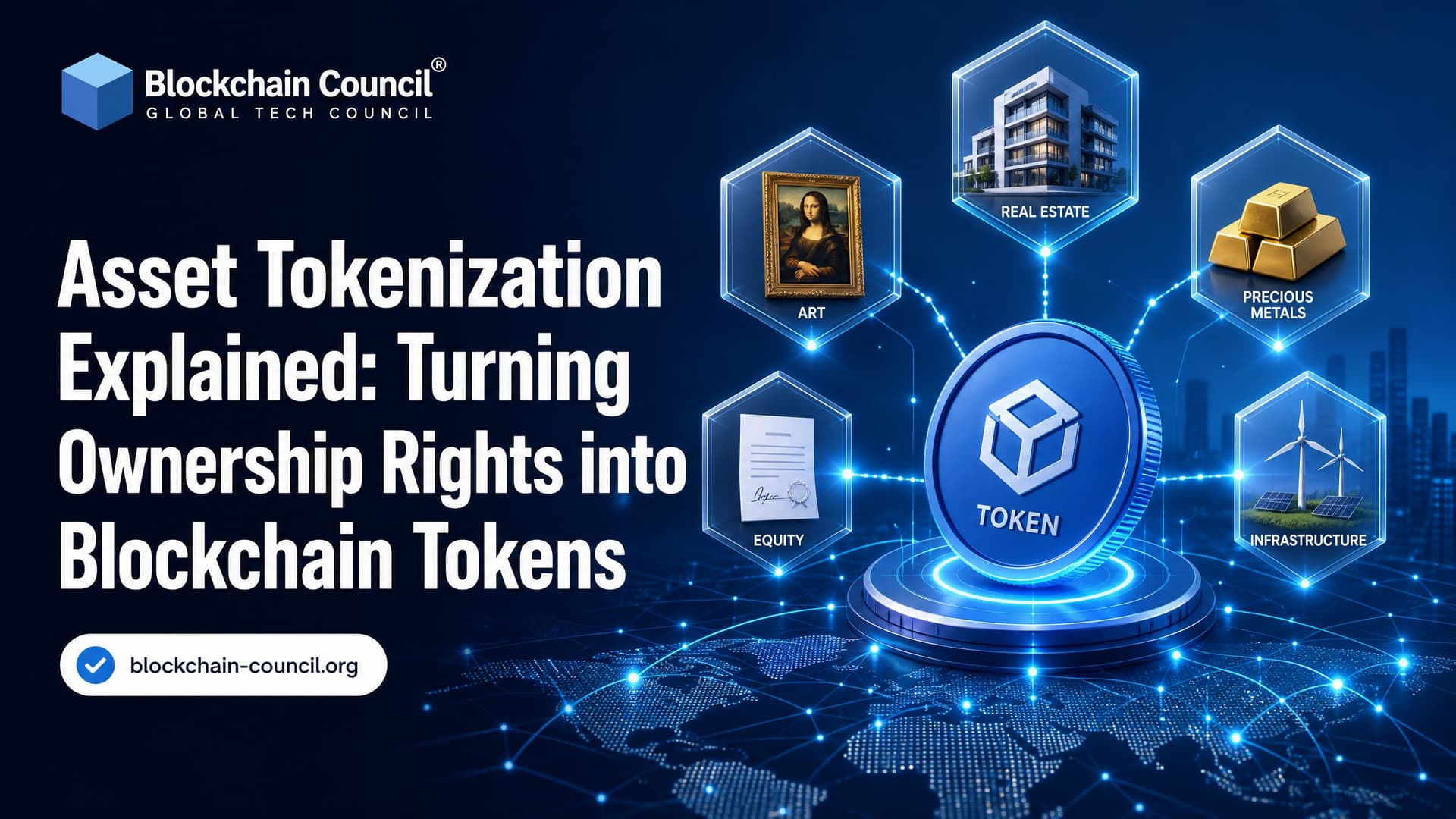
Asset tokenization turns ownership rights in real or digital assets into blockchain tokens that can be issued, transferred, audited, and redeemed under defined legal rules. The token is not magic. It is a programmable record of a claim, and its value depends on the legal, custody, and technical system behind it.
That distinction matters. A tokenized Treasury fund share, a stablecoin, and a fractional real estate token may all sit on a blockchain, but each has a different claim structure, risk profile, and compliance burden. If you work in finance, Web3, compliance, or software development, asset tokenization is now a practical infrastructure topic, not just a crypto talking point.

As financial institutions and enterprises continue to adopt blockchain-based assets, professionals need a deeper understanding of tokenization, digital asset governance, custody frameworks, and regulatory compliance. A Certified Digital Assets Expert credential helps build these practical skills, providing the knowledge required to evaluate and manage digital asset ecosystems with greater confidence.
What Is Asset Tokenization?
Asset tokenization is the process of recording ownership rights or economic claims to an asset as blockchain-based tokens. These tokens can represent financial assets such as bonds and fund shares, physical assets such as real estate or commodities, or digital assets such as intellectual property and data rights.
In many real-world asset (RWA) structures, the underlying asset stays offchain with a custodian, fund administrator, broker-dealer, trustee, or special purpose vehicle. The blockchain token represents the holder's claim on that asset. This is why legal design is just as important as smart contract design.
Fungible Tokens vs Non-Fungible Tokens
Tokenized assets usually fall into two broad groups:
Fungible tokens: Interchangeable units that represent equal claims, such as tokenized shares, tokenized bonds, or stablecoins.
Non-fungible tokens: Unique tokens that represent distinct assets, such as one artwork, one property deed claim, or a specific patent license.
Most institutional tokenization projects use fungible or semi-fungible designs because financial assets usually need standardized units, transfer controls, and predictable redemption workflows.
How Asset Tokenization Works in Practice
A serious asset tokenization project starts before a single line of Solidity is written. The technical token is the visible layer. The legal and operational layers carry much of the weight.
Identify the asset: Choose the asset to tokenize, such as a Treasury bill portfolio, private credit pool, real estate property, or money market fund.
Define the legal claim: Decide whether token holders own equity, debt, fund interests, beneficial interests, receivables, or redemption rights.
Set custody and administration: Appoint the custodian, trustee, broker-dealer, transfer agent, or fund administrator that controls the offchain asset.
Issue tokens: Deploy smart contracts that mint tokens to approved investors or wallets.
Control transfers: Apply KYC, AML, sanctions screening, lockups, jurisdiction rules, and investor eligibility checks.
Manage lifecycle events: Process dividends, coupons, interest, rent, redemptions, splits, maturities, and reporting.
Developers often underestimate step five. A plain ERC-20 token is usually not enough for regulated securities. You may need permissioned transfers, identity registries, allowlists, and forced transfer functions for legal recovery. Standards and patterns such as ERC-1400 and ERC-3643 were created for this reason.
A small but real builder detail: if you use OpenZeppelin Contracts v5 and inherit Ownable without passing an initial owner, Solidity will throw an error like No arguments passed to the base constructor. Specify the arguments or mark contract as abstract. Many tokenization prototypes fail at simple deployment hygiene before they ever reach compliance testing.
Successful tokenization projects also require a solid understanding of cryptocurrency markets, blockchain transactions, wallets, digital asset custody, and the broader crypto ecosystem. A Certified Cryptocurrency Expert credential equips professionals with the practical knowledge needed to connect tokenized assets with real-world cryptocurrency infrastructure and market operations.
Why Asset Tokenization Matters
The strongest argument for asset tokenization is not speculation. It is operational efficiency.
Faster Settlement
Traditional securities settlement has improved, with the United States moving to T+1 for many securities in May 2024. Tokenized systems can shorten settlement further by recording trade and ownership changes onchain, sometimes near instantly. The New York Stock Exchange's parent, Intercontinental Exchange, has explored blockchain-based settlement for tokenized assets, with goals that include around-the-clock trading, faster settlement, and stablecoin-based funding.
Liquidity and Fractional Ownership
Tokenization can divide high-value assets into smaller units. That matters for assets such as real estate, private credit, infrastructure, and art, where minimum investment sizes are often too high for many participants.
Be careful, though. Fractionalization does not automatically create liquidity. A token can be easy to transfer and still have no buyers. Real liquidity needs market makers, investor demand, clear disclosures, custody confidence, and legal certainty.
Transparency and Auditability
Blockchains give participants a shared record of issuance, transfers, and balances. Public networks make this visible to anyone. Permissioned networks can still give auditors, regulators, and counterparties a consistent source of truth.
This can reduce reconciliation work. In traditional finance, different firms often maintain separate ledgers and resolve breaks after the fact. Tokenized systems can cut some of that duplication, although they still need clean integrations with offchain books and records.
Programmable Finance
Smart contracts can automate coupons, dividend distributions, rental payments, redemptions, collateral checks, and compliance rules. This is where tokenization becomes more than a digital wrapper.
For example, a tokenized private credit instrument could distribute interest to eligible wallets on a schedule, while blocking transfers to unverified addresses. A tokenized fund share could support same-day subscription and redemption workflows if the fund's legal documents and administrator support it.
Current Market State: From Pilot Projects to Infrastructure
Asset tokenization has moved past the whitepaper stage. McKinsey has written that tokenized financial assets are progressing from pilots to scaled deployment, especially in cash and deposits, bonds, exchange-traded notes, mutual funds, ETFs, loans, and securitization.
Broadridge has reported more than 1 trillion dollars in monthly transaction volume on its distributed ledger platform, showing that distributed ledger technology is already being used for large-scale institutional workflows.
RWA analytics show tens of billions of dollars in tokenized real-world assets onchain, excluding stablecoins. Tokenized US Treasuries and tokenized private credit are the two largest categories, followed by equities, real estate, and commodities.
Stablecoins are the clearest mass-market example. State Street Global Advisors describes stablecoins as tokenized representations of fiat currency, usually designed to maintain a 1:1 value. They are widely used for crypto market settlement, cross-border payments, and onchain liquidity.
Market Projections: Big Numbers, Wide Ranges
Forecasts vary because analysts count different things. Some exclude stablecoins and cryptocurrencies. Others include deposits, fund shares, private assets, and almost every financial instrument that could be represented onchain.
McKinsey: Around 2 trillion dollars in tokenized financial asset market capitalization by 2030, excluding cryptocurrencies and stablecoins.
Broader McKinsey scenarios: About 4 to 5 trillion dollars by 2030 under wider assumptions.
Standard Chartered: Up to 30 trillion dollars in tokenized assets by 2034.
Chainlink's long-term framing: A theoretical upper bound that could reach well above 100 trillion dollars annually if most economic activity were represented onchain.
My view: the 2 trillion dollar range is easier to defend than the 30 trillion dollar figure in the near term. Treasuries, money market funds, collateral, and private credit have clear demand. Tokenized single-family homes and art NFTs are more uneven because valuation, governance, and resale markets are harder.
Key Use Cases for Asset Tokenization
Tokenized US Treasuries
Tokenized Treasuries are one of the strongest RWA categories because they solve a real need for blockchain-native investors: access to yield-bearing, relatively low-risk government debt with onchain transfer and settlement features.
Tokenized Private Credit
Private credit tokenization can represent claims on loan portfolios or structured credit products. It may lower minimum investment sizes and improve secondary market access, but credit underwriting remains the core risk. A blockchain cannot fix a weak borrower.
Tokenized Funds and ETFs
Asset managers are testing tokenized fund shares, money market funds, and ETF-like products to improve settlement, reporting, and distribution. If regulated platforms mature, this category could become one of the largest institutional use cases.
Real Estate and Alternative Assets
Real estate tokenization can split exposure to a property into smaller units. Art, collectibles, intellectual property, and data rights can also be tokenized. These markets need careful governance because token holders may not control the asset directly.
Risks and Challenges
Asset tokenization has real benefits, but the risks are not small.
Regulatory uncertainty: Securities, commodities, payments, custody, tax, and cross-border rules differ by jurisdiction.
Custody risk: The token only works if the offchain asset is properly held, audited, and legally linked to token holders.
Smart contract risk: Bugs, unsafe upgrade patterns, private key compromise, and poor access control can cause losses.
Liquidity risk: A tokenized asset may still trade in a thin market.
Interoperability gaps: Fragmented platforms and standards can make assets hard to move between markets.
For enterprises, the hard part is often not choosing Ethereum, Polygon, Hyperledger Fabric, or a permissioned chain. The harder task is matching legal rights, investor controls, custody records, and smart contract state without gaps.
Building secure tokenization platforms also depends on expertise in cybersecurity, cloud infrastructure, APIs, enterprise systems, automation, analytics, and secure software development. A Tech Certification helps professionals strengthen these complementary technical skills, supporting the design, integration, and long-term resilience of enterprise blockchain solutions.
Skills Professionals Need for Tokenization Projects
If you want to work in asset tokenization, build both financial and technical depth. You should understand ERC-20, ERC-721, ERC-1155, permissioned token models, wallet security, gas mechanics under EIP-1559, and the difference between public and private blockchain settlement.
You also need the finance language: NAV, settlement, transfer agency, beneficial ownership, corporate actions, redemption, custody, and investor accreditation. Developers who can speak to compliance teams without hand-waving are rare. They get hired.
For structured learning, Blockchain Council readers can explore certifications such as Certified Blockchain Expert™, Certified Blockchain Developer™, Certified Smart Contract Developer™, and Certified DeFi Expert™. These are natural next steps if you want to connect token design with real blockchain implementation.
Where Asset Tokenization Goes Next
The next three to five years will likely favor practical instruments: tokenized cash, deposits, Treasuries, money market funds, bonds, collateral, loans, and securitized products. These have clearer buyers and cleaner operational benefits.
The broader vision, where every stock and bond exists on a shared ledger, has strong supporters. BlackRock CEO Larry Fink has said that every stock and bond could eventually be tokenized, making markets faster and cheaper. That may happen, but it will require regulatory alignment, trusted identity layers, institutional custody, and serious market infrastructure.
If you are a professional, start with one asset class and map the full lifecycle: issuance, investor onboarding, transfer, income distribution, reporting, redemption, and default handling. If you are a developer, build a permissioned ERC-20 prototype with allowlisted transfers and a mock redemption flow. Then test the unhappy paths. That is where real tokenization knowledge begins.
As tokenized assets become more widely adopted, organizations must also communicate their value, governance models, and compliance practices clearly to investors, regulators, customers, and internal stakeholders. A Marketing Certification helps professionals strengthen strategic communication and stakeholder engagement skills, making complex asset tokenization concepts easier to explain while supporting greater trust and adoption.
FAQs
1. What is asset tokenization?
Asset tokenization is the process of representing ownership rights or interests in a real-world or digital asset as blockchain-based tokens. These tokens can represent assets such as real estate, securities, commodities, artwork, intellectual property, or financial instruments, depending on the legal structure and applicable regulations.
2. How does asset tokenization work?
Asset tokenization typically involves identifying an eligible asset, establishing the appropriate legal framework, creating blockchain-based tokens through smart contracts, and issuing those tokens to eligible participants. Ownership records and transfers are then maintained on a blockchain, while legal rights are governed by applicable contracts and regulations.
3. What types of assets can be tokenized?
A wide range of assets may be tokenized, including commercial and residential real estate, stocks, bonds, investment funds, commodities, infrastructure projects, intellectual property, collectibles, carbon credits, private equity interests, and other real-world assets (RWAs).
4. Why is asset tokenization important?
Tokenization has the potential to improve transaction efficiency, transparency, ownership tracking, and accessibility to certain assets. It may also support fractional ownership, faster settlement, and programmable financial services, although benefits depend on the underlying legal and technical framework.
5. What is fractional ownership?
Fractional ownership allows a high-value asset to be divided into multiple blockchain tokens, with each token representing a proportional interest in the underlying asset. This structure can broaden access to certain investment opportunities, subject to regulatory requirements and offering terms.
6. How do smart contracts support tokenization?
Smart contracts automate functions such as token issuance, ownership transfers, dividend or income distributions where applicable, compliance checks, voting rights, and other predefined asset management processes. They execute according to programmed rules recorded on the blockchain.
7. What is the difference between tokenization and securitization?
Tokenization refers to representing ownership or rights as blockchain-based tokens, while securitization is a traditional financial process that pools assets into securities for investment purposes. In some cases, tokenization and securitization may be combined, depending on the asset structure and regulatory framework.
8. How does blockchain improve asset ownership records?
Blockchain provides an immutable and transparent ledger that records ownership changes and transaction history. This can improve auditability, reduce reconciliation efforts, and increase confidence in ownership records, while legal ownership remains subject to applicable laws and contractual agreements.
9. What are tokenized real-world assets (RWAs)?
Tokenized real-world assets (RWAs) are blockchain-based representations of physical or traditional financial assets. Examples include tokenized real estate, private credit, government bonds, commodities, investment funds, and other regulated financial products.
10. Which industries are adopting asset tokenization?
Industries exploring tokenization include banking, real estate, private equity, venture capital, insurance, supply chain management, healthcare, energy, commodities, fine art, intellectual property, and asset management. Adoption varies according to market demand and regulatory developments.
11. How can tokenization improve liquidity?
Tokenization may increase liquidity by enabling fractional ownership, simplifying transfers, expanding access to qualified participants, and supporting more efficient digital trading platforms. However, actual liquidity depends on market demand, regulatory restrictions, and the availability of compliant trading venues.
12. How does AI complement asset tokenization?
Artificial intelligence can assist with asset valuation, compliance monitoring, fraud detection, blockchain analytics, document processing, transaction monitoring, portfolio analysis, and operational automation. AI should support established governance practices and human oversight rather than replace them.
13. What are the risks of asset tokenization?
Potential risks include regulatory uncertainty, smart contract vulnerabilities, cybersecurity threats, operational failures, custody risks, liquidity constraints, valuation challenges, and legal disputes regarding ownership or rights. Organizations should conduct appropriate due diligence before implementing tokenization projects.
14. How is asset tokenization regulated?
Regulatory treatment depends on the type of asset being tokenized, the rights represented by the token, and the applicable jurisdiction. Regulations may cover securities laws, anti-money laundering (AML), know-your-customer (KYC) requirements, taxation, consumer protection, and financial reporting.
15. How does tokenization affect investors?
Tokenization may provide investors with greater access to fractional ownership, improved transparency, and more efficient settlement processes. However, investors should understand the legal rights, liquidity characteristics, fees, and risks associated with each tokenized asset before participating.
16. What role do custodians play in tokenized assets?
Custodians safeguard digital assets and the private keys used to control them. Institutional custodians may also provide secure storage, compliance services, transaction support, governance controls, and reporting capabilities for tokenized asset portfolios.
17. What trends are shaping asset tokenization in 2025-2026?
Key trends include institutional adoption of tokenized real-world assets, AI-assisted compliance, blockchain interoperability, programmable securities, expanded digital custody solutions, cross-border settlement initiatives, decentralized identity integration, and increasing regulatory clarity in major financial markets.
18. What are best practices for implementing asset tokenization?
Best practices include establishing a clear legal structure, conducting smart contract audits, implementing strong cybersecurity controls, maintaining transparent governance, performing regulatory due diligence, selecting appropriate blockchain infrastructure, and providing clear documentation for investors and stakeholders.
19. What should organizations evaluate before tokenizing assets?
Organizations should assess the suitability of the underlying asset, legal ownership structure, regulatory obligations, technology infrastructure, custody arrangements, scalability, interoperability, operational costs, and long-term business objectives. Careful planning can improve implementation outcomes while reducing operational and compliance risks.
20. What is the future of asset tokenization?
Asset tokenization is expected to become an increasingly important part of digital finance as blockchain technology, institutional adoption, AI-powered operations, and regulatory frameworks continue to mature. Broader acceptance may improve market efficiency, transparency, and access to a wider range of assets while maintaining appropriate legal and investor protection standards. Turning ownership into digital tokens is technologically impressive, but making the legal paperwork keep pace remains one of the most interesting parts of the journey.
Related Articles
View All
Digital Assets
What Is On-Chain Asset Ownership in RWA Tokenization?
On-chain asset ownership records tokenized claims to real-world assets on blockchain while legal title remains tied to custody and contracts.

Digital Assets
How Asset Tokenization Creates Verifiable Digital Ownership
Asset tokenization turns rights to real world and financial assets into blockchain tokens, giving authorized parties a verifiable record of ownership, provenance, and compliance.

Digital Assets
How RWA Tokenization Works: From Physical Assets to Blockchain Tokens
Learn how RWA tokenization links real-world assets to blockchain tokens through legal structures, custody, smart contracts, oracles, and compliance controls.
Trending Articles
How Blockchain Secures AI Data
Understand how blockchain technology is being applied to protect the integrity and security of AI training data.
What is AWS? A Beginner's Guide to Cloud Computing
Everything you need to know about Amazon Web Services, cloud computing fundamentals, and career opportunities.
Claude AI Tools for Productivity
Discover Claude AI tools for productivity to streamline tasks, manage workflows, and improve efficiency.