

What Are Altcoins? A Complete Guide Beyond Bitcoin

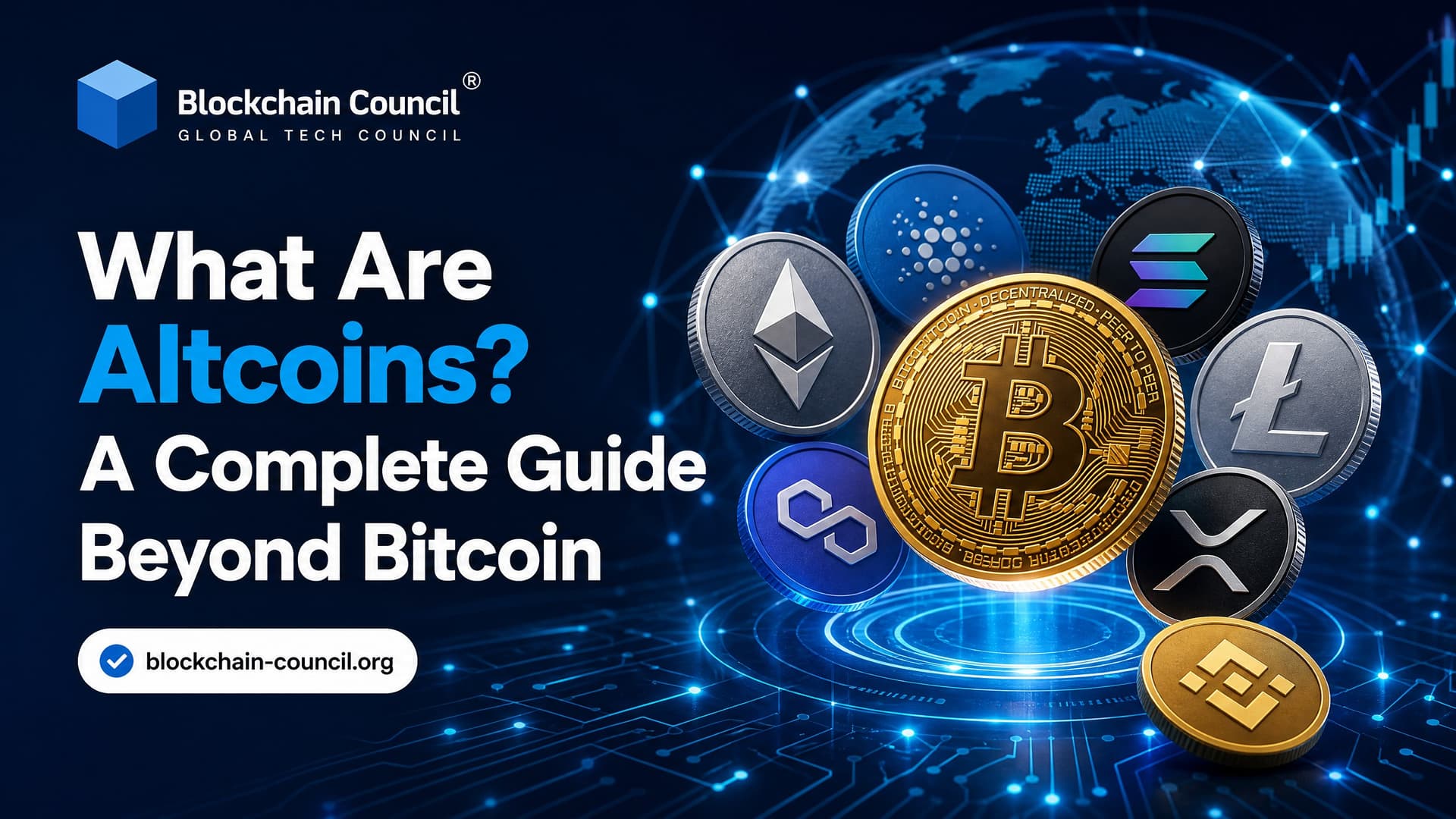
What are altcoins? Altcoins are cryptocurrencies other than Bitcoin. The word comes from alternative coin, and it covers a huge range of digital assets, from Ethereum and Litecoin to stablecoins, governance tokens, gaming tokens, and meme coins. Bitcoin is still the benchmark crypto asset, but most experimentation in blockchain now happens outside Bitcoin.
That matters if you trade crypto, build Web3 applications, work in compliance, or prepare for a blockchain certification. Altcoins are not one thing. Some are full layer-1 networks. Some are tokens issued on Ethereum using standards such as ERC-20 or ERC-721. Some are serious infrastructure. Some are just a logo and a Discord server. You need to know the difference.

What Are Altcoins?
An altcoin is any cryptocurrency that is not Bitcoin. This is the most common industry definition used by exchanges, market data platforms, and educational sources.
There is one small wrinkle. Some analysts no longer call Ethereum an altcoin, because Ethereum has become its own major category: a programmable smart contract platform with a large developer ecosystem. Still, in practical market discussions, altcoins usually means all non-Bitcoin crypto assets, including Ethereum, XRP, Solana, Cardano, Dogecoin, Tether, Uniswap, Aave, and thousands more.
Altcoins can be native coins or tokens:
- Native coins run on their own blockchain. ETH on Ethereum, SOL on Solana, and ADA on Cardano are examples.
- Tokens are issued on an existing blockchain. USDC on Ethereum, UNI, AAVE, and many NFT assets are examples.
This distinction trips up new developers. A coin pays for network activity on its own chain. A token depends on another chain's infrastructure. If you send an ERC-20 token from a contract without prior approval, the transaction may fail with a familiar message: execution reverted: ERC20: insufficient allowance. Small detail. Big lesson.
How Altcoins Evolved After Bitcoin
Bitcoin launched in 2009 as a peer-to-peer electronic cash system using proof of work and a fixed supply limit of 21 million BTC. It proved that decentralized digital money could work without a bank or payment company in the middle.
Altcoins appeared soon after. Many early projects reused parts of Bitcoin's open-source code and changed parameters such as block time, mining algorithm, or total supply. Litecoin, launched in 2011, is a classic example of a payment-focused altcoin built to process blocks faster than Bitcoin.
Later altcoins moved beyond payments. Ethereum introduced general-purpose smart contracts, letting developers build decentralized applications, DeFi protocols, DAOs, NFT marketplaces, and tokenized assets. That changed the industry. Bitcoin showed how to move value without a central operator. Ethereum showed how to run programmable agreements on-chain.
The market itself grew fast. Depending on the source, counts range from roughly 14,000 to more than 17,000 altcoins, with the altcoin share of total crypto market capitalization sitting well above half at various points. Counts vary because inactive tokens, scam tokens, and low-liquidity assets get filtered differently. The direction is clear. The altcoin market is large, fragmented, and far broader than Bitcoin alone.
Main Types of Altcoins
Altcoins are best understood by function. Here are the major categories you will see in professional crypto analysis.
Payment Coins
Payment coins aim to move value quickly and cheaply. Litecoin, XRP, and Dogecoin are common examples. Their appeal usually comes from faster confirmation times, lower fees, or strong community adoption. That does not automatically make them better money than Bitcoin. It makes them different tools.
Smart Contract Platforms
Smart contract platforms are layer-1 blockchains that support programmable applications. Ethereum, Solana, Cardano, Avalanche, and similar networks fall into this group. Developers use them to deploy dApps, DeFi protocols, NFT collections, and on-chain governance systems.
If you are learning to build on Ethereum, watch your compiler version. Solidity 0.8.x introduced built-in overflow and underflow checks. Older tutorials that use SafeMath everywhere may still run, but they often teach outdated patterns.
Stablecoins
Stablecoins are designed to hold a stable value, usually against the US dollar. USDT and USDC are the best-known examples. Traders use them to move between positions without returning to bank rails. DeFi protocols use them as collateral, quote assets, and settlement units.
Stablecoins are useful, but they are not risk-free. Reserve quality, issuer transparency, smart contract security, and regulatory treatment all matter.
Utility Tokens
Utility tokens provide access to a product, network function, or application feature. A token might pay fees, activate services, reward participation, or serve as an in-app asset. The hard question is whether the token is truly needed. Many projects add tokens where a normal database credit would work better.
Governance Tokens
Governance tokens give holders voting power over protocol decisions, treasury spending, fee changes, or upgrades. UNI, AAVE, and COMP are widely cited examples in DeFi. Governance sounds democratic, but token-weighted voting can concentrate power among large holders. Check voter participation and delegate concentration before assuming a protocol is community-run.
Security Tokens
Security tokens represent regulated financial interests such as equity, debt, revenue rights, or investment contracts. They sit closer to traditional finance and usually face stricter compliance requirements. For enterprises, this category is important because token design can trigger securities law obligations.
Meme Coins and Community Tokens
Meme coins such as Dogecoin and Shiba Inu are driven mainly by culture, branding, and community momentum. Some become liquid markets. Many disappear. Treat them as speculative, not infrastructure.
Gaming and Play-to-Earn Tokens
Gaming tokens power in-game economies, rewards, asset ownership, and sometimes governance. This category grew during the NFT boom, but many projects learned a hard lesson. If the game is not fun without token rewards, the economy usually breaks.
How Altcoins Differ From Bitcoin
Altcoins share the broad idea of cryptographically secured digital assets, but they often make different technical and economic choices.
- Consensus: Bitcoin uses proof of work. Many altcoins use proof of stake or related staking systems, where validators secure the network by locking capital.
- Energy profile: Proof of stake systems generally consume less energy than proof of work mining, though decentralization and validator distribution still need scrutiny.
- Speed and fees: Many altcoins target faster settlement and lower fees than Bitcoin. The trade-off may be higher hardware demands, greater centralization, or weaker security assumptions.
- Programmability: Ethereum and similar chains support smart contracts, while Bitcoin's base layer is intentionally more limited.
- Privacy: Some altcoins add privacy features through confidential transactions or zero-knowledge proofs.
- Supply model: Bitcoin has a fixed 21 million BTC cap. Altcoins may have fixed supply, inflationary issuance, burning mechanisms, or complex token schedules.
Here is my blunt view. Bitcoin is still the cleanest monetary asset design in crypto. Altcoins are where application design happens. Do not confuse those two roles.
Real-World Uses of Altcoins
DeFi
Decentralized finance runs mainly on altcoin ecosystems. Ethereum-based protocols such as Uniswap, Aave, and Compound use smart contracts for trading, lending, borrowing, and collateral management. Stablecoins make these systems practical because users need a lower-volatility asset for pricing and settlement.
Cross-Border Payments
Payment altcoins are often used for fast transfers across borders, especially where banking rails are slow or expensive. XRP and Litecoin come up frequently in this context. The advantage is speed. The risk is price movement if users hold the asset for too long.
NFTs and Digital Ownership
NFTs usually rely on smart contract platforms. ERC-721 and ERC-1155 on Ethereum are standard examples. NFTs can represent art, game items, event access, identity credentials, or tokenized real-world assets.
Governance and DAOs
Altcoins also coordinate communities. Governance tokens let holders vote on proposals, allocate treasury funds, and adjust protocol rules. The model is powerful, but it needs careful design. Low turnout and whale dominance are common problems.
Risks of Altcoins
Altcoins can offer higher upside than Bitcoin, but the risk is also higher. Most professional analysis describes altcoins as highly speculative and volatile, and that matches what practitioners see in the market.
- Liquidity risk: Smaller tokens can move sharply because order books are thin.
- Smart contract risk: Bugs can freeze funds or allow exploits.
- Execution risk: Many projects never find real users.
- Regulatory risk: Some tokens may be treated as securities or payment instruments.
- Staking risk: Validators can face slashing, lockups, and protocol failures.
- Tokenomics risk: Insider unlocks and inflation can pressure price even when the product is decent.
Before you buy or build around an altcoin, read the token supply schedule, check active developer activity, review audits, inspect governance participation, and understand the chain's security model. If the pitch depends only on price going up, walk away.
What Altcoins Mean for Professionals
If you work in blockchain, altcoins are not optional knowledge. Developers need to understand token standards, gas mechanics, wallets, bridges, and smart contract security. Compliance teams need to classify tokens by rights, usage, and distribution. Product leaders need to ask whether a token improves the system or only adds complexity.
For structured learning, Blockchain Council offers relevant certifications such as the Certified Cryptocurrency Expert™ (CCE), Certified Blockchain Expert™ (CBE), and Certified Blockchain Developer™. If your goal is analysis and investment literacy, start with cryptocurrency fundamentals. If you want to build, move into smart contracts, Ethereum tooling, and security testing with Hardhat or Foundry.
The Future of Altcoins
The altcoin market will not disappear. It will split. Strong infrastructure, regulated stablecoins, useful DeFi protocols, and enterprise-grade tokenization platforms are likely to survive. Thousands of weak tokens will not.
Expect three forces to shape the next phase:
- Regulation: Stablecoin rules, securities classification, and exchange listing standards will filter the market.
- Consolidation: Developers and liquidity will cluster around leading ecosystems.
- Utility: Projects with real users, clear token purpose, and sound security will have an edge.
If you are new to altcoins, do not start by chasing the smallest token on an exchange. Start by understanding Bitcoin, then Ethereum, then stablecoins, then DeFi. Build a simple ERC-20 token on a testnet. Send it through MetaMask. Watch how gas works on Ethereum mainnet chain ID 1 versus a test network. That hands-on experience will teach you faster than any price chart.
Your next step: pick one category of altcoins and study it deeply. For most professionals, smart contract platforms and stablecoins are the best starting point, because they sit at the center of Web3 infrastructure, DeFi, enterprise adoption, and regulatory debate.
Related Articles
View All
Cryptocurrency
Beyond Bitcoin: DeFi, Stablecoins, NFTs & the Expanding Crypto Ecosystem
Go Beyond Bitcoin and explore DeFi, stablecoins, NFTs, DAOs, tokenisation, and Web3. A clear guide to how the expanding crypto ecosystem works and how its parts connect.
Cryptocurrency
What Is Crypto Asset Recovery? A Complete Beginner's Guide
Learn what crypto asset recovery means, how blockchain forensics and legal tools work, and how to avoid fake recovery services after theft or wallet loss.

Cryptocurrency
Crypto Portfolio Diversification: Balancing Bitcoin, Altcoins, Stablecoins, and DeFi
Learn how crypto portfolio diversification balances Bitcoin, altcoins, stablecoins, and DeFi assets using risk tiers, liquidity, and sector exposure.
Trending Articles

Top 5 DeFi Platforms
Explore the leading decentralized finance platforms and what makes each one unique in the evolving DeFi landscape.
What is AWS? A Beginner's Guide to Cloud Computing
Everything you need to know about Amazon Web Services, cloud computing fundamentals, and career opportunities.

Can DeFi 2.0 Bridge the Gap Between Traditional and Decentralized Finance?
The next generation of DeFi protocols aims to connect traditional banking with decentralized finance ecosystems.