

Crypto Portfolio Diversification: Balancing Bitcoin, Altcoins, Stablecoins, and DeFi

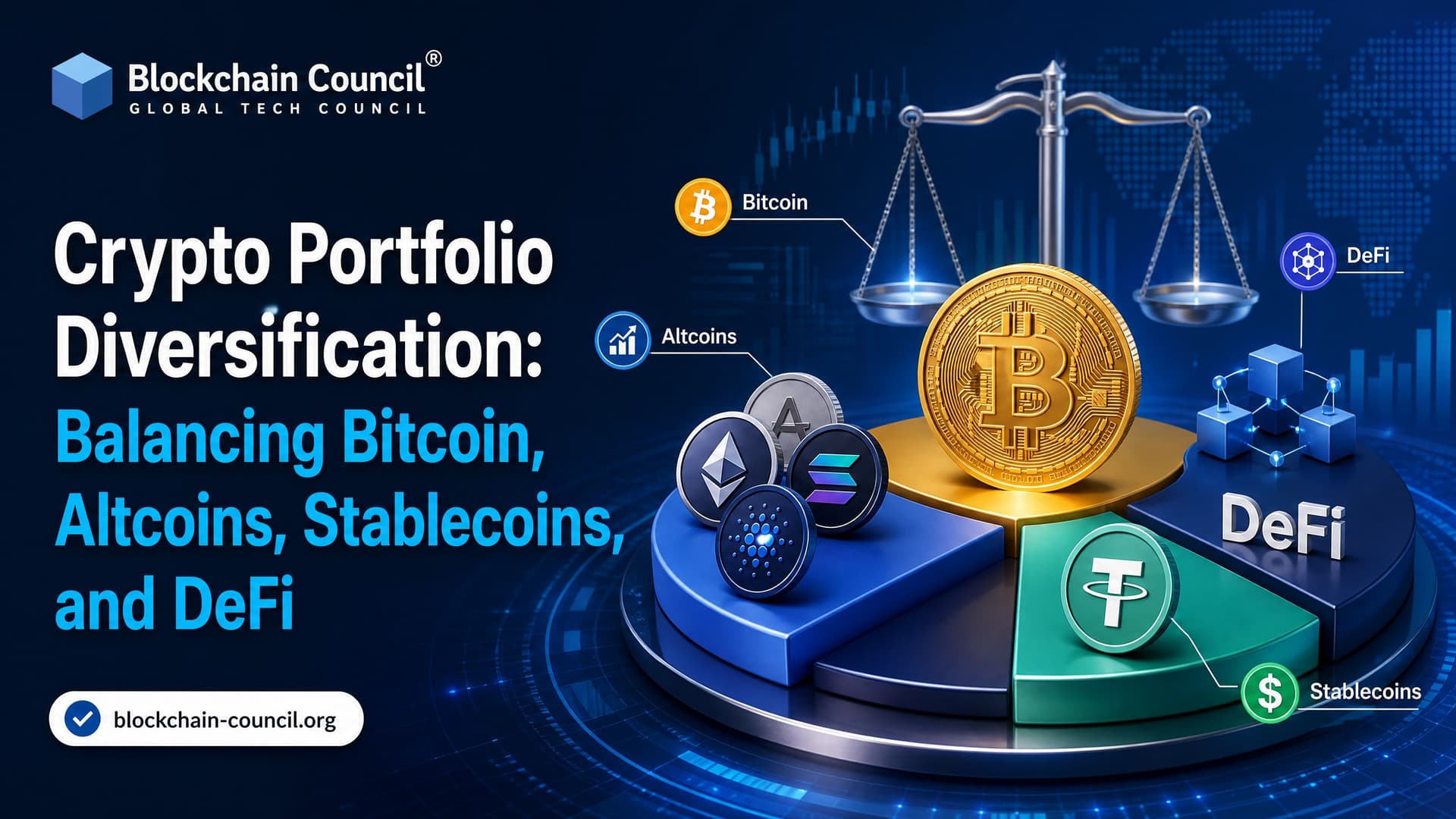
Crypto portfolio diversification is not about buying twenty random tokens and hoping a few run. It is about structuring Bitcoin, Ethereum, altcoins, stablecoins, and DeFi assets so one bad trade, sector, issuer, or protocol does not dominate your results.
Here is the harder truth. Crypto assets often move together when markets panic. A portfolio with ten layer 1 tokens may look diversified in a spreadsheet, then behave like one oversized risk position during a drawdown. Your job is to build by role, risk tier, liquidity, and sector exposure.

What Crypto Portfolio Diversification Really Means
Crypto portfolio diversification means spreading exposure across different digital assets, use cases, and risk levels. It can include Bitcoin, Ethereum, large-cap altcoins, DeFi tokens, stablecoins, tokenized real-world assets, and smaller speculative positions.
Good diversification usually works across three layers:
- Asset type: Bitcoin, Ethereum, altcoins, stablecoins, DeFi tokens, NFTs, and tokenized assets.
- Sector: Layer 1 networks, layer 2 scaling, lending, decentralized exchanges, data services, AI, DePIN, gaming, infrastructure, and RWAs.
- Risk tier: Large-cap, mid-cap, small-cap, and high-risk micro-cap assets.
Do not confuse coin count with diversification. Academic research on cryptocurrency portfolios has found that adding more coins often gives only limited diversification benefit, because many assets show strong co-movement during market stress. That matches what traders see in real time. When Bitcoin drops sharply, weak altcoins rarely act as a hedge.
The Role of Bitcoin and Ethereum as Core Holdings
Most professional frameworks start with Bitcoin and Ethereum. They have the deepest liquidity, the longest operating history among major crypto assets, and the strongest institutional recognition. Bitcoin remains the primary monetary asset of the crypto market. Ethereum remains the dominant smart contract settlement layer by developer activity and DeFi usage.
Many allocation models place 40 percent to 70 percent of a crypto portfolio in Bitcoin and Ethereum combined. Some institutional guidance leans toward 60 percent to 70 percent in BTC and ETH as core assets. Retail-focused balanced models often sit closer to 40 percent to 50 percent.
For most investors, this is sensible. If you are new to crypto, a BTC and ETH core is usually better than chasing five small narratives you barely understand. Boring is useful here.
When a Heavy BTC and ETH Allocation Makes Sense
- You have a long time horizon.
- You want crypto exposure without constant monitoring.
- You care about liquidity and execution quality.
- You are building an institutional or treasury-style allocation.
A practical note from trading desks: liquidity matters most when you need it. You can exit BTC or ETH quickly on major venues. Some smaller tokens show tight spreads in calm markets, then the order book disappears when volatility hits.
How Altcoins Fit Into a Diversified Crypto Portfolio
Altcoins include everything outside BTC and ETH: layer 1s, layer 2s, exchange tokens, infrastructure tokens, DeFi governance assets, gaming tokens, AI tokens, DePIN projects, and more.
Their role is growth. Altcoins can outperform in risk-on markets because they are tied to newer products, smaller networks, and shifting narratives. That upside comes with sharp drawdowns. Many altcoins fall 70 percent to 90 percent from cycle highs. Some never recover.
A common allocation range is 20 percent to 40 percent in a diversified altcoin basket. One simple model splits a portfolio into 60 percent established coins, 30 percent altcoins, and 10 percent stablecoins. More institutional-style models often place 20 percent to 30 percent in altcoins and satellite assets.
Build Altcoin Exposure by Sector, Not Hype
Use buckets. For example:
- Layer 1 and layer 2 networks: Smart contract platforms and scaling networks.
- Infrastructure: Oracles, interoperability, indexing, storage, and data services.
- DeFi: Lending, decentralized exchanges, liquid staking, derivatives, and yield tools.
- Emerging themes: Tokenized real-world assets, AI, DePIN, and on-chain credit.
Do not hold six tokens that all depend on the same ecosystem unless you mean to make that concentrated bet. A portfolio with multiple DEX tokens, several ecosystem coins, and correlated liquidity incentives may be less diverse than it looks.
Why Stablecoins Deserve a Real Allocation
Stablecoins are often treated like dead weight by new investors. That is a mistake. A stablecoin allocation is not low conviction. It is liquidity management.
Stablecoins such as USDC and USDT are usually pegged to fiat currencies and used as cash-equivalent assets inside crypto markets. They help you rebalance, reduce volatility, and act when prices dislocate. They also help you avoid forced selling during a drawdown.
Most frameworks recommend 5 percent to 20 percent in stablecoins, depending on risk tolerance and market conditions. A conservative portfolio may hold closer to 20 percent. A more aggressive portfolio might keep 5 percent to 10 percent as dry powder.
Stablecoin Risks You Should Not Ignore
- Issuer risk: The stablecoin depends on reserves, banking access, and redemption processes.
- De-pegging risk: Stablecoins can temporarily trade below their intended peg.
- Regulatory risk: Rules may affect issuance, transfers, and exchange support.
- Counterparty risk: Lending stablecoins through a platform adds another layer of exposure.
If you use stablecoins in DeFi, check the asset decimals before building or running scripts. USDC uses 6 decimals, while ETH uses 18. I have seen beginners size transactions incorrectly because they assumed every ERC-20 token used 18 decimals. That mistake can wreck a bot, a rebalance, or a lending position.
Where DeFi Assets Belong
DeFi assets usually sit inside the altcoin sleeve. They give exposure to lending protocols, decentralized exchanges, derivatives, liquid staking, and yield aggregators. Some tokens carry governance rights. Some may be tied indirectly to protocol revenue, liquidity incentives, or fee switches, depending on design and regulation.
DeFi can add useful sector exposure, but it is not a safe yield machine. Smart contract bugs, oracle failures, governance attacks, bridge exploits, and liquidity shortages are real. If a strategy pays unusually high yield, ask what risk you are being paid to take.
For many portfolios, DeFi tokens and DeFi yield positions should be sized separately:
- DeFi tokens: Price exposure to protocols such as exchanges, lending markets, or staking infrastructure.
- DeFi yield positions: Operational exposure through lending, liquidity provision, staking, or vaults.
When rebalancing through MetaMask or a hardware wallet, nonce issues happen more often than people expect. The error replacement transaction underpriced usually means you tried to speed up or replace a pending transaction without offering enough extra gas. That is not portfolio theory, but it matters when markets move fast.
Example Crypto Portfolio Allocation Models
These are reference models, not financial advice. Adjust them for time horizon, tax rules, liquidity needs, and risk tolerance.
Conservative Crypto Portfolio
- 50 percent BTC and ETH: Core exposure with higher liquidity.
- 20 percent stablecoins: Reserve for volatility, emergencies, and rebalancing.
- 30 percent diversified altcoins: Larger DeFi, infrastructure, layer 1, and layer 2 assets.
This suits investors who want crypto exposure but cannot tolerate deep altcoin-led drawdowns.
Balanced Core-Satellite Portfolio
- 60 percent to 70 percent BTC and ETH: Portfolio anchor.
- 20 percent to 30 percent altcoins and DeFi: Sector growth exposure.
- 5 percent to 10 percent stablecoins: Rebalancing and liquidity reserve.
This is close to how many institutional-style crypto models are described: core first, satellites second, liquidity always present.
Growth-Oriented Crypto Portfolio
- 30 percent to 40 percent BTC and ETH: Smaller core.
- 30 percent to 40 percent mid and high-cap altcoins: DeFi, infrastructure, data, and scaling exposure.
- 10 percent to 20 percent speculative themes: AI, RWAs, DePIN, early protocols, or tactical trades.
- 5 percent to 10 percent stablecoins: Minimum liquidity buffer.
This approach requires active monitoring. If you do not review positions weekly, it is probably too aggressive.
Risk Management Rules That Actually Help
- Set target weights before buying. Do not let excitement decide position size.
- Rebalance on a schedule or drift rule. Quarterly works for many investors. Others rebalance when an asset moves 5 percent to 10 percent away from target weight.
- Cap speculative exposure. A 5 percent mistake is survivable. A 40 percent mistake can define your cycle.
- Track correlations. If every holding falls when BTC falls, you have less diversification than you think.
- Separate investment risk from custody risk. Use hardware wallets, withdrawal allowlists, and tested backups.
- Document why you own each asset. If the reason changes, review the position.
Professionals and developers who want deeper fluency should also study token standards, custody models, on-chain analytics, and DeFi mechanics. Blockchain Council's Certified Cryptocurrency Expert™ (CCE), Certified Blockchain Expert™ (CBE), and Certified DeFi Expert™ are useful learning paths to connect portfolio decisions with the technology underneath.
Future Outlook: From Coin Picking to Portfolio Engineering
The next stage of crypto portfolio diversification will look less like casual coin picking and more like portfolio engineering. BTC and ETH will likely stay core anchors for many professional portfolios. Stablecoins will keep serving as liquidity tools. DeFi, RWAs, AI, DePIN, and infrastructure assets will sit in sized satellite sleeves.
The key shift is measurement. Serious investors will use sector exposure, correlation analysis, drawdown limits, liquidity checks, and stress testing instead of simple coin-count diversification.
Your next step is practical. Write a target allocation for BTC, ETH, altcoins, stablecoins, and DeFi before your next trade. Then test whether each holding has a clear role. If it does not, it is probably not diversification. It is clutter.
Related Articles
View All
Cryptocurrency
Crypto Lending and Borrowing Explained: DeFi Loans, Rates, and Risks
Crypto lending and borrowing lets users earn yield or access liquidity through DeFi loans, but rates, collateral rules, and liquidations matter.

Cryptocurrency
Stablecoins Explained: How Crypto Maintains Price Stability
Stablecoins explained: learn how reserves, redemption, arbitrage, and smart contracts help crypto tokens maintain price stability.

Cryptocurrency
What Are Altcoins? A Complete Guide Beyond Bitcoin
Altcoins are cryptocurrencies beyond Bitcoin, including Ethereum, stablecoins, DeFi tokens, governance assets, meme coins, and gaming tokens.
Trending Articles
How Blockchain Secures AI Data
Understand how blockchain technology is being applied to protect the integrity and security of AI training data.
What is AWS? A Beginner's Guide to Cloud Computing
Everything you need to know about Amazon Web Services, cloud computing fundamentals, and career opportunities.

Can DeFi 2.0 Bridge the Gap Between Traditional and Decentralized Finance?
The next generation of DeFi protocols aims to connect traditional banking with decentralized finance ecosystems.