

The History of Cryptocurrency: From Bitcoin to Web3

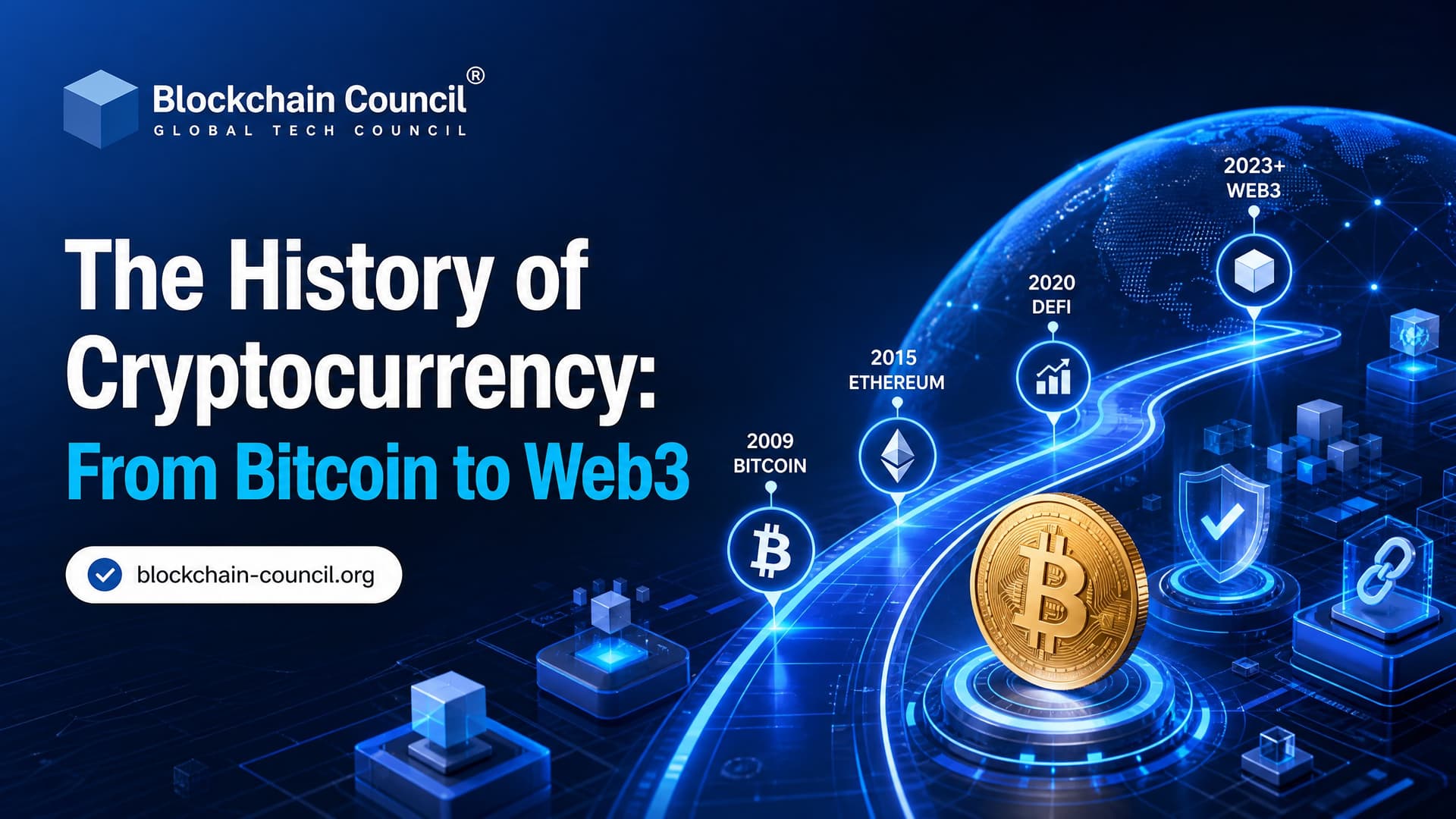
The history of cryptocurrency starts long before Bitcoin. It begins with cryptographers chasing a stubborn problem: how can digital money move across the internet without a bank, card network, or payment company sitting in the middle?
Bitcoin answered that question in 2009. Ethereum changed the question in 2015 by asking what else could run on a blockchain. Web3 is the result: a broad mix of decentralized finance, NFTs, DAOs, stablecoins, tokenized assets, and user-controlled digital identity. Some of it is useful. Some of it is overbuilt. The difference matters if you work in finance, software, compliance, or product strategy.

Before Bitcoin: The Cryptography Behind Digital Money
Cryptocurrency did not appear out of nowhere. In the 1970s, Whitfield Diffie and Martin Hellman introduced public-key cryptography, which made secure communication possible over open networks. That breakthrough later became essential for digital signatures, wallet addresses, and blockchain transaction validation.
In 1983, David Chaum proposed anonymous electronic cash, later implemented through DigiCash. Chaum's eCash was not decentralized in the Bitcoin sense, but it introduced an important idea: digital payments could preserve privacy if the cryptography was designed correctly.
Other experiments followed. Hashcash used proof-of-work to reduce email spam. Wei Dai's b-money and Nick Szabo's bit gold explored decentralized digital value. None became mass-market systems, but they shaped the thinking that led to Bitcoin.
The missing piece was coordination. How do strangers agree on the state of a money system without trusting a company? Bitcoin's answer was proof-of-work plus a public, append-only ledger.
Bitcoin: The First Widely Adopted Decentralized Cryptocurrency
On October 31, 2008, Satoshi Nakamoto published the whitepaper Bitcoin: A Peer-to-Peer Electronic Cash System. The timing was hard to ignore. Global trust in banks had been damaged by the financial crisis, and Bitcoin proposed a payment network that did not depend on trusted intermediaries.
On January 3, 2009, Nakamoto mined Bitcoin's genesis block. The network was open-source from the start, so anyone could inspect the code, run a node, mine blocks, and send BTC.
What Made Bitcoin Different?
- Public blockchain: Transactions are recorded on a shared ledger that anyone can verify.
- Proof-of-work: Miners spend computational energy to compete for block creation.
- Fixed supply: Bitcoin has a protocol-level cap of 21 million BTC.
- No central issuer: BTC is issued by code, not by a central bank or company.
Bitcoin began as peer-to-peer electronic cash, but its main narrative shifted over time. Fees, volatility, and slow confirmation compared with card networks made everyday payments difficult. Its fixed supply and censorship-resistant design, though, strengthened the "digital gold" argument.
As of mid 2024, roughly 19.7 million BTC had already been issued, leaving about 1.3 million BTC to be mined over future decades. That scarcity is not marketing copy. It is enforced by network rules that nodes reject if miners try to break them.
Early Market Cycles and Real-World Adoption
Bitcoin's early history was messy. That is normal for a new monetary network, but it was painful for users. Markets were thin. Exchanges failed. Prices moved violently.
Major boom-bust periods hit in 2011, 2013 to 2014, 2017 to 2018, and again from 2021 to 2023. Forbes called Bitcoin the best investment of 2013. Bloomberg called it the worst investment of 2014. Both takes made sense in context.
By the mid 2010s, merchants and online platforms had begun accepting Bitcoin. In 2021, El Salvador made Bitcoin legal tender, a landmark national experiment. The country later rolled back that legal tender status in 2025 after mixed results and pressure around financial stability. It remains one of the clearest examples of how difficult sovereign crypto adoption can be outside the lab.
Altcoins and the Search for Better Blockchain Designs
Once Bitcoin proved that decentralized digital money could work, developers began launching alternative cryptocurrencies. Some changed mining algorithms. Some focused on privacy. Others adjusted issuance schedules or governance rules.
This produced useful experimentation, but also fragmentation. The market eventually grew to thousands of digital currencies. Many had weak security assumptions or little demand. A blunt view: most altcoins were not needed. The important ones taught the industry what trade-offs mattered.
Privacy coins showed that transaction transparency is not always acceptable. Stablecoins showed that users often want blockchain settlement without crypto price volatility. Smart contract platforms showed that blockchains could do more than move coins from one address to another.
Ethereum: When Cryptocurrency Became Programmable
Ethereum was the most important step after Bitcoin. Vitalik Buterin published the Ethereum whitepaper in 2013, the project held an ether sale in 2014, and the Ethereum mainnet launched on July 30, 2015.
Bitcoin is intentionally limited. Ethereum took a different path. It introduced a general-purpose execution environment where developers could deploy smart contracts, programs that live on-chain and execute according to shared rules.
Why Ethereum Changed the Industry
- ERC-20 tokens made it easy to issue fungible tokens.
- ERC-721 tokens standardized non-fungible assets, later powering NFTs.
- Smart contracts enabled decentralized exchanges, lending markets, DAOs, and on-chain games.
- Composability let one protocol connect with another like software building blocks.
If you have deployed contracts yourself, you know Ethereum's learning curve is not theoretical. A beginner compiling Solidity 0.8.x with the wrong Hardhat config often hits a version mismatch error where the compiler cannot resolve the contract pragma. The fix is usually simple: match the compiler version in hardhat.config.js to the contract pragma. But it teaches a real lesson. Blockchains are not magic platforms. They are strict execution systems with unforgiving defaults.
Ethereum also kept changing. EIP-1559 altered gas fee mechanics in 2021. The Merge moved Ethereum from proof-of-work to proof-of-stake in September 2022. These changes made Ethereum a living infrastructure project, not a finished product.
From Cryptocurrency to Web3
Web3 describes internet applications built around decentralized networks, smart contracts, wallets, tokens, and user-owned digital assets. The term is broad, so use it carefully. A normal web app with a token bolted on is not automatically Web3.
A useful Web3 application usually gives users one or more of the following:
- Control over assets through a wallet
- Transparent rules enforced by smart contracts
- Open participation without platform approval
- Portable identity, credentials, or reputation
- Shared ownership or governance through tokens
This is where the history of cryptocurrency expands beyond money. Crypto became infrastructure for digital coordination.
DeFi, NFTs, DAOs, and Stablecoins
DeFi
Decentralized finance, or DeFi, uses smart contracts to offer lending, borrowing, trading, derivatives, and asset management. Automated market makers replaced traditional order books in many decentralized exchanges. Liquidity pools let users supply assets and earn fees.
DeFi is powerful, but not risk-free. Smart contract bugs, oracle failures, bad collateral design, and governance attacks can wipe out funds. For professionals, this is where formal training helps. Blockchain Council's Certified Blockchain Expert™ and Certified Smart Contract Developer™ are natural learning paths if you want to understand the technical and risk layers behind DeFi systems.
NFTs
NFTs use standards such as ERC-721 to represent unique assets. Digital art made the term famous, but the stronger long-term cases may be gaming assets, ticketing, licensing, loyalty, and verifiable digital rights.
DAOs
DAOs use tokens, voting systems, and smart contracts to coordinate groups. Some manage protocol upgrades. Others control treasuries. The hard part is not creating a token vote. It is designing governance that cannot be captured by whales or ignored by passive holders.
Stablecoins
Stablecoins bridge crypto markets and traditional money. They are widely used for trading, payments, remittances, and DeFi collateral. Regulators watch them closely because they can resemble payment systems, money market products, or bank-like instruments depending on their structure.
Institutional Adoption and Regulation
The crypto sector has moved from hobbyist forums to regulated markets. In October 2021, the United States SEC approved the first US Bitcoin futures ETF, ProShares BITO. In January 2024, the SEC approved 11 spot Bitcoin ETFs. In July 2024, spot Ether ETFs received approval to begin trading.
These approvals did not remove crypto risk. They changed access. Asset managers, advisors, and retail investors can now gain exposure through familiar brokerage and fund structures.
Regulation is also tightening around exchanges, stablecoins, custody, market manipulation, and financial crime controls. That is healthy when done well. The FTX bankruptcy in November 2022 showed the difference between decentralized protocols and centralized companies that merely operate in the crypto market. Do not confuse the two.
Where Cryptocurrency and Web3 Stand Now
By the mid 2020s, cryptocurrency had become a deep tech sector touching finance, computing, cybersecurity, identity, and internet infrastructure. River Financial estimated Bitcoin users at about 81.7 million globally in June 2023, roughly 1 percent of the world population.
The technical frontier is clear:
- Layer 2 networks aim to reduce fees and increase throughput.
- Interoperability protocols connect assets and applications across chains.
- Tokenized real-world assets bring bonds, funds, commodities, and credit products on-chain.
- Wallet UX must improve before mainstream users can manage keys safely.
- CBDCs may compete with or coexist beside private stablecoins and public cryptocurrencies.
My view: Bitcoin remains the cleanest case for non-sovereign digital scarcity. Ethereum remains the strongest general-purpose smart contract ecosystem. Many smaller chains will survive only if they offer real developer activity, liquidity, security, or a clear regulatory niche.
What You Should Learn Next
If you want to understand the history of cryptocurrency in a professional way, do not stop at price charts. Study cryptography basics, Bitcoin's UTXO model, Ethereum smart contracts, token standards, custody models, DeFi risk, and regulation.
For structured learning, consider Blockchain Council's Certified Cryptocurrency Expert™ if your goal is market and ecosystem fluency. Choose Certified Blockchain Expert™ if you need broader architecture knowledge. If you plan to build, move toward Certified Smart Contract Developer™ and practice with Solidity, Hardhat, Foundry, MetaMask, and testnets before touching mainnet funds.
Start small this week: read the Bitcoin whitepaper, send a low-value test transaction, inspect it in a block explorer, then deploy a simple ERC-20 contract on a testnet. History makes more sense once you have used the tools yourself.
Related Articles
View All
Cryptocurrency
Beyond Bitcoin: DeFi, Stablecoins, NFTs & the Expanding Crypto Ecosystem
Go Beyond Bitcoin and explore DeFi, stablecoins, NFTs, DAOs, tokenisation, and Web3. A clear guide to how the expanding crypto ecosystem works and how its parts connect.

Cryptocurrency
How Cryptocurrency Actually Works: Wallets, Transactions & Mining
Learn How Cryptocurrency Actually Works, from wallets and keys to transaction verification, mining, staking, gas fees, confirmations, and the security mistakes to avoid.

Cryptocurrency
Crypto Explained: From Bitcoin to the Digital Asset Revolution
Crypto Explained in simple terms. Learn what cryptocurrency is, why Bitcoin was created, how coins differ from tokens, how wallets work, and the key benefits and risks.
Trending Articles
The Role of Blockchain in Ethical AI Development
How blockchain technology is being used to promote transparency and accountability in artificial intelligence systems.

Top 5 DeFi Platforms
Explore the leading decentralized finance platforms and what makes each one unique in the evolving DeFi landscape.

Can DeFi 2.0 Bridge the Gap Between Traditional and Decentralized Finance?
The next generation of DeFi protocols aims to connect traditional banking with decentralized finance ecosystems.