

Bitcoin Explained: How BTC Works and Why It Matters

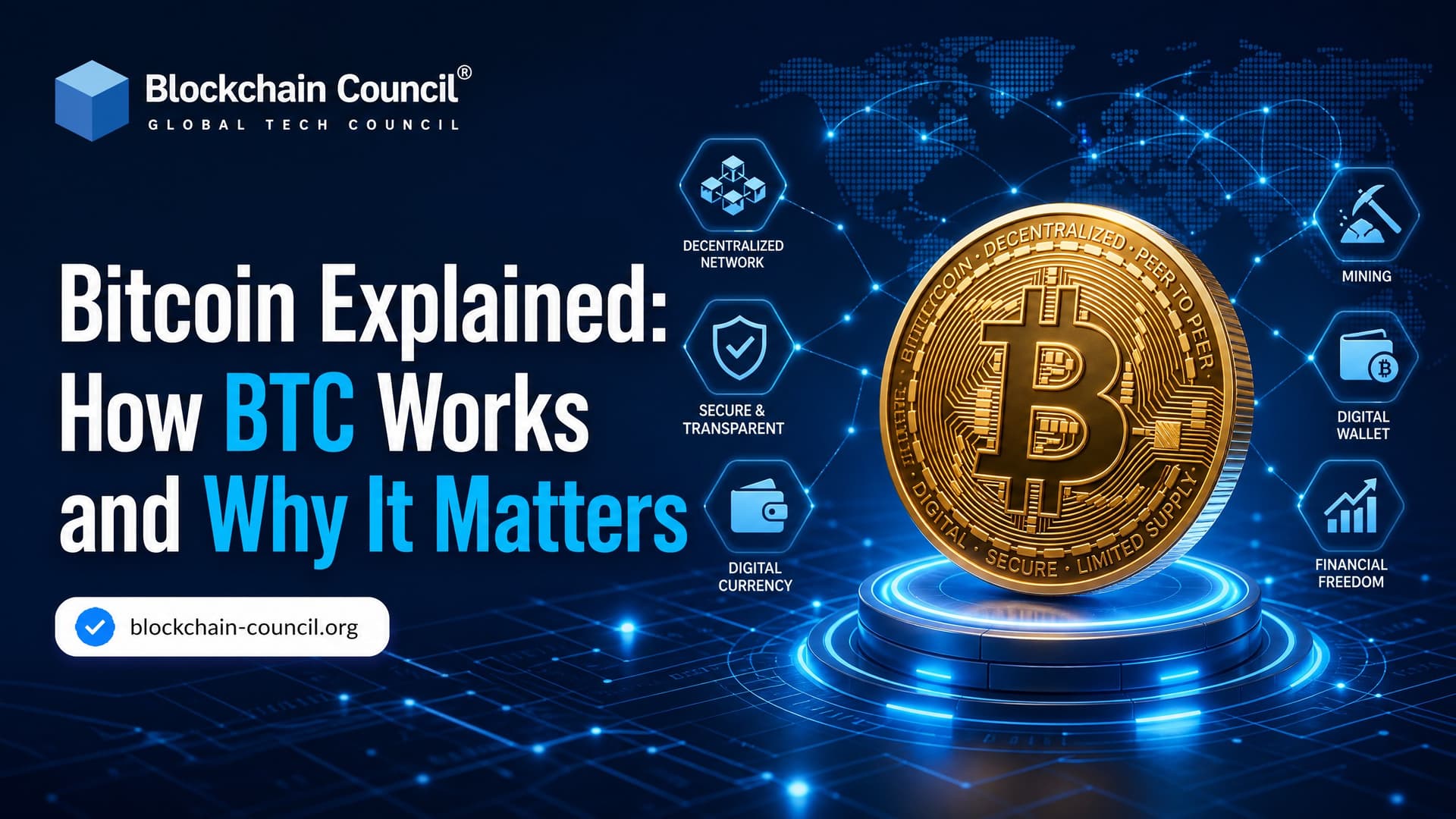
Bitcoin explained in plain terms: Bitcoin is decentralized digital money that runs on a public blockchain instead of a bank ledger. It lets you send value over the internet to another person without asking a bank, card network, payment processor, or government-run system for permission.
That sounds simple. The engineering behind it is not. Bitcoin combines cryptography, peer-to-peer networking, economic incentives, and a fixed monetary policy into one system. Satoshi Nakamoto published the Bitcoin white paper in 2008 and released the open-source software in 2009. Since then BTC has grown from a cypherpunk experiment into the largest cryptocurrency by market value.

What Is Bitcoin?
Bitcoin, usually written as BTC, is both a digital currency and a payment network. The currency is the asset you hold or transfer. The network is the infrastructure that records and verifies those transfers.
There are no physical bitcoins. What you own is a spendable balance recorded on Bitcoin's distributed ledger. Your wallet does not store coins the way a leather wallet stores cash. It stores private keys that prove you can spend specific bitcoin outputs on the blockchain.
Bitcoin's design reflects a clear idea: money can be governed by transparent rules rather than a central institution. The network does not rely on a bank administrator to approve transactions. It relies on thousands of nodes following the same consensus rules.
How Bitcoin Works
The Blockchain Ledger
Bitcoin uses a public blockchain. Transactions are grouped into blocks, and each new block links back to the block before it. This creates a chronological record of Bitcoin activity that starts with the genesis block mined on January 3, 2009.
Anyone can run a Bitcoin node and verify the ledger. That matters. If you run your own node, you do not have to trust an exchange dashboard or a block explorer to tell you whether a transaction is valid. Your node checks the rules itself.
Nodes and the Peer-to-Peer Network
Bitcoin is a peer-to-peer network. When you send BTC, your wallet creates a transaction and broadcasts it to nodes. Nodes check basic rules before relaying it further:
- Are the digital signatures valid?
- Are the inputs unspent?
- Does the transaction follow size and fee rules?
- Does it avoid creating bitcoin out of thin air?
Invalid transactions are rejected. Here is a detail beginners often run into: if a transaction fee is too low, Bitcoin Core may reject it with an error such as min relay fee not met. The protocol is unforgiving. It does exactly what the rules say.
Keys, Addresses, and Wallets
Bitcoin ownership depends on public-key cryptography. You control BTC by controlling a private key. Your wallet uses that key to sign a transaction. Other nodes can verify the signature without ever seeing your private key.
Most modern wallets show a recovery phrase, often based on the BIP39 standard. Write it down offline. Do not put it in cloud notes. Do not send it to support staff. If someone gets that seed phrase, they can take the funds. If you lose it and have no backup, nobody can reset your password.
Mining and Proof of Work
Bitcoin miners compete to create the next block using proof of work. They gather valid transactions, build a candidate block, and repeatedly hash the block data until they find a hash below the network target.
This takes real hardware and electricity. That cost is the point. Rewriting Bitcoin's history would force an attacker to redo the proof of work and outpace honest miners. The economics make large-scale attacks expensive.
When a miner finds a valid block, nodes verify it. If accepted, the miner receives the transaction fees plus the block subsidy. After the April 2024 halving, that subsidy became 3.125 BTC per block.
Fixed Supply and Halving
Bitcoin's maximum supply is 21 million BTC. More than 19 million BTC have already been mined, and new issuance slows over time through halving events that occur roughly every 210,000 blocks, or about every four years.
The final fraction of bitcoin is expected to be issued around the year 2140. This fixed supply is one reason people call Bitcoin digital scarcity. Unlike fiat currencies, BTC supply cannot be increased by a central bank meeting or an emergency policy vote.
Why Bitcoin Matters
It Introduced Scarce Digital Money
Before Bitcoin, digital files were easy to copy. Bitcoin solved the double-spend problem for money without a central authority. That was the breakthrough.
Scarcity is enforced by code, proof of work, and consensus. If someone tries to create 50 million BTC, nodes reject the block. Not politely. Automatically.
It Supports Permissionless Access
You do not need a bank account to receive bitcoin. You need a wallet and an internet connection. That gives Bitcoin relevance in regions where banking access is limited, capital controls are strict, or payment systems are unreliable.
This does not make Bitcoin perfect for every payment. Fees can rise during congestion, and confirmation times are not ideal for buying coffee on the base layer. But for censorship-resistant settlement across borders, Bitcoin has properties traditional systems do not offer.
It Enables Self-Custody
Self-custody means you hold your own keys and control your own funds. This reduces counterparty risk. No exchange freeze. No bank holiday. No account closure.
The trade-off is responsibility. If you send BTC to the wrong address, there is no chargeback desk. If malware steals your seed phrase, the blockchain will not care that it was unfair. For serious holdings, use hardware wallets, multisignature setups, and tested backup procedures.
It Resists Censorship
Bitcoin transactions that follow network rules are difficult to block globally. A government can regulate exchanges. A company can refuse service. But stopping the Bitcoin network itself is much harder because there is no single server to shut down.
This is one reason Bitcoin attracts activists, savers, developers, and institutions. It is also why regulators watch it closely. Permissionless systems can be used by ordinary people and by criminals. Both statements are true.
Common Bitcoin Use Cases
- Store of value: Many investors hold BTC as a long-term scarce asset, often comparing it to digital gold.
- Cross-border payments: Bitcoin can move value globally without correspondent banks, though exchange access and local regulation still matter.
- Trading and liquidity: BTC trades around the clock on major crypto exchanges and is usually the most liquid cryptocurrency.
- Corporate and institutional exposure: Some public companies hold BTC in treasury reserves, and spot Bitcoin ETFs approved in the United States in January 2024 gave traditional investors regulated market access.
- Collateral and DeFi: Bitcoin is used as collateral in some lending markets and is represented on other chains through wrapped assets, although those wrappers add custody and bridge risk.
Risks You Should Understand
Volatility
Bitcoin can move sharply in both directions. A 10 percent swing in a day is not unusual. If you need stable purchasing power next month, BTC is the wrong tool.
Regulation
Different countries treat Bitcoin differently. Some allow regulated trading and tax reporting. Others restrict or ban cryptocurrency activity. El Salvador made Bitcoin legal tender in 2021, then later revised its framework under international policy pressure, which shows how national adoption can shift.
Security and Custody
The Bitcoin protocol has been highly resilient, but users lose funds through phishing, fake wallet apps, exchange failures, weak backups, and bad operational habits. Most losses happen at the edges, not inside the core protocol.
Usability
Bitcoin still asks a lot from beginners. Addresses look strange. Fees change. Confirmations take time. Wallet backups are scary the first time. Better tools have helped, but self-custody is still a learned skill.
Bitcoin vs Traditional Money
Bitcoin is not just a faster bank transfer. It is a different monetary model.
- Fiat money: Issued by governments and managed through central banks and commercial banking systems.
- Bitcoin: Issued by protocol rules, verified by nodes, secured by proof of work, and capped at 21 million BTC.
That difference is why Bitcoin debates get intense. Supporters see neutral, rules-based money. Critics see volatility, energy use, regulatory risk, and limited everyday merchant adoption. My view: Bitcoin is strongest as censorship-resistant settlement and long-term digital scarcity. It is weaker as a daily retail payment method on the base chain.
How to Learn Bitcoin Professionally
If you want to work with Bitcoin rather than just watch price charts, learn the technical base first: UTXOs, private keys, transaction fees, mempools, confirmations, mining difficulty, and wallet security.
You can use this topic as a starting point for deeper study through certifications such as Certified Bitcoin Expert™, Certified Cryptocurrency Expert™, Certified Blockchain Expert™, and Certified Blockchain Developer™. For finance-focused roles, pair Bitcoin fundamentals with risk management, custody models, and regulatory awareness.
What to Do Next
Install a reputable Bitcoin testnet wallet, send a small test transaction, and inspect it on a block explorer. Then study how inputs, outputs, fees, and confirmations appear in the raw transaction. If you can explain that flow clearly, you already understand more about Bitcoin than most market commentators.
Related Articles
View All
Cryptocurrency
Crypto Explained: From Bitcoin to the Digital Asset Revolution
Crypto Explained in simple terms. Learn what cryptocurrency is, why Bitcoin was created, how coins differ from tokens, how wallets work, and the key benefits and risks.
Cryptocurrency
Bitcoin vs Ethereum: BTC, ETH, and Their Real Roles in Crypto
Bitcoin vs Ethereum explained with 2026 market data, BTC and ETH use cases, risks, developer relevance, and practical learning paths.

Cryptocurrency
Beyond Bitcoin: DeFi, Stablecoins, NFTs & the Expanding Crypto Ecosystem
Go Beyond Bitcoin and explore DeFi, stablecoins, NFTs, DAOs, tokenisation, and Web3. A clear guide to how the expanding crypto ecosystem works and how its parts connect.
Trending Articles
AWS Career Roadmap
A step-by-step guide to building a successful career in Amazon Web Services cloud computing.

Top 5 DeFi Platforms
Explore the leading decentralized finance platforms and what makes each one unique in the evolving DeFi landscape.

Can DeFi 2.0 Bridge the Gap Between Traditional and Decentralized Finance?
The next generation of DeFi protocols aims to connect traditional banking with decentralized finance ecosystems.