

Japan’s Finance Minister Backs Crypto for Diversification
 Michael Willson
Japan’s Finance Minister Katsunobu Kato has publicly stated that crypto assets can play a role in portfolio diversification. His remarks are important because they signal a shift in how one of the world’s largest economies views digital assets. For investors and professionals, this recognition from a top policymaker highlights the need to understand crypto as more than a speculative tool. Building this knowledge through a Crypto Certification can help individuals navigate opportunities as Japan and other nations open the door to wider adoption.
Why This Statement Matters
Japan has long been cautious about crypto. Yet its Finance Minister has now described digital assets as a potential source of real returns, particularly in a time when traditional investments are pressured by economic conditions. He acknowledged that crypto is volatile but said it could offer balance when added carefully to diversified portfolios.

This recognition is not just symbolic. It shows that regulators in Japan are moving toward integrating crypto into mainstream financial planning rather than keeping it at the margins.
The Economic Backdrop
Japan faces unique challenges. Its debt-to-GDP ratio exceeds 200 percent, one of the highest in the developed world. This creates pressure on government finances and raises concerns that traditional investments such as government bonds may not deliver strong returns in the future.
At the same time, the Japanese yen has faced weakness, leading investors to search for alternative assets. Against this backdrop, crypto offers both diversification and a potential hedge against macroeconomic risks.
Tax and Regulatory Reforms
One of the key barriers for Japanese investors has been taxation. Currently, crypto is subject to a progressive tax system with rates as high as 55 percent. To encourage growth, the government plans to switch to a flat tax rate of about 20 percent, similar to how equities are treated.
Alongside tax reform, Japan’s Financial Services Agency (FSA) is working to reclassify crypto assets under financial regulations. This would place them alongside traditional securities, offering more legal clarity. Together, these steps would make Japan a more attractive market for both retail and institutional investors.
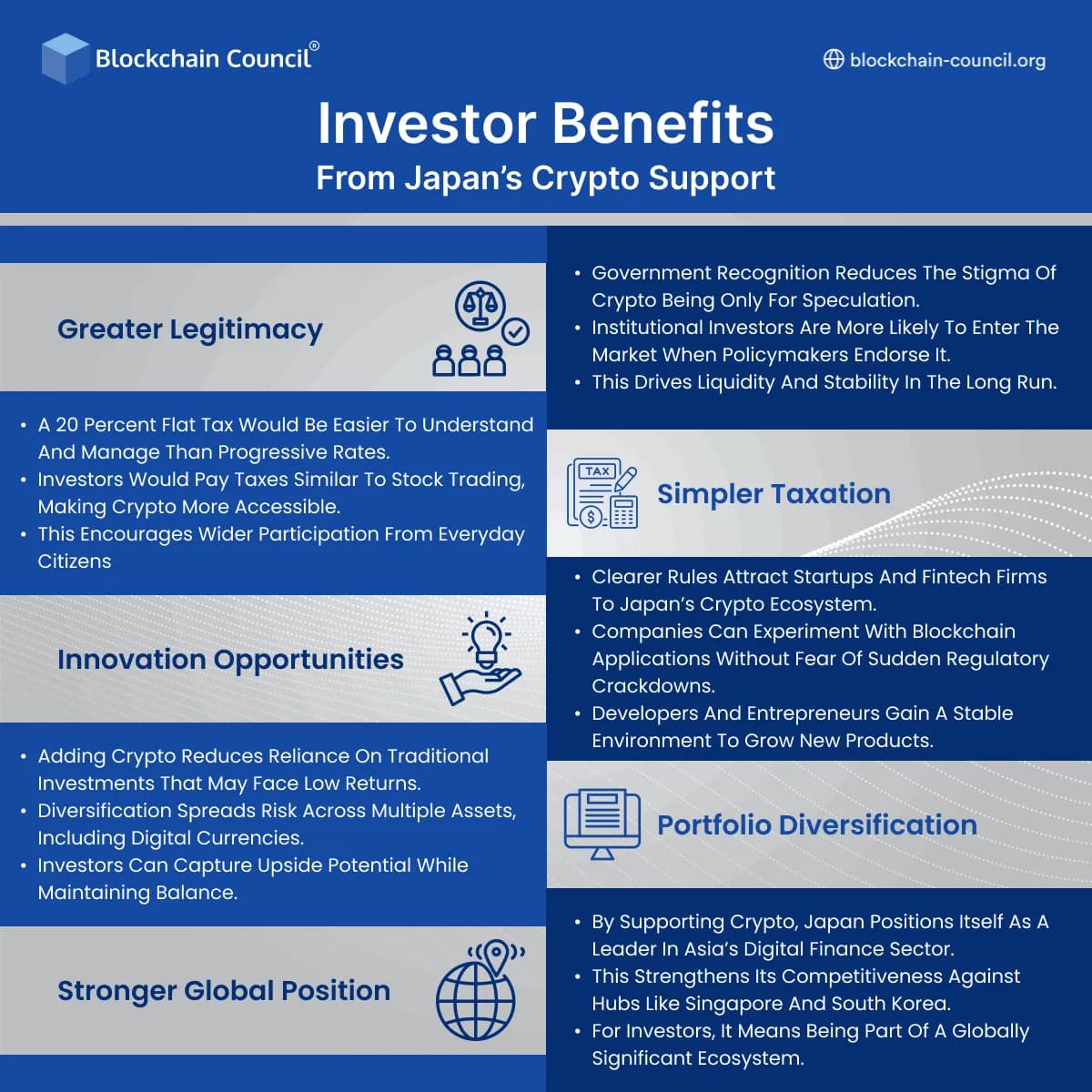
Investor Benefits from Japan’s Crypto Support
Greater Legitimacy
- Government recognition reduces the stigma of crypto being only for speculation.
- Institutional investors are more likely to enter the market when policymakers endorse it.
- This drives liquidity and stability in the long run.
Simpler Taxation
- A 20 percent flat tax would be easier to understand and manage than progressive rates.
- Investors would pay taxes similar to stock trading, making crypto more accessible.
- This encourages wider participation from everyday citizens.
Innovation Opportunities
- Clearer rules attract startups and fintech firms to Japan’s crypto ecosystem.
- Companies can experiment with blockchain applications without fear of sudden regulatory crackdowns.
- Developers and entrepreneurs gain a stable environment to grow new products.
Portfolio Diversification
- Adding crypto reduces reliance on traditional investments that may face low returns.
- Diversification spreads risk across multiple assets, including digital currencies.
- Investors can capture upside potential while maintaining balance.
Stronger Global Position
- By supporting crypto, Japan positions itself as a leader in Asia’s digital finance sector.
- This strengthens its competitiveness against hubs like Singapore and South Korea.
- For investors, it means being part of a globally significant ecosystem.
Corporate and Institutional Adoption
Japan is not just supporting crypto in theory. Corporate adoption is already underway. Metaplanet, a company holding Bitcoin as part of its treasury, was upgraded to mid-cap status on the FTSE Japan Index. This move shows that corporate crypto strategies are gaining legitimacy in mainstream markets.
At the same time, SBI Group, one of Japan’s leading financial firms, is actively partnering with global players like Ripple, Chainlink, Circle, and Startale. These collaborations are aimed at building strong crypto infrastructure for the country.
Stablecoin Development
Another important step is the approval of a yen-backed stablecoin. The FSA is preparing to give the green light to JPYC’s stablecoin by fall 2025. This would give citizens and businesses a reliable digital version of the yen for payments and settlements.
Stablecoins often act as bridges between traditional finance and crypto. With official backing, Japan could encourage everyday use of blockchain-based payments without the volatility of Bitcoin or Ethereum.
The Bigger Picture
Japan’s embrace of crypto diversification is part of a global trend. Policymakers everywhere are recognizing that digital assets are not going away. The key challenge is finding a balance between innovation and regulation.
For Japan, this balance involves promoting innovation while ensuring investor protection. By reforming taxes and setting clear rules, the government is making it easier for citizens and institutions to participate responsibly.
What Professionals Can Learn
For individuals working in finance, technology, or business, these developments highlight several lessons:
- Policy shapes opportunity: When governments create supportive environments, industries expand.
- Diversification is essential: Relying on traditional investments alone is increasingly risky.
- Education is a priority: Understanding blockchain and crypto markets is now a professional necessity.
- Corporate adoption signals change: When major firms adopt crypto, it validates long-term potential.
To prepare, professionals can upskill with targeted programs. The Data Science Certification equips analysts with tools to interpret crypto data trends. The Marketing and Business Certification provides strategies for leading growth in industries shaped by digital transformation.
Conclusion
Japan’s Finance Minister backing crypto as a diversification tool marks an important milestone. It shows that one of the world’s most advanced economies now sees digital assets as part of responsible financial planning. With tax reforms, regulatory clarity, and growing corporate adoption, Japan is positioning itself as a leader in digital finance.
Related Articles
View All
Cryptocurrency
Crypto Portfolio Diversification: Balancing Bitcoin, Altcoins, Stablecoins, and DeFi
Learn how crypto portfolio diversification balances Bitcoin, altcoins, stablecoins, and DeFi assets using risk tiers, liquidity, and sector exposure.

Cryptocurrency
DeFi Explained: Decentralized Finance, Protocols, and Use Cases
DeFi explained for professionals: learn how decentralized finance works, key protocols, real use cases, risks, and what to study next.

Cryptocurrency
Crypto Lending and Borrowing Explained: DeFi Loans, Rates, and Risks
Crypto lending and borrowing lets users earn yield or access liquidity through DeFi loans, but rates, collateral rules, and liquidations matter.
Trending Articles

Top 5 DeFi Platforms
Explore the leading decentralized finance platforms and what makes each one unique in the evolving DeFi landscape.
How Blockchain Secures AI Data
Understand how blockchain technology is being applied to protect the integrity and security of AI training data.
How to Create Claude Skills?
Claude Skills are one of the most important features Anthropic has introduced for users who want automation that is structured, consistent and reusable. Instead of giving Claude long instructions ever