

Risk Management With AI in Crypto Trading
 Suyash Raizada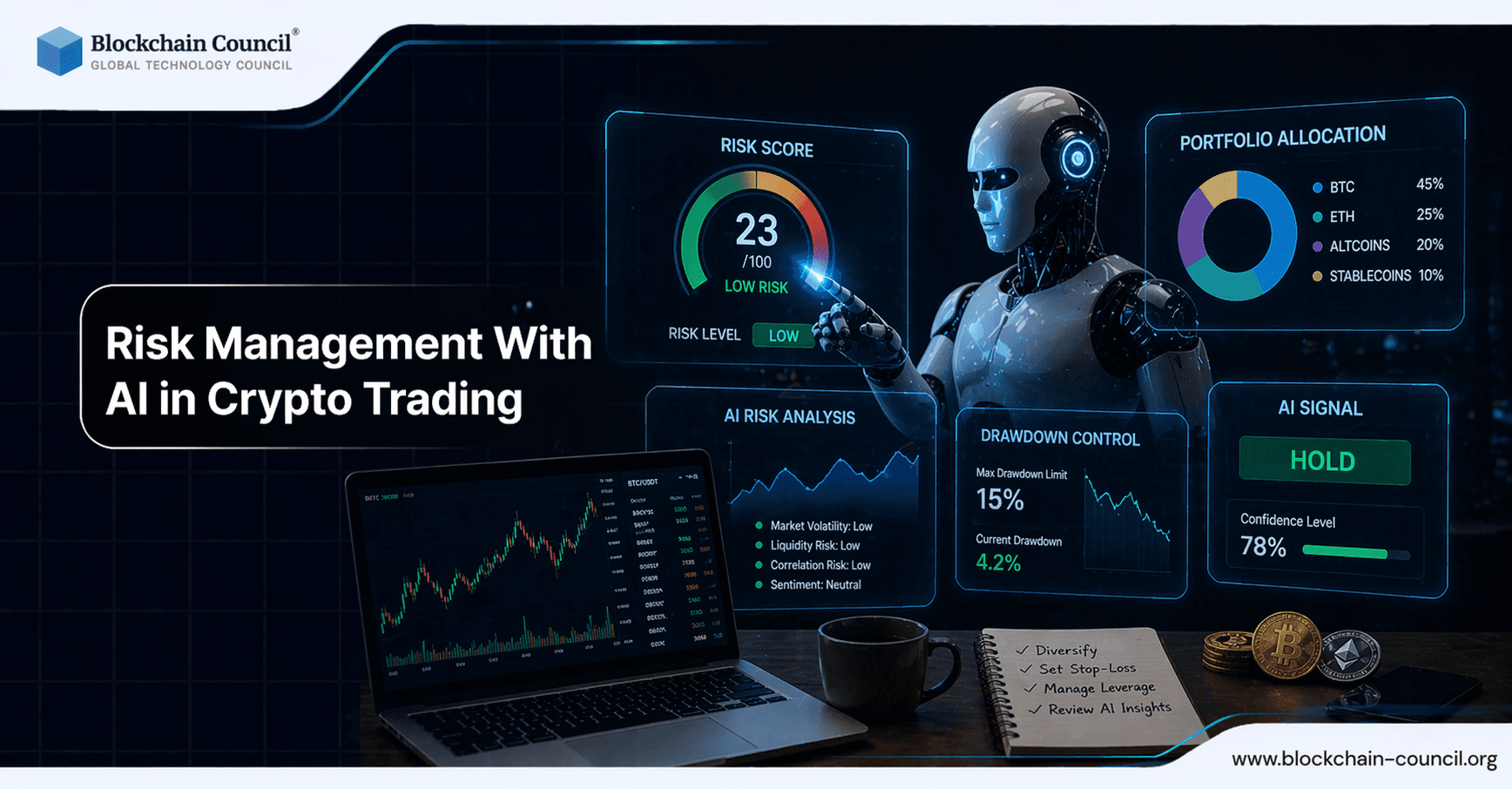
Risk management with AI in crypto trading has moved from an edge-case advantage to an operational necessity. Crypto markets run 24/7, volatility regimes can change in minutes, and liquidity conditions vary widely across venues. Automated and AI-assisted systems are estimated to account for roughly 65% of crypto trading volume, reflecting how strongly professionals rely on machines for speed, consistency, and risk controls.
This article breaks down three practical pillars of AI-driven risk control: volatility forecasting, dynamic position sizing, and stop-loss automation. It also covers where human oversight still matters and how to evaluate tools and models with a focus on survival over perfect prediction.

Manage crypto trading risks using AI-driven analytics, predictive models, and anomaly detection by mastering secure systems through an AI Security Certification, building trading models using a Python certification, and scaling strategies via a Digital marketing course.
Why Risk Management With AI in Crypto Trading Matters
AI trading bots can ingest and interpret far more inputs than a human trader, including price action, order book dynamics, cross-exchange spreads, on-chain indicators, and market sentiment. Modern systems can process over 100,000 market signals simultaneously, enabling real-time reactions that are difficult to replicate manually.
Industry practitioners increasingly emphasize that the goal is not to predict the market perfectly. Effective systems prioritize risk intelligence: controlling drawdowns, scaling exposure up or down with volatility, and enforcing exit logic consistently. Bots that ignore risk eventually fail, especially in crypto where volatility spikes can cascade through correlated assets.
Volatility Forecasting With AI: Turning Signals Into Risk Estimates
Volatility forecasting is the foundation for most AI risk controls. When a model can estimate near-term variance or the probability of extreme moves, it can adapt exposure, tighten stops, or pause trading when conditions become unstable.
What AI Models Typically Analyze
Volatility forecasting uses machine learning to map a broad set of signals into a risk estimate. Common inputs include:
Market microstructure: order book imbalance, spread changes, liquidity depth, and trade flow.
Price behavior: realized volatility, trend strength, mean reversion markers, and breakout frequency.
Cross-asset relationships: correlations between BTC, ETH, majors, and sector baskets.
Sentiment: news and social sentiment analysis that can precede abrupt repricing.
Regime detection: identification of trending, ranging, or volatility spike regimes to adjust parameters accordingly.
How Volatility Forecasts Are Used in Decision Systems
Volatility forecasting becomes actionable when tied to concrete rules. For example:
Risk-on when volatility is stable or declining, allowing wider stops and larger sizing.
Risk-off during spikes, reducing leverage, tightening stops, and limiting new entries.
Pause logic when predicted volatility exceeds a threshold, preventing trades in chaotic conditions.
Reinforcement learning is increasingly used to improve these policies through trial and feedback, helping bots adjust to new market regimes without constant manual retuning. This is particularly relevant in crypto, where structural shifts can follow regulatory headlines, macro events, or exchange-specific liquidity changes.
Dynamic Position Sizing: The Core of AI Risk Management
Position sizing is often the biggest determinant of long-term survival. Even a strategy with a positive edge can fail if sizing is too aggressive during high volatility periods. AI enhances position sizing by adapting exposure continuously based on volatility, account balance, and portfolio concentration.
Key Sizing Approaches AI Systems Implement
Volatility targeting: size positions so that expected volatility contribution stays near a target level.
Equity-based scaling: adjust size based on current account balance and drawdown status.
Correlation-aware limits: reduce combined exposure when assets become highly correlated.
Liquidity-aware sizing: cap size based on order book depth to reduce slippage and market impact.
A Simple Example of Volatility-Based Sizing Logic
Many professional systems apply a straightforward rule: when volatility rises, position size goes down. A simplified implementation might:
Estimate near-term volatility for the asset and timeframe.
Set a maximum risk per trade as a percentage of equity (for example, 0.25% to 1%).
Compute position size so that a stop-loss distance in price terms corresponds to the chosen risk amount.
Apply caps for leverage, liquidity, and portfolio concentration.
This is where risk management with AI in crypto trading becomes tangible: the model is not only identifying opportunities, but continuously shaping exposure so that any single adverse move does not threaten the overall portfolio.
Stop-Loss Automation: Consistent Exits in a 24/7 Market
Stop-loss automation is a practical advantage of AI systems because exits are time-sensitive, emotionally difficult, and operationally challenging in always-on markets. Automated stop logic reduces hesitation, enforces discipline, and executes with speed during fast-moving conditions.
Common AI-Driven Stop Types
Fixed threshold stops: exit if price drops by a set percentage or crosses a technical level.
Trailing stops: follow favorable price movement, locking in gains while allowing room for trend continuation.
Volatility-adjusted stops: widen in calm regimes and tighten during spikes to reduce tail risk.
Time-based stops: exit if the trade thesis fails to play out within a defined window.
Sentiment-augmented stops: tighten risk when sentiment deteriorates rapidly or when panic signals appear.
Why Automated Stops Can Outperform Manual Execution
In high-volatility conditions, precise execution timing can materially affect outcomes. Bots react instantly, place orders with predefined logic, and reduce slippage by selecting order types and execution paths more consistently than a human switching between charts and exchanges.
Stop-loss automation must still be engineered carefully. Overly tight stops cause frequent whipsaws, while overly wide stops can convert manageable losses into significant account-level drawdowns. The most effective systems tie stop parameters to volatility forecasts and liquidity conditions rather than arbitrary static numbers.
Portfolio Rebalancing and Drawdown Control: Risk Beyond Single Trades
Professional risk management operates at the portfolio level, not just the trade level. Many AI platforms support automated portfolio rebalancing to maintain target allocations and reduce concentration risk. Drawdown control policies are a core component of this approach.
Examples of portfolio-level controls include:
Maximum drawdown limits that reduce exposure or halt trading after losses exceed a defined threshold.
Risk parity or volatility-weighted allocation to prevent any single asset from dominating portfolio risk.
Regime-based allocation that shifts between spot, hedged, or lower-beta baskets when conditions deteriorate.
Decentralized approaches are also growing. Protocols like dHEDGE enable on-chain strategy replication and AI-influenced rebalancing, with reported total value locked around $100 million across strategies. This signals meaningful market adoption of transparent, composable portfolio automation.
AI Tools for Risk Management in Crypto Trading: What to Look For
Tool selection should map to your workflow, exchange coverage, and the degree of control you require. Common options in the current market include:
Kryll: ML-assisted strategy optimization and visual stop-loss logic building, suitable for no-code experimentation.
Coinrule: rule-based automation with AI signals, suitable for clear if-then risk rules such as percentage-drop exits.
3Commas: dynamic sizing, AI signals, and portfolio tools for active multi-exchange traders.
dHEDGE: on-chain strategy following and rebalancing for decentralized execution and transparency.
Stoic AI: volatility-based allocation and drawdown control oriented toward longer-term optimization.
BitsStrategy: end-to-end automation analyzing volatility, liquidity, and patterns with minimal configuration.
Evaluation Checklist for Professionals
Explainability: can you understand why the system changed sizing or triggered a stop?
Backtesting realism: are fees, slippage, funding rates, and latency included in results?
Execution quality: does it handle partial fills, liquidity gaps, and exchange downtime?
Risk limits: are there portfolio-level drawdown controls and exposure caps?
Security and compliance: API key permissions, logging, and governance structures for audits.
Regulatory scrutiny is increasing, particularly around black-box decisioning, bias, and accountability. Building processes for monitoring and audit trails is becoming as important as the model itself.
Build robust crypto trading strategies with AI-powered risk mitigation and portfolio optimization by gaining expertise through an AI Security Certification, developing trading systems via a Node JS Course, and promoting trading insights using an AI powered marketing course.
Conclusion: AI Risk Management Works Best as a Hybrid System
Risk management with AI in crypto trading is defined by three core capabilities: accurate enough volatility forecasting to detect regime changes, dynamic position sizing that controls exposure as conditions shift, and stop-loss automation that enforces exits consistently in a 24/7 environment. Tools like 3Commas, Kryll, Coinrule, Stoic AI, BitsStrategy, and decentralized options like dHEDGE show how these concepts are being operationalized across centralized and on-chain venues.
The most resilient approach is hybrid: use AI to monitor thousands of signals, execute rules with discipline, and optimize sizing and stops, while humans define risk limits, audit system behavior, and validate performance under stress. In a market where volatility is the norm, risk-first automation is not optional. It is the infrastructure that keeps strategies viable long enough to compound.
FAQs
1. What is risk management in AI crypto trading?
Risk management in AI crypto trading involves using algorithms to minimize losses and control exposure. AI analyzes market data and adjusts strategies in real time. This helps traders make more informed decisions.
2. How does AI help manage risk in crypto trading?
AI processes large volumes of data to identify patterns and predict market movements. It can automate stop-loss, position sizing, and portfolio adjustments. This reduces emotional trading and improves consistency.
3. Why is risk management important in crypto trading?
Crypto markets are highly volatile and unpredictable. Without risk management, traders can face significant losses. Proper strategies help protect capital and ensure long-term sustainability.
4. What are common AI risk management strategies in crypto?
Common strategies include stop-loss automation, portfolio diversification, and volatility analysis. AI can also adjust trading frequency based on market conditions. These methods help reduce exposure to sudden market shifts.
5. Can AI predict crypto market risks accurately?
AI can identify patterns and probabilities but cannot guarantee accuracy. Markets are influenced by unpredictable factors. AI should be used as a support tool, not a sole decision-maker.
6. How does AI use data for risk assessment?
AI analyzes historical prices, trading volume, sentiment data, and market indicators. It identifies trends and anomalies to assess risk levels. This allows for more informed trading decisions.
7. What is stop-loss automation in AI trading?
Stop-loss automation allows AI systems to exit trades when losses reach a predefined level. This prevents excessive losses during market downturns. It is a key component of risk control.
8. How does AI handle market volatility in crypto?
AI monitors volatility indicators and adjusts trading strategies accordingly. It may reduce position sizes or pause trading during extreme conditions. This helps limit risk exposure.
9. Can beginners use AI for crypto risk management?
Yes, many platforms offer user-friendly AI tools for beginners. These tools automate key risk management functions. However, users should still understand basic trading principles.
10. What are the risks of relying on AI in crypto trading?
Risks include overfitting, data inaccuracies, and unexpected market events. AI models may fail under unusual conditions. Human oversight is still necessary.
11. How does portfolio diversification reduce risk in AI trading?
Diversification spreads investments across multiple assets. AI can optimize asset allocation based on risk profiles. This reduces the impact of losses from a single asset.
12. What role does machine learning play in risk management?
Machine learning helps AI systems improve predictions over time. It adapts to new market data and evolving trends. This enhances the effectiveness of risk management strategies.
13. How can AI detect market anomalies?
AI uses pattern recognition and anomaly detection algorithms. It identifies unusual price movements or trading behavior. Early detection helps traders react quickly.
14. Is AI trading safer than manual trading?
AI trading can reduce emotional decision-making and improve consistency. However, it is not risk-free. Proper setup and monitoring are essential for safe operation.
15. How do AI models handle sudden market crashes?
AI systems can trigger stop-loss orders and reduce exposure quickly. Some models may pause trading during extreme volatility. This helps limit losses during crashes.
16. What tools are used for AI-based risk management in crypto?
Tools include trading bots, analytics platforms, and machine learning frameworks. These tools automate analysis and execution. Selection depends on user experience and needs.
17. Can AI help with long-term crypto investment strategies?
Yes, AI can analyze trends and optimize long-term portfolios. It helps balance risk and return over time. This supports strategic investment planning.
18. How do traders measure risk using AI?
AI uses metrics like volatility, drawdown, and risk-reward ratios. It evaluates potential outcomes and probabilities. This helps traders make data-driven decisions.
19. What is backtesting in AI crypto trading?
Backtesting involves testing AI strategies on historical data. It helps evaluate performance and identify weaknesses. This is essential before deploying live trading strategies.
20. What are best practices for using AI in crypto risk management?
Use reliable data sources, set clear risk parameters, and monitor performance regularly. Combine AI insights with human judgment. Continuous optimization improves results over time.
Related Articles
View All
Cryptocurrency
Crypto Options Trading: Calls, Puts, and Risk Management
Learn how crypto options trading works through calls, puts, Greeks, hedging strategies, and practical risk management rules for volatile markets.

Cryptocurrency
Crypto Margin Trading Explained: Leverage, Liquidation, and Risk
Crypto margin trading explained with leverage, liquidation, funding costs, and risk controls for traders who want practical, evidence-based guidance.

Cryptocurrency
Risk Management Strategies for Building a Long-Term Crypto Portfolio
Learn how to manage risk in a long-term crypto portfolio using allocation limits, diversification, DCA, custody controls, rebalancing, and compliance checks.
Trending Articles
How Blockchain Secures AI Data
Understand how blockchain technology is being applied to protect the integrity and security of AI training data.

Can DeFi 2.0 Bridge the Gap Between Traditional and Decentralized Finance?
The next generation of DeFi protocols aims to connect traditional banking with decentralized finance ecosystems.
How to Install Claude Code
Learn how to install Claude Code on macOS, Linux, and Windows using the native installer, plus verification, authentication, and troubleshooting tips.