

Explainable AI (XAI) for Crypto Trading
 Suyash Raizada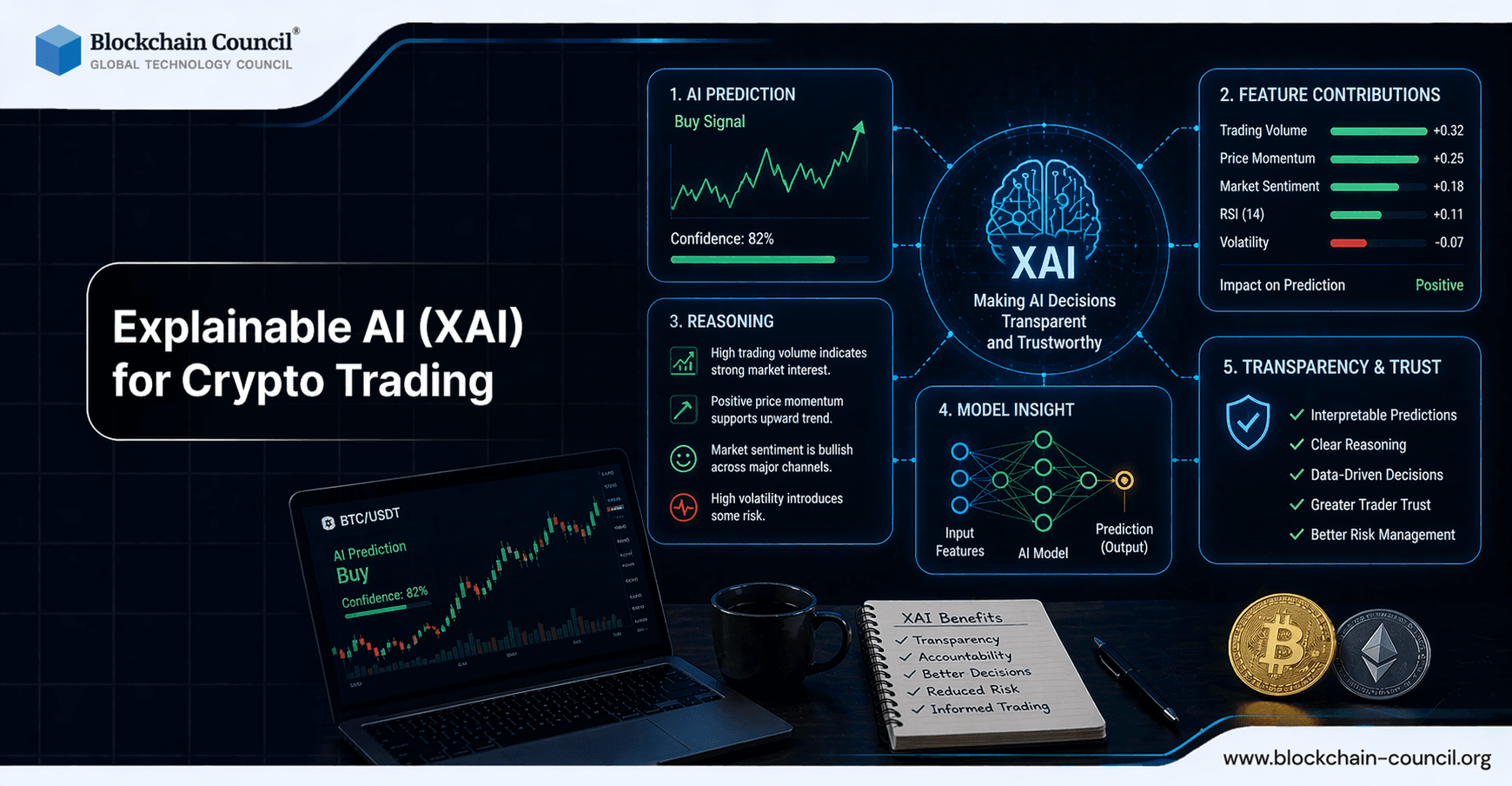
Explainable AI (XAI) for crypto trading is becoming a practical requirement, not a secondary concern. As AI systems handle a growing share of trading activity, traders, risk teams, and compliance leaders increasingly need to understand why a model issued a buy, sell, or hold decision. In volatile crypto markets, where sudden regime shifts and sentiment shocks are common, explainability reduces blind reliance on black-box signals and strengthens trust, auditability, and oversight.
Industry research indicates AI already drives the majority of trading activity, with AI handling approximately 89% of global trading volume by 2025 and around 65% of crypto trading volume in 2026. With the AI trading market projected to reach $35 billion by 2030, the need for interpretable decision-making grows alongside adoption. XAI addresses this by translating complex model behavior into human-understandable insights that can be validated, monitored, and governed. Use Explainable AI to understand trading model decisions, risk signals, and prediction outputs for better transparency in crypto markets by mastering secure AI systems through an AI Security Certification, building interpretable models using a Python certification, and scaling trading insights via a Digital marketing course.

Why explainability matters in crypto trading
Crypto trading has characteristics that amplify the risks of opaque automation:
High volatility and non-stationarity: models trained on one market regime may fail during sudden rallies, crashes, or liquidity changes.
Multi-source signals: price, order book data, on-chain flows, social sentiment, and news can conflict or shift quickly.
24/7 execution: automated strategies can accumulate losses rapidly if they drift or react incorrectly to a novel event.
Regulatory and institutional scrutiny: institutions typically require traceability for model risk management, surveillance, and post-trade review.
XAI helps by making model decisions interpretable at the level each stakeholder needs: traders want actionable rationale, risk teams want failure modes identified, and compliance teams want audit trails.
Current state of AI-driven crypto trading in 2026
Modern crypto trading platforms increasingly rely on:
Machine learning and deep learning for predictive analytics and pattern recognition
Neural networks to detect complex, nonlinear relationships
Natural language processing (NLP) for sentiment analysis across social media and news sources
Reinforcement learning for position sizing, execution, and adaptive strategies
These systems ingest real-time data from exchanges, social channels, news feeds, and blockchain networks. They can execute high-frequency trading, arbitrage, grid trading, and portfolio rebalancing at speeds that humans cannot match. Platforms commonly discussed in this context include Token Metrics, Cryptohopper, and Bitsgap, which illustrate how AI is operationalized for signal generation and strategy management.
Where XAI fits in the stack
XAI integrates into AI trading workflows to answer questions such as:
Signal explanation: Why did the model flag a price anomaly or trend reversal?
Feature influence: Which inputs mattered most - order book imbalance, on-chain inflows, or sentiment shifts?
Regime awareness: Is the model behaving differently during volatility spikes versus calm market conditions?
Action justification: Why did a reinforcement learning agent reduce risk or increase exposure?
XAI turns black-box outputs into interpretable decision narratives, metrics, and logs that can be tested against real market outcomes.
How explainable AI improves trust and governance
Trust in automated crypto trading is not just confidence in a system's track record. It is operational trust supported by evidence. XAI contributes in several concrete ways.
1) Better human oversight and fewer set-and-forget failures
Trading bots function like a GPS: they provide signals and execution assistance, but humans must set objectives and monitor feedback loops spanning data collection, analysis, signal generation, and execution. XAI strengthens this workflow by showing whether the model is reasoning in a way that aligns with the trader's strategy constraints.
For example, if a bot increases leverage after a sentiment spike, an explanation layer can reveal whether it did so because of genuine multi-source confirmation or because it overweighted a single noisy signal.
2) Stronger model risk management
Explainability supports model validation and monitoring practices, including:
Detecting feature drift when on-chain or social indicators change meaning over time
Identifying brittle rules such as overreactions to thin liquidity or manipulated sentiment
Stress testing by checking whether model reasoning remains stable during extreme events
Persistent challenges in AI-driven crypto trading include data quality, interpretability gaps, infrastructure resiliency, and regulatory uncertainty. XAI does not eliminate all of these, but it makes them visible and measurable.
3) Auditability for compliance and institutional adoption
As AI expands in crypto trading, institutions often require decision logs and traceability for:
Post-trade review and best execution analysis
Internal controls and escalation workflows
Documentation for model governance committees
XAI can provide structured explanations and evidence, including which data sources were used and which conditions triggered a trade. This is especially relevant as autonomous agents begin executing transactions using stablecoins and smart contracts for continuous rebalancing - for example, maintaining a fixed allocation such as 70% BTC and 30% altcoins.
Common XAI techniques used for crypto trading models
Explainable AI for crypto trading typically combines technical methods with user-facing interpretation. Common approaches include:
Global interpretability: understanding overall model behavior, such as which features generally drive predictions.
Local explanations: explaining a specific trade decision at a specific point in time.
Feature attribution: estimating each input's contribution to a prediction.
Surrogate models: approximating a complex model with a simpler, more interpretable one for analysis purposes.
Counterfactual explanations: describing what would need to change for the model to reach a different decision.
Effective XAI also includes clear reporting for non-ML stakeholders: concise rationales, confidence indicators, and decision boundaries aligned to trading rules and risk limits.
Real-world examples: what XAI can reveal
Several real-world systems illustrate where explainability adds practical value:
Supervised execution logic
Supervised learning execution systems aim to reduce slippage. In a crypto context, XAI can clarify which market microstructure signals drove an execution choice - such as spread widening, order book depth, or recent volatility. This helps traders verify that execution quality is improving rather than simply shifting risk elsewhere. JPMorgan's LOXM project is a well-cited example of this approach applied at scale.
Sentiment-driven decisions in NLP-based platforms
Platforms integrating NLP and blockchain analytics can benefit from XAI by showing how social and news signals were interpreted. An explanation can separate a genuine sentiment shift from a short-lived social spike, and confirm whether on-chain activity supported the move before a trade was executed.
Strategy selection and rotation
When an AI layer scores market conditions and rotates between strategies - such as trailing stops or dollar-cost averaging - XAI can expose the scoring logic: which volatility bands, trend indicators, or liquidity conditions triggered a strategy change. This supports deliberate configuration and ongoing oversight rather than assuming the system will always self-correct.
Reinforcement learning agents and adaptive behavior
Reinforcement learning agents learn through trial and error over many iterations. XAI can clarify why an agent reduced exposure during a volatility spike, or why it adjusted position sizing after repeated execution slippage. This context is critical in crypto markets, where conditions can change faster than retraining cycles allow.
Parameter recommendations across exchanges
When an AI assistant suggests parameters for grid trading or arbitrage across exchanges, XAI can trace signal origins and surface underlying assumptions. For example, it can show that a suggested grid width depends heavily on recent volatility that may be inflated by a temporary liquidity gap rather than a persistent structural condition.
Implementation checklist: adopting explainable AI for crypto trading
A practical rollout of explainable AI (XAI) for crypto trading typically includes the following steps:
Define what must be explained: entry signals, exits, position sizing, execution, or all of the above.
Standardize data lineage: document data sources (exchange feeds, on-chain, social, news) and cleaning rules to reduce data-quality disputes.
Choose explanation outputs by audience: traders need concise rationale, risk teams need diagnostics, and compliance needs structured logs.
Set monitoring metrics: drift detection, explanation stability, and performance segmented by market regime.
Keep a human in the loop: establish review thresholds for low-confidence trades or outlier market conditions.
Build trust in AI-driven crypto trading strategies using explainability techniques and model transparency by gaining expertise through an AI Security Certification, developing analytics systems via a Node JS Course, and promoting data-driven trading strategies using an AI powered marketing course.
Future outlook: XAI as crypto adopts autonomous agents
The next phase of AI and crypto convergence includes decentralized AI networks, increased tokenization, and autonomous agents capable of transacting directly using stablecoins via smart contracts. As these systems move from signal generation to direct on-chain execution, explainability becomes even more important because failures can be immediate and financially significant.
Automation is also reshaping job roles across trading operations. As routine analysis becomes increasingly automated, human judgment remains essential for setting objectives, interpreting risk, and responding to genuinely novel events. XAI supports hybrid human-AI workflows by making model reasoning legible, enabling domain experts to challenge outputs, correct assumptions, and refine strategies over time.
Conclusion
Explainable AI (XAI) for crypto trading is a direct response to the risks of black-box automation in volatile, always-on markets. With AI responsible for a large and growing share of trading activity, explainability helps traders and institutions understand model decisions, validate signals, manage drift, and satisfy governance requirements. The practical outcome is better oversight, stronger risk controls, and greater confidence in automated strategies - particularly as autonomous agents and smart-contract execution become more common.
For teams implementing AI trading systems, the goal should not be blind automation. It should be transparent automation that can be interrogated, audited, and improved over time.
FAQs
1. What is Explainable AI (XAI) in crypto trading?
Explainable AI refers to methods that make AI trading decisions understandable to humans. In crypto trading, it helps users see why a model made a specific trade. This improves transparency and trust.
2. Why is explainability important in AI crypto trading?
Crypto markets are volatile and high-risk. Explainability helps traders understand decisions and manage risk better. It also reduces blind reliance on automated systems.
3. How does XAI work in crypto trading systems?
XAI uses techniques to highlight key factors influencing predictions. These may include feature importance or decision paths. This allows users to interpret model behavior.
4. What are common XAI techniques used in crypto trading?
Common techniques include SHAP values, LIME, and feature importance analysis. These methods explain how inputs affect outputs. They help users understand model reasoning.
5. How does XAI improve trading decisions?
By explaining predictions, XAI helps traders validate or question AI outputs. It enables more informed decision-making. This reduces the risk of blindly following incorrect signals.
6. Can XAI help reduce losses in crypto trading?
XAI can highlight risky patterns and unexpected model behavior. This allows traders to adjust strategies. While it does not eliminate losses, it improves risk awareness.
7. What is the importance of XAI?
Feature importance shows which variables most influence a model’s decisions. In crypto trading, this could include price trends or volume. It helps users understand key drivers of predictions.
8. How does SHAP work in explainable AI?
SHAP assigns contribution values to each feature in a prediction. It shows how each factor impacts the outcome. This provides a detailed and consistent explanation.
9. What is LIME in XAI?
LIME explains individual predictions by approximating the model locally. It creates simpler models to interpret complex decisions. This helps users understand specific outputs.
10. Is XAI necessary for automated crypto trading bots?
Yes, especially for high-value or long-term strategies. XAI adds transparency and accountability. It helps users trust and monitor automated systems.
11. How does XAI improve trust in AI trading systems?
By making decisions transparent, users can verify and understand outcomes. This reduces uncertainty and skepticism. Trust increases when systems are explainable.
12. Can XAI detect errors in trading models?
Yes, XAI can reveal unexpected patterns or biases in model behavior. This helps identify errors or poor assumptions. Early detection improves model reliability.
13. What are the limitations of XAI in crypto trading?
XAI methods can be complex and may not fully explain all model behaviors. Some explanations are approximations. Interpretation still requires user understanding.
14. How does XAI support regulatory compliance in crypto trading?
Explainability helps meet transparency and audit requirements. Regulators may require clear reasoning behind automated decisions. XAI supports accountability and documentation.
15. Can beginners use XAI tools in crypto trading?
Yes, many platforms provide user-friendly XAI tools and visualizations. These simplify complex explanations. Beginners can gain insights without deep technical knowledge.
16. How does XAI handle real-time trading decisions?
XAI can generate explanations alongside predictions in real time. Performance depends on system design and resources. Efficient models balance speed and interpretability.
17. What role does XAI play in risk management?
XAI identifies factors contributing to risky trades. It helps traders adjust strategies based on insights. This improves overall risk control.
18. How can developers implement XAI in trading systems?
Developers can integrate libraries like SHAP or LIME into their models. They should design systems to log and display explanations. Proper integration enhances usability.
19. Does XAI affect trading performance?
XAI itself does not directly improve performance but supports better decisions. It may add computational overhead. The benefit lies in improved understanding and control.
20. What is the future of XAI in crypto trading?
XAI will become more integrated into trading platforms and tools. Advances will improve accuracy and usability of explanations. It will play a key role in transparent AI-driven trading systems.
Related Articles
View All
Cryptocurrency
Crypto Options Trading: Calls, Puts, and Risk Management
Learn how crypto options trading works through calls, puts, Greeks, hedging strategies, and practical risk management rules for volatile markets.

Cryptocurrency
Crypto Futures Trading Explained: Contracts, Hedging, and Speculation
Crypto futures trading lets you hedge, speculate, and trade crypto price movements without owning coins, but margin and liquidation risk demand discipline.

Cryptocurrency
Crypto Margin Trading Explained: Leverage, Liquidation, and Risk
Crypto margin trading explained with leverage, liquidation, funding costs, and risk controls for traders who want practical, evidence-based guidance.
Trending Articles
The Role of Blockchain in Ethical AI Development
How blockchain technology is being used to promote transparency and accountability in artificial intelligence systems.

Top 5 DeFi Platforms
Explore the leading decentralized finance platforms and what makes each one unique in the evolving DeFi landscape.
What is AWS? A Beginner's Guide to Cloud Computing
Everything you need to know about Amazon Web Services, cloud computing fundamentals, and career opportunities.