

Cryptocurrency vs CBDCs: Private Crypto and Central Bank Digital Currencies Compared

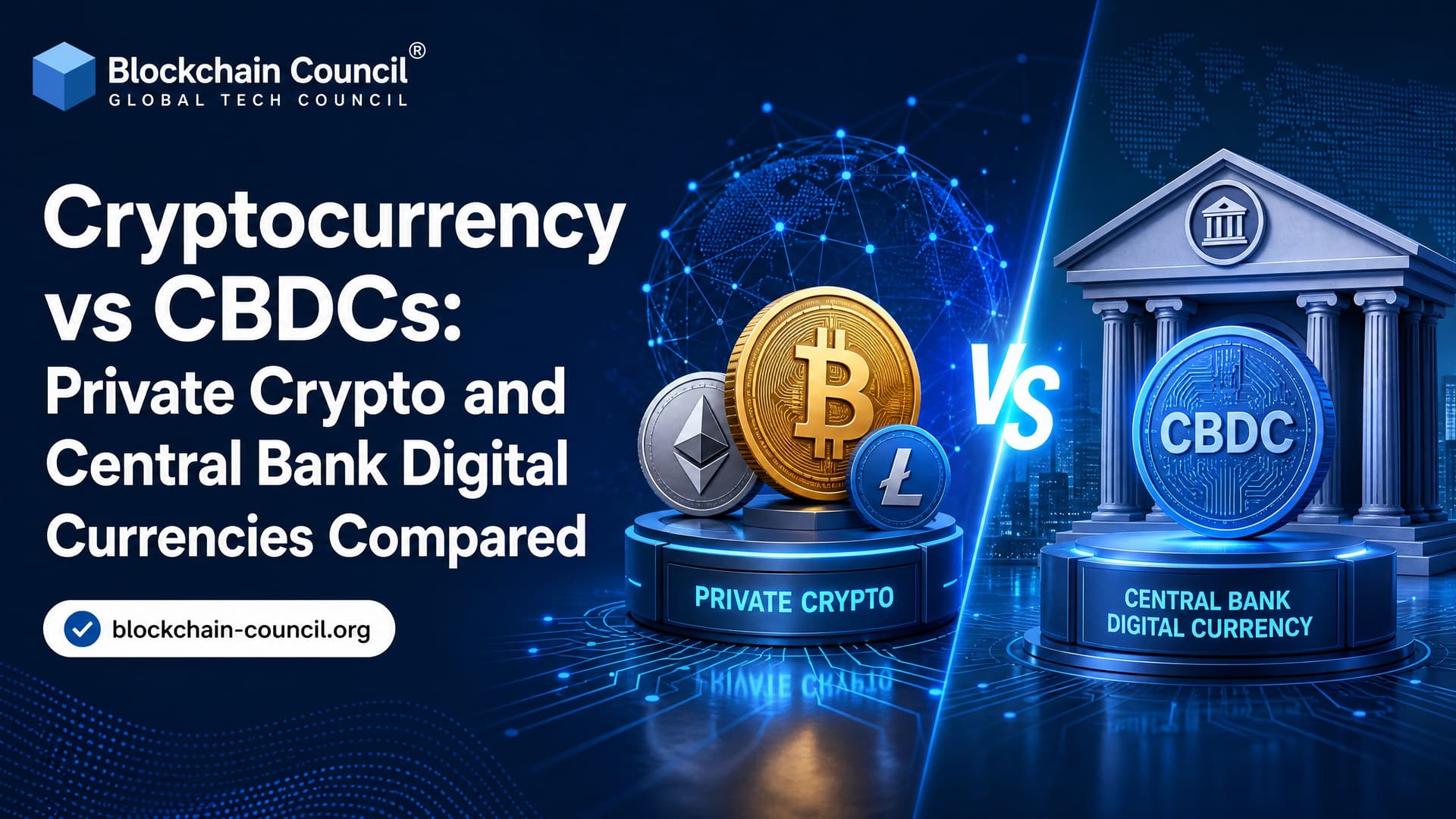
Cryptocurrency vs CBDCs is not just a technical comparison. It is a debate about who should issue money, who validates payments, how much privacy users deserve, and whether digital money should serve state policy or individual autonomy.
Both are digital. That is where the similarity mostly ends. A central bank digital currency, or CBDC, is sovereign money in digital form. Bitcoin, Ethereum, and other private cryptocurrencies are non-state assets that run on public blockchain networks. If you work in payments, compliance, Web3, banking, or blockchain development, you need to understand this split before you make design or policy decisions.

What Is a CBDC?
A CBDC is a digital version of a country's fiat currency, issued by its central bank. It is backed by the state the same way physical cash and central bank reserves are backed. Mastercard describes CBDCs as carrying the same guarantees as paper currency, and central banks generally frame them as digital cash for payments, settlement, and public sector use.
CBDCs are designed for two broad markets:
- Retail CBDCs: Used by individuals and businesses for everyday payments.
- Wholesale CBDCs: Used by banks and financial institutions for interbank settlement.
Most CBDC systems are centralized or permissioned. Some pilots use distributed ledger technology, but the central bank stays the issuer and final authority. That point matters. A CBDC can borrow blockchain-like components without becoming decentralized.
What Is a Private Cryptocurrency?
A private cryptocurrency is a digital asset created by a protocol, company, foundation, or open-source community rather than a central bank. Bitcoin is the cleanest example: no central issuer, a fixed supply schedule, public validation, and global peer-to-peer transfer.
Ethereum is different. It is not just money. It is a programmable blockchain where developers deploy smart contracts for tokens, decentralized finance, NFTs, and on-chain applications. Stablecoins such as USDT and USDC sit somewhere in the middle. They are privately issued tokens pegged to fiat currencies, but they still move across blockchain networks.
Here is the practical distinction. If you send ETH from MetaMask, you are using a public blockchain. If you use a retail CBDC wallet, you are using sovereign digital money under rules set by a central bank and regulated intermediaries.
Cryptocurrency vs CBDCs: The Core Differences
Issuer and Legal Status
CBDCs are issued by central banks. They are usually designed to be legal tender or close to cash-equivalent state money. Private cryptocurrencies are issued by protocols or private actors and are generally not legal tender, although some jurisdictions have experimented with Bitcoin as legal tender.
This changes user trust. With a CBDC, trust sits with the state. With Bitcoin, trust sits with code, consensus, incentives, and the network's history of operation.
Governance
CBDCs are centrally governed. A central bank can change access rules, reporting requirements, wallet limits, offline payment rules, or transaction monitoring policies.
Cryptocurrencies are governed by protocol rules, open-source communities, validators, miners, token holders, foundations, or a mix of these. Governance can be messy. That is the price of decentralization. Ethereum's move to Proof of Stake in 2022, for example, required broad client, validator, and ecosystem coordination rather than a simple executive order.
Technology Architecture
CBDCs often use centralized databases or permissioned ledgers. Access is controlled. Validation is limited to approved parties.
Public cryptocurrencies use permissionless blockchains. Anyone can run a Bitcoin node. Anyone can inspect Ethereum transactions. Ethereum mainnet uses chain ID 1, and every transaction includes gas mechanics shaped by EIP-1559, including maxFeePerGas and maxPriorityFeePerGas.
A small practitioner detail. If you have ever tried to speed up a stuck Ethereum transaction and seen replacement transaction underpriced, you have touched the public mempool reality that CBDC users will probably never see. In CBDC systems, users are shielded from that complexity. In crypto, you get control, but you also inherit operational risk.
Privacy
CBDCs raise serious privacy questions. Unlike physical cash, a CBDC can create a detailed digital record of who paid whom, when, how much, and possibly for what purpose. Some proposed designs include tiered privacy, where small payments receive more privacy and larger transfers require stronger identity checks.
Private cryptocurrencies are not fully anonymous. They are usually pseudonymous. Bitcoin and Ethereum transactions are public forever, but wallet addresses are not automatically tied to legal names. Chain analysis, exchange KYC records, and poor wallet hygiene can still identify users. To be blunt, if you reuse addresses and withdraw from a regulated exchange, your privacy is thinner than you think.
Policy Goals
CBDCs are built for policy goals: payment modernization, monetary control, financial inclusion, government disbursements, and settlement efficiency.
Crypto was built for a different purpose. Bitcoin's design rejects central monetary control. Ethereum enables programmable financial markets. Stablecoins serve traders, remittance users, and DeFi applications that need dollar-like liquidity on-chain.
Current State of CBDC and Crypto Adoption
The global CBDC race has moved from theory to pilots. The Atlantic Council CBDC Tracker has reported that around 137 countries, representing about 98% of global GDP, are exploring CBDCs. About 72 countries are in advanced phases such as pilot, proof of concept, development, or launch.
Retail CBDCs have launched in the Bahamas, Jamaica, and Nigeria. China has widely piloted the e-CNY. India has tested the e-rupee, with reported circulation reaching INR 10.16 billion, roughly USD 122 million, up 334% from 2024. Cambodia's Bakong is often discussed as a CBDC-like national payment infrastructure because it combines mobile wallets, QR payments, and bank interoperability.
The European Central Bank has been working toward a possible digital euro, with many observers placing a potential launch window around 2026 to 2029. The United States has taken a more cautious and political path. Reporting around July 2025 pointed to a halt in retail CBDC development under President Trump and a stronger focus on stablecoin regulation, including the GENIUS Act passed by the U.S. House during Crypto Week.
Crypto adoption is also large. Industry estimates placed global crypto users at around 560 million in 2024. Use is driven by investment, stablecoin transfers, DeFi, trading, and protection against weak local currencies in some markets.
CBDC Use Cases
CBDCs make the most sense where governments need official digital money with controlled access and compliance built in.
- Retail payments: Digital wallets for daily purchases, transit, and merchant payments.
- Government transfers: Direct benefit payments, tax refunds, subsidies, and emergency support.
- Financial inclusion: Low-cost wallets for people without traditional bank accounts.
- Wholesale settlement: Faster interbank settlement and cross-border experiments between central banks.
- Programmable policy: Spending limits, expiry dates, or targeted payments, although these features are controversial.
The wrong use case? Speculation. A CBDC is not designed to be a high-risk asset. It should hold the same nominal value as the fiat currency it represents.
Cryptocurrency Use Cases
Private crypto fits different needs.
- Store of value: Bitcoin is often used as a long-term asset, especially by users worried about inflation or capital controls.
- DeFi: Ethereum and other networks support lending, borrowing, automated market makers, derivatives, and collateral markets.
- Stablecoin transfers: USDT and USDC are widely used for round-the-clock dollar-denominated settlement across borders.
- Censorship-resistant payments: Users can transact without asking a bank or payment processor for permission.
- Tokenization: Public blockchains support ERC-20 tokens, ERC-721 NFTs, and smart contract-based assets.
The wrong use case? Putting payroll reserves into a volatile token without treasury controls. Crypto gives you speed and openness, but it does not remove market risk, smart contract risk, or custody risk.
Stablecoins Sit Between CBDCs and Crypto
Stablecoins deserve their own category. They are private tokens pegged to fiat currencies. They are not CBDCs because no central bank issues them. They are not like Bitcoin either, because their value depends on reserves, issuer controls, redemption rules, and regulation.
In practice, stablecoins are the most used form of blockchain-based money for trading, DeFi liquidity, and cross-border settlement. They are faster to deploy than CBDCs and easier for Web3 developers to integrate. But they carry issuer risk. If reserves, audits, or redemption mechanisms fail, the peg can break.
Privacy and Control: The Real Debate
The central tension in cryptocurrency vs CBDCs is control.
CBDCs can improve payment efficiency and give central banks better data. They can also make financial surveillance easier. Programmable limits may help with fraud prevention or targeted aid, but they can also restrict lawful spending if misused.
Cryptocurrencies reduce dependence on central authorities. They support open access and self-custody. Yet they can also enable scams, sanctions evasion, tax avoidance, and unstable capital flows in weaker economies.
So the better question is not which is superior? Ask this instead: which trust model fits the job?
- Choose CBDC architecture when legal tender status, central bank backing, and public policy integration are required.
- Choose public blockchain infrastructure when openness, composability, censorship resistance, and global developer access matter.
- Choose regulated stablecoins when you need fiat-like value on-chain but cannot wait for a national CBDC rollout.
What Professionals Should Learn Next
If you work in finance or technology, do not treat CBDCs and cryptocurrencies as interchangeable digital money. They sit on opposite ends of the governance spectrum.
For policy, compliance, or enterprise strategy, study CBDC architecture, privacy models, and stablecoin regulation. For development, build on public networks first. Deploy an ERC-20 token on a testnet, inspect transactions in a block explorer, and learn why private key custody is still the part that breaks most beginner projects.
Relevant Blockchain Council learning paths include the Certified Cryptocurrency Expert™ (CCE) for crypto markets and digital asset fundamentals, the Certified Blockchain Expert™ (CBE) for blockchain architecture, and the Certified Blockchain Developer™ (CBD) if you want hands-on smart contract and decentralized application skills.
Your next step: map one payment use case you care about, then decide whether it needs sovereign control, private stablecoin rails, or public blockchain settlement. That single design choice will shape everything that follows.
Related Articles
View All
Cryptocurrency
The Future of Crypto: Regulation, Institutional Adoption & Digital Assets
Explore the Future of Crypto, from regulation and spot ETFs to stablecoin payments, CBDCs, and tokenised assets. A clear, up-to-date guide for beginners and professionals.

Cryptocurrency
Crypto Explained: From Bitcoin to the Digital Asset Revolution
Crypto Explained in simple terms. Learn what cryptocurrency is, why Bitcoin was created, how coins differ from tokens, how wallets work, and the key benefits and risks.

Cryptocurrency
Cryptocurrency Exchanges Explained: How to Buy, Sell, and Trade Crypto
Learn how cryptocurrency exchanges work, how to buy and sell crypto, compare CEX and DEX platforms, manage trading risk, and store assets safely.
Trending Articles
The Role of Blockchain in Ethical AI Development
How blockchain technology is being used to promote transparency and accountability in artificial intelligence systems.
AWS Career Roadmap
A step-by-step guide to building a successful career in Amazon Web Services cloud computing.
How Blockchain Secures AI Data
Understand how blockchain technology is being applied to protect the integrity and security of AI training data.