

Cryptocurrency Exchanges Explained: How to Buy, Sell, and Trade Crypto

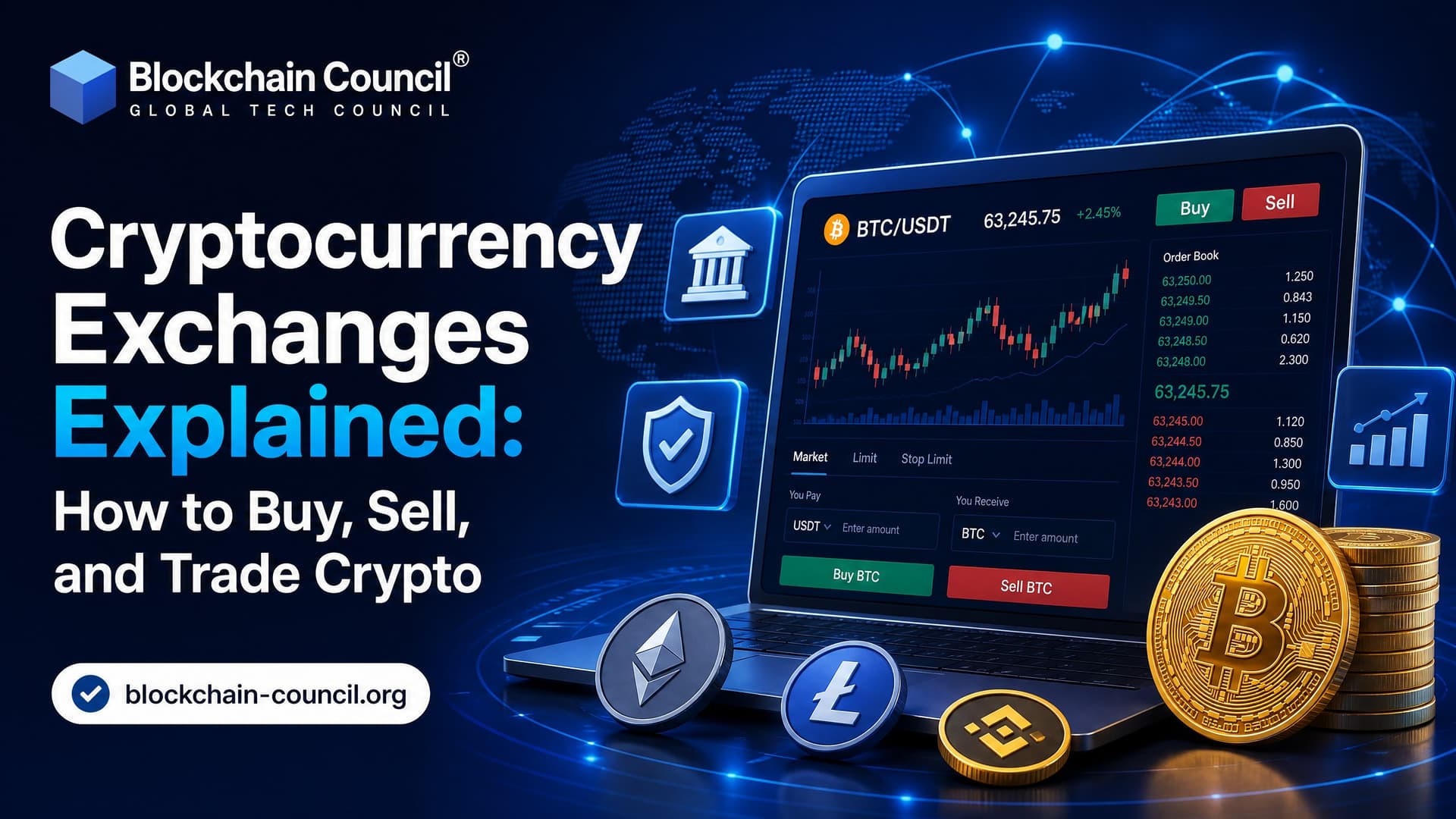
Cryptocurrency exchanges are online marketplaces where you can buy, sell, trade, and convert crypto assets such as Bitcoin, Ethereum, stablecoins, and thousands of other tokens. If you have used an online brokerage account, the basic idea will feel familiar: create an account, fund it, choose an asset, place an order, and manage the position.
The differences matter, though. Crypto markets run 24 hours a day, price swings can be sharp, wallet withdrawals are irreversible, and investor protections vary by country and platform. A careful exchange workflow is not optional. It is the difference between controlled participation and avoidable loss.

What Is a Cryptocurrency Exchange?
A cryptocurrency exchange is a digital platform that connects buyers and sellers of crypto assets. You can trade crypto for fiat currencies such as USD or EUR, swap one cryptocurrency for another, or convert holdings into stablecoins like USDT or USDC.
Most exchanges provide:
- Account dashboards for balances, deposits, withdrawals, and transaction history.
- Trading screens with charts, order books, and buy or sell forms.
- Fiat on-ramps such as bank transfers, cards, or supported payment apps.
- Crypto wallets controlled by the exchange for deposits and trades.
- Security controls such as two-factor authentication, withdrawal allowlists, and device management.
An exchange is not just an app. It is also a counterparty, a custodian, and your gateway to market access. Regulatory standards and investor protections differ across jurisdictions, so the same brand can offer very different products depending on where you sign up. That point deserves attention.
Centralized Exchanges vs Decentralized Exchanges
Centralized Exchanges (CEX)
A centralized exchange is run by a company that manages user accounts, custody, order matching, and withdrawals. Coinbase, Kraken, Binance, and other large platforms follow this general model, though their services differ by jurisdiction.
Centralized exchanges are usually the better starting point if you are new. They offer fiat deposits, customer support, simplified buy screens, and account recovery. The trade-off is custody. If your coins sit on the exchange, you rely on that company to secure them and honor withdrawals.
To be blunt, a reputable CEX is convenient for buying your first crypto. It is not the best place to store long term holdings unless you have a clear reason.
Decentralized Exchanges (DEX)
A decentralized exchange lets you trade directly from a wallet such as MetaMask through smart contracts. Uniswap on Ethereum is a common example. You keep custody of your assets, connect your wallet, approve token spending, and confirm swaps on-chain.
DEXs are powerful, but they are less forgiving. If MetaMask is connected to Ethereum mainnet, which uses chain ID 1, and you try to swap without ETH for gas, you may see an error such as insufficient funds for gas even when your token balance looks fine. Beginners often confuse token balance with gas balance. They are not the same.
How to Choose a Cryptocurrency Exchange
Do not choose an exchange only because a friend uses it or because a token is trending there. Use a short checklist.
- Regulatory status: Check whether the exchange operates legally in your country and follows Know Your Customer, or KYC, requirements.
- Security history: Look for two-factor authentication, withdrawal allowlists, proof of reserves where available, and a clear incident response record.
- Supported assets: Confirm that the exchange lists the coins and trading pairs you need, such as BTC/USD, ETH/USDC, or SOL/EUR.
- Fees and spreads: Compare trading fees, card purchase costs, withdrawal fees, and the spread shown on simple buy screens.
- Liquidity: Higher liquidity usually means tighter spreads and less slippage on large orders.
- Withdrawal support: Make sure you can withdraw assets to a personal wallet and select the correct blockchain network.
Here is a practical warning from real desk work. USDT can exist on Ethereum as ERC-20, on Tron as TRC-20, and on several other networks. If you withdraw to the wrong network, recovery may be impossible or expensive. Always match the asset and network on both the sending and receiving side.
How to Buy Cryptocurrency on an Exchange
The buying process is simple once you know the sequence. Follow it slowly the first few times.
- Create an account: Sign up with your email, set a strong password, and enable two-factor authentication before depositing funds.
- Complete KYC: Upload the required identification documents and personal information. This is standard on regulated centralized exchanges.
- Deposit funds: Add fiat using a bank transfer, card, or supported payment method. You can also deposit crypto from another wallet.
- Select the asset: Search for the cryptocurrency you want, such as Bitcoin or Ethereum, and choose the correct pair.
- Choose order type: Use a market order for immediate execution or a limit order to set your preferred price.
- Review details: Check the amount, fee, estimated received asset, and trading pair.
- Confirm the order: Once filled, the crypto appears in your exchange balance.
A market order buys at the best available price in the order book. It is fast, but the final price can move if liquidity is thin. A limit order lets you set the maximum price you are willing to pay. It may not fill, but it gives you more control.
If you are buying for long term storage, withdraw to a wallet you control after the trade settles. For larger holdings, a hardware wallet is usually a better choice than keeping assets on an exchange.
How to Sell Cryptocurrency on an Exchange
Selling is the reverse process, but the details still matter.
- Move crypto to the exchange: If your asset is in a private wallet, copy the correct deposit address from the exchange and verify the network.
- Wait for confirmations: The deposit will appear after the exchange receives enough blockchain confirmations.
- Open the sell screen: Choose the asset and the currency you want to receive, such as BTC to USD or ETH to USDC.
- Select market or limit: Use market if speed matters. Use limit if price matters more.
- Confirm the sale: Review fees, quantity, and expected proceeds.
- Withdraw funds: Send fiat to your bank account if supported, or withdraw crypto to your own wallet.
For assets such as XRP or Stellar, watch for memo or tag requirements when depositing to an exchange. Skipping the tag is a common mistake. The transaction may reach the exchange wallet, but the platform may not know which customer account to credit.
How to Trade Crypto: Tools, Strategies, and Risk
Trading crypto means buying and selling digital assets on an exchange to profit from price changes. It can involve spot trading, derivatives, arbitrage, or longer term allocation. The tool is easy to access. The discipline is hard.
Common Exchange Tools
- Order book: Shows current bids and offers from market participants.
- Candlestick chart: Displays price movement over selected timeframes.
- Market order: Executes quickly at available prices.
- Limit order: Executes only at your chosen price or better.
- Stop loss order: Helps exit a position if price moves against you.
- Portfolio page: Tracks holdings, profit and loss, and transaction history.
Popular Trading Approaches
- Dollar cost averaging: Buy a fixed amount at regular intervals. This fits long term investors better than screen watching.
- Breakout trading: Enter when price moves above or below a key level with volume confirmation.
- Trend following: Trade in the direction of a sustained move instead of trying to catch exact tops or bottoms.
- Arbitrage: Buy on one exchange and sell on another when prices differ. Fees, transfer time, and withdrawal limits often erase the apparent profit.
My view: most beginners should avoid high frequency trading, high leverage, and thinly traded altcoins. Start with spot markets, small size, and a written plan. If you cannot explain why you entered a trade and where you will exit, you are gambling.
Risk Management Rules You Should Not Ignore
Crypto markets can move while you sleep. Build rules before you need them.
- Only risk money you can afford to lose: Crypto is speculative, even when the asset is well known.
- Use position sizing: Do not put a large share of your portfolio into one trade.
- Set stop losses: Decide your invalidation point before entering.
- Take profits in stages: Waiting for the exact top is not a strategy.
- Separate trading and storage: Keep only active trading funds on an exchange.
- Track taxes: Sales, swaps, and some crypto income may create taxable events depending on your jurisdiction.
- Beware fake support: Real exchanges will not ask for your seed phrase. Never share it.
Risk awareness sits at the center of any serious crypto education, and that matches professional practice. The best traders are not the ones who win every trade. They are the ones who survive losing streaks without blowing up their account.
Where Cryptocurrency Exchanges Are Heading
Expect stronger compliance, better custody options, and more education inside exchange platforms. KYC requirements are already common on major centralized exchanges. At the same time, demand for self-custody and decentralized trading keeps growing.
Hybrid models are likely to become more common. These may combine familiar exchange interfaces with non-custodial settlement or clearer proof of reserves. Retail access to staking, derivatives, and structured products will also expand, but regulators will keep a close watch.
For professionals, this creates a skills gap. It is no longer enough to know how to click Buy. You need to understand market structure, custody, token standards, wallet security, smart contract risk, and compliance basics.
Build Your Crypto Exchange Knowledge the Right Way
If you want a structured path, pair hands-on exchange practice with formal study. Blockchain Council's Certified Cryptocurrency Expert™ (CCE) covers market fundamentals, trading concepts, wallets, and crypto asset behavior. If you want to understand the underlying networks behind exchanges, add the Certified Blockchain Expert™ (CBE). Developers who plan to work with DEXs or token contracts should also explore smart contract focused training.
Your next step is simple. Open a small account on a reputable exchange, enable two-factor authentication, place a tiny limit order, withdraw a small amount to your own wallet, and document every step. That single exercise teaches more than passive reading, and it gives you the practical base for serious crypto learning.
Related Articles
View All
Cryptocurrency
Decentralized Exchanges (DEX) Explained: Peer-to-Peer Crypto Trading
Decentralized exchanges let users trade crypto directly from wallets through smart contracts. Learn how DEXs work, key risks, market trends, and use cases.

Cryptocurrency
Crypto Explained: From Bitcoin to the Digital Asset Revolution
Crypto Explained in simple terms. Learn what cryptocurrency is, why Bitcoin was created, how coins differ from tokens, how wallets work, and the key benefits and risks.

Cryptocurrency
Crypto Lending and Borrowing Explained: DeFi Loans, Rates, and Risks
Crypto lending and borrowing lets users earn yield or access liquidity through DeFi loans, but rates, collateral rules, and liquidations matter.
Trending Articles
The Role of Blockchain in Ethical AI Development
How blockchain technology is being used to promote transparency and accountability in artificial intelligence systems.

Top 5 DeFi Platforms
Explore the leading decentralized finance platforms and what makes each one unique in the evolving DeFi landscape.
How Blockchain Secures AI Data
Understand how blockchain technology is being applied to protect the integrity and security of AI training data.