

Cryptocurrency vs Blockchain: Key Differences Every Beginner Should Know

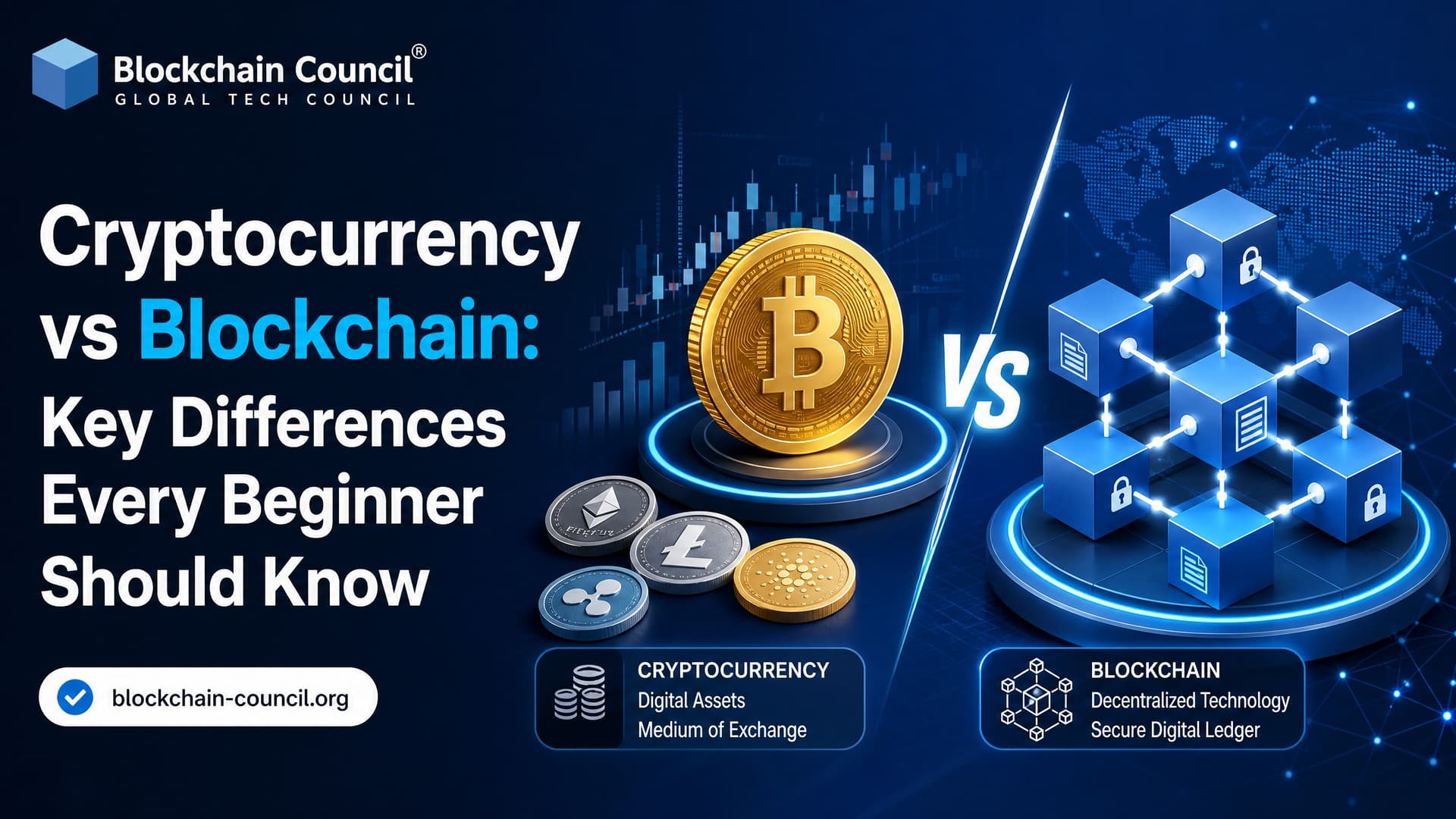
Cryptocurrency vs blockchain is one of the first distinctions you need to get right. Blockchain is the shared record-keeping technology. Cryptocurrency is a digital asset that usually runs on that technology. Confuse the two, and you will misunderstand how Bitcoin works, why enterprises build private ledgers, and why regulators treat tokens differently from software infrastructure.
Short version: blockchain is the rail system, cryptocurrency is one type of train running on it. Not every rail system carries crypto. But almost every cryptocurrency needs some kind of trusted ledger to prove who owns what.

What Is Blockchain?
A blockchain is a distributed digital ledger that records data across many computers, often called nodes. Each new batch of data is grouped into a block, and each block is cryptographically linked to the one before it. That link makes the history tamper-evident. If someone changes an old record, the change breaks the chain of hashes and honest nodes can reject it.
A common way to describe blockchain is a decentralized ledger of transactions across a peer-to-peer network, where participants confirm transactions without a central clearing authority. Another useful framing is to think of it as a distributed database. The key idea is shared verification, not digital coins.
Public and Private Blockchains
Blockchains are not all the same. Beginners often picture Bitcoin or Ethereum, but enterprises usually care about access control.
- Public blockchains: Networks such as Bitcoin and Ethereum are open for anyone to read, verify, and often submit transactions to. Ethereum mainnet uses chain ID 1, a detail you will see when configuring wallets or deployment tools.
- Private or permissioned blockchains: These restrict who can join, read, or write data. They are common in banking, supply chain, healthcare, and consortium projects.
Here is a practical detail that catches new developers. If you deploy a smart contract to Ethereum using Hardhat or Foundry and your wallet balance is too low, the transaction may fail with an error like insufficient funds for intrinsic transaction cost. That is not a blockchain problem. It means the network requires gas fees, paid in the native cryptocurrency, to include your transaction.
What Is Cryptocurrency?
Cryptocurrency is a digital or virtual asset secured by cryptography. It usually runs on a blockchain or a similar distributed ledger. Bitcoin is the best-known example. Ether is the native asset of Ethereum. Stablecoins, governance tokens, and utility tokens are other common categories.
Cryptocurrencies can serve different purposes:
- Medium of exchange: Users send value directly to another address.
- Store of value or speculative asset: Traders and investors hold tokens hoping they increase in price.
- Network incentive: Public blockchain validators or miners may receive rewards in the native coin.
- Utility token: Some tokens pay fees, grant access to applications, or work as collateral in decentralized finance.
This is where regulation enters the picture. Blockchain software is generally treated as technology. Cryptocurrency is more often treated as a financial asset, with tax, anti-money-laundering, commodities, or securities implications depending on the jurisdiction and token design.
Cryptocurrency vs Blockchain: The Core Difference
The cleanest way to understand cryptocurrency vs blockchain is this: blockchain records and verifies data, while cryptocurrency represents value on top of that record.
You can build a blockchain system without a cryptocurrency. Many enterprise ledgers do exactly that. A hospital network might use a permissioned ledger for audit trails. A university might issue tamper-evident certificates. A logistics company might track goods from factory to warehouse. None of these examples require a coin traded on an exchange.
The reverse is harder. A cryptocurrency needs a ledger so the network can answer basic questions. Who owns this asset? Was it already spent? Is the transaction valid? Without that shared history, digital money becomes easy to copy.
Side-by-Side Comparison
| Aspect | Blockchain | Cryptocurrency |
|---|---|---|
| Definition | Distributed ledger or database for recording and verifying data | Digital asset or currency secured by cryptography |
| Main purpose | Record-keeping, verification, auditability | Payments, investment, incentives, utility |
| Scope | Finance, supply chain, healthcare, identity, education, government | Trading, transfers, tokenized access, protocol rewards |
| Dependency | Can work with or without tokens | Usually depends on blockchain or similar ledger technology |
| Market value | Not traded as a single asset | Trades on exchanges and can be highly volatile |
| Regulation | Regulated mainly through use cases such as data privacy or compliance | Often regulated as a financial asset or payment instrument |
| Examples | Ethereum, Hyperledger-based networks, credential ledgers | Bitcoin, Ether, stablecoins, governance tokens |
How They Work Together
Public blockchains often use cryptocurrencies to secure the network. Bitcoin rewards miners with bitcoin. Ethereum, after its move to Proof of Stake in 2022, uses validators who stake ETH and receive rewards for helping secure the chain. Fees also discourage spam. If transactions were free on an open global network, attackers could flood it cheaply.
On Ethereum, EIP-1559 changed the fee model in August 2021. Transactions now include a base fee that is burned and a priority fee paid to validators. That sounds like a small mechanism, but it affects wallet UX, gas estimation, and how users think about transaction costs. Beginners who only study price charts miss these mechanics.
Private blockchains can skip public token economics. A consortium of banks may know every participant and use contractual penalties instead of cryptocurrency rewards. That is not less legitimate. It is just a different trust model.
Real-World Blockchain Uses Beyond Crypto
Blockchain has value when multiple parties need a shared record but do not fully trust one central database owner. That is the serious use case. If one company controls all participants and data, a normal database is often cheaper and faster. To be blunt, not every project needs blockchain.
Common Non-Crypto Use Cases
- Supply chain tracking: Recording product origin, custody changes, and compliance checks.
- Healthcare records: Creating tamper-evident logs for data access and consent.
- Education credentials: Issuing verifiable diplomas and certificates to reduce forgery.
- Voting and public records: Testing transparent audit trails, though privacy and coercion risks must be handled carefully.
- Asset registries: Recording ownership history for property, intellectual property, or digital assets.
These examples show why blockchain is broader than crypto. The ledger can store or reference many types of information, not just coin transfers.
Cryptocurrency Uses and Risks
Cryptocurrency use cases are narrower but financially significant. People use crypto for peer-to-peer payments, remittances, decentralized finance, trading, and participation in blockchain networks. The global crypto market has been measured in the trillions of dollars at various points, which shows the scale of interest. Size does not remove risk.
Crypto prices can move sharply because of liquidity, macroeconomic news, exchange failures, token supply changes, and regulatory decisions. A token can be technically sound and still be a poor investment. Tokenomics matter. So do custody practices. If you lose a private key, there is usually no bank hotline to reverse the mistake.
Which Should You Learn First?
If your goal is to build applications, start with blockchain fundamentals before trading tokens. Learn wallets, hashes, consensus, smart contracts, gas, and basic security. Solidity 0.8.x, Hardhat, Foundry, MetaMask, and the ERC-20 or ERC-721 standards are useful starting points for Ethereum developers.
If your goal is investment analysis, study cryptocurrency after you understand blockchain basics. You need to read token supply schedules, validator incentives, exchange liquidity, custody risks, and regulatory signals. Price alone is a poor teacher.
For structured learning, consider these Blockchain Council certifications:
- Certified Blockchain Expert™: Best for professionals who want a broad understanding of blockchain architecture, use cases, and business impact.
- Certified Blockchain Developer™: Better if you plan to write smart contracts or build decentralized applications.
- Certified Cryptocurrency Expert™: A stronger fit if your focus is crypto assets, trading concepts, wallets, and market structure.
Beginner Takeaways
- Blockchain is infrastructure. It is a distributed ledger for shared verification.
- Cryptocurrency is an asset. It often runs on a blockchain and can be traded, transferred, or used inside a protocol.
- Blockchain can exist without crypto. Many enterprise networks do not use tradable tokens.
- Crypto usually needs a ledger. Ownership and double-spending checks depend on shared records.
- Regulation differs. The technology is not treated the same way as financial tokens.
- Volatility belongs to crypto markets, not blockchain as a concept. A ledger does not have a coin price unless a token is attached to it.
Final Word
The cryptocurrency vs blockchain distinction is not academic. It changes how you evaluate projects, choose tools, manage risk, and plan your career. If you want to build, learn blockchain architecture first. If you want to invest or analyze markets, learn how cryptocurrencies use that architecture and where the financial risks sit.
Your next step: set up a test wallet, run a local Ethereum development network with Hardhat or Foundry, and send a test transaction before touching real funds. Then choose the Blockchain Council certification that matches your goal, whether that is the expert, developer, or cryptocurrency specialist track.
Related Articles
View All
Cryptocurrency
Common Cryptocurrency Scams Explained: Red Flags Every Investor Should Know
Learn how common cryptocurrency scams work, from pig butchering to rug pulls, and spot the red flags before sending funds or signing wallet approvals.

Cryptocurrency
How Does Cryptocurrency Work? Blockchain, Wallets, and Transactions Explained
A clear guide to how cryptocurrency works, covering blockchains, wallets, private keys, transaction signing, mining, staking, fees, and real-world use cases.

Cryptocurrency
Rug Pull vs Exit Scam: Key Differences Crypto Investors Must Understand
Understand rug pull vs exit scam differences, how each works, key warning signs, real examples, and due diligence steps for safer crypto investing.
Trending Articles
AWS Career Roadmap
A step-by-step guide to building a successful career in Amazon Web Services cloud computing.
What is AWS? A Beginner's Guide to Cloud Computing
Everything you need to know about Amazon Web Services, cloud computing fundamentals, and career opportunities.
Claude AI Tools for Productivity
Discover Claude AI tools for productivity to streamline tasks, manage workflows, and improve efficiency.